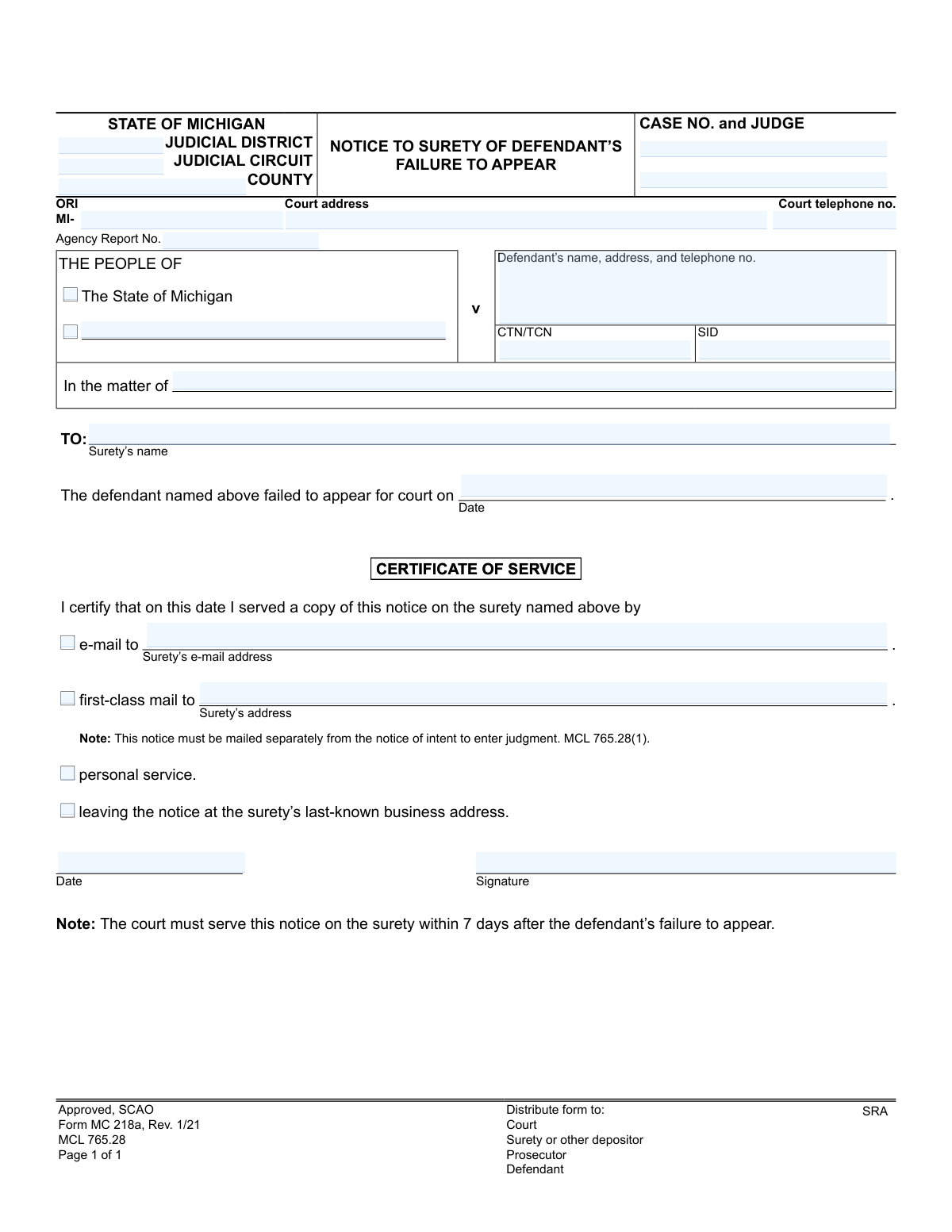
Yes! You can use AI to fill out State of Michigan, Form MC 218a, Notice to Surety of Defendant's Failure to Appear

Form MC 218a is a legal document used by Michigan courts to formally notify a surety that a defendant for whom they have posted bond has failed to appear for a scheduled court date. This notice is a critical step in the bond forfeiture process, as required by Michigan law (MCL 765.28). Today, this form can be filled out quickly and accurately using AI-powered services like Instafill.ai, which can also convert non-fillable PDF versions into interactive fillable forms.
MC 218a is part of the Michigan court forms category on Instafill.
Our AI automatically handles information lookup, data retrieval, formatting, and form filling.
It takes less than a minute to fill out MC 218a using our AI form filling.
Securely upload your data. Information is encrypted in transit and deleted immediately after the form is filled out.

Form specifications

Form name: State of Michigan, Form MC 218a, Notice to Surety of Defendant's Failure to Appear
Number of fields: 26
Number of pages: 1
Language: English
main-image

Instafill Demo: How to fill out PDF forms in seconds with AI

How to Fill Out MC 218a Online for Free in 2026

Are you looking to fill out a MC 218A form online quickly and accurately? Instafill.ai offers the #1 AI-powered PDF filling software of 2026, allowing you to complete your MC 218A form in just 37 seconds or less.
Follow these steps to fill out your MC 218A form online using Instafill.ai:
  1. 1 Navigate to Instafill.ai and upload or select the MC 218a form.
  2. 2 Use the AI assistant to automatically populate court information, such as the judicial district, circuit, county, and court address.
  3. 3 Enter the specific case details, including the case number, judge's name, defendant's information, and any relevant identification numbers (CTN/TCN/SID).
  4. 4 Input the surety's name and contact information, including their address or email for service.
  5. 5 Specify the date the defendant failed to appear and check the box indicating the method of service for the notice (e.g., email, first-class mail, personal service).
  6. 6 Review all AI-populated and manually entered data for accuracy before the authorized court personnel signs and dates the form.
  7. 7 Download, print, or electronically file the completed notice to be served on the surety, prosecutor, and other required parties.

Our AI-powered system ensures each field is filled out correctly, reducing errors and saving you time.

Why Choose Instafill.ai for Your Fillable MC 218a Form?

Speed

Complete your MC 218a in as little as 37 seconds.

Up-to-Date

Always use the latest 2026 MC 218a form version.

Cost-effective

No need to hire expensive lawyers.

Accuracy

Our AI performs 10 compliance checks to ensure your form is error-free.

Security

Your personal information is protected with bank-level encryption.

Frequently Asked Questions About Form MC 218a

This form is used by the court in Michigan to officially notify a surety (such as a bail bondsman) that a defendant they posted bond for has failed to appear for a scheduled court date.

The court where the defendant's case is being heard is responsible for completing this form and serving it on the surety. It is an official judicial notice.

A surety is a person or company that guarantees a defendant's appearance in court by posting a financial bond. They receive this notice because the defendant's failure to appear puts the bond money at risk of being forfeited to the court.

Yes, the form explicitly states that the court must serve this notice on the surety within 7 days after the defendant’s failure to appear.

Receiving this notice is the first formal step in the bond forfeiture process. You should immediately attempt to contact the defendant to arrange their appearance in court or take other actions as outlined in your agreement to mitigate your financial liability.

The form can be delivered by email, first-class mail, personal service, or by leaving it at the surety's last-known business address. The court official will indicate the method of service used on the form.

This notice is the initial alert that the defendant missed court. A 'notice of intent to enter judgment' is a separate, subsequent legal step informing the surety that the court is proceeding to formally claim the forfeited bond money.

According to the form's distribution list, copies are sent to the Court, the Surety (or other depositor), the Prosecutor, and the Defendant.

The form requires specific case information, including the judicial district, case number, judge, defendant's name, surety's name and contact details, and the exact date the defendant failed to appear.

Yes, services like Instafill.ai use AI to auto-fill form fields accurately and save time. It can pull data from case management systems to populate the defendant, surety, and case details automatically.

You can upload the MC 218a form to the Instafill.ai platform. The AI will make all the fields interactive, allowing you to easily type in the required information, save, and print the completed document.

Instafill.ai can convert flat, non-fillable PDFs into interactive forms. Simply upload the document, and the platform will make it fillable online, so you don't have to print it and fill it out by hand.

These are identifiers used in the justice system. CTN is Compliant Tracking Number, SID is State Identification Number, and ORI is Originating Agency Identifier, all used to track individuals and cases across different agencies.

Compliance MC 218a
Validation Checks by Instafill.ai

1
Ensures Failure to Appear Date is Valid and in the Past
This check validates that the 'failure to appear date' field contains a valid calendar date and that this date is not in the future. A notice cannot be issued for a future event, so this date must be today or a past date. If the date is invalid or in the future, the form submission will be rejected, as it would represent a logical impossibility and invalidate the notice.
2
Validates Signature Date is Logically Consistent
This validation ensures the 'Signature date' is a valid date that occurs on or after the 'failure to appear date'. It is impossible to sign a notice about an event before the event has occurred. An invalid sequence of dates would undermine the legal integrity of the document, so the submission will be blocked until the dates are corrected.
3
Confirms Timely Service of Notice
Based on the form's note (MCL 765.28), this check verifies that the 'Signature date' (representing the date of service) is within 7 days after the 'failure to appear date'. This is a statutory requirement to ensure the surety is notified promptly. Submissions outside this window will be flagged as non-compliant with legal deadlines, potentially making the notice void.
4
Requires at Least One Method of Service
This check ensures that at least one of the service method checkboxes ('e-mail', 'first-class mail', 'personal service', 'leaving the notice') is selected. The notice is legally ineffective if it is not properly served on the surety, and selecting a method is the first step in documenting that service. If no method is chosen, the form cannot be submitted, preventing the creation of an incomplete legal record.
5
Conditional Validation of Surety's Email Address
If the 'e-mail' service method is checked, this validation confirms that the 'Surety’s e-mail address' field is not empty and contains a string in a valid email format (e.g., [email protected]). Sending a notice to an invalid or non-existent email address constitutes a failure of service. The system will prevent submission until a valid email is provided to ensure the selected service method can be executed.
6
Conditional Validation of Surety's Mailing Address
If the 'first-class mail' service method is checked, this validation ensures the 'Surety’s address' field is filled out. A notice cannot be mailed without a destination address, making this information critical for completing service. The form will be considered incomplete and rejected if this service method is chosen without a corresponding address.
7
Verifies Completeness of Essential Case Information
This check confirms that the 'Case no', 'Judge', and 'County' fields are all populated. These details are fundamental for identifying the specific legal case to which this notice applies. Without this information, the notice is ambiguous and legally deficient, so the form will be rejected until all required case identifiers are provided.
8
Ensures Defendant Information is Provided
This validation ensures that the field for 'Defendant’s name, address, and telephone no.' is not empty. Identifying the defendant is the primary purpose of the form, as their failure to appear is the subject of the notice. A notice without defendant information is meaningless and will be blocked from submission.
9
Validates Court Telephone Number Format
This check verifies that the 'Court telephone no.' field contains a number in a recognized US phone number format (e.g., (XXX) XXX-XXXX or XXX-XXX-XXXX). A valid phone number is necessary for the surety or other parties to contact the court with questions. The system will flag incorrectly formatted numbers to ensure the contact information is accurate and usable.
10
Requires Presence of Surety's Name
This validation confirms that the 'Surety’s name' field is not empty. The notice is directed to the surety, and without their name, it is impossible to determine who is being notified of the defendant's failure to appear. This is a critical field for the notice's validity, and the form will be rejected if it is left blank.
11
Validates ORI Number Format
This check ensures the 'ORIMI' field follows the expected format, likely starting with 'MI-' followed by a specific code. The Originating Agency Identifier (ORI) is a unique code used for tracking and routing documents within justice systems. An invalid format could lead to processing errors or misfiling of the notice, so the system will enforce the correct structure.
12
Confirms Signature Field is Completed
This validation verifies that the 'Signature' field has been filled, whether by digital signature, typed name, or an uploaded image. An unsigned notice is not legally executed and has no authority. The system will prevent submission of an unsigned form to ensure the document is properly authenticated by a court representative.

Common Mistakes in Completing MC 218a

Incorrect or Incomplete Case Identification

Users often enter the case number with typos, use an incorrect format, or omit the assigned judge's name. They may also confuse the Judicial District with the Judicial Circuit, leading to filing errors. These mistakes can cause significant delays as the notice may not be docketed correctly or could be rejected by the clerk's office, jeopardizing the 7-day service deadline.

Erroneous 'Failure to Appear' Date

A common and critical error is entering the wrong date in the 'failed to appear for court on' field. Users might accidentally input the date they are filling out the form or a different court date entirely. This mistake invalidates the entire premise of the notice and can lead to the legal proceedings for bond forfeiture being dismissed.

Incomplete or Unsigned Certificate of Service

Filers frequently forget to check the box indicating the method of service (e.g., first-class mail, personal service) or fail to sign and date the certificate section. An incomplete or unsigned certificate is legally insufficient to prove that the surety was properly notified. This oversight can nullify the notice and prevent the court from proceeding with bond forfeiture.

Using Outdated Surety Contact Information

The notice is often sent to an old address or a misspelled email for the surety, rendering the service invalid. This happens when filers don't verify the surety's current contact information from the original bond agreement. Failure to properly serve the surety within the 7-day window can result in the court being unable to forfeit the bond, causing a significant financial loss.

Missing or Inaccurate Offender ID Numbers (CTN/TCN/SID)

The CTN/TCN and SID fields are frequently left blank or filled with incorrect data due to transcription errors from other documents. These unique identifiers are crucial for linking the defendant to their statewide criminal history. An omission or error complicates record-keeping and can hinder the prosecutor's ability to track the defendant's status across different systems.

Disregarding the 7-Day Service Mandate

The form explicitly states that the notice must be served on the surety within 7 days of the defendant’s failure to appear. Court staff or filers may delay preparing or sending the notice, missing this strict statutory deadline. Failure to comply with this timeline renders the notice ineffective and prevents the court from legally pursuing the bond forfeiture against the surety.

Inaccurate Defendant Personal Information

Typos in the defendant's name, or entering an incomplete or outdated address in the 'D info' box, are frequent mistakes. This can lead to confusion in court records and may result in the defendant's copy of the notice being undeliverable. Accurate information is vital for maintaining a clear case file and ensuring all parties are properly identified.

Omitting Required Jurisdictional Details

Users sometimes leave the 'County', 'Judicial District', or 'Judicial Circuit' fields blank, assuming the court address is sufficient. However, these fields are essential for proper routing, filing, and statistical tracking within the state's judicial system. An omission can lead to the document being rejected or misfiled, delaying the legal process.

Illegible Handwriting on a Non-Fillable Form

If this form is only available as a flat, non-fillable PDF, users must fill it out by hand, often leading to illegible entries. Poorly written case numbers, names, or dates can be misinterpreted, causing filing errors and delays. To avoid this, AI-powered tools like Instafill.ai can convert flat PDFs into digitally fillable forms, ensuring all entries are clear and accurate.
Saved over 80 hours a year

“I was never sure if my IRS forms like W-9 were filled correctly. Now, I can complete the forms accurately without any external help.”

Kevin Martin Green

Your data stays secure with advanced protection from Instafill and our subprocessors

Robust compliance program

Transparent business model

You’re not the product. You always know where your data is and what it is processed for.

ISO 27001, HIPAA, and GDPR

Our subprocesses adhere to multiple compliance standards, including but not limited to ISO 27001, HIPAA, and GDPR.

Security & privacy by design

We consider security and privacy from the initial design phase of any new service or functionality. It’s not an afterthought, it’s built-in, including support for two-factor authentication (2FA) to further protect your account.

Fill out MC 218a with Instafill.ai

Worried about filling PDFs wrong? Instafill securely fills state-of-michigan-form-mc-218a-notice-to-surety-of-defendants-failure-to-appear forms, ensuring each field is accurate.