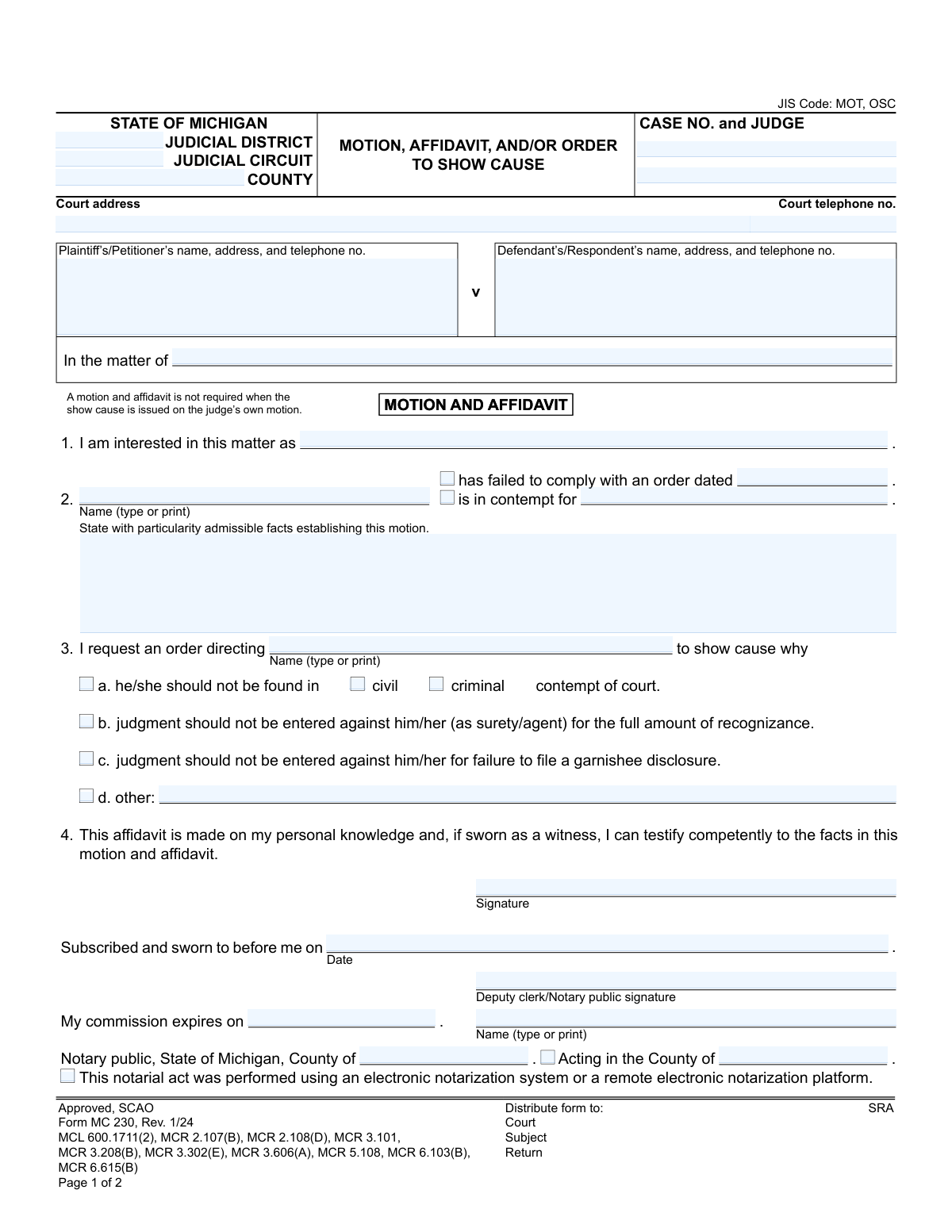
Yes! You can use AI to fill out State of Michigan, Form MC 230, Motion, Affidavit, and/or Order to Show Cause
Form MC 230 is a legal document used in Michigan courts to initiate a motion, provide a sworn statement (affidavit), and request an Order to Show Cause. This order compels an individual or entity to appear before a judge and explain why a specific action, such as being held in contempt of court, should not be taken against them. It is a critical tool for enforcing court orders and addressing non-compliance. Today, this form can be filled out quickly and accurately using AI-powered services like Instafill.ai, which can also convert non-fillable PDF versions into interactive fillable forms.
MC 230 is part of the
Michigan court forms category on Instafill.
Our AI automatically handles information lookup, data retrieval, formatting, and form filling.
It takes less than a minute to fill out MC 230 using our AI form filling.
Securely upload your data. Information is encrypted in transit and deleted immediately after the form is filled out.
Form specifications
| Form name: | State of Michigan, Form MC 230, Motion, Affidavit, and/or Order to Show Cause |
| Number of fields: | 80 |
| Number of pages: | 1 |
| Language: | English |
More forms in Michigan court forms
Instafill Demo: How to fill out PDF forms in seconds with AI
How to Fill Out MC 230 Online for Free in 2026
Are you looking to fill out a MC 230 form online quickly and accurately? Instafill.ai offers the #1 AI-powered PDF filling software of 2026, allowing you to complete your MC 230 form in just 37 seconds or less.
Follow these steps to fill out your MC 230 form online using Instafill.ai:
- 1 Navigate to Instafill.ai and upload or select Form MC 230.
- 2 Enter the court and case information, including the judicial district/circuit, county, case number, and judge's name.
- 3 Provide the full names and addresses for the plaintiff/petitioner and defendant/respondent involved in the matter.
- 4 Complete the 'Motion and Affidavit' section by stating your interest in the matter, the specific reasons for the motion (e.g., contempt of court), and providing a detailed account of the facts.
- 5 Indicate the specific relief you are requesting the court to order the other party to show cause for.
- 6 Review all the information populated by the AI for accuracy, then sign the affidavit section. If required, have the document notarized.
- 7 Download the completed form to file with the court and serve on the opposing party as required by court rules.
Our AI-powered system ensures each field is filled out correctly, reducing errors and saving you time.
Why Choose Instafill.ai for Your Fillable MC 230 Form?
Speed
Complete your MC 230 in as little as 37 seconds.
Up-to-Date
Always use the latest 2026 MC 230 form version.
Cost-effective
No need to hire expensive lawyers.
Accuracy
Our AI performs 10 compliance checks to ensure your form is error-free.
Security
Your personal information is protected with bank-level encryption.
Frequently Asked Questions About Form MC 230
This form is used to ask the court to order someone to appear and explain why a certain action, such as being held in contempt for disobeying a court order, should not be taken against them.
A party in a legal case (the movant) fills out the 'Motion and Affidavit' section to request a court hearing. A judge then completes and signs the 'Order to Show Cause' section, which officially commands the other person to appear in court.
An 'Order to Show Cause' is a formal court order that requires a person to appear in court and provide a valid reason why the court should not take a specific action against them as requested in the motion.
You are being ordered to appear in court at the date and time listed in the 'Order to Show Cause' section. It is crucial that you attend this hearing, and it is highly recommended that you seek legal advice beforehand.
As stated on the form, failure to appear for a scheduled hearing may result in a bench warrant being issued for your arrest.
The affidavit is a sworn statement of facts made under oath. A notary public must witness your signature to verify your identity and that you are signing willingly, which makes the statements legally binding and admissible in court.
You must provide specific, factual details about how the other party failed to comply with a court order, including the date of the original order. You must state these facts based on your personal knowledge.
This section provides the court with official proof that the person ordered to appear was legally notified of the hearing. Proper service is a legal requirement and must be completed and filed with the court.
The time between filing the motion and the hearing date varies depending on the judge's and the court's schedule. The judge will set the hearing date in the 'Order to Show Cause' section.
Yes, services like Instafill.ai use AI to help you accurately auto-fill form fields with your saved information, which saves time and helps prevent errors. However, AI cannot provide legal advice for the substance of your motion.
You can upload the form to a platform like Instafill.ai, which will make the document interactive. You can then type in your information, use AI to auto-fill fields, and download the completed form for filing with the court.
If you have a flat, non-fillable PDF, you can use a service like Instafill.ai. It can convert the document into an interactive, fillable form that you can complete easily on your computer.
Generally, civil contempt is meant to compel a person to obey a court order, while criminal contempt is meant to punish a person for disrespecting the court's authority. The form allows the filer to request either, but the judge makes the final determination.
Compliance MC 230
Validation Checks by Instafill.ai
1
Case Number Presence and Format
This check ensures the 'Case No.' field is not empty and conforms to the expected format for the specified court. The case number is a critical identifier for filing and retrieving the document within the court system. If the case number is missing or malformed, the document cannot be correctly associated with the existing case file, leading to rejection by the court clerk.
2
Party Information Completeness
Validates that the names for both the 'Plaintiff’s/Petitioner’s name' and 'Defendant’s/Respondent’s name' are provided. These fields are essential for identifying the primary parties involved in the legal action. A failure to provide this information makes the motion legally insufficient as it's unclear who is bringing the action and against whom it is directed.
3
Affiant's Standing Requirement
Ensures that field 1, 'I am interested in this matter as...', is filled out. This statement establishes the affiant's legal standing or relationship to the case, which is a prerequisite for filing a motion. Without a stated interest, the court may dismiss the motion for lack of standing, as the filer has not demonstrated a legal right to be heard.
4
Factual Basis for Motion
Verifies that the text area for 'State with particularity admissible facts establishing this motion' is not empty. This section contains the core evidence and sworn testimony supporting the motion. If this section is blank, the affidavit lacks a factual basis, rendering it legally powerless and certain to be denied by the judge.
5
Contempt Order Date Logic
Checks that the 'order dated' field contains a valid date that occurs before the affidavit's signature date. This is a logical check to ensure the order that was allegedly violated existed before the motion was filed. An invalid or future date would be nonsensical and undermine the credibility of the motion.
6
Motion Request Selection
Confirms that at least one of the checkboxes in section 3 (a, b, c, or d) has been selected. This section specifies the relief or action the filer is requesting from the court. If no option is selected, the court does not know what is being asked for, and the motion will be rejected as incomplete or purposeless.
7
Conditional 'Other' Field Requirement
If checkbox '3d. other:' is selected, this validation ensures the corresponding text field is filled in. This prevents the submission of an ambiguous request. The court needs a specific description of the 'other' relief being sought to make a ruling, and failure to provide it will result in the request being ignored or the motion being returned.
8
Notary Commission Expiration Date
Validates that the 'My commission expires on' date is a valid date set in the future relative to the affidavit signature date. A notary cannot legally perform a notarization with an expired commission. An expired or invalid commission date would invalidate the notarization, and therefore the entire affidavit, making it inadmissible in court.
9
Future Hearing Date
Ensures that the 'Date and time' for the hearing in the 'Order to Show Cause' section is a valid date and time set in the future. A hearing cannot be scheduled for the past, and this check prevents clerical errors that would make the order impossible to comply with. An invalid hearing date would require the order to be amended and re-served, causing significant delays.
10
Service Days is a Positive Integer
Verifies that the value entered in 'served on the person ordered to appear at least __ days before the hearing' is a positive integer. This number represents a legal deadline for providing notice. A zero, negative, or non-numeric value is illogical and would make the service requirement unenforceable, potentially violating the due process rights of the recipient.
11
Proof of Service Detail Completeness
If the 'Proof of Service' indicates that service was completed ('personally' or 'by mail'), this check ensures that the 'Date and time of service' and 'Place or address of service' fields are filled. These details are required to create a legally valid record of service. Without them, the opposing party could successfully challenge whether they were properly notified of the hearing.
12
Service Fee Calculation Integrity
This validation checks that the 'TOTAL FEE' field in the 'Proof of Service' section is the correct sum of the individual fee components ('Service fee', 'Fee', 'Incorrect address fee', 'Fee'). This is important for accurate accounting, billing, and reimbursement of court costs. An incorrect total can lead to financial discrepancies and disputes.
13
Judge's Bar Number Format
Verifies that the 'Bar no.' field, when filled, matches the expected format for a Michigan attorney or judge (e.g., a 'P' followed by a series of numbers). This helps ensure the correct judge is identified and that the data is clean for internal court records. While not always filled by the user, validating the format when present prevents data entry errors.
14
Affidavit Signature Date Presence
Ensures the 'Date' field next to the affiant's signature in the 'MOTION AND AFFIDAVIT' section is completed. This date is legally crucial as it establishes when the sworn statements were made. An undated affidavit is legally deficient and may be rejected by the court, as the timing of the sworn statement is a critical element.
Common Mistakes in Completing MC 230
Users often enter the wrong Case Number, Judge name, or court location at the top of the form. This typically happens when referencing old documents or from memory, leading to the filing being rejected by the clerk or misfiled with the wrong case. To avoid this, meticulously copy the information from the most recent court order or official case document. AI-powered tools like Instafill.ai can help by storing and auto-populating correct case information across multiple documents, ensuring consistency and accuracy.
In Section 2, when asked to describe why a person is in contempt, filers often use emotional language or make vague accusations instead of stating 'particular admissible facts.' The court needs specific, provable actions, dates, and details (e.g., 'Failed to pay $500 in child support due on May 1, 2024' not 'He never pays what he owes'). A vague motion will likely be denied for lack of evidence. Stick strictly to the facts of the violation.
Section 2 requires the exact date of the court order that was allegedly violated. Many people forget to include this date or guess at it. Without the correct date, the court cannot identify the specific order in question, rendering the motion defective and causing it to be dismissed. Always have a copy of the order you are referencing and double-check the date before filling out the form.
The affidavit section (Section 4) must be signed in the presence of a notary public. A common mistake is signing the document beforehand or forgetting to have it notarized at all, which invalidates the entire affidavit. This will cause the court to reject the motion, forcing the filer to start over. Always wait to sign the form until you are physically in front of the notary.
Filers, especially those representing themselves, sometimes mix up the Plaintiff/Petitioner and Defendant/Respondent fields. This can cause significant confusion, potentially leading to notices being sent to the wrong party or the motion being processed incorrectly. Carefully verify which party is which based on the original case filing and enter the names and addresses in the correct designated boxes.
The Proof of Service section is critical and frequently filled out incorrectly. Mistakes include using the wrong method of service (e.g., mail when personal service is required), forgetting to state the date and time of service, or failing to have the server sign the form. An improper Proof of Service means the court has no evidence the other party was legally notified, which will halt the proceedings until service is properly completed and proven.
When a form is only available as a flat PDF, people often print it and fill it out by hand. Illegible handwriting can lead to court clerks misinterpreting names, addresses, or case numbers, causing delays, returned mail, or rejection of the filing. To prevent this, print legibly in block letters. Alternatively, services like Instafill.ai can convert non-fillable PDFs into fillable forms, allowing you to type directly into the fields for maximum clarity.
When filing a motion to show cause for contempt, it is standard practice to attach a copy of the court order that was violated. Many filers forget this crucial step. Without the attached order, the judge and the opposing party may not have immediate access to the specific terms that were allegedly breached, weakening the motion and potentially causing delays.
In Section 3, the filer must request a specific action by checking the appropriate box (e.g., civil or criminal contempt). People often check the wrong box, or multiple conflicting boxes, or fail to check any box at all. This ambiguity can lead to the court being unable to grant the requested relief or issuing an order for the wrong type of hearing, requiring correction and causing delays.
Court forms are periodically updated, as indicated by the 'Rev. 1/24' date on this form. Using an old version can result in an automatic rejection by the court clerk because it may lack newly required fields or contain outdated legal references. Always ensure you are using the most current version of any legal form by downloading it directly from the official court website before you begin.
Section 1 asks, 'I am interested in this matter as...'. Filers sometimes write vague, non-legal descriptions like 'the father' or 'the aggrieved party.' The court requires your specific legal role in the case, such as 'Plaintiff,' 'Defendant,' or 'Attorney for Petitioner.' Failing to state your proper legal standing can create ambiguity and may require clarification before the court proceeds.
Saved over 80 hours a year
“I was never sure if my IRS forms like W-9 were filled correctly. Now, I can complete the forms accurately without any external help.”
Kevin Martin Green
Your data stays secure with advanced protection from Instafill and our subprocessors

Robust compliance program
Transparent business model
You’re not the product. You always know where your data is and what it is processed for.
ISO 27001, HIPAA, and GDPR
Our subprocesses adhere to multiple compliance standards, including but not limited to ISO 27001, HIPAA, and GDPR.
Security & privacy by design
We consider security and privacy from the initial design phase of any new service or functionality. It’s not an afterthought, it’s built-in, including support for two-factor authentication (2FA) to further protect your account.
Fill out MC 230 with Instafill.ai
Worried about filling PDFs wrong? Instafill securely fills state-of-michigan-form-mc-230-motion-affidavit-andor-order-to-show-cause forms, ensuring each field is accurate.