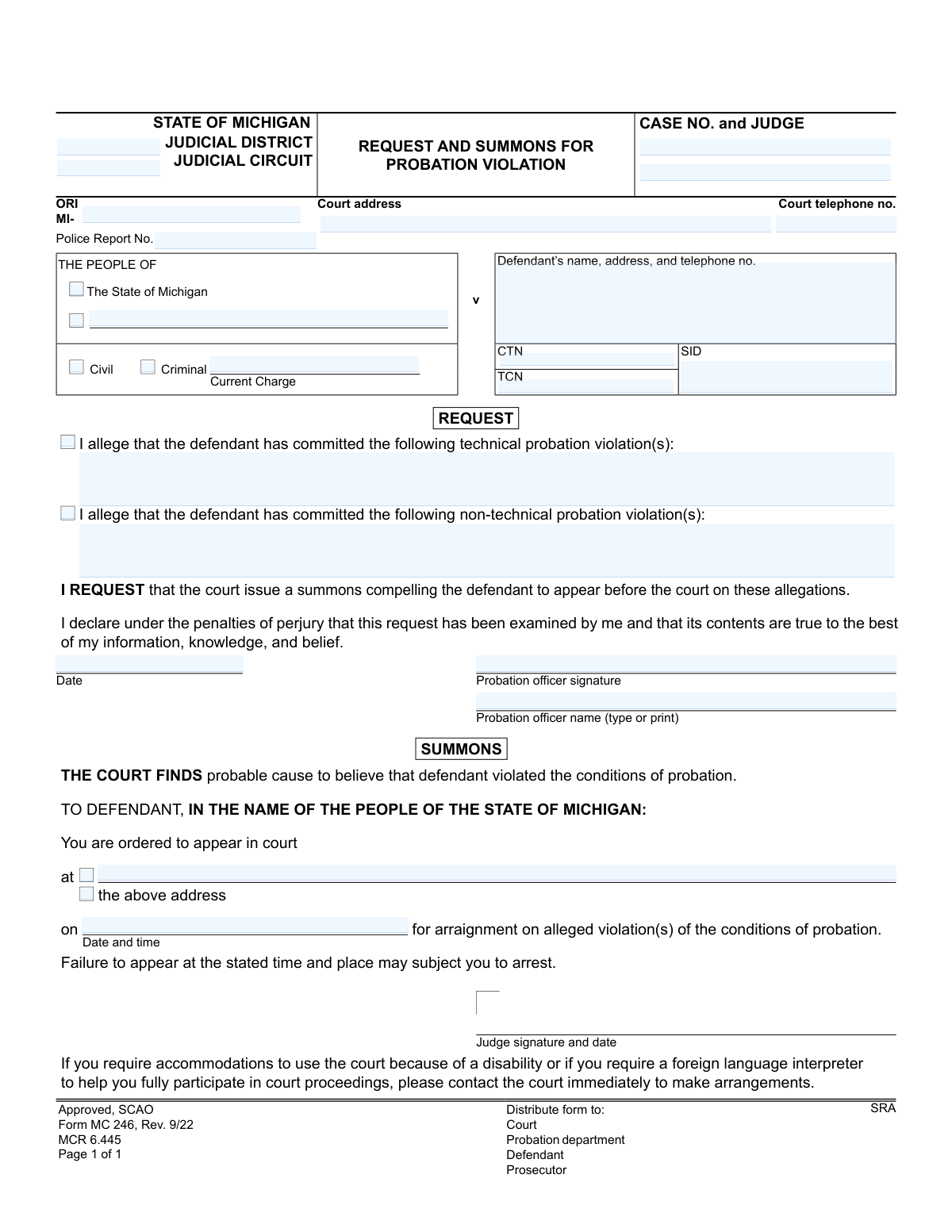
Yes! You can use AI to fill out State of Michigan Form MC 246, Request and Summons For Probation Violation
Form MC 246, Request and Summons For Probation Violation, is a legal document used within the Michigan judicial system. A probation officer fills out this form to formally allege that a defendant has violated the conditions of their probation and to request that the court issue a summons for the defendant to appear. The form details the specific violations and, once signed by a judge, serves as an official order for the defendant's court appearance. Today, this form can be filled out quickly and accurately using AI-powered services like Instafill.ai, which can also convert non-fillable PDF versions into interactive fillable forms.
MC 246 is part of the
Michigan court forms category on Instafill.
Our AI automatically handles information lookup, data retrieval, formatting, and form filling.
It takes less than a minute to fill out MC 246 using our AI form filling.
Securely upload your data. Information is encrypted in transit and deleted immediately after the form is filled out.
Form specifications
| Form name: | State of Michigan Form MC 246, Request and Summons For Probation Violation |
| Number of fields: | 52 |
| Number of pages: | 1 |
| Language: | English |
More forms in Michigan court forms
Instafill Demo: How to fill out PDF forms in seconds with AI
How to Fill Out MC 246 Online for Free in 2026
Are you looking to fill out a MC 246 form online quickly and accurately? Instafill.ai offers the #1 AI-powered PDF filling software of 2026, allowing you to complete your MC 246 form in just 37 seconds or less.
Follow these steps to fill out your MC 246 form online using Instafill.ai:
- 1 Navigate to Instafill.ai and upload or select the Michigan Form MC 246.
- 2 Use the AI assistant to automatically populate court information, including the judicial district, circuit, case number, and court address.
- 3 Enter the defendant's name, address, and other identifying information in the designated fields.
- 4 Clearly specify the alleged technical and/or non-technical probation violations in the appropriate sections of the form.
- 5 The probation officer must review the request, then digitally sign and date it to declare the contents are true to their knowledge.
- 6 Once the judge's summons section is completed, fill out the Proof of Service or Certificate of Mailing section after serving the defendant.
- 7 Review the entire completed form for accuracy before downloading, printing, or submitting it to the court and other required parties.
Our AI-powered system ensures each field is filled out correctly, reducing errors and saving you time.
Why Choose Instafill.ai for Your Fillable MC 246 Form?
Speed
Complete your MC 246 in as little as 37 seconds.
Up-to-Date
Always use the latest 2026 MC 246 form version.
Cost-effective
No need to hire expensive lawyers.
Accuracy
Our AI performs 10 compliance checks to ensure your form is error-free.
Security
Your personal information is protected with bank-level encryption.
Frequently Asked Questions About Form MC 246
This form, the 'Request and Summons For Probation Violation,' is used by a probation officer to notify the court of alleged probation violations and to summon the defendant to a court hearing.
A probation officer initiates the form by detailing the alleged violations in the 'Request' section. A judge then authorizes the 'Summons' section, and a process server or court clerk completes the 'Proof of Service' after delivering the form.
You are being ordered to appear in court for an arraignment on the alleged probation violations. You must go to the court at the address, date, and time specified in the 'Summons' section.
Failure to appear in court as ordered may subject you to arrest. A bench warrant could be issued, and you could face additional consequences.
A technical violation is breaking a specific rule of your probation, like missing a meeting or failing a drug test. A non-technical violation typically means you have been charged with a new crime while on probation.
This section is legal proof that you were officially notified of the court hearing. It is completed by the person who delivered the summons, detailing when, where, and how it was served.
You should contact the court immediately to make arrangements. The form states that the court will provide accommodations to help you fully participate in the proceedings.
Yes, for administrative sections, a service like Instafill.ai can use AI to accurately auto-fill fields like names and case numbers, saving time and reducing errors. The specific violation details, however, must be entered by the probation officer.
You can use a platform like Instafill.ai to upload the PDF and complete it electronically. Their service allows you to type directly into the form fields, add digital signatures, and then download or print the completed document.
If you have a non-fillable or 'flat' PDF, you can use a tool like Instafill.ai to automatically convert it into an interactive, fillable form. This will allow you to easily type your information into the correct fields on your computer.
This means the process server handed the summons directly to you. If 'by first-class mail' is checked, it was mailed to your last known address.
As indicated on the form, copies are distributed to the court, the probation department, the defendant (you), and the prosecutor.
Attachments are any additional documents provided with the summons, such as police reports or other evidence related to the alleged probation violation. The 'Proof of Service' will indicate if any attachments were included.
Compliance MC 246
Validation Checks by Instafill.ai
1
Case Number Format Validation
Ensures the Case Number (`Caseno`) field conforms to the specific format required by the judicial circuit. This is critical for correctly identifying and filing the document within the court's case management system. An invalid format could lead to the document being rejected, misfiled, or causing significant processing delays.
2
At Least One Violation Type Required
Validates that at least one of the probation violation checkboxes (`techcheck` or `nontechcheck`) is selected and that the corresponding description field (`techlist` or `nontechlist`) is not empty. This check ensures the form has a substantive basis and is not submitted without a clear allegation. A form without a specified violation is incomplete and cannot be acted upon by the court.
3
Probation Officer Information Completeness
Verifies that the probation officer's printed name (`proboffname`) and signature (`probsig`) are present in the 'REQUEST' section. This is essential for authenticating the request and establishing the authority of the person making the allegations. A missing name or signature invalidates the request, preventing the court from issuing a summons.
4
Summons Hearing Date is in the Future
Checks that the hearing date and time (`hdate`) entered in the 'SUMMONS' section is a valid date and occurs in the future. This prevents the scheduling of impossible or past court dates, which would render the summons legally defective. The system must reject any date that has already passed to ensure the defendant is given proper and valid notice.
5
Exclusive Service Method Selection
Ensures that only one of the primary service statuses in the 'PROOF OF SERVICE' section is selected: 'personally served', 'served by first-class mail', or 'attempted to serve'. These options are mutually exclusive, and selecting more than one creates a logical contradiction. This validation maintains the legal integrity of the proof of service document.
6
Proof of Service Detail Completeness
If service is marked as completed ('personally' or 'by first-class mail'), this validation requires the date/time of service (`datetimeserv`) and the place of service (`placeaddress`) to be filled out. This information is legally necessary to constitute valid proof of service. Incomplete details can lead to the service being challenged in court and deemed invalid.
7
Defendant Information Presence
Validates that the defendant's information block (`dinfo`), which includes name, address, and telephone number, is not empty. Identifying the specific individual being summoned is the most fundamental requirement of this form. Without this information, the summons is unenforceable and has no legal effect.
8
Court Telephone Number Format
Validates that the court telephone number (`cttelno`) is entered in a standard US phone number format, such as (XXX) XXX-XXXX. This ensures the contact information is clear, usable, and can be correctly parsed by other systems or read by individuals. An improperly formatted number can cause communication failures for defendants needing to contact the court.
9
Mandatory Case Type Selection
Verifies that exactly one of the 'Civil' (`civilcheck`) or 'Criminal' (`crimcheck`) checkboxes is selected. This classification is critical for proper case processing, routing, and the application of correct legal procedures. Failure to select a case type would halt processing until the ambiguity is resolved.
10
Request Date Validation
Ensures the 'Date' (`date`) field in the 'REQUEST' section is a valid date that is not in the future. This date establishes when the probation officer formally made the allegation. A future date is logically impossible and would compromise the legal integrity of the document.
11
Service Fee Calculation Verification
Checks that the 'TOTAL FEE' (`Totalfee`) field is the correct sum of the individual fee components (`Servicefee`, `fee`, `Incorrectaddfee`, `fee2`). This automated check ensures mathematical accuracy for billing and reimbursement purposes. Discrepancies could lead to accounting errors and payment disputes with the process server.
12
ORI Number Format Validation
Validates that the Originating Agency Identifier (`ori`) field follows the standard 9-character format (e.g., MI1234567). The ORI is crucial for inter-agency tracking, data aggregation, and reporting. An invalid format would cause data integration failures between justice system databases.
13
State Identifier Format Validation (CTN/SID/TCN)
Checks that the Court Tracking Number (`ctn`), State ID (`sid`), and Transaction Control Number (`tcn`) fields adhere to their expected formats. These unique identifiers are essential for linking the defendant and the case across different state and local justice information systems. Incorrect formats can break critical data linkages and cause significant record-keeping problems.
14
Summons Location Completeness
If a summons is being issued, this validation ensures the location of the appearance (`location` or `addresscheck`) is specified. The defendant must be clearly and unambiguously informed of where to appear for the summons to be legally valid. Omitting the location would render the summons defective and unenforceable.
Common Mistakes in Completing MC 246
This form requires multiple identifiers like 'CASE NO.', 'CTN', 'SID', and 'TCN'. Users often transpose numbers, omit leading zeros, or confuse one identifier for another. This can lead to the document being filed under the wrong case, causing significant administrative delays and potentially linking the violation to an incorrect individual's record. To avoid this, meticulously cross-reference all numbers with the official court file before submission.
The 'Defendant’s name, address, and telephone no.' field is critical for serving the summons. Probation officers may inadvertently use an old address from the original case file instead of the defendant's last known address. This results in failed service, delays the legal process, and can lead to the issuance of an unnecessary arrest warrant when the defendant simply never received the notice. Always verify the defendant's most current contact details before completing this section.
In the sections for 'technical' and 'non-technical' violations, users sometimes write vague statements like 'Failed to comply' without specifics. A proper description must include dates, times, locations, and a clear account of the actions (or inactions) that constitute the violation. Ambiguity can lead to a successful legal challenge by the defendant's counsel and the dismissal of the violation allegation.
The distinction between a 'technical' violation (e.g., missing an appointment) and a 'non-technical' one (i.e., committing a new crime) is legally significant and affects the subsequent court process. An officer might incorrectly classify a new criminal charge as a technical violation, or vice-versa. This mistake can affect the defendant's rights and the type of hearing they receive, creating grounds for an appeal if not handled correctly.
The 'PROOF OF SERVICE' section is complex and frequently filled out incorrectly by process servers or clerks. Common errors include checking the wrong service method (personal vs. mail), omitting the date and time of service, or failing to detail unsuccessful attempts. An improperly completed Proof of Service can invalidate the summons, as it fails to legally establish that the defendant was notified, forcing the entire process to restart.
A legal document like this is invalid without the proper signatures and corresponding dates from the probation officer, judge, and court clerk. This mistake often happens due to oversight during a busy day or when the form is passed between multiple people. An unsigned form will be rejected by the court clerk, halting the process until the required signature is obtained, causing unnecessary delays.
The summons section requires the court to specify the date, time, and location for the defendant's appearance. Sometimes this information is left blank, is illegible, or only partially completed (e.g., providing a date but no time). This makes it impossible for the defendant to comply with the order, leading to a failure to appear and potentially an unjust arrest.
The form contains several checkboxes, such as 'Civil' vs. 'Criminal' or the method of service, that are critical for classification and processing. Users often overlook these small but essential fields. Forgetting to mark a required box creates ambiguity and can cause the form to be returned for correction, delaying the hearing.
When this form is not available as a fillable document and is completed by hand, poor handwriting can render critical information unreadable. Names, case numbers, and violation details may be misinterpreted during data entry into the court's system, leading to errors in the official record. Using a tool like Instafill.ai can convert a flat PDF into a fillable version, ensuring all entries are typed and legible, preventing such mistakes.
The 'PROOF OF SERVICE' section includes fields for calculating total fees based on service type, mileage, and other costs. Process servers may make simple arithmetic errors or misinterpret the fee schedule. This leads to billing discrepancies, payment delays, and requires administrative effort to correct the accounting with the court.
The form has fields for listing attachments, but officers may forget to physically include the referenced documents, such as police reports, positive drug test results, or correspondence. Submitting the request without the supporting evidence weakens the allegation and may not provide the judge with sufficient information to find probable cause. This can result in the court denying the request for a summons.
Saved over 80 hours a year
“I was never sure if my IRS forms like W-9 were filled correctly. Now, I can complete the forms accurately without any external help.”
Kevin Martin Green
Your data stays secure with advanced protection from Instafill and our subprocessors

Robust compliance program
Transparent business model
You’re not the product. You always know where your data is and what it is processed for.
ISO 27001, HIPAA, and GDPR
Our subprocesses adhere to multiple compliance standards, including but not limited to ISO 27001, HIPAA, and GDPR.
Security & privacy by design
We consider security and privacy from the initial design phase of any new service or functionality. It’s not an afterthought, it’s built-in, including support for two-factor authentication (2FA) to further protect your account.
Fill out MC 246 with Instafill.ai
Worried about filling PDFs wrong? Instafill securely fills state-of-michigan-form-mc-246-request-and-summons-for-probation-violation forms, ensuring each field is accurate.