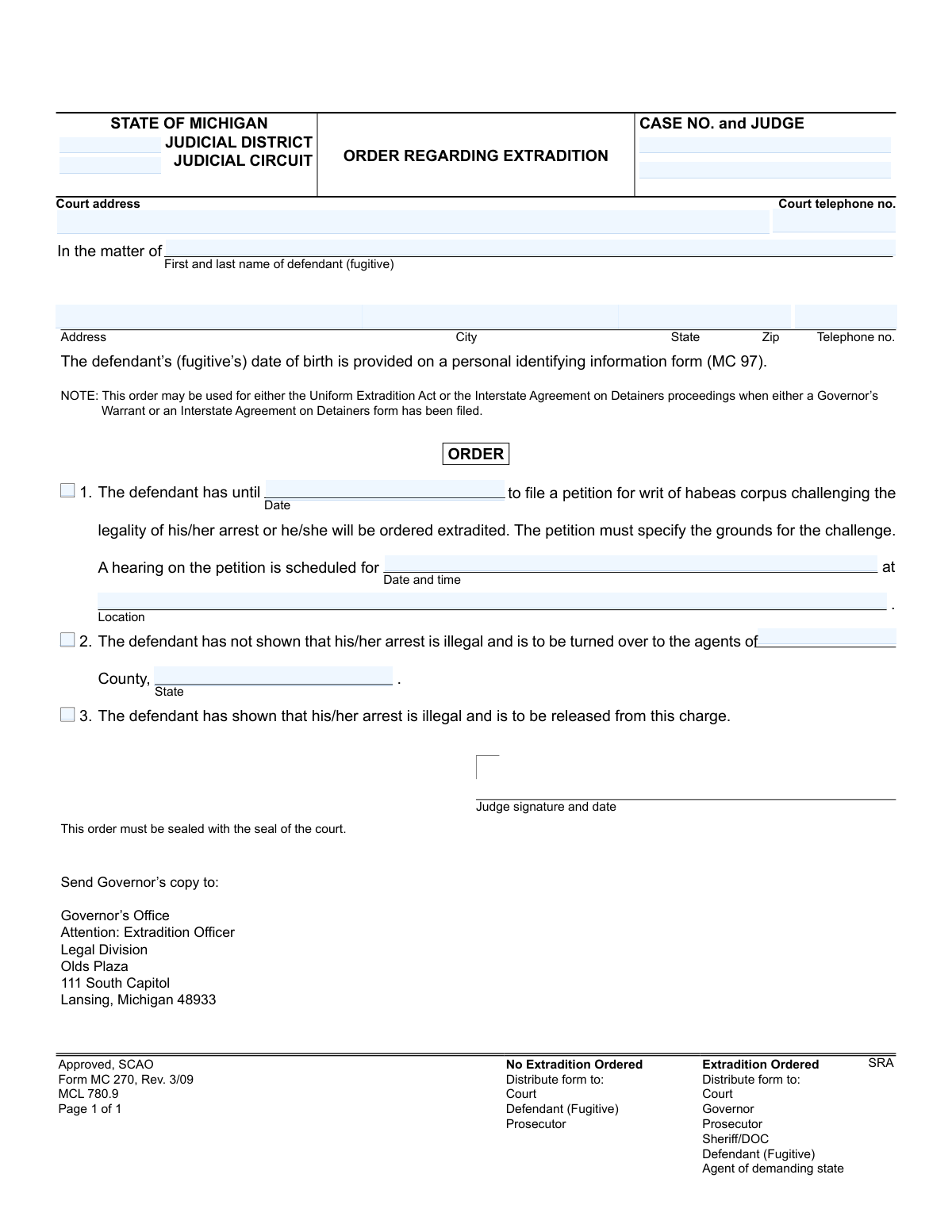
Yes! You can use AI to fill out State of Michigan, Form MC 270, Order Regarding Extradition

Form MC 270 is a legal document used by Michigan courts to issue an order concerning the extradition of a defendant, also referred to as a fugitive. It formalizes the court's decision on whether to turn the individual over to another state's agents or to release them, and it may set deadlines for legal challenges like a writ of habeas corpus. Today, this form can be filled out quickly and accurately using AI-powered services like Instafill.ai, which can also convert non-fillable PDF versions into interactive fillable forms.
MC 270 is part of the Michigan court forms category on Instafill.
Our AI automatically handles information lookup, data retrieval, formatting, and form filling.
It takes less than a minute to fill out MC 270 using our AI form filling.
Securely upload your data. Information is encrypted in transit and deleted immediately after the form is filled out.

Form specifications

Form name: State of Michigan, Form MC 270, Order Regarding Extradition
Number of fields: 20
Number of pages: 1
Language: English
main-image

Instafill Demo: How to fill out PDF forms in seconds with AI

How to Fill Out MC 270 Online for Free in 2026

Are you looking to fill out a MC 270 form online quickly and accurately? Instafill.ai offers the #1 AI-powered PDF filling software of 2026, allowing you to complete your MC 270 form in just 37 seconds or less.
Follow these steps to fill out your MC 270 form online using Instafill.ai:
  1. 1 Navigate to Instafill.ai and upload or select the MC 270 Order Regarding Extradition form.
  2. 2 Use the AI assistant to input the court and case details, such as the judicial district, circuit, case number, and judge's name.
  3. 3 Provide the defendant's (fugitive's) full name and contact information as prompted.
  4. 4 Select the appropriate order option: set a deadline for a habeas corpus petition, order the extradition, or order the defendant's release.
  5. 5 If ordering extradition, specify the destination county and state to which the defendant will be turned over.
  6. 6 Review all auto-filled information for accuracy before the judge signs and dates the document.
  7. 7 Download the completed form and distribute it to the required parties, such as the court, governor, prosecutor, and sheriff.

Our AI-powered system ensures each field is filled out correctly, reducing errors and saving you time.

Why Choose Instafill.ai for Your Fillable MC 270 Form?

Speed

Complete your MC 270 in as little as 37 seconds.

Up-to-Date

Always use the latest 2026 MC 270 form version.

Cost-effective

No need to hire expensive lawyers.

Accuracy

Our AI performs 10 compliance checks to ensure your form is error-free.

Security

Your personal information is protected with bank-level encryption.

Frequently Asked Questions About Form MC 270

This form is a court order issued by a Michigan judge that finalizes the decision on whether a person will be sent to another state to face criminal charges. It is used in proceedings under the Uniform Extradition Act or the Interstate Agreement on Detainers.

This is an official court order, so it is completed and signed by a judge or authorized court personnel. The defendant or their attorney does not fill out this specific form, but they will receive a copy.

This order details the court's decision regarding your extradition. It will state whether you have time to challenge your arrest, if you will be turned over to another state's authorities, or if you are being released from the extradition charge.

A writ of habeas corpus is a legal action you can file to challenge the legality of your arrest and detention. The form will specify the deadline by which you must file this petition if you wish to contest the extradition.

This means the judge has approved your extradition. You will be taken into custody by law enforcement agents from the state that requested you and transported there to face the pending charges.

The form's distribution depends on the outcome. Copies are typically sent to the court, the prosecutor, the defendant, the sheriff, the Governor's office, and the law enforcement agents from the demanding state if extradition is ordered.

To protect your personal information, your date of birth is recorded on a separate, confidential form (MC 97), which is kept in the court file. This helps prevent the public disclosure of sensitive data.

The form requires official court and case details, such as the case number and judge's name, as well as the defendant's name and address. Most importantly, it requires the judge's final decision on the extradition.

Yes, the form outlines the process for challenging the extradition by filing a petition for a writ of habeas corpus. You should consult with an attorney immediately to understand your rights and the specific grounds for a challenge.

No, as this is an official court order filled out by court personnel. However, AI-powered services like Instafill.ai can help you accurately fill out other related legal documents you may need to prepare, such as a petition or other motions.

You can upload your legal form to the Instafill.ai platform. The AI will identify the fields, and you can then fill them out interactively online, saving you time and ensuring accuracy.

Services like Instafill.ai can convert flat, non-fillable PDFs into interactive, fillable forms. Simply upload the document to their platform to make it easy to complete digitally.

If the judge checks the box indicating your arrest was illegal, you will be released from custody related to this specific extradition request. This does not necessarily resolve the underlying charges in the other state, but it stops the current extradition process in Michigan.

Compliance MC 270
Validation Checks by Instafill.ai

1
Ensures Mutually Exclusive Order Selection
This validation confirms that only one of the three main order checkboxes is selected: allowing time to file a petition, ordering immediate extradition, or ordering release. The form's purpose is to issue a single, unambiguous order. If more than one or none are selected, the order is legally void and cannot be processed, leading to rejection of the form.
2
Conditional Requirement for Petition Deadline Date
This check ensures that if the option to allow the defendant to file a petition for writ of habeas corpus is selected, the corresponding deadline date field is populated with a valid, future date. This date is legally critical as it defines the defendant's window to challenge the arrest. Failure to provide this date makes the order incomplete and unenforceable.
3
Conditional Requirement for Hearing Details
If the defendant is given time to file a petition, a hearing must be scheduled. This validation verifies that the hearing date/time and location fields are both filled out. Without this information, the defendant's right to a hearing is compromised, and the court cannot properly schedule the proceeding, invalidating this part of the order.
4
Conditional Requirement for Demanding State Agent Details
This check is triggered if the order for extradition is selected. It validates that the 'County' and 'State' fields for the receiving agents are both completed. This information is essential for identifying the correct jurisdiction and agents who will take custody of the fugitive. An omission would prevent the transfer and render the extradition order impractical.
5
Validates Demanding State is Not Michigan
This is a logical consistency check on the demanding state field ('state2'). Extradition is the process of transferring a fugitive to another state for prosecution. Therefore, the demanding state cannot be Michigan. If 'Michigan' is entered, it indicates a fundamental misunderstanding of the process, and the form submission should be flagged for correction.
6
Case Identifier Completeness
This validation ensures that the 'Judicial District', 'Judicial Circuit', and 'Case No.' fields are all populated. These three pieces of information work together to create a unique identifier for the case within the Michigan court system. Missing any of these fields could lead to the order being filed incorrectly or being impossible to locate in court records.
7
Chronological Order of Petition and Hearing Dates
This check verifies that the scheduled hearing date/time is set for a time after the petition filing deadline. A hearing cannot logically occur before the deadline to file the petition that prompts it. This validation prevents the creation of a legally nonsensical and impossible timeline, ensuring due process is followed.
8
Defendant Full Name Requirement
This validation ensures the 'In the matter of' field, which corresponds to the defendant's name, is not empty and likely contains at least two words (a first and last name). The defendant's full legal name is the primary identifier on this legal document. An incomplete or missing name makes the order ambiguous and legally insufficient.
9
Court Telephone Number Format
This check validates that the 'cttelno' field contains a properly formatted 10-digit telephone number (e.g., (XXX) XXX-XXXX or XXX-XXX-XXXX). A valid phone number is necessary for communication between agencies, the defendant, and the court. An incorrectly formatted number can cause communication delays and administrative errors.
10
Judge Name Presence
This validation confirms that the 'Judge' field is not empty. A judicial order is only valid if it is issued by a judge. The absence of a judge's name would render the entire document legally powerless and invalid.
11
Defendant Address Completeness
This check ensures that the defendant's full address, including street, city, state, and zip code, is provided. This information is required for official records and for mailing legal notices to the defendant. An incomplete address can lead to failed communication and procedural delays.
12
Valid ZIP Code Format
This validation ensures the 'zip' field for the defendant's address contains a valid 5-digit or 9-digit (ZIP+4) numerical code. A correct ZIP code is crucial for the mailability of legal documents sent to the defendant. An invalid format will cause mail to be returned and delay legal proceedings.

Common Mistakes in Completing MC 270

Incorrect or Incomplete Court Identifiers

Users often enter the wrong Judicial District/Circuit number or misspell the judge's name. This typically happens when referencing memory or an incomplete case file. An incorrect identifier can lead to the order being misfiled, delayed, or rejected by the court clerk, potentially invalidating the timeline for extradition.

Ambiguous Defendant Identification

The form asks for the defendant's name in the 'In the matter of' field. A common mistake is to use an alias, a partial name, or misspell it. This creates legal ambiguity and can be grounds for a challenge based on mistaken identity, severely complicating the extradition process. Always use the full, legal name as it appears on the Governor's Warrant.

Selecting Contradictory Order Checkboxes

The form presents mutually exclusive options, such as ordering extradition versus ordering release. A critical error is checking more than one of these boxes, often due to haste or misunderstanding. This renders the order legally void and unenforceable, requiring a new hearing and a corrected order, which causes significant delays.

Incomplete Habeas Corpus Information

When granting the defendant time to challenge their arrest, filers may check the box but forget to fill in the deadline date or the hearing schedule ('hdatetime', 'hloc'). This omission makes the order legally deficient, as it fails to clearly state the defendant's rights and timeline. It can easily lead to the order being overturned on appeal.

Confusing the Demanding and Arresting Jurisdictions

When ordering the defendant to be turned over, the form requires the demanding 'County' and 'State'. A frequent mistake is to list the Michigan county where the defendant was arrested instead of the out-of-state jurisdiction that requested the extradition. This could lead to the defendant being sent to the wrong place, a major logistical and legal failure.

Missing Judge's Signature and Date

An order is not legally valid until it is signed and dated by the presiding judge. In the rush of court proceedings, the form can be filed without this crucial element. An unsigned order is unenforceable and has no legal effect, halting the entire extradition process until it is properly executed.

Following the Incorrect Distribution List

The form specifies two different distribution lists based on whether extradition is ordered or not. A common clerical error is to follow the wrong list, failing to notify essential parties like the Governor's Office or the agent of the demanding state. This failure of notice can halt the physical transfer of the fugitive and cause procedural chaos.

Using an Obsolete Version of the Form

The form is marked 'Rev. 3/09', but legal forms are updated periodically to reflect changes in law and procedure. Using an outdated version can lead to rejection by the court or legal challenges, as it may lack required language or fields. Always verify the latest version on the State Court Administrative Office (SCAO) website before use.

Illegible Handwritten Entries

Since this is a PDF, it is often printed and filled out by hand, leading to illegible entries for names, dates, and case numbers. Poor handwriting can cause data entry errors by clerks, misinterpretation of the order's terms, and delays in processing. To prevent this, use a typewriter or an AI-powered tool like Instafill.ai, which can convert the non-fillable PDF into a digital, fillable version for clear, legible text.

Vague Hearing Location or Time

When a hearing is scheduled, the 'hdatetime' and 'hloc' fields must be precise. Mistakes include omitting AM/PM, writing a general location like 'Courthouse' instead of a specific courtroom number, or entering an incorrect date. This ambiguity can cause the defendant or counsel to miss the hearing, violating due process and creating grounds for appeal. AI form-filling tools like Instafill.ai can help by using standardized formats for dates and times to ensure clarity.
Saved over 80 hours a year

“I was never sure if my IRS forms like W-9 were filled correctly. Now, I can complete the forms accurately without any external help.”

Kevin Martin Green

Your data stays secure with advanced protection from Instafill and our subprocessors

Robust compliance program

Transparent business model

You’re not the product. You always know where your data is and what it is processed for.

ISO 27001, HIPAA, and GDPR

Our subprocesses adhere to multiple compliance standards, including but not limited to ISO 27001, HIPAA, and GDPR.

Security & privacy by design

We consider security and privacy from the initial design phase of any new service or functionality. It’s not an afterthought, it’s built-in, including support for two-factor authentication (2FA) to further protect your account.

Fill out MC 270 with Instafill.ai

Worried about filling PDFs wrong? Instafill securely fills state-of-michigan-form-mc-270-order-regarding-extradition forms, ensuring each field is accurate.