Yes! You can use AI to fill out State of Michigan, Form MC 522, Affidavit of Probable Cause

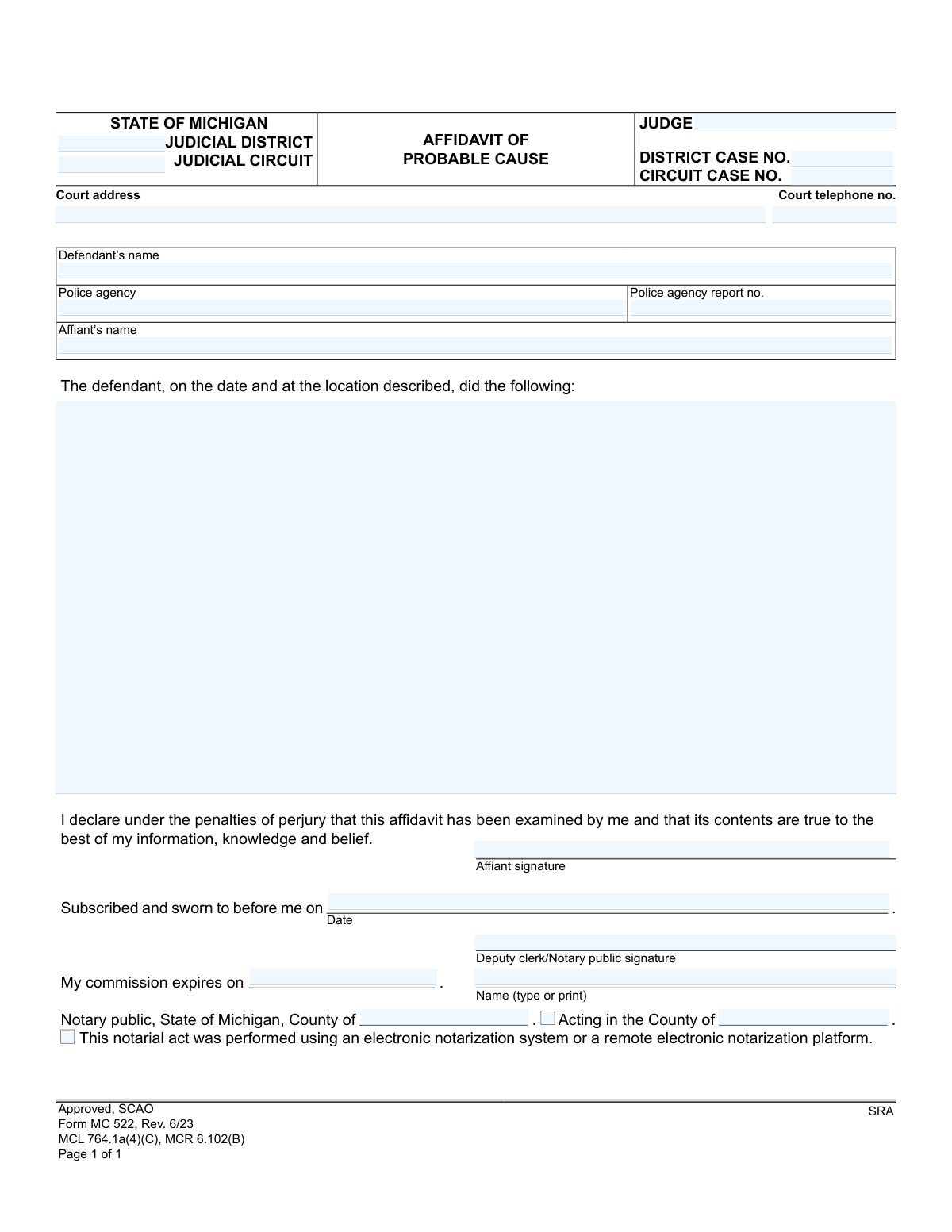
Form MC 522 is a sworn statement, typically made by a law enforcement officer (the affiant), detailing the facts and circumstances that establish probable cause to believe a crime has been committed and the named defendant committed it. This affidavit is a critical component in the Michigan judicial system for obtaining arrest warrants and initiating criminal proceedings. Today, this form can be filled out quickly and accurately using AI-powered services like Instafill.ai, which can also convert non-fillable PDF versions into interactive fillable forms.
MC 522 is part of the Michigan court forms category on Instafill.
Our AI automatically handles information lookup, data retrieval, formatting, and form filling.
It takes less than a minute to fill out MC 522 using our AI form filling.
Securely upload your data. Information is encrypted in transit and deleted immediately after the form is filled out.

Form specifications

Form name: State of Michigan, Form MC 522, Affidavit of Probable Cause
Number of fields: 21
Number of pages: 1
Language: English
main-image

Instafill Demo: How to fill out PDF forms in seconds with AI

How to Fill Out MC 522 Online for Free in 2026

Are you looking to fill out a MC 522 form online quickly and accurately? Instafill.ai offers the #1 AI-powered PDF filling software of 2026, allowing you to complete your MC 522 form in just 37 seconds or less.
Follow these steps to fill out your MC 522 form online using Instafill.ai:
  1. 1 Navigate to Instafill.ai and upload or select the 'Affidavit of Probable Cause (MC 522)' form.
  2. 2 Enter the court and case information, including the judicial district, circuit, case numbers, and court address.
  3. 3 Provide the defendant's name and the relevant police agency details, such as the agency name and report number.
  4. 4 Carefully draft and input the detailed narrative in the main section, describing the facts and evidence that establish probable cause.
  5. 5 As the affiant, thoroughly review the entire completed affidavit to ensure all information is accurate and true to the best of your knowledge.
  6. 6 Sign the affidavit in the presence of a deputy clerk or notary public, who will then complete the notarization section, including their signature and commission details.
  7. 7 Download, print, and file the completed and notarized MC 522 form with the appropriate Michigan court as required.

Our AI-powered system ensures each field is filled out correctly, reducing errors and saving you time.

Why Choose Instafill.ai for Your Fillable MC 522 Form?

Speed

Complete your MC 522 in as little as 37 seconds.

Up-to-Date

Always use the latest 2026 MC 522 form version.

Cost-effective

No need to hire expensive lawyers.

Accuracy

Our AI performs 10 compliance checks to ensure your form is error-free.

Security

Your personal information is protected with bank-level encryption.

Frequently Asked Questions About Form MC 522

This form is a sworn legal statement, usually from a law enforcement officer, that provides facts to a judge. Its purpose is to establish that there is probable cause to believe a specific person has committed a crime, which is necessary for issuing an arrest warrant or filing charges.

The affiant is the person swearing that the information in the affidavit is true. This is almost always a police officer or other law enforcement official with knowledge of the investigation who is presenting the case.

This section requires a detailed, factual narrative explaining what the defendant allegedly did. You must include the date, location, and specific actions that constitute the crime to establish probable cause for the judge's review.

An affidavit is a statement made under oath, and its signature must be officially witnessed to be legally valid. A notary public or deputy clerk verifies the affiant's identity and administers the oath, confirming the truthfulness of the contents.

This is a formal declaration that you are legally swearing the contents of the affidavit are true. Knowingly providing false information on a sworn document is the crime of perjury, which carries serious legal consequences.

It is common to not have a case number when this affidavit is first prepared, as it is often the document that initiates the case. You can leave the case number fields blank; the court clerk will assign them upon filing.

After being filled out, signed, and notarized, the affidavit is submitted to the court specified at the top of the form. It is typically filed with the court clerk's office to be presented to a judge or magistrate.

While this form is a standalone document, it is often submitted as part of a package with other legal documents, such as a police report or a formal criminal complaint. Check with the prosecutor's office or local court rules for specific submission requirements.

Yes, services like Instafill.ai can use AI to auto-fill standard fields like court and agency information, saving time and ensuring accuracy. However, the affiant must personally write the factual narrative describing the probable cause.

You can use a service like Instafill.ai to upload the PDF and complete it electronically. Their platform allows you to type directly into the fields, save your work, and prepare the document for signature and submission.

If you have a non-fillable or 'flat' PDF, you can use a tool like Instafill.ai. It can convert the static document into an interactive, fillable form that you can easily complete on your computer.

This box is checked by the notary if the notarial act was performed using a remote audio-visual platform instead of in person. This is a legally accepted method for notarizing documents in Michigan.

Compliance MC 522
Validation Checks by Instafill.ai

1
Notary Commission Expiration Date Validity
This check ensures the notary's commission expiration date is a valid future date. The system compares the 'My commission expires on' date with the date the affidavit is signed. An affidavit is legally invalid if notarized by someone with an expired commission, so this check prevents the submission of unenforceable documents.
2
Mandatory Affidavit Narrative
Validates that the main description field, detailing the defendant's actions, is not empty. This field contains the core facts establishing probable cause and is the primary purpose of the affidavit. If this field is empty, the submission is rejected as it lacks the necessary information to proceed.
3
Affiant Signature Presence
This check verifies that the 'Affiant signature' field contains a signature. The affiant's signature, under penalty of perjury, is what gives the affidavit its legal weight. A submission without this signature is incomplete and legally non-binding, and therefore must be rejected.
4
Date of Affidavit Chronology
Ensures the 'Subscribed and sworn to before me on' date is not a future date. The date must be the current day or a past day, reflecting when the oath was actually taken. This prevents clerical errors and ensures the timeline of events is legally sound.
5
Case Number Format and Consistency
This validation checks that the 'District Case No.' and 'Circuit Case No.' fields adhere to the court's standardized format (e.g., YY-######-XX). It also ensures that at least one of the two case numbers is provided to properly associate the affidavit with a court file. Incorrectly formatted or missing case numbers would cause filing and retrieval errors.
6
Mandatory Defendant Name
Verifies that the 'Defendant’s name' field is populated. An affidavit of probable cause must clearly identify the individual being accused to be legally valid and actionable. A submission lacking a defendant's name is fundamentally flawed and will be rejected.
7
Police Report Number Presence
This check ensures that the 'Police agency report no.' field is filled out. This number is a critical cross-reference for law enforcement and judicial tracking, linking the affidavit to the original investigation. Failure to include it can delay proceedings and create administrative confusion.
8
Valid Michigan County
Validates that the 'County' and 'Acting in the County of' fields contain names from an official list of Michigan counties. This is crucial for establishing correct legal jurisdiction for the notarization. An incorrect or misspelled county could be grounds to challenge the affidavit's validity.
9
Court Telephone Number Format
This check ensures the 'Court telephone no.' is in a valid 10-digit format (e.g., (XXX) XXX-XXXX or XXXXXXXXXX). A valid phone number is necessary for communication between parties and agencies involved in the case. The validation prevents data entry errors and ensures contact information is reliable.
10
Mandatory Affiant Name
This validation confirms that the 'Affiant's name' field is not empty. The identity of the person swearing to the facts is a fundamental legal requirement for an affidavit. An anonymous or unidentified affiant invalidates the document, so the submission must be blocked if this information is missing.
11
Date Field Formatting
Ensures that all date fields, including the affidavit date and the commission expiration date, are entered in a consistent and valid format (e.g., MM/DD/YYYY). This prevents ambiguity and errors in processing time-sensitive legal documents. Submissions with improperly formatted dates will be flagged for correction.
12
Electronic Notarization Checkbox Logic
This check verifies the logic associated with the electronic notarization checkbox. If the box 'This notarial act was performed using an electronic notarization system...' is checked, the system may require additional validation on the notary's signature field to ensure it meets electronic signature standards. This is important for compliance with state laws governing remote and electronic notarizations.

Common Mistakes in Completing MC 522

Signing the Affidavit Before Notarization

Affiants often sign the document out of habit before meeting with the official. However, the legal validity of an affidavit requires the signature to be witnessed by the notary or deputy clerk as the oath is administered. Signing beforehand invalidates the document, forcing the entire process to be repeated and causing significant delays. Always wait to sign until you are in the presence of the authorized official.

Using Conclusory Language Instead of Factual Descriptions

The narrative section is often filled with legal conclusions (e.g., "the defendant assaulted the victim") instead of objective facts (e.g., "the defendant struck the victim in the face with a closed fist"). This happens when the affiant summarizes the crime instead of describing the specific actions and evidence that constitute it. A conclusory affidavit may be rejected by a judge for failing to independently establish probable cause, leading to the denial of a warrant.

Incorrect or Incomplete Defendant Name

Misspelling the defendant's name, omitting a middle name or suffix, or using an unverified alias is a critical error. This often results from rushing or failing to consult official identification. An incorrect name can lead to the wrong person being arrested, invalidate a subsequent warrant, and create significant legal challenges that could jeopardize the case. Always verify the full legal name from an official source.

Incomplete Notary Public Information

The notary or clerk may forget to fill in their commission expiration date, the county of their commission, or the county where they are acting. This oversight can render the notarization invalid, which in turn invalidates the entire affidavit. To avoid this, the notary must meticulously complete their entire section, as a defective notarization can cause the evidence to be challenged or the case filing to be rejected.

Omitting Specific Date, Time, and Location from the Narrative

The affiant may neglect to include the precise date, time, and location of the incident within the main descriptive paragraph. This information is fundamental for establishing the context of the probable cause and properly informing the defendant of the charges. Its absence can weaken the affidavit and open it up to legal challenges, potentially leading to dismissal. The narrative should always begin by clearly stating these essential details.

Missing or Incorrect Case and Court Information

Fields like 'Judicial District,' 'Circuit Case No.,' and 'District Case No.' are frequently left blank or filled with incorrect data. This occurs when the affiant doesn't have the information readily available at the time of drafting. The consequence is misfiling or rejection by the court clerk, delaying the judicial process until the correct information is obtained and the form is resubmitted. It's crucial to verify these details with the clerk's office before filing.

Inconsistent Dates of Signature and Notarization

The date the affiant signs the document may not match the date entered by the notary in the 'Subscribed and sworn to before me on' line. This discrepancy creates ambiguity about when the oath was actually administered and can be used to question the document's integrity. To prevent this, the affiant and notary must ensure they are executing and dating the document on the same calendar day.

Using an Outdated Version of the Form

Court forms are periodically updated, as indicated by the 'Rev. 6/23' marker on this one. Using an obsolete version can lead to rejection by the court clerk because it may lack required fields or legal language from the current version. Always check the official court website for the latest version of any form to ensure compliance and avoid unnecessary processing delays.

Illegible Handwriting and Data Entry Errors

Critical information like the police report number, defendant's name, or address can be entered illegibly or with transposed numbers. Since this form is often a non-fillable PDF, it must be printed and filled by hand, increasing the risk of errors. Such mistakes can make it difficult to cross-reference case files, leading to administrative delays. AI-powered tools like Instafill.ai can convert flat PDFs into fillable forms, ensuring all data is typed, legible, and correctly formatted to prevent these issues.

Forgetting to Mark the Electronic Notarization Checkbox

When a notarization is performed remotely using an electronic system, the form requires checking a specific box to indicate this. Forgetting to do so fails to comply with state requirements for remote online notarization (RON), creating a procedural flaw. This omission could be used to challenge the validity of the notarization and, by extension, the affidavit itself. Always ensure the method of notarization is accurately documented on the form.
Saved over 80 hours a year

“I was never sure if my IRS forms like W-9 were filled correctly. Now, I can complete the forms accurately without any external help.”

Kevin Martin Green

Your data stays secure with advanced protection from Instafill and our subprocessors

Robust compliance program

Transparent business model

You’re not the product. You always know where your data is and what it is processed for.

ISO 27001, HIPAA, and GDPR

Our subprocesses adhere to multiple compliance standards, including but not limited to ISO 27001, HIPAA, and GDPR.

Security & privacy by design

We consider security and privacy from the initial design phase of any new service or functionality. It’s not an afterthought, it’s built-in, including support for two-factor authentication (2FA) to further protect your account.

Fill out MC 522 with Instafill.ai

Worried about filling PDFs wrong? Instafill securely fills state-of-michigan-form-mc-522-affidavit-of-probable-cause forms, ensuring each field is accurate.