Yes! You can use AI to fill out Statement of Authority for School Transport Assistance

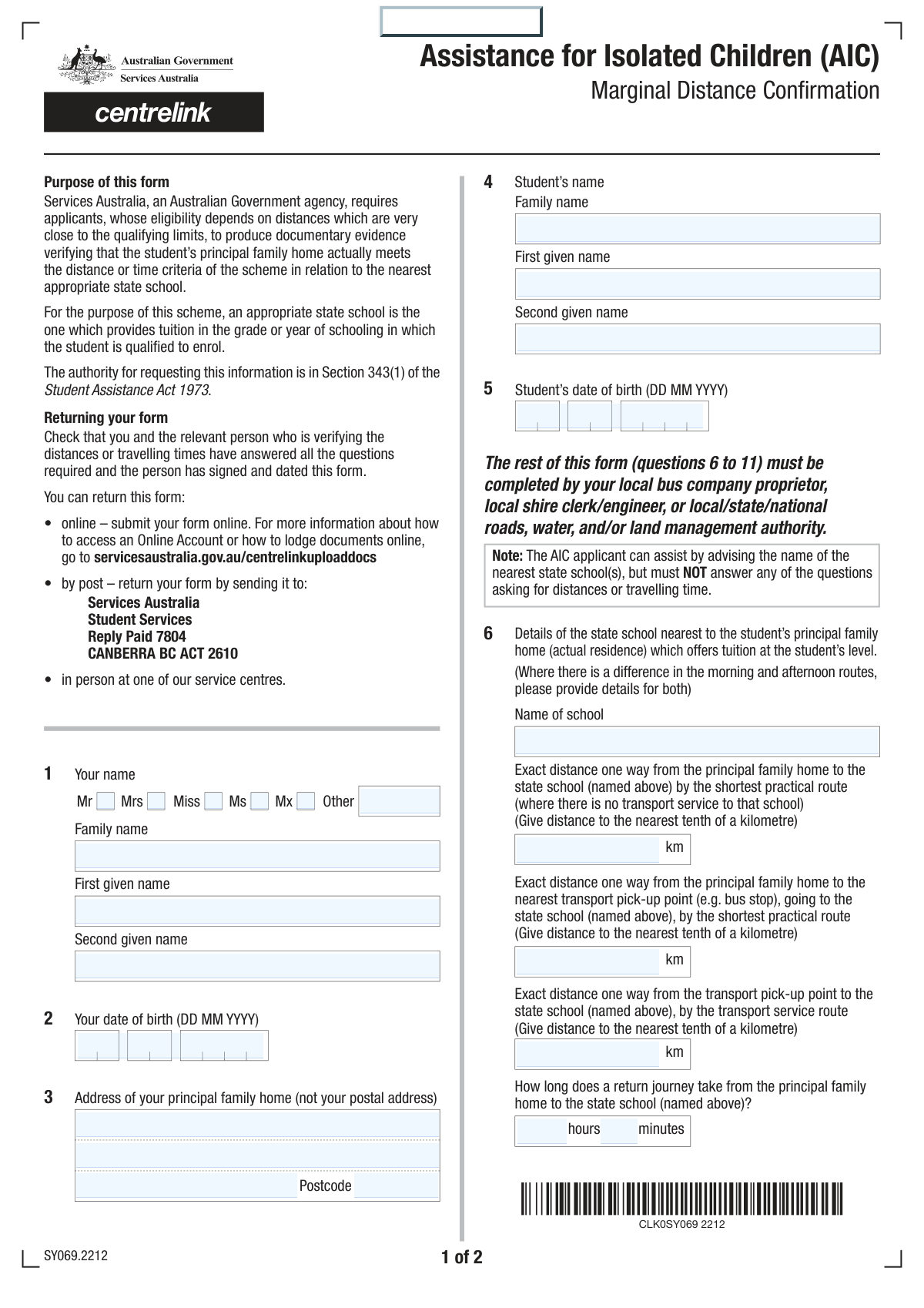
The Statement of Authority for School Transport Assistance is an official document used to verify a student's travel details for a school transport subsidy application. It requires an authorized person, like a bus proprietor or local council clerk, to confirm specific distances and travel times between the student's home, the nearest school, and transport points. This verification is critical for the education department to accurately assess eligibility for transport assistance. Today, this form can be filled out quickly and accurately using AI-powered services like Instafill.ai, which can also convert non-fillable PDF versions into interactive fillable forms.
School Transport Verification is part of the NJ state forms, PA state forms, school forms and state ID forms categories on Instafill.
Our AI automatically handles information lookup, data retrieval, formatting, and form filling.
It takes less than a minute to fill out School Transport Verification using our AI form filling.
Securely upload your data. Information is encrypted in transit and deleted immediately after the form is filled out.

Form specifications

Form name: Statement of Authority for School Transport Assistance
Number of fields: 41
Number of pages: 2
Filled form examples: Form School Transport Verification Examples
Language: English
main-image

Instafill Demo: How to fill out PDF forms in seconds with AI

How to Fill Out School Transport Verification Online for Free in 2026

Are you looking to fill out a SCHOOL TRANSPORT VERIFICATION form online quickly and accurately? Instafill.ai offers the #1 AI-powered PDF filling software of 2026, allowing you to complete your SCHOOL TRANSPORT VERIFICATION form in just 37 seconds or less.
Follow these steps to fill out your SCHOOL TRANSPORT VERIFICATION form online using Instafill.ai:
  1. 1 Navigate to Instafill.ai and upload or select the Statement of Authority for School Transport Assistance form.
  2. 2 Enter the personal details for the parent/guardian and the student, including full names, dates of birth, and the principal home address.
  3. 3 Input the verified travel information, such as the nearest school's name and the precise one-way distances for the student's journey.
  4. 4 Answer the questions regarding return journey time, the availability of closer transport stops, and proximity to alternate schools.
  5. 5 Fill out the 'Statement of Authority' section, providing your organization's details and confirming your role in verifying the travel measurements.
  6. 6 Carefully review all the information for accuracy, then digitally sign and date the form to finalize the verification.
  7. 7 Download the completed document to provide to the applicant or submit it as instructed by the relevant education authority.

Our AI-powered system ensures each field is filled out correctly, reducing errors and saving you time.

Why Choose Instafill.ai for Your Fillable School Transport Verification Form?

Speed

Complete your School Transport Verification in as little as 37 seconds.

Up-to-Date

Always use the latest 2026 School Transport Verification form version.

Cost-effective

No need to hire expensive lawyers.

Accuracy

Our AI performs 10 compliance checks to ensure your form is error-free.

Security

Your personal information is protected with bank-level encryption.

Frequently Asked Questions About Form School Transport Verification

This form is used to collect and verify a student's travel details to determine eligibility for school transport assistance. It requires precise information about the student's home address, nearest school, and travel distances.

A parent or guardian must fill out the student and family details, and an authorized official (like a Shire Clerk or Bus Proprietor) must complete and sign the 'Statement of Authority' section to verify the travel information.

Use a reliable online mapping service or a vehicle's trip meter to measure the exact one-way distance in kilometers via the shortest, most practical route. Be sure to distinguish between the distance to a bus stop versus the distance directly to the school.

The 'Distance Home to School (No Transport)' field is only for situations where no transport service is available at all. The other fields break down the journey into the distance from home to the pick-up point and from the pick-up point to the school.

This section must be completed by an official who can verify the distances and times you have provided. This could be a representative from your local council (Shire Clerk) or the transport provider (Bus Proprietor).

No, the 'Second Given Name' field is optional for both the parent/guardian and the student. You only need to complete it if the person has a middle name.

This is the total time for a complete round trip from home to school and back home again on a typical school day. Add the morning travel time and the afternoon travel time together and enter the total in hours and minutes.

You only need to complete this section if your home is less than 4.5km away from a transport service that goes to another appropriate state school. If so, you must provide the name of that alternate school.

Submission instructions are not provided on the form itself. You should submit the completed form to the educational authority or department that requested it.

This question is asking if you, the person filling out the form, are the same person who personally measured and verified the travel distances and times listed. This is separate from the official verification in the 'Statement of Authority' section.

Yes, services like Instafill.ai use AI to accurately auto-fill form fields with your saved information, which can save you time and help prevent errors. The AI can help you fill out your name, address, and other personal details instantly.

Simply upload the form to the Instafill.ai platform. The AI will identify all the fields, allowing you to click and fill them with your securely stored information, making the process fast and simple.

If you have a flat, non-fillable PDF, you can use a service like Instafill.ai to make it interactive. Upload the file, and the platform will automatically convert it into a fillable form that you can complete on your computer.

Compliance School Transport Verification
Validation Checks by Instafill.ai

1
Exclusive Title Selection
This check ensures that a user selects only one title option. If a user fills in the 'Other Title' text field, it verifies that none of the 'Mr', 'Mrs', 'Miss', 'Ms', or 'Mx' checkboxes are selected. This prevents contradictory data entry and ensures data cleanliness. If validation fails, the user should be prompted to select only one option.
2
Applicant Date of Birth Validity
Validates that the 'Date of Birth' for the applicant is a real date in a valid format (e.g., DD/MM/YYYY) and is in the past. It also checks that the calculated age is reasonable for a parent or guardian (e.g., over 18). This is crucial for verifying the identity and eligibility of the person completing the form. A failure would trigger an error message asking for a valid past date.
3
Student Age Consistency
This is a logical check that compares the applicant's date of birth with the student's date of birth. It ensures the student is younger than the applicant, which is logically expected in a parent/guardian-student relationship. This check prevents data entry errors that could complicate eligibility assessment. If the student's date of birth is earlier than the applicant's, an error should be displayed.
4
Required Name Fields
This validation confirms that the 'Family Name' and 'First Given Name' fields are completed for both the applicant and the student. These fields are fundamental for identification and processing the application. An incomplete name would make the form submission invalid and unusable, so a failure should prevent submission and highlight the required fields.
5
Postcode Format Validation
This check verifies that the 'Postcode' field contains a value that conforms to the expected format for the relevant country or region (e.g., a 4-digit number). Correctly formatted postcodes are essential for address validation, mail delivery, and determining geographic-based eligibility for services. An invalid format would prompt the user to correct the entry.
6
Mandatory Address Information
Ensures that 'Address Line 1' and 'Postcode' for the principal family home are not empty. This information is critical for calculating distances to schools and transport, which is the primary purpose of the form. Without a complete address, key calculations cannot be performed, so submission should be blocked until these fields are filled.
7
Travel Distance Logic
This check enforces a logical rule on the travel distance fields. It ensures that the user provides either the 'Distance Home to School (No Transport)' OR the combination of 'Distance Home to Transport Pick-up' and 'Distance Transport Pick-up to School', but not both sets. This prevents ambiguous or conflicting data regarding the student's travel situation. A validation failure would require the user to correct their entries to reflect only one travel scenario.
8
Journey Time Minutes Range
Validates that the value entered in the 'Return Journey Time (Minutes)' field is a whole number between 0 and 59. This ensures the time data is logical and can be correctly combined with the 'Hours' field for total time calculations. An entry outside this range (e.g., 75 minutes) is invalid and should be corrected to the proper hour and minute format.
9
Conditional Closer Pick-up Distance
This validation is triggered if the user checks 'Yes' for 'Closer Transport Pick-up Point Availability'. It then requires that the 'Whole Kilometre Distance' field must be filled out. This ensures that when a user indicates a condition is true, the necessary corresponding data is provided. If the condition is met but the distance is not provided, the form should show an error.
10
Conditional Alternate School Name
This check ensures that if the 'Yes' option is selected for 'Proximity to Alternate State School', the 'Name of School' field must be completed. This rule enforces data completeness for conditional scenarios. The name of the alternate school is essential information if this condition applies, and failure to provide it would render the answer incomplete.
11
Mandatory Distance Verification Selection
Verifies that the user has selected either 'Yes' or 'No' for the 'Distance Verification Confirmation' question. This is a mandatory declaration that cannot be left blank, as it confirms who is responsible for the provided measurements. If neither option is selected, the user should be blocked from submitting the form until a choice is made.
12
Statement of Authority Date Validity
This check validates that the 'Date' in the 'Statement Of Authority' section is a valid date and is not in the future. It ensures the statement was signed on or before the form submission date, which is critical for its legal and procedural validity. A future date is impossible and would be flagged as an error.
13
Required Authority Identification
Ensures that if any part of the 'Statement Of Authority' section is filled, the 'Name of Authority or Organisation' and 'Type of Authority or Organisation' fields are mandatory. These fields are essential for identifying the entity making the statement. Without this information, the signature and date are meaningless, so the validation prevents an incomplete authority statement.
14
Student Date of Birth Validity
Validates that the 'Student's Date of Birth' is a real date in a valid format and is in the past. It also checks that the age is appropriate for a student (e.g., between 5 and 18 years old). This is fundamental for determining eligibility for school-related services. An invalid or future date would be rejected.

Common Mistakes in Completing School Transport Verification

Inaccurate Distance and Time Measurements

The form requires exact distances in kilometers and total return journey times. Applicants often estimate these values or use unreliable methods like car odometers, leading to inaccuracies. Since eligibility for transport assistance is often based on precise distance thresholds, incorrect data can result in a rejected application. To avoid this, use a reliable online mapping tool set to the 'shortest practical route' and carefully calculate the return journey time by doubling the one-way trip.

Applicant Completing the 'Statement of Authority' Section

This section is intended for an external official (e.g., Shire Clerk, Bus Proprietor) to verify the travel details. A common error is for the applicant to fill out and sign this section themselves, which invalidates the verification step and will cause the form to be rejected. Applicants should complete their sections and then take the form to the appropriate authority for their signature and official details.

Confusing Different Distance Scenarios

The form asks for three distinct distance measurements: home to school (if no transport is used), home to the transport pick-up point, and the transport route from pick-up to school. Applicants may get confused and fill in the wrong field or provide redundant information. This can lead to processing delays as officials try to understand the applicant's actual travel situation. Carefully read each field's description and only provide the distance that accurately reflects your journey.

Mishandling Conditional Yes/No Questions

The form contains questions that only need to be answered if a specific 'Yes' box is checked, such as providing details about an alternate school. Applicants frequently miss these instructions, either leaving a required follow-up field blank after checking 'Yes' or filling in a field that should have been left empty. This creates an incomplete or contradictory submission, requiring clarification and delaying the process.

Providing a P.O. Box for a Physical Address

The form specifically requests the 'Principal Family Home Address,' which is a physical location used to calculate travel distances. Applicants sometimes provide a P.O. Box or mailing address out of habit. This is a critical error because a P.O. Box cannot be used to determine eligibility based on distance, leading to an automatic rejection or a request for more information. Always provide the full, physical street address where the student resides.

Incorrect Journey Time Calculation

The form asks for the *return* journey time, split into hours and minutes. A frequent mistake is to enter the one-way journey time, or to enter a total number of minutes (e.g., '90') in the minutes field instead of converting it to hours and minutes ('1' hour, '30' minutes). This misrepresentation of travel time can affect eligibility assessments. Calculate the one-way journey time first, then double it for the return trip, and be sure to separate the total into the correct hour and minute fields.

Using Inconsistent or Incomplete Names

The form requires full legal names for both the applicant and the student. Applicants may use nicknames, omit middle names that are on official records, or accidentally swap the student's and parent's information. These inconsistencies can cause problems with identity verification and cross-referencing with school records. Always use full legal names as they appear on official documents like birth certificates or school enrollment forms.

Entering an Abbreviated or Incorrect School Name

The form requires the 'full name of the state school.' Applicants may use common abbreviations, local nicknames, or slightly incorrect names for the school. This ambiguity can force processors to look up the school, slowing down the application and risking that they identify the wrong institution. To prevent delays, find the official, full name of the school and enter it exactly as required.

Illegible Handwriting on a Printed Form

If this form is only available as a non-fillable PDF, applicants must print it and fill it out by hand, often leading to illegible handwriting. An unreadable form can be rejected outright, as the data for names, addresses, and crucial distance numbers cannot be accurately entered into the system. To avoid this, use a tool like Instafill.ai to convert the non-fillable PDF into a fillable format, allowing you to type directly into the fields for a clean and legible submission.

Swapping Applicant and Student Dates of Birth

The form has separate fields for the applicant's and the student's date of birth. In a rush, it's easy for a parent or guardian to mix these up or enter their own DOB in the student's field. This error can cause significant processing delays and data mismatches with official records. Double-check that the correct date of birth is entered in the corresponding section for both the applicant and the student before submitting.
Saved over 80 hours a year

“I was never sure if my IRS forms like W-9 were filled correctly. Now, I can complete the forms accurately without any external help.”

Kevin Martin Green

Your data stays secure with advanced protection from Instafill and our subprocessors

Robust compliance program

Transparent business model

You’re not the product. You always know where your data is and what it is processed for.

ISO 27001, HIPAA, and GDPR

Our subprocesses adhere to multiple compliance standards, including but not limited to ISO 27001, HIPAA, and GDPR.

Security & privacy by design

We consider security and privacy from the initial design phase of any new service or functionality. It’s not an afterthought, it’s built-in, including support for two-factor authentication (2FA) to further protect your account.

Fill out School Transport Verification with Instafill.ai

Worried about filling PDFs wrong? Instafill securely fills statement-of-authority-for-school-transport-assistance forms, ensuring each field is accurate.