Yes! You can use AI to fill out School Psychology Request for Assistance 2026
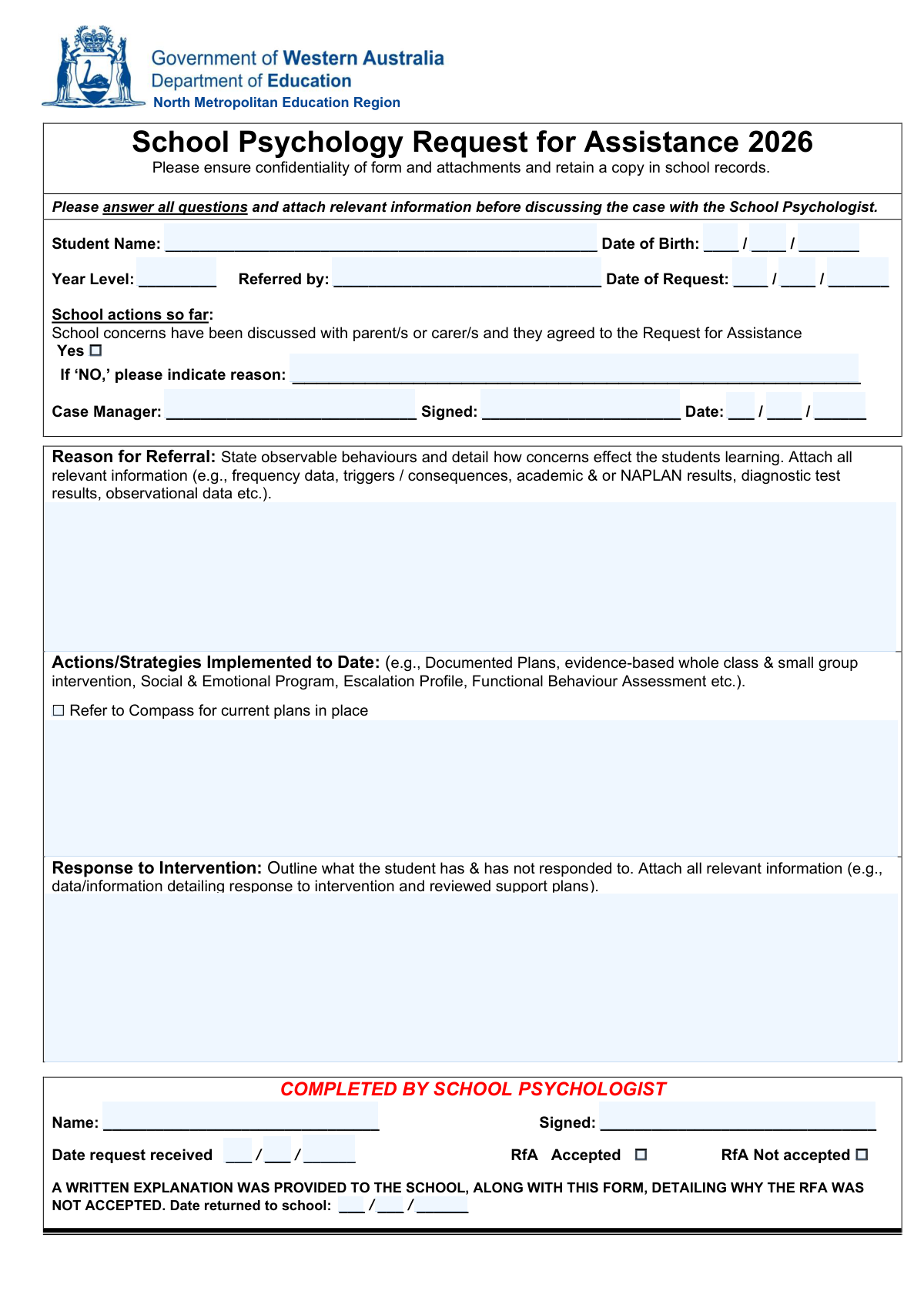
The School Psychology Request for Assistance 2026 is an official referral form completed by school staff to seek support from a School Psychologist for a student. It captures key student information, confirmation of parent/carer discussion and agreement, and a clear description of observable concerns affecting learning. The form also requires documentation of strategies already implemented and evidence of the studentâs response to intervention, helping ensure referrals are evidence-based and appropriately triaged. A section is reserved for the School Psychologist to record whether the request is accepted and, if not, to document that a written explanation was provided.
Our AI automatically handles information lookup, data retrieval, formatting, and form filling.
It takes less than a minute to fill out School Psychology RfA 2026 using our AI form filling.
Securely upload your data. Information is encrypted in transit and deleted immediately after the form is filled out.
Form specifications
| Form name: | School Psychology Request for Assistance 2026 |
| Number of pages: | 1 |
| Official download URL: | https://stinstafill.blob.core.windows.net/static/forms/school-psychology-request-for-assistance-2026/original.pdf |
| Filled form examples: | Form School Psychology RfA 2026 Examples |
| Language: | English |
Instafill Demo: filling out a legal form in seconds
How to Fill Out School Psychology RfA 2026 Online for Free in 2026
Are you looking to fill out a SCHOOL PSYCHOLOGY RFA 2026 form online quickly and accurately? Instafill.ai offers the #1 AI-powered PDF filling software of 2026, allowing you to complete your SCHOOL PSYCHOLOGY RFA 2026 form in just 37 seconds or less.
Follow these steps to fill out your SCHOOL PSYCHOLOGY RFA 2026 form online using Instafill.ai:
- 1 Enter the student’s identifying details (student name, date of birth, and year level).
- 2 Complete referral details (referred by, date of request) and record whether concerns were discussed with parent/carer and they agreed; if not, provide the reason.
- 3 Add case management information (case manager name, signature, and date) and confirm confidentiality/record-keeping requirements are met.
- 4 Write the reason for referral using observable behaviours and explain how the concerns affect learning; upload/attach supporting evidence (e.g., frequency data, triggers/consequences, academic/NAPLAN results, diagnostic/observational data).
- 5 Document actions and strategies implemented to date (e.g., documented plans, class/small group interventions, social-emotional programs, escalation profile, FBA) and reference Compass plans if applicable.
- 6 Describe the student’s response to intervention, including what has and has not worked, and attach data and reviewed support plans.
- 7 Submit the completed form and attachments to the School Psychologist for review; the psychologist then completes the acceptance/not accepted section and dates the receipt/return as required.
Our AI-powered system ensures each field is filled out correctly, reducing errors and saving you time.
Why Choose Instafill.ai for Your Fillable School Psychology RfA 2026 Form?
Speed
Complete your School Psychology RfA 2026 in as little as 37 seconds.
Up-to-Date
Always use the latest 2026 School Psychology RfA 2026 form version.
Cost-effective
No need to hire expensive lawyers.
Accuracy
Our AI performs 10 compliance checks to ensure your form is error-free.
Security
Your personal information is protected with bank-level encryption.
Frequently Asked Questions About Form School Psychology RfA 2026
This form is used by the school to request support from a School Psychologist for a student. It summarises the schoolâs concerns, what has already been tried, and the studentâs response to interventions.
The form is completed by the referring school staff member/case manager, with the final section completed by the School Psychologist. The case manager is responsible for ensuring the information is accurate and complete before submission.
Yesâthere is a checkbox confirming the concerns have been discussed with the parent/carer and that they agreed to the request. If parent/carer agreement has not been obtained, you must indicate the reason on the form.
You must provide the studentâs name, date of birth, year level, who the referral is from, and the date of request. These details help identify the student and track the request timeline.
Describe observable behaviours and clearly explain how the concerns affect the studentâs learning. Attach supporting evidence such as frequency data, triggers/consequences, academic results (including NAPLAN if relevant), diagnostic testing, and observation notes.
Observable behaviours are specific actions that can be seen or measured (e.g., âleaves seat 6 times in 20 minutesâ), rather than general labels (e.g., âis disruptiveâ). Being specific helps the School Psychologist understand the concern and plan next steps.
List the supports already put in place, such as documented plans, evidence-based whole-class or small-group interventions, social-emotional programs, escalation profiles, or a Functional Behaviour Assessment. If plans are stored in Compass, you can tick the box and reference them, but include key details and dates where possible.
This section explains what the student has and has not responded to after supports were implemented. Attach data showing progress (or lack of progress), review notes, and any updated support plans to demonstrate the impact of interventions over time.
Attach relevant information such as behaviour frequency charts, ABC (trigger/consequence) data, academic assessments, NAPLAN results (if applicable), diagnostic test results, observation records, and reviewed support plans. The goal is to provide enough evidence to understand the concern and what has already been tried.
It indicates that current student plans and documentation are available in Compass. Even if you tick it, ensure the form still summarises the key strategies and outcomes so the request can be understood without searching for missing context.
The case manager is the staff member coordinating the studentâs support and the referral process. They must sign and date the form, confirm parent/carer discussion, and ensure all required sections and attachments are completed before speaking with the School Psychologist.
The School Psychologist records the date the request was received and indicates whether the RfA is accepted or not accepted. If it is not accepted, the psychologist provides a written explanation to the school along with the returned form.
If the RfA is not accepted, the form includes a section noting that a written explanation was provided to the school and the date it was returned. This explanation should outline why it was not accepted and what may be needed next.
The form states that confidentiality must be ensured for the form and attachments, and that a copy should be retained in school records. Store it according to your schoolâs privacy and record-management procedures.
Noâthe form instructs staff to answer all questions and attach relevant information before discussing the case with the School Psychologist. Completing the form first helps ensure the discussion is informed by evidence and documented supports.
Compliance School Psychology RfA 2026
Validation Checks by Instafill.ai
1
Student Name is present and appears to be a full name
Validate that the Student Name field is not blank and contains at least two alphabetic tokens (e.g., given name and family name), allowing for hyphens and apostrophes. This reduces ambiguity and prevents misidentification when the request is actioned or filed. If the name is missing or clearly incomplete (e.g., initials only), the submission should be rejected or returned for correction.
2
Date of Birth is a valid date and not in the future
Check that Date of Birth matches the expected format (DD/MM/YYYY) and represents a real calendar date. Also validate that it is not a future date and is within a plausible range for a school-aged student. If invalid, the form should be flagged because DOB is critical for identity matching, eligibility, and age-related interpretation of assessment data.
3
Year Level is completed and within allowed range
Ensure Year Level is provided and is a valid value for the school system (e.g., Foundation/Prep or 1â12, depending on jurisdiction), not free text like 'N/A'. This supports correct triage and ensures interventions and expectations are age/grade appropriate. If the year level is missing or out of range, the request should be returned for completion.
4
Referred By field is completed with an identifiable staff member
Validate that the Referred by field is not blank and contains a person identifier (name and/or role) rather than generic text (e.g., 'staff'). This is important for follow-up questions, accountability, and audit trails. If missing or non-identifiable, the submission should be flagged and the school asked to provide a specific referrer.
5
Date of Request is a valid date and not after psychologist receipt date
Check that Date of Request is in DD/MM/YYYY format and is a real date. If the psychologist section is completed, ensure the request date is not later than the 'Date request received' (logical sequence). If the date is invalid or the sequence is impossible, the form should be held for correction to maintain accurate timelines and compliance records.
6
Parent/Carer discussion consent is explicitly indicated (Yes/No)
Validate that the checkbox for 'School concerns have been discussed with parent/s or carer/s and they agreed' is explicitly marked, and that the response is unambiguous. This is essential for consent, collaboration, and confidentiality expectations before psychological involvement. If neither option is selected or the mark is unclear, the form should be rejected as incomplete.
7
Reason required when parent/carer agreement is 'No'
If the parent/carer agreement is marked 'No', ensure the 'If NO, please indicate reason' field is completed with meaningful text (not just a dash or 'N/A'). This provides necessary context for risk management, engagement planning, and whether the request can proceed. If missing, the submission should be returned because the form explicitly requires a reason.
8
Case Manager name, signature, and date are all present and consistent
Validate that the Case Manager name is provided, the Signed field is completed (typed name or captured signature per system rules), and the date is a valid DD/MM/YYYY date. These fields establish responsibility for the referral and confirm the information has been reviewed. If any element is missing or the date is invalid, the form should be flagged as not formally authorized.
9
Reason for Referral narrative is completed and includes observable impacts on learning
Ensure the Reason for Referral section is not blank and contains sufficient detail, including observable behaviours and a description of how concerns affect learning (as the prompt requires). This is necessary for appropriate triage and to avoid vague referrals that cannot be actioned. If the narrative is empty or too minimal (e.g., a single word), the form should be returned for elaboration.
10
Attachments/evidence indicated when referenced in the referral narrative
If the Reason for Referral text references attachments (e.g., 'see attached frequency data', 'NAPLAN attached'), validate that attachments are actually included or that a link/reference is provided per system capability. Missing evidence can prevent acceptance or delay assessment planning. If referenced evidence is absent, the submission should be flagged and the requester prompted to attach the documents.
11
Actions/Strategies Implemented section is completed or Compass reference is checked
Validate that either the Actions/Strategies Implemented narrative contains content or the 'Refer to Compass for current plans in place' checkbox is selected. This ensures the school has attempted documented interventions and provides the psychologist with current supports. If both are empty/unchecked, the form should be returned because it lacks required background on interventions.
12
Response to Intervention section is completed with what worked and what did not
Check that the Response to Intervention section is not blank and includes information about both responses and non-responses (or explicitly states that data is unavailable and why). This is critical for determining next steps and avoiding repetition of ineffective strategies. If missing, the request should be flagged as incomplete and not ready for review.
13
School Psychologist section completeness based on acceptance status
If the form is marked as completed by the School Psychologist, validate that Name, Signed, and 'Date request received' are completed and valid. Also ensure exactly one of 'RfA Accepted' or 'RfA Not accepted' is selected to avoid contradictory outcomes. If these fields are incomplete or both/neither status boxes are checked, the record should be rejected for correction.
14
Written explanation and return date required when RfA is not accepted
When 'RfA Not accepted' is selected, validate that the statement about a written explanation is supported by a completed 'Date returned to school' field (valid DD/MM/YYYY). This enforces procedural compliance and provides an auditable timeline for communication back to the school. If the return date is missing or invalid, the form should be flagged as non-compliant and incomplete.
15
All date fields follow consistent format and are internally consistent
Validate that every date field on the form uses the same expected format (DD/MM/YYYY) and represents a real date (e.g., no 31/02/2026). Where multiple dates exist, check logical ordering (DOB < Date of Request †Date request received †Date returned to school, when applicable). If any date fails format/validity or ordering checks, the submission should be held for correction to prevent timeline and recordkeeping errors.
Common Mistakes in Completing School Psychology RfA 2026
People often skip or partially complete the studentâs identifying details, especially date of birth or year level, because they assume the school psychologist can look it up elsewhere. Missing identifiers can delay triage, create confusion with students who have similar names, and increase the risk of filing errors. Always enter the full legal name as recorded by the school, a complete DOB in the requested format, and the current year level.
This form uses a day/month/year layout, but staff sometimes enter dates in month/day/year or write only month/year. Incorrect dates can affect timelines (e.g., when concerns were raised, when consent was obtained) and may cause the request to be returned for clarification. Use the exact DD/MM/YYYY format for every date field and double-check that the âDate of Requestâ matches when the form is actually submitted.
A common issue is ticking âYesâ without having documented discussion/consent, or ticking nothing and leaving the âIf NO, indicate reasonâ line blank. This can breach process expectations and may prevent the psychologist from proceeding due to consent and collaboration requirements. Ensure the conversation has occurred, record the outcome accurately, and if âNo,â provide a clear reason (e.g., unable to contact after X attempts, parent declined) and note next steps.
Referrers often write general statements like âanxiety,â âbehaviour issues,â or âstruggling academicallyâ without describing what is seen and how it affects learning. Vague descriptions make it hard to determine urgency, appropriate assessment, and whether school-based interventions have been sufficient. Describe specific, observable behaviours (what, when, how often, in which settings) and explicitly link them to learning outcomes (engagement, work completion, attendance, peer interactions, progress).
People frequently mention that data exists (e.g., NAPLAN, diagnostic tests, behaviour logs) but do not attach it or summarize key findings. Without evidence, the request may be delayed, not accepted, or require follow-up, slowing support for the student. Attach relevant documents and include a brief summary of the most important data points (dates, scores, frequency counts, patterns, triggers/consequences).
A common mistake is naming interventions (e.g., âsmall group intervention,â âSEL programâ) without specifying duration, frequency, group size, fidelity, and who delivered them. This makes it impossible to judge whether the student had adequate opportunity to respond or whether adjustments are needed. For each strategy, include start/end dates, session frequency, measurable goals, and evidence of implementation (plans, logs, work samples).
Checking âRefer to Compass for current plans in placeâ is often used as a substitute for summarizing key plans and outcomes. School psychologists may not have immediate access, may not know which entries are relevant, or may miss critical information, causing delays. If referencing Compass, include the plan names, dates, and where to find them (e.g., document title, last review date) and still provide a short summary in the form.
Many submissions describe what was tried but do not state the studentâs response, or they use subjective language like âa bit betterâ without evidence. This prevents effective decision-making about next steps and may lead to the request being returned for more information. Clearly state what the student responded to and did not respond to, supported by data (progress monitoring, behaviour frequency, attendance, work completion) and note any plan reviews/adjustments.
When behaviour is part of the referral, people often omit patterns such as triggers, setting events, and what typically happens after the behaviour. Without this, itâs difficult to determine function, risk, and appropriate supports (e.g., whether an FBA is indicated). Include common antecedents, the behaviour topography, typical consequences, and any escalation profile information, ideally with examples and frequency.
Forms are frequently submitted without the case managerâs name, signature, and/or date, especially when multiple staff contribute. Missing sign-off can create accountability issues, slow processing, and lead to the form being returned as incomplete. Ensure the nominated case manager is clearly identified and that the signature and date fields are completed before submission.
Because the form requests attachments, staff sometimes include unnecessary sensitive details (e.g., unrelated family information) or send the form via insecure channels. This increases privacy risk and may breach confidentiality requirements stated at the top of the form. Attach only information relevant to the referral, redact non-essential identifiers where appropriate, and follow your schoolâs secure storage and transmission procedures while retaining a copy in school records.
Saved over 80 hours a year
âI was never sure if my IRS forms like W-9 were filled correctly. Now, I can complete the forms accurately without any external help.â
Kevin Martin Green
Your data stays secure with advanced protection from Instafill and our subprocessors

Robust compliance program
Transparent business model
Youâre not the product. You always know where your data is and what it is processed for.
ISO 27001, HIPAA, and GDPR
Our subprocesses adhere to multiple compliance standards, including but not limited to ISO 27001, HIPAA, and GDPR.
Security & privacy by design
We consider security and privacy from the initial design phase of any new service or functionality. Itâs not an afterthought, itâs built-in, including support for two-factor authentication (2FA) to further protect your account.
Fill out School Psychology RfA 2026 with Instafill.ai
Worried about filling PDFs wrong? Instafill securely fills school-psychology-request-for-assistance-2026 forms, ensuring each field is accurate.



