Fill out psychology forms
with AI.
Psychology forms in an educational context serve as critical tools for identifying, documenting, and addressing the social, emotional, behavioral, and cognitive needs of students. These forms create a structured, evidence-based pathway between classroom observations and professional psychological support, ensuring that students who need additional help are referred through a clear and accountable process. They also protect the rights of students and families by requiring documented parental consent and transparent communication at every stage.
By continuing, you acknowledge Instafill's Privacy Policy and agree to get occasional product update and promotional emails.
About psychology forms
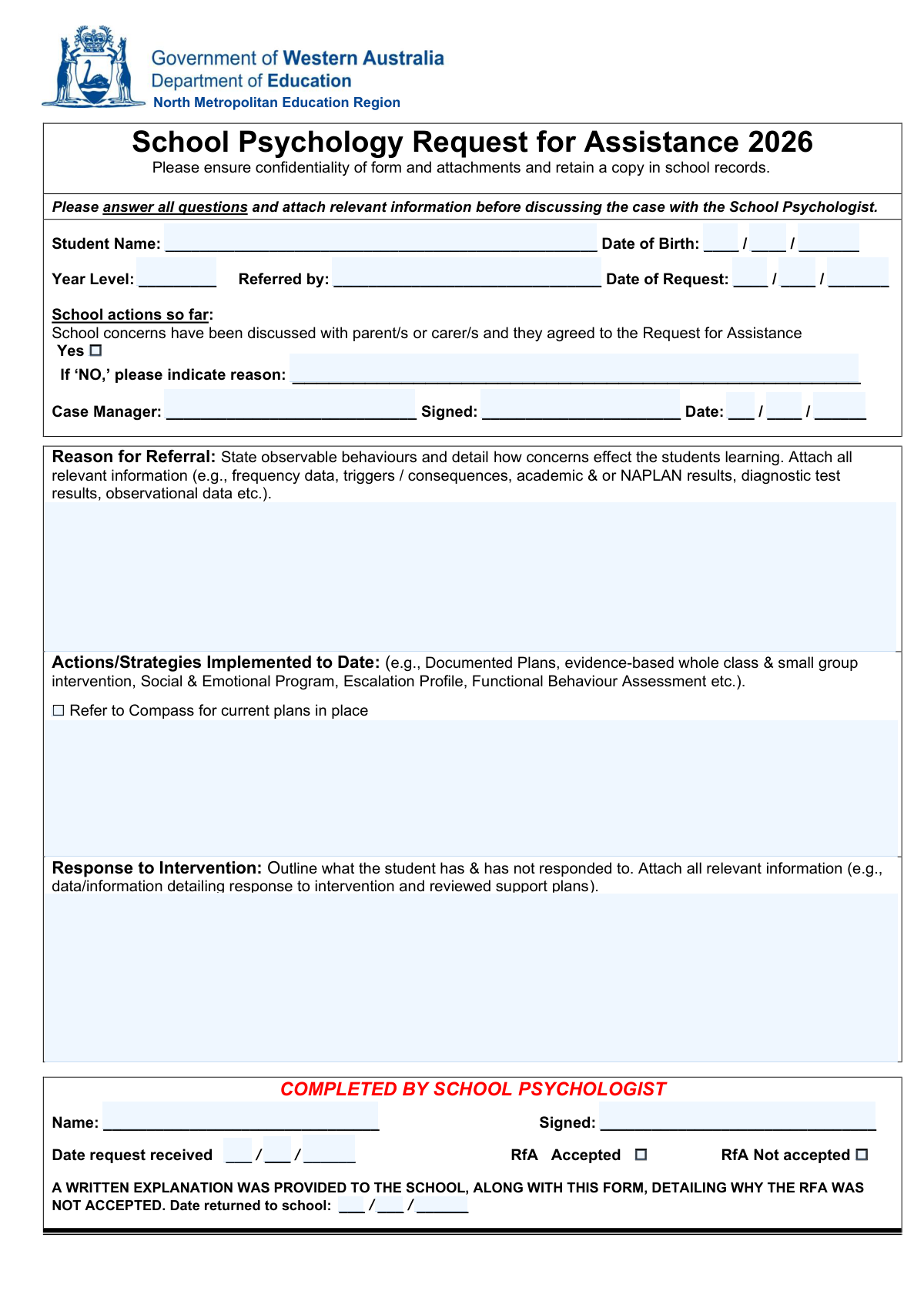
These forms are most commonly used by teachers, school counselors, learning support staff, and administrators who have identified a student displaying signs of difficulty that may require specialist assessment or intervention. A form like the School Psychology Request for Assistance, for example, is typically completed when a student is struggling in ways that go beyond what general classroom strategies can address — capturing not just the concerns, but also what has already been tried and how the student has responded.
Because these forms often need to be completed promptly and accurately to avoid delays in student support, tools like Instafill.ai use AI to help school staff fill them out in under 30 seconds, reducing administrative burden while keeping sensitive student data secure.
Every form on this page can be completed without typing. Instafill is form filling software that reads a PDF and fills it for you — including flat and scanned documents that carry no fillable fields at all.
Forms in This Category
The forms in this category have a median Form Complexity Index of 39/100 (Basic), measured across 1 forms by field count, input difficulty, length, conditional logic and structure. See how it is calculated.
| Form Name | Pages | FCI | |
|---|---|---|---|
| 1. | School Psychology Request for Assistance 2026 | 1 | Basic 39 |
- Enterprise-grade security & data encryption
- 99%+ accuracy powered by AI
- 1,000+ forms from all industries
- Complete forms in under 60 seconds
How to Choose the Right Form
Navigating psychology and special education documentation requires precision to ensure students receive the right support at the right time. This category focuses on the formal intake and referral process within the school environment, bridging the gap between classroom observation and professional psychological intervention.
Initiating a Referral for Support
If you are a teacher, counselor, or school administrator identifying a student who is struggling with learning or behavioral challenges, you should use the School Psychology Request for Assistance 2026. This form is the primary tool for transitioning a student from general classroom interventions to a formal review by a school psychologist. It is specifically designed to facilitate evidence-based triage, ensuring that the psychologist has the necessary data to make an informed decision on the case.
Key Criteria for Using This Form
Before completing the School Psychology Request for Assistance 2026, ensure you have met the following procedural requirements:
- Documented Interventions: You must provide evidence of specific strategies already implemented in the classroom and the student’s response to those interventions (often part of a Multi-Tiered System of Supports or MTSS).
- Parental Consultation: The form requires confirmation that a discussion has occurred with the parent or carer and that they have provided agreement for the referral to proceed.
- Specific Observable Concerns: Rather than general statements, the form asks for clear descriptions of observable behaviors or learning barriers that are directly affecting the student's educational outcomes.
When to Use This Specific Version
This 2026 updated form is essential for school staff who need a standardized way to request assistance. It includes a dedicated section for the School Psychologist to formally record their decision, making it a vital piece of the student's permanent educational record and a necessary step in the special education evaluation path.
Tips for psychology forms
Before submitting a request, ensure you have a clear record of the strategies already attempted in the classroom. This documentation is essential for the triage process and helps the psychologist understand which support methods have already been explored.
The referral process cannot proceed without documented agreement from the student's guardians. Discuss the concerns with the family beforehand to ensure they are informed and supportive of the school psychology involvement to avoid processing delays.
When describing student concerns, focus on specific, measurable behaviors rather than subjective interpretations. Instead of stating a student is 'distracted,' describe how frequently they lose focus during specific tasks or require redirection.
AI-powered tools like Instafill.ai can complete these detailed forms in under 30 seconds with high accuracy. Your sensitive data stays secure during the process, providing a practical and time-saving solution for educators handling multiple psychology and education forms.
Clearly articulate how the observed behaviors or psychological concerns are directly affecting the student's academic progress or social integration. This helps the school psychologist prioritize cases based on the severity of the educational impact.
Include data-driven evidence showing how the student responded to previous support measures. Providing specific progress monitoring data or work samples helps the psychologist make an evidence-based decision on whether to accept the request for assistance.
Frequently Asked Questions
These forms are usually initiated by school staff members, such as classroom teachers or special education coordinators, who have observed a student struggling with learning or behavioral challenges. The form acts as a formal bridge between the classroom environment and specialized psychological support services.
Yes, standard procedure for school psychology forms requires confirmation that the parent or legal guardian has been consulted and has agreed to the referral. This ensures that the evaluation process is collaborative and adheres to student privacy and parental rights regulations.
You should prepare evidence of observable concerns, including academic performance data, behavioral logs, and a history of strategies already implemented in the classroom. Documentation regarding the student’s Response to Intervention (RTI) is essential to demonstrate that standard supports have been tried and evaluated.
These documents serve as the official record for triaging student needs and determining whether a formal psychological assessment is warranted. They ensure that referrals are evidence-based, helping school districts allocate resources and personnel to the students who require the most intensive support.
Yes, AI tools like Instafill.ai can assist by accurately extracting data from existing student records or teacher observation notes and placing it directly into the form fields. This technology allows users to complete complex psychology and education forms in under 30 seconds.
Once submitted, the school psychologist reviews the request and the provided evidence to determine if the case is accepted for further action. If the request is not accepted, the psychologist typically provides a written explanation to the referring staff member, often suggesting alternative interventions.
Manually entering detailed academic and behavioral data can be time-consuming, but using an AI-powered platform like Instafill.ai can complete the process in less than 30 seconds. The AI identifies and maps data from your source documents directly to the PDF fields with high accuracy.
Yes, school psychology forms are designed to be comprehensive, addressing a range of issues from cognitive learning difficulties to emotional or social-behavioral concerns. They provide a structured way to describe any observable behaviors that prevent a student from successfully accessing the school curriculum.
Documenting previous interventions is a critical requirement to show that the school has attempted to support the student within the general education framework. This evidence helps psychologists understand what has not worked and determines the level of specialized assistance needed.
After the form is signed and the necessary data is compiled, it is typically submitted to the school's special education department or directly to the assigned school psychologist. Most districts have a specific internal protocol for routing these requests to ensure they are triaged according to priority and legal deadlines.
Glossary
- Form Complexity Index
- Instafill’s 0–100 measure of how much effort a form takes to complete, calculated deterministically from the form’s own structure rather than estimated. It combines the number of fillable fields (the largest factor), how difficult those fields are to complete based on their type, the number of pages that contain fields, the amount of conditional “fill-only-if” logic, and how many sections the form is divided into, then adds modifiers for tables and repeating lists, bundled instruction pages, and dense page layouts. A higher score means the form is harder to fill out by hand. The forms in this category have a median Form Complexity Index of 39/100 (Basic). See exactly how it is calculated.
- Response to Intervention (RTI)
- A multi-tier approach used by educators to identify and provide early support to students with learning and behavior needs.
- Informed Consent
- The formal agreement provided by a parent or legal guardian after being fully briefed on the purpose, risks, and benefits of the school psychologist's involvement.
- Observable Concerns
- Specific, objective descriptions of a student's behavior or academic performance that can be seen and measured, rather than subjective opinions.
- Evidence-Based Intervention (EBI)
- Instructional techniques or behavioral strategies that have been proven effective through rigorous scientific research and data collection.
- Triage
- The process school psychologists use to evaluate and prioritize requests for assistance based on the severity and urgency of the student's needs.
- Multi-Tiered System of Supports (MTSS)
- A comprehensive school framework that organizes academic and behavioral interventions into different levels of intensity to support all students.
- Functional Behavior Assessment (FBA)
- A systematic process used to determine the underlying cause or 'function' of a student's challenging behavior to create a targeted intervention plan.
- Psycho-educational Assessment
- A formal evaluation involving standardized testing to understand a student’s cognitive strengths, weaknesses, and academic achievement levels.