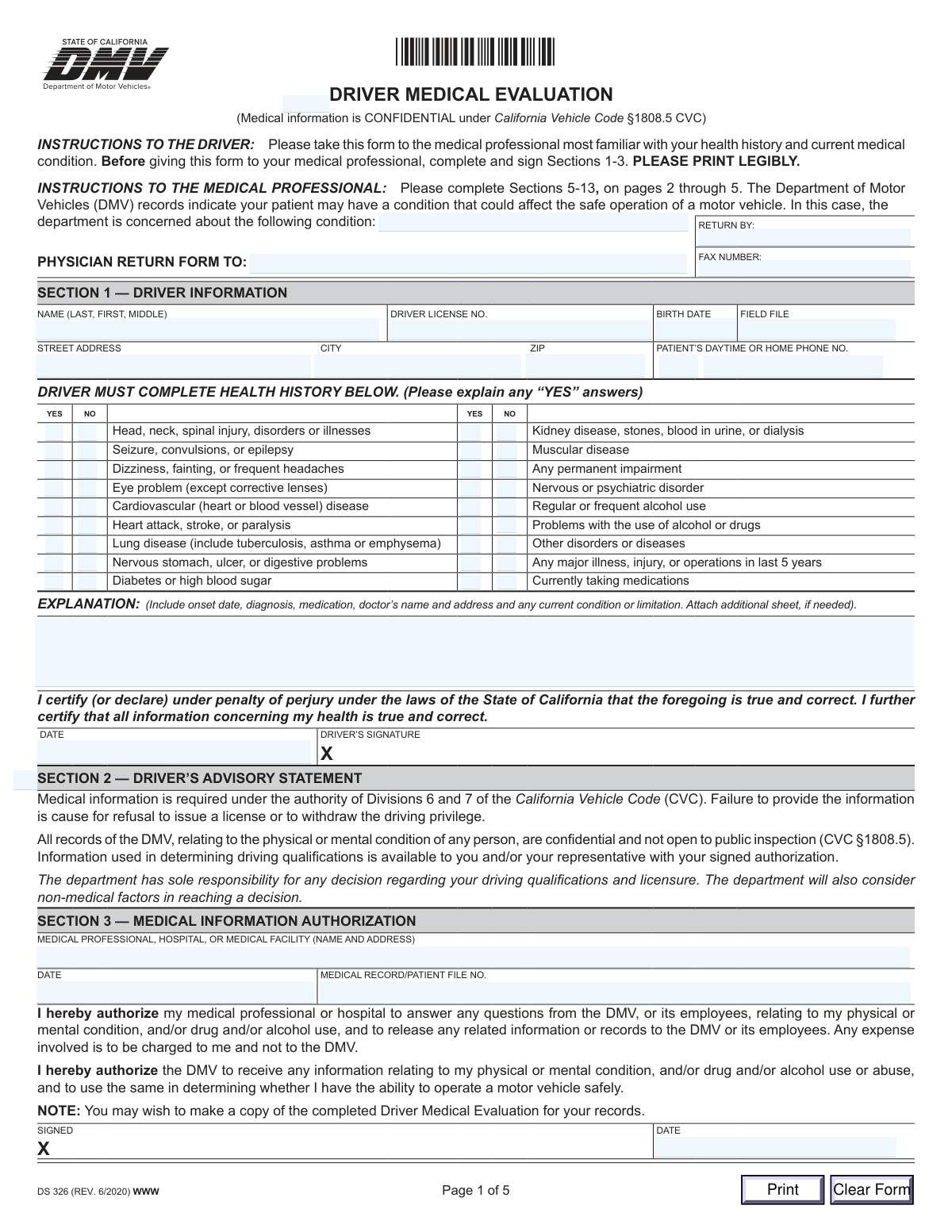
Yes! You can use AI to fill out California Form DS 326, Driver Medical Evaluation

California Form DS 326, the Driver Medical Evaluation, is a confidential document used by the Department of Motor Vehicles (DMV) to assess if a driver's medical condition could impact their ability to operate a motor vehicle safely. The form requires the driver to provide their health history and authorize a medical professional to complete a detailed evaluation of specific conditions like vision, cognitive function, and diabetes. This evaluation is crucial for the DMV to make an informed decision about the driver's licensing status. Today, this form can be filled out quickly and accurately using AI-powered services like Instafill.ai, which can also convert non-fillable PDF versions into interactive fillable forms.
DS 326 is part of the California medical forms, Medi-Cal forms, medical forms and VA medical forms categories on Instafill.
Our AI automatically handles information lookup, data retrieval, formatting, and form filling.
It takes less than a minute to fill out DS 326 using our AI form filling.
Securely upload your data. Information is encrypted in transit and deleted immediately after the form is filled out.

Form specifications

Form name: California Form DS 326, Driver Medical Evaluation
Number of fields: 334
Number of pages: 5
Language: English
main-image

Instafill Demo: How to fill out PDF forms in seconds with AI

How to Fill Out DS 326 Online for Free in 2026

Are you looking to fill out a DS 326 form online quickly and accurately? Instafill.ai offers the #1 AI-powered PDF filling software of 2026, allowing you to complete your DS 326 form in just 37 seconds or less.
Follow these steps to fill out your DS 326 form online using Instafill.ai:
  1. 1 Navigate to Instafill.ai and upload or select the DS 326 Driver Medical Evaluation form.
  2. 2 Use the AI assistant to fill in your driver information, including name, address, and license number in Section 1.
  3. 3 Complete the Health History questionnaire in Section 1, providing detailed explanations for any 'YES' answers as required.
  4. 4 Electronically sign and date the driver certification in Section 1 and the medical information authorization in Section 3.
  5. 5 Securely share the partially completed form with your medical professional for them to complete their evaluation.
  6. 6 Your medical professional fills out Sections 5-13, signs the form, and can then submit it directly to the DMV via the provided fax number or address.
  7. 7 Download a final, completed copy of the DS 326 for your personal records.

Our AI-powered system ensures each field is filled out correctly, reducing errors and saving you time.

Why Choose Instafill.ai for Your Fillable DS 326 Form?

Speed

Complete your DS 326 in as little as 37 seconds.

Up-to-Date

Always use the latest 2026 DS 326 form version.

Cost-effective

No need to hire expensive lawyers.

Accuracy

Our AI performs 10 compliance checks to ensure your form is error-free.

Security

Your personal information is protected with bank-level encryption.

Frequently Asked Questions About Form DS 326

You likely received this form because the California DMV has information indicating you may have a medical condition that could affect your ability to drive safely. This evaluation helps the DMV gather information from you and your doctor to make a fair licensing decision.

You, the driver, must complete and sign Sections 1-3, which cover your personal information, health history, and medical authorization. A qualified medical professional must then complete the detailed evaluation in Sections 5-13.

Before your appointment, you must completely fill out your personal information in Section 1, answer all health history questions, and sign both the certification in Section 1 and the medical information authorization in Section 3.

Failure to provide the required medical information is cause for the DMV to refuse to issue a license or to withdraw your current driving privilege.

Yes, the form explicitly states that under California Vehicle Code §1808.5, all DMV records relating to your physical or mental condition are confidential and not open to public inspection.

The DMV has the sole responsibility for any decision regarding your driving qualifications and license. They will consider the medical evaluation from your doctor, but will also consider non-medical factors in their final decision.

Your medical professional should send the completed form to the DMV address or fax number listed in the 'PHYSICIAN RETURN FORM TO' box on the first page by the specified 'RETURN BY' date.

Use the 'EXPLANATION' box provided in Section 1 to detail your conditions. If you need more room, you are permitted to attach an additional sheet with the necessary information.

Not necessarily. A driving test recommendation is one piece of information the DMV uses to assess your current ability to drive safely, and passing it can help you retain your driving privilege.

Yes, for your portion of the form, services like Instafill.ai can use AI to accurately auto-fill your personal information fields, saving time and helping to prevent errors. Your medical professional must still complete their sections manually.

You can upload the DS 326 PDF to the Instafill.ai platform to fill out your sections (1-3) online. After completing your part, you can print the form to take to your doctor for their evaluation and signature.

If you have a non-fillable or 'flat' PDF, you can use a service like Instafill.ai. It can convert the document into an interactive, fillable form that you can easily complete on your computer.

The form specifies that Sections 5-13 must be completed by a Physician, Physician's Assistant, or Advanced Practice Registered Nurse who is familiar with your health history.

Compliance DS 326
Validation Checks by Instafill.ai

1
Conditional Health History Explanation
This validation ensures that if the driver answers 'Yes' to any of the health history questions in Section 1, the 'EXPLANATION' text field must be filled out. This is critical for the DMV to understand the nature, onset, and treatment of any reported condition. If this validation fails, the form is considered incomplete as the context for the 'Yes' answer is missing, preventing a proper medical evaluation.
2
Driver License Number Format
This check verifies that the 'DRIVER LICENSE NO.' in Section 1 conforms to the standard California format, which is a single letter followed by seven digits. This ensures the form can be correctly associated with the driver's official DMV record. A failure would prevent the system from locating the correct driver file, rendering the submission unusable until corrected.
3
Date of Last Examination Validity
This validation confirms that the 'DATE OF LAST EXAMINATION' in Section 7 is a valid date and occurs in the past, prior to the current date. It is important for establishing a recent and relevant medical assessment. An invalid or future date would call into question the timeliness and validity of the entire medical professional's evaluation.
4
Conditional 'Other Medical Professional' Details
This check ensures that if the medical professional checks 'Yes' for 'IS THIS PATIENT BEING TREATED FOR ANY CONDITION BY ANOTHER MP?' in Section 6, then the 'NAME OF TREATING MP(S)' and 'CONDITION BEING TREATED' fields must be completed. This information is vital for a comprehensive understanding of the patient's total health picture. Failure to provide these details would result in an incomplete medical history, potentially overlooking conditions relevant to driving safety.
5
Conditional Adherence to Regimen Explanation
This validation requires an explanation if the medical professional answers 'No' to 'IS THE PATIENT ADHERING TO THE MEDICAL REGIMEN?' in Section 7. Understanding why a patient is non-adherent is crucial for assessing the stability of their condition and the reliability of their treatment. Without this explanation, the DMV cannot accurately gauge the risk associated with the patient's condition being uncontrolled.
6
Conditional Medication Side Effects Description
This check mandates that if 'Yes' is selected for 'WOULD THE SIDE EFFECTS FROM THE PRESCRIBED MEDICATIONS INTERFERE WITH YOUR PATIENT’S ABILITY TO DRIVE SAFELY?' in Section 7, the corresponding description field must be filled. This detail is essential for determining if medication itself poses a driving risk, such as drowsiness or impaired judgment. A missing description would leave a critical safety question unanswered.
7
Conditional Driving Impact Explanation
This validation ensures that if the medical professional answers 'Yes' to 'DOES YOUR PATIENT’S MEDICAL CONDITION CURRENTLY AFFECT SAFE DRIVING?' in Section 7, an explanation must be provided. This is one of the most important fields on the form, as it directly addresses the primary concern of the DMV. Failure to explain how a condition affects driving would make it impossible to make an informed licensing decision.
8
Visual Acuity Denominator Format
This check validates that the values entered for visual acuity in Section 5 are numeric and fall within a reasonable range (e.g., 10-800). The form shows '20/', so this check ensures a valid denominator is provided to complete the fraction. This data is fundamental to assessing whether the driver meets the minimum vision standards for operating a vehicle, and incorrect formatting would prevent this assessment.
9
Dementia Impairment Rating Exclusivity
For each cognitive impairment listed in Section 9 (e.g., 'Memory Loss', 'Diminished Judgment'), this validation ensures that only one severity level ('NONE', 'MILD', 'MODERATE', 'SEVERE', 'UNCERTAIN') is selected. This prevents ambiguous or contradictory data entry in a critical assessment area. If more than one level is selected for a single impairment, the data is invalid and cannot be used to evaluate the patient's cognitive state.
10
Conditional Diabetes Hospitalization Details
This validation rule ensures that if 'Yes' is checked for 'HAS THE PATIENT BEEN HOSPITALIZED WITHIN THE LAST THREE YEARS DUE TO DIABETES COMPLICATIONS?' in Section 11, then the 'dates' and 'WHAT COMPLICATIONS NECESSITATED HOSPITALIZATION?' fields must be completed. This information helps the DMV understand the severity and frequency of acute diabetic events. Missing these details would obscure the full history and severity of the patient's diabetes.
11
Medical Professional Signature Section Completeness
This validation verifies that all fields in Section 13 ('MP’S NAME', 'DATE', 'CLASSIFICATION OR SPECIALTY', 'MEDICAL LICENSE NUMBER', 'TELEPHONE NUMBER') are filled out. This section is required to authenticate the evaluation and provide contact information for the medical professional. An incomplete section would invalidate the form from a legal and administrative standpoint, as the source of the medical opinion would be unverified.
12
Medical License Number Validity
This check verifies that the 'MEDICAL LICENSE NUMBER' in Section 13 is present and follows the expected format for a California medical license. This is essential for verifying the credentials of the person completing the evaluation and ensuring they are a qualified medical professional. An invalid or missing license number would render the entire medical evaluation untrustworthy and void.
13
Logical Date Sequence
This validation checks for logical consistency between dates on the form, such as ensuring the 'MP'S SIGNATURE DATE' (Section 13) is on or after the 'DATE OF LAST EXAMINATION' (Section 7). It also ensures the 'Driver Certification Date' (Section 1) is not in the future. This maintains the chronological integrity of the events documented on the form. A failed check could indicate a data entry error or a procedural anomaly that needs correction.
14
Conditional 'Regular Follow-up' Frequency
This check ensures that if the medical professional indicates 'Yes' to 'DO YOU NEED TO SEE YOUR PATIENT AT REGULAR INTERVALS?' in Section 7, the 'IF YES, HOW OFTEN?' field must be populated. This information is key to understanding the ongoing management and stability of the patient's condition. Without the frequency, the DMV cannot determine if the proposed follow-up plan is adequate for monitoring a condition that could affect driving.

Common Mistakes in Completing DS 326

Incomplete Explanations for 'Yes' Answers

In Section 1, drivers often check 'Yes' to a health condition but fail to provide a complete description in the 'EXPLANATION' box. The form requires details like onset date, diagnosis, medications, and doctor's information. An empty or vague explanation forces the DMV to request more information, delaying the evaluation process. To prevent this, meticulously detail every 'Yes' answer as instructed, ensuring all parts of the question are addressed.

Missing One of Two Driver Signatures

Page 1 requires two separate signatures from the driver: one in Section 1 to certify the health history, and another in Section 3 to authorize the release of medical information. It is very common for drivers to sign in one place but miss the other. An incomplete form is invalid and will be returned, delaying the license review. Always double-check page 1 for both the 'DRIVER'S SIGNATURE' and the 'SIGNED' line in the authorization section.

Leaving Medical Professional Fields Blank

Medical professionals sometimes leave non-applicable fields blank, especially in the detailed checklists for dementia, seizures, or diabetes. The instructions state to use 'N/A' if a question does not apply. Blank fields create ambiguity, as the reviewer cannot know if the question was missed or intentionally left as not applicable, which can lead to form rejection. Using 'N/A' provides clarity and ensures the form is considered complete.

Vague Medication Details

When listing medications in Section 7, a medical professional might only write the drug's name, omitting the required dosage and frequency (e.g., 'Lisinopril' instead of 'Lisinopril 10mg, once daily'). The DMV needs this full context to assess potential side effects and their impact on driving. Incomplete medication information can trigger a follow-up request, slowing down the entire process. Always include the drug name, dosage, and frequency for all prescribed medications.

Failing to Explain Conditional Answers

Several questions require an explanation if a specific answer is chosen, such as explaining why a patient is not adhering to a medical regimen or describing how medication side effects interfere with driving. Professionals may check the box but forget to provide the mandatory narrative. This missing context is critical for the DMV's decision and its absence will halt the review. Ensure any answer that prompts for an explanation is followed by a clear and concise description.

Missing Medical License Number

In the final signature block (Section 13), the medical professional's license number is required for verification. Forgetting to enter this number is a frequent oversight that prevents the DMV from confirming the practitioner's credentials. This simple mistake can invalidate the entire medical evaluation, requiring the form to be sent back to the doctor for completion. Always ensure the medical license number is clearly printed alongside the signature and date.

Illegible Handwriting

Since this form is often printed and filled out by hand, illegible handwriting is a major issue, particularly in the sections for diagnosis, medications, and comments. If the DMV reviewer cannot read the information, the form is effectively useless and will be rejected. This leads to significant delays and frustration for the driver. Using clear block letters is essential. AI-powered tools like Instafill.ai can prevent this by converting the PDF into a fillable format, allowing information to be typed clearly.

Inconsistent Information Between Sections

A medical professional might indicate in Section 7 that a patient's condition does not affect safe driving, but then describe significant cognitive or motor impairments in Sections 8 or 9. These contradictions create confusion and undermine the credibility of the evaluation, often resulting in a request for clarification or a mandatory driving test. It is crucial to ensure that all checklist answers, ratings, and narrative comments present a consistent and logical clinical picture.

Incorrect Name or Address Formatting

In Section 1, drivers may enter their name in a standard 'First Last' format instead of the required 'LAST, FIRST, MIDDLE' format, or provide an incomplete address. These data entry errors can cause mismatches with DMV records, delaying the processing of the evaluation. To avoid this, carefully follow the specified format for each field. Using a form-filling tool like Instafill.ai can help by automatically populating and formatting personal information correctly based on official records.

Omitting the 'Return By' Date or Fax Number

The top of the form includes fields for 'RETURN BY' and 'FAX NUMBER' that are often pre-filled by the DMV but can sometimes be left blank. If the driver or physician misplaces the cover letter, they may not know the deadline or where to send the completed form. This can lead to a missed deadline and a potential suspension of the driving privilege. It is vital to confirm this information is present before leaving the DMV or to contact the DMV if it is missing.
Saved over 80 hours a year

“I was never sure if my IRS forms like W-9 were filled correctly. Now, I can complete the forms accurately without any external help.”

Kevin Martin Green

Your data stays secure with advanced protection from Instafill and our subprocessors

Robust compliance program

Transparent business model

You’re not the product. You always know where your data is and what it is processed for.

ISO 27001, HIPAA, and GDPR

Our subprocesses adhere to multiple compliance standards, including but not limited to ISO 27001, HIPAA, and GDPR.

Security & privacy by design

We consider security and privacy from the initial design phase of any new service or functionality. It’s not an afterthought, it’s built-in, including support for two-factor authentication (2FA) to further protect your account.

Fill out DS 326 with Instafill.ai

Worried about filling PDFs wrong? Instafill securely fills california-form-ds-326-driver-medical-evaluation forms, ensuring each field is accurate.