Yes! You can use AI to fill out Medicare Enrollment Application for Durable Medical Equipment, Prosthetics, Orthotics, and Supplies (DMEPOS) Suppliers, CMS-855S

Form CMS-855S is a Centers for Medicare & Medicaid Services (CMS) enrollment application required for Durable Medical Equipment, Prosthetics, Orthotics, and Supplies (DMEPOS) suppliers to obtain or maintain Medicare billing privileges. The form collects detailed information about the supplier's business location, ownership structure, accreditation, products and services, insurance, surety bonds, and authorized officials, and must be submitted to the National Supplier Clearinghouse (NSC) Medicare Administrative Contractor. Completing this form accurately is critical, as falsifying information can result in criminal and civil penalties, denial of enrollment, or revocation of billing privileges. Today, DMEPOS suppliers can fill out the CMS-855S quickly and accurately using AI-powered services like Instafill.ai, which can also convert non-fillable PDF versions into interactive fillable forms.
Our AI automatically handles information lookup, data retrieval, formatting, and form filling.
It takes less than a minute to fill out CMS-855S using our AI form filling.
Securely upload your data. Information is encrypted in transit and deleted immediately after the form is filled out.

Form specifications

Form name: Medicare Enrollment Application for Durable Medical Equipment, Prosthetics, Orthotics, and Supplies (DMEPOS) Suppliers, CMS-855S
Number of pages: 1
Language: English
Categories: medical forms, CAR forms, VA medical forms, Medi-Cal forms, CMS forms, enrollment forms, L.A. Care forms, enrollment application forms, MEP forms, Medicare forms
main-image

Instafill Demo: How to fill out PDF forms in seconds with AI

How to Fill Out CMS-855S Online for Free in 2026

Are you looking to fill out a CMS-855S form online quickly and accurately? Instafill.ai offers the #1 AI-powered PDF filling software of 2026, allowing you to complete your CMS-855S form in just 37 seconds or less.
Follow these steps to fill out your CMS-855S form online using Instafill.ai:
  1. 1 Navigate to Instafill.ai and upload the CMS-855S form or select it from the available form library to begin filling it out online.
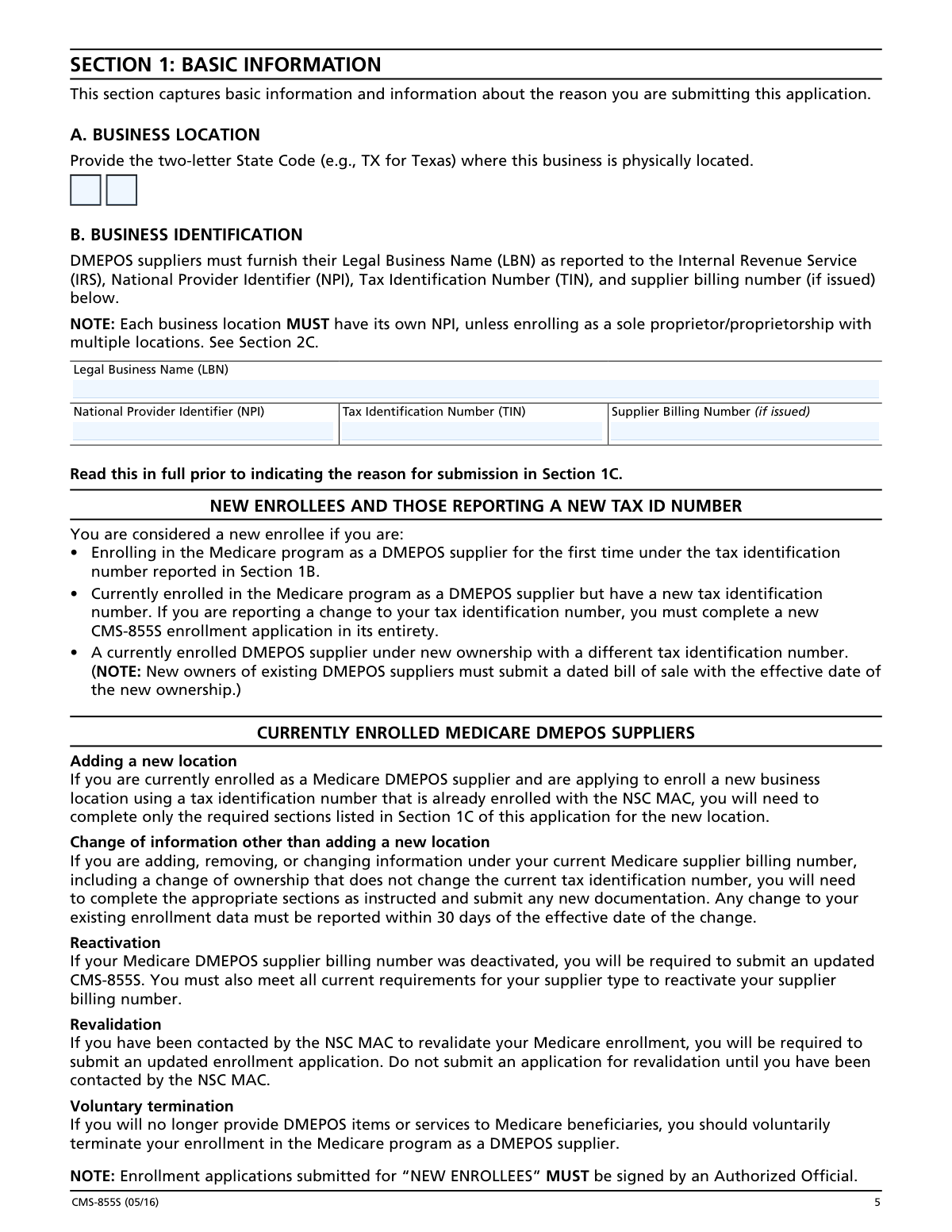
  2. 2 Complete Section 1 by entering your business state code, Legal Business Name (LBN), National Provider Identifier (NPI), Tax Identification Number (TIN), and selecting the reason for submission (new enrollment, change, revalidation, reactivation, or termination).
  3. 3 Fill out Section 2 with your business location address, hours of operation, business structure type, IRS registration information, and the states/territories where you provide DMEPOS items or services.
  4. 4 Complete Sections 3 through 6 by identifying your supplier type, accreditation status, products and services offered, mailing addresses, comprehensive liability insurance details, and surety bond information.
  5. 5 Disclose any final adverse legal actions in Section 7, and report all ownership interests and managing control information for both organizations (Section 8) and individuals (Section 9), including any adverse legal action history for each.
  6. 6 Complete Sections 10 and 11 with billing agency information (if applicable) and contact person details, then compile and attach all required supporting documents listed in Section 12 (licenses, insurance certificate, IRS confirmation, CMS-588 EFT form, application fee receipt, etc.).
  7. 7 Review the certification statement in Section 15A, then have all required Authorized Officials and any Delegated Officials sign and date Sections 14 and 15 with original signatures in blue ink before submitting the completed package to the National Supplier Clearinghouse.

Our AI-powered system ensures each field is filled out correctly, reducing errors and saving you time.

Why Choose Instafill.ai for Your Fillable CMS-855S Form?

Speed

Complete your CMS-855S in as little as 37 seconds.

Up-to-Date

Always use the latest 2026 CMS-855S form version.

Cost-effective

No need to hire expensive lawyers.

Accuracy

Our AI performs 10 compliance checks to ensure your form is error-free.

Security

Your personal information is protected with bank-level encryption.

Frequently Asked Questions About Form CMS-855S

The CMS-855S is the Medicare Enrollment Application for Durable Medical Equipment, Prosthetics, Orthotics, and Supplies (DMEPOS) suppliers. Any business or individual that wants to bill Medicare for DMEPOS items — including pharmacies, medical supply companies, home health agencies, physicians, orthotics/prosthetics personnel, oxygen suppliers, and many others — must complete this form to enroll in the Medicare program and receive a Medicare billing number.

Before submitting the CMS-855S, you must: (1) obtain your National Provider Identifier (NPI) from the National Plan and Provider Enumeration System (NPPES) at https://nppes.cms.hhs.gov; (2) obtain the required surety bond and/or accreditation from a CMS-approved accreditation organization; and (3) pay the required application fee at www.pay.gov. These steps must be completed prior to submitting the application to the National Supplier Clearinghouse (NSC MAC).

Mail your completed application to the National Supplier Clearinghouse (NSC MAC) at: Post Office Box 100142, Columbia, SC 29202-3142. For overnight delivery, use: Palmetto GBA AG-495, 2300 Springdale Drive, Bldg. 1, Camden, SC 29020. You can also reach customer service at 1-866-238-9652. Do NOT mail your application to the CMS address listed in the Privacy Act Statement, as this will significantly delay processing.

There are 30 supplier standards you must meet, including: maintaining compliance with all federal and state licensure requirements; having a physical facility of at least 200 square feet with posted hours open to the public at least 30 hours per week; maintaining comprehensive liability insurance of at least $300,000; obtaining CMS-approved accreditation; obtaining a surety bond (unless exempt); maintaining a primary business telephone listed in a directory; and not engaging in direct solicitation of Medicare beneficiaries. The full list is found in 42 C.F.R. section 424.57(c) and (d).

The sections you must complete depend on your reason for submitting. New enrollees and those reactivating, revalidating, or changing their Tax ID must complete all sections. If you are adding a new location using an already-enrolled TIN, complete Sections 1–7, 9 (managing employee only), 11 (optional), 12, and either 14 or 15. For voluntary termination, complete Sections 1, 2A, 4B, 4D, 11 (optional), and either 14 or 15. For changes to existing enrollment, refer to Section 1D for the specific sections required.

Mandatory documents for all new applications include: copies of all applicable federal, state, and local professional and business licenses; a copy of the Certificate of Insurance for comprehensive liability coverage (with the NSC MAC listed as certificate holder); IRS confirmation of your TIN and Legal Business Name (e.g., IRS Form CP-575); a completed CMS-588 Electronic Funds Transfer Authorization Agreement with a voided check; and a copy of the application fee receipt from www.pay.gov. Additional documents may be required depending on your situation, such as a copy of your surety bond, IRS Form 501(c)(3) for non-profits, or a bill of sale for purchased businesses.

An Authorized Official is an appointed officer (e.g., CEO, CFO, general partner, or 5%+ owner) who has the legal authority to enroll the organization in Medicare and commit it to all Medicare laws and regulations — their signature is required on all initial enrollment applications. A Delegated Official is an individual with ownership/control interest or a W-2 managing employee who is delegated authority by an Authorized Official to report changes and updates to the enrollment record. Delegated Officials cannot further delegate their authority, and independent contractors cannot serve as Delegated Officials.

Any changes to your enrollment information must be reported to the NSC MAC within 30 days of the effective date of the change. You can report changes using either the paper CMS-855S or through the Internet-based PECOS system at https://pecos.cms.hhs.gov. In Section 1C, select 'You are changing your Medicare enrollment information' and then complete Section 1D to indicate what specific information is changing. Always complete Sections 1B, 7, and either Section 14 or 15 in addition to the sections relevant to the change.

All DMEPOS suppliers must maintain comprehensive liability insurance of at least $300,000 per incident at all times. The NSC MAC must be listed on the policy as a certificate holder. If the supplier manufactures its own items, the insurance must also cover product liability and completed operations. Note that malpractice insurance does NOT satisfy this requirement. Failure to maintain the required insurance will result in retroactive revocation of your Medicare supplier billing number and potential overpayment collection.

Yes. Section 7 requires you to disclose all final adverse legal actions, including federal or state felony convictions within the past 10 years, certain misdemeanor convictions related to healthcare or financial misconduct, any revocation or suspension of a healthcare license, exclusions or suspensions from federal or state health care programs, and any Medicare/Medicaid payment suspensions or billing number revocations. All such actions must be reported regardless of whether records were expunged or appeals are pending, and copies of relevant documentation must be attached.

Providing false information on this application can result in serious criminal and civil penalties. Criminal penalties under 18 U.S.C. section 1001 include fines up to $250,000 and imprisonment up to 5 years for individuals (up to $500,000 for organizations). The Civil False Claims Act can impose civil penalties of $5,000–$10,000 per violation plus three times the damages. Additional penalties include exclusion from Medicare, revocation of billing privileges, and civil monetary penalties up to $10,000 per item or service. Healthcare fraud convictions can result in imprisonment up to 10 years, or up to 20 years if serious bodily injury results.

Yes — services like Instafill.ai use AI to auto-fill form fields accurately, saving you significant time when completing complex forms like the CMS-855S. If you have a flat, non-fillable PDF version of the form, Instafill.ai can also convert it into an interactive fillable form. This can be especially helpful given the CMS-855S's many sections covering business identification, ownership, accreditation, insurance, and legal history. Always review all auto-filled information carefully before signing and submitting, as you are legally responsible for the accuracy of the information provided.

Most DMEPOS suppliers are required to obtain a surety bond as specified in 42 C.F.R. section 424.57(d). You must complete Section 6 of the CMS-855S with information about the surety bond company and submit a copy of the original surety bond signed by a Delegated or Authorized Official. Some suppliers may be exempt from this requirement — check the NSC MAC website at www.palmettogba.com/nsc to determine if you qualify for an exemption. If exempt, check the box in Section 6 and skip to Section 7.

The enrollment process involves several steps: (1) obtain your NPI, surety bond, and accreditation; (2) pay the application fee at www.pay.gov; (3) submit the completed CMS-855S and all supporting documents to the NSC MAC; (4) if requested, submit a fingerprint background check through Accurate Biometrics (866-361-9944); (5) the NSC MAC reviews your application and conducts a site visit to verify compliance with supplier standards; and (6) the NSC MAC notifies you in writing of its enrollment decision. You must respond to any requests for additional information within 30 days. The estimated time to complete the application is approximately 4 hours.

You must disclose all organizations (Section 8) and individuals (Section 9) that have 5% or more direct or indirect ownership interest, any partnership interest, or managing control of the DMEPOS supplier. For corporations, this includes all officers, directors, and board members. All managing employees (general managers, administrators, directors, or others who conduct day-to-day operations) must also be reported. Additionally, all delegated and authorized officials listed in Sections 14 and 15 must be reported in Section 9. At least one owner and one managing employee must be reported for each location.

Compliance CMS-855S
Validation Checks by Instafill.ai

1
National Provider Identifier (NPI) Format and Consistency Validation
Validates that the NPI entered in Section 1B is exactly 10 digits in length and contains only numeric characters, as required by the National Plan and Provider Enumeration System (NPPES). This check also verifies that the NPI matches the Legal Business Name (LBN) and Tax Identification Number (TIN) on file with NPPES, since the form explicitly states these must match exactly in both PECOS and NPPES. If the NPI is missing, incorrectly formatted, or does not correspond to the LBN and TIN provided, the application will be rejected and enrollment will be delayed.
2
Tax Identification Number (TIN) Format and IRS Consistency Check
Validates that the TIN provided in Section 1B is in the correct format — either a 9-digit Employer Identification Number (EIN) formatted as XX-XXXXXXX for organizational suppliers, or a 9-digit Social Security Number (SSN) formatted as XXX-XX-XXXX for sole proprietors. The check also confirms that the Legal Business Name associated with the TIN matches exactly what is reported to the IRS, as required by the form instructions. Mismatches between the TIN and LBN will result in application denial or processing delays, and may trigger IRS discrepancy issues.
3
Legal Business Name Matches IRS Documentation
Verifies that the Legal Business Name (LBN) entered in Section 1B is identical to the name as registered with the Internal Revenue Service and as it appears on the IRS Form CP-575 or equivalent IRS-issued document submitted with the application. The form explicitly warns that the LBN, TIN, and NPI must match exactly across PECOS and NPPES. Any abbreviation, variation in punctuation, or discrepancy in spelling between the application and IRS records will cause the application to be flagged for correction or rejected outright.
4
Business Location Address is a Valid Physical Street Address (No P.O. Box)
Checks that the Business Location Address in Section 2A is a specific physical street address as recorded by the United States Postal Service, and that no P.O. Box has been entered in the street address field. Per the form instructions, a P.O. Box is not acceptable as a business location address because DMEPOS suppliers must maintain a physical facility accessible to the public. If a P.O. Box is detected in the address line, the application must be returned for correction, as this would indicate non-compliance with DMEPOS supplier standard #7 requiring a physical facility.
5
Hours of Operation Meet Minimum 30-Hour Weekly Requirement
Validates that the total hours open to the public per week, as entered in Section 2B, meets the minimum threshold of 30 hours per week as required by DMEPOS supplier standard #30 (42 C.F.R. section 424.57(c)(30)). The check sums all daily open hours entered across Sunday through Saturday and compares the total to the 30-hour minimum. Exceptions apply only for physicians, physical and occupational therapists, or suppliers working with custom-made orthotics and prosthetics, or those who have checked 'By Appointment Only' and qualify for the exemption. Failure to meet this requirement will result in denial of billing privileges.
6
Date Format Validation for All Date Fields (mm/dd/yyyy)
Ensures that all date fields throughout the application — including business start date, termination date, accreditation effective and expiration dates, insurance policy dates, surety bond dates, ownership acquired/ended dates, and all signature dates — are entered in the required mm/dd/yyyy format and represent valid calendar dates. This check verifies that month values are between 01 and 12, day values are appropriate for the given month, and year values are reasonable (not in the future for historical events, not in the past for future-dated items). Invalid date formats are a common cause of application processing delays.
7
Comprehensive Liability Insurance Minimum Coverage Amount Validation
Verifies that the comprehensive liability insurance policy reported in Section 5 provides coverage of at least $300,000 per incident, as mandated by 42 C.F.R. section 424.57(c)(10). The check also confirms that the policy is not expired by comparing the policy expiration date against the application submission date, and that the NSC MAC is listed as a certificate holder on the policy. Malpractice insurance is explicitly noted as not meeting this requirement. Failure to maintain the required insurance at all times results in retroactive revocation of the Medicare supplier billing number and potential overpayment collection.
8
Accreditation Status and Expiration Date Consistency Check
Validates that if the supplier has indicated they are accredited in Section 3B, the accreditation effective date is prior to the accreditation expiration date, and that the expiration date has not already passed as of the application submission date. The check also confirms that the name of the accrediting organization is provided and that the accreditation covers the specific products and services listed in Section 3D, as required by DMEPOS supplier standard #22. If the accreditation is expired or does not cover the products and services being billed, the supplier will be ineligible to receive Medicare payments for those items.
9
Social Security Number Format Validation for Sole Proprietors and Individual Owners
Checks that any Social Security Number (SSN) entered — whether in Section 4A for sole proprietors or in Section 9A for individual owners and managing employees — follows the standard 9-digit format (XXX-XX-XXXX) and does not contain all zeros, repeated sequences, or other invalid patterns. The form requires SSNs for all individuals with ownership or managing control interest, and these are stored in PECOS. Additionally, the check ensures that sole proprietors do not attempt to use both an SSN and an EIN simultaneously, as the form explicitly states only one number may be used to bill Medicare.
10
At Least One Owner and One Managing Employee Reported
Verifies that the application includes at least one owner or controlling entity reported in Section 8 (Organizations) and/or Section 9 (Individuals), and that at least one managing employee is also reported in these sections. The form explicitly states the supplier MUST have at least one owner or officer/director and one managing employee reported. An individual owner may serve as the managing employee to satisfy both requirements simultaneously. If either the owner or managing employee information is missing, the application is incomplete and will not be processed, potentially delaying enrollment or revalidation.
11
Authorized Official Signature Presence and Validity for New Enrollments
Confirms that Section 15B contains at least one original signature from an Authorized Official for all new enrollment applications, reactivations, and revalidations, as the form states these applications will be rejected and returned unprocessed without an Authorized Official signature. The check also verifies that the signature date is present and in the correct mm/dd/yyyy format, and that the Authorized Official is reported in Section 9 of the application. Stamped, faxed, photocopied, or undated signatures are explicitly not accepted and will result in the application being returned without processing.
12
Reason for Submission Selection and Required Sections Completeness Check
Validates that exactly one reason for submission has been selected in Section 1C, and that all sections required for that specific submission type have been completed. For example, new enrollees must complete all sections, while those adding a new location with an existing TIN need only complete sections 1–7, 9 (managing employee only), 11, 12, and either 14 or 15. For voluntary terminations, an effective date of termination must be provided. If the selected reason for submission does not align with the sections completed, or if required sections are left blank, the application will be considered incomplete and returned for correction.
13
Surety Bond Information Completeness and Date Consistency
For suppliers who are required to obtain a surety bond under 42 C.F.R. section 424.57(d), this check validates that Section 6 is fully completed with the legal business name and TIN of the surety bond company, the bond amount, bond number, and effective date. If a new bond is being reported, the cancellation date of the current bond must also be provided and must be after the effective date of the new bond to ensure continuous coverage. The check also verifies that the surety bond has been signed by a Delegated or Authorized Official and that a copy is included with the application. Missing or inconsistent surety bond information will result in application denial.
14
Final Adverse Legal Action Disclosure Completeness
Verifies that Section 7C has been answered with either YES or NO for both the supplier entity (Section 7C) and for each organization (Section 8B) and individual (Section 9B) reported in the application. If YES is selected for any party, the check confirms that the required details are provided: the specific final adverse legal action, the date it occurred, the federal or state agency or court that imposed the action, and the resolution if any. Supporting documentation must also be indicated as attached. All final adverse legal actions must be reported regardless of whether records were expunged or appeals are pending, and failure to disclose constitutes grounds for denial or revocation.
15
Delegated Official Eligibility and Authorization Consistency
Validates that any Delegated Official listed in Section 14 is also reported as an individual in Section 9 of the application, and that the individual meets the eligibility criteria — specifically that they have an ownership or control interest in the supplier or are a W-2 managing employee, as independent contractors cannot serve as delegated officials. The check also confirms that the Authorized Official's signature assigning the delegation is present and dated, and that the delegated official's own signature and date are included. Additionally, the check verifies that the delegated official is not attempting to further delegate their authority, as only authorized officials may delegate.
16
Electronic Funds Transfer (EFT) Agreement Requirement for New Enrollees
Confirms that new enrollees have indicated the inclusion of a completed Form CMS-588 Electronic Funds Transfer Authorization Agreement with a voided check in Section 12, as Medicare issues all routine payments via EFT and this form is mandatory for new enrollments. The check also verifies that the remittance/special payments mailing address in Section 4D has been completed or that the supplier has indicated correspondence should go to the business location or correspondence address. Missing EFT documentation is one of the most common causes of enrollment processing delays and will prevent the supplier from receiving Medicare payments upon approval.

Common Mistakes in Completing CMS-855S

Mismatched Legal Business Name between IRS records and the application

Applicants frequently enter a trade name, DBA name, or abbreviated version of their business name instead of the exact Legal Business Name (LBN) as registered with the IRS. This causes a critical mismatch between the CMS-855S, PECOS, and NPPES systems, resulting in application rejection or enrollment delays. The LBN entered in Section 1B must exactly match the name on IRS documents such as Form CP-575. Always verify your LBN against your IRS confirmation letter before completing the form. AI-powered tools like Instafill.ai can help by automatically cross-referencing and formatting the LBN consistently across all relevant fields.

Submitting the application before obtaining the NPI, surety bond, or accreditation

Many applicants submit the CMS-855S before completing the prerequisite steps of obtaining their National Provider Identifier (NPI), required surety bond, and/or CMS-approved accreditation. The form explicitly states these must be obtained PRIOR to submission. Submitting without these prerequisites leads to automatic rejection and significant processing delays. Additionally, the application fee via www.pay.gov must also be paid before submission for initial enrollments, new locations, and revalidations. Review the process checklist on pages 3-4 of the application before beginning to fill out any section.

Entering an incorrect or mismatched Tax Identification Number (TIN)

Applicants sometimes enter a TIN that does not match what was used to obtain their NPI in NPPES, or they confuse their Employer Identification Number (EIN) with their Social Security Number (SSN) in the wrong sections. For sole proprietors, using both an SSN and EIN is not permitted — only one number can be used to bill Medicare. A TIN mismatch between PECOS and NPPES will cause the application to be rejected. Always confirm your TIN against your IRS CP-575 or equivalent document, and ensure it matches exactly what was used during NPI enumeration.

Providing a P.O. Box as the business location address in Section 2A

The form explicitly requires a specific physical street address as recorded by the United States Postal Service for the business location in Section 2A. Applicants sometimes enter a P.O. Box, which is not acceptable for the physical business location. This is particularly important because CMS conducts on-site inspections to verify compliance with supplier standards, including the requirement for a physical facility of at least 200 square feet. Similarly, P.O. Boxes are not acceptable for the Medicare beneficiary medical records storage address in Section 4E. Always provide a complete, valid street address for all physical location fields.

Failing to complete hours of operation accurately or not meeting the 30-hour minimum

Applicants often leave the hours of operation section incomplete, enter hours without specifying A.M. or P.M., or fail to calculate the total weekly hours correctly. A critical compliance issue arises when suppliers do not meet the minimum requirement of being open to the public for at least 30 hours per week (unless a specific exemption applies, such as for custom orthotics/prosthetics suppliers). Checking 'By Appointment Only' without qualifying for the exemption under 42 C.F.R. section 424.57(c)(30) is also a common error. Carefully list all open hours for each day and verify the weekly total meets the minimum threshold before submitting.

Omitting required ownership and managing control information in Sections 8 and 9

Applicants frequently fail to report all individuals and organizations with 5% or greater ownership interest, all officers and directors of corporations, all partners in a partnership (regardless of ownership percentage), and all managing employees. The form requires at least one owner and one managing employee to be reported. A common misunderstanding is that limited partners with less than 5% ownership do not need to be reported — in fact, all partners in any partnership must be reported. Failure to disclose all required parties can result in denial or revocation of billing privileges and potential fraud penalties. Review the definitions of 'officer,' 'director,' and 'managing employee' carefully in Section 9 before completing these sections.

Using non-original, stamped, faxed, or photocopied signatures

A very common reason for application rejection is submitting forms with signatures that are not original ink signatures. The form explicitly states that stamped, faxed, or copied signatures will not be accepted in Sections 14 and 15. Additionally, signatures must be dated — undated signatures will also result in the application not being processed. For initial enrollment applications, the signature must be from an Authorized Official (not just a Delegated Official). Ensure all signatures are made in original blue ink as specified, and that each signature field includes the corresponding date in mm/dd/yyyy format.

Selecting the wrong reason for submission and completing incorrect sections

Applicants often check the wrong box in Section 1C (Reason for Submitting), which leads them to complete the wrong combination of sections or miss required sections entirely. For example, someone adding a new location with an already-enrolled TIN only needs to complete Sections 1-7, 9 (managing employee only), 11, 12, and either 14 or 15 — not all sections. Conversely, new enrollees and those changing their TIN must complete all sections. Carefully read Section 1B and 1C in full before determining which sections apply to your situation, and follow the section completion instructions precisely for your submission type.

Failing to list the NSC MAC as certificate holder on the liability insurance policy

Section 5 requires comprehensive liability insurance of at least $300,000 per incident, and the NSC MAC must be listed on the policy as a certificate holder with its full mailing address (Post Office Box 100142, Columbia, SC 29202-3142). Applicants frequently submit a certificate of insurance without this requirement fulfilled, or they submit malpractice insurance instead of comprehensive liability insurance. Malpractice insurance does not satisfy this requirement. Contact your insurance provider before submitting to confirm the NSC MAC is properly listed as certificate holder, and verify the policy covers both the place of business and all customers and employees.

Failing to report all final adverse legal actions, including expunged records

Applicants sometimes omit final adverse legal actions because they believe expunged records, pending appeals, or older incidents do not need to be disclosed. The form explicitly states that ALL applicable final adverse legal actions must be reported regardless of whether records were expunged or appeals are pending. This includes convictions, license revocations or suspensions, exclusions from federal or state health care programs, and Medicare/Medicaid payment suspensions. Failure to disclose these actions constitutes falsification of the application and can result in criminal penalties, fines up to $250,000, and imprisonment. Review Section 7 carefully and disclose all applicable actions with supporting documentation.

Not submitting required supporting documentation or submitting outdated documents

Applicants frequently submit the enrollment application without all required supporting documents listed in Section 12, or they submit documents that are outdated. For example, a Certificate of Good Standing submitted in lieu of licenses cannot be more than 30 days old. Required documents include copies of all applicable professional and business licenses, IRS Form CP-575 or equivalent, a completed CMS-588 EFT Authorization Agreement with a voided check, proof of application fee payment from www.pay.gov, and a copy of the surety bond. For non-profits, IRS Form 501(c)(3) is also required. Create a checklist from Section 12 before submitting and verify each document is current and complete.

Incorrectly completing the 1099 mailing address section for sole proprietors versus organizational suppliers

Section 4A has two distinct subsections — one for organizational suppliers and one for sole proprietors — and applicants frequently complete the wrong subsection or mix up the required identifiers. Sole proprietors must provide their SSN (required) and may optionally provide an EIN, but cannot use both to bill Medicare. Organizational suppliers must provide their TIN and submit IRS Form CP-575. A sole proprietor who provides an EIN will have payments made to that EIN, while one who does not will have payments made to their SSN. Carefully identify your business structure in Section 2C first, then complete only the appropriate 1099 mailing address subsection that corresponds to your structure.
Saved over 80 hours a year

“I was never sure if my IRS forms like W-9 were filled correctly. Now, I can complete the forms accurately without any external help.”

Kevin Martin Green

Your data stays secure with advanced protection from Instafill and our subprocessors

Robust compliance program

Transparent business model

You’re not the product. You always know where your data is and what it is processed for.

ISO 27001, HIPAA, and GDPR

Our subprocesses adhere to multiple compliance standards, including but not limited to ISO 27001, HIPAA, and GDPR.

Security & privacy by design

We consider security and privacy from the initial design phase of any new service or functionality. It’s not an afterthought, it’s built-in, including support for two-factor authentication (2FA) to further protect your account.

Fill out CMS-855S with Instafill.ai

Worried about filling PDFs wrong? Instafill securely fills medicare-enrollment-application-for-durable-medical-equipment-prosthetics-orthotics-and-supplies-dmepos-suppliers-cms forms, ensuring each field is accurate.



