Fill out medical enrollment forms
with AI.
Medical enrollment forms are the essential gateway to healthcare benefits and professional participation in insurance networks. These documents are critical for establishing eligibility for government programs, ensuring that patients receive necessary coverage and that providers can legally bill for their services. Whether you are an individual transitioning into retirement or a healthcare professional seeking to expand your practice, these forms provide the official record needed to navigate the complex landscape of public and private health insurance.
By continuing, you acknowledge Instafill's Privacy Policy and agree to get occasional product update and promotional emails.
About medical enrollment forms
This category typically serves two main groups: individuals and healthcare providers. For individuals, forms like the CMS-40B are vital for enrolling in Medicare Part B during specific enrollment periods, preventing gaps in medical coverage. On the professional side, healthcare providers and equipment suppliers use documents such as the CMS-855 series to apply for billing privileges or to certify that they are eligible to order and prescribe services for beneficiaries. These forms are often required during significant life transitions, when starting a new medical practice, or when re-certifying to maintain uninterrupted access to healthcare systems.
Completing these detailed documents manually can be a tedious process prone to errors that might delay your enrollment or billing status. Tools like Instafill.ai use AI to fill these forms in under 30 seconds, handling your sensitive data accurately and securely to streamline the application process.
Every form on this page can be completed without typing. Instafill is form filling software that reads a PDF and fills it for you — including flat and scanned documents that carry no fillable fields at all.
Forms in This Category
The forms in this category have a median Form Complexity Index of 60/100 (Moderate), measured across 7 forms by field count, input difficulty, length, conditional logic and structure. See how it is calculated.
- Enterprise-grade security & data encryption
- 99%+ accuracy powered by AI
- 1,000+ forms from all industries
- Complete forms in under 60 seconds
How to Choose the Right Form
Selecting the right medical enrollment form depends on whether you are an individual seeking health coverage, a healthcare professional joining a network, or a supplier of medical equipment.
Individual Medicare Enrollment
If you are a resident looking to secure health insurance coverage, you will likely need the Form CMS-40B, Application for Enrollment in Medicare Part B. This form is specifically for individuals who are already enrolled in Medicare Part A but now need to add Part B (Medical Insurance). It is commonly used by those who delayed enrollment because they were still working or are now applying during a Special Enrollment Period.
Healthcare Provider and Supplier Enrollment
For medical professionals and businesses, the forms focus on billing privileges and authorization:
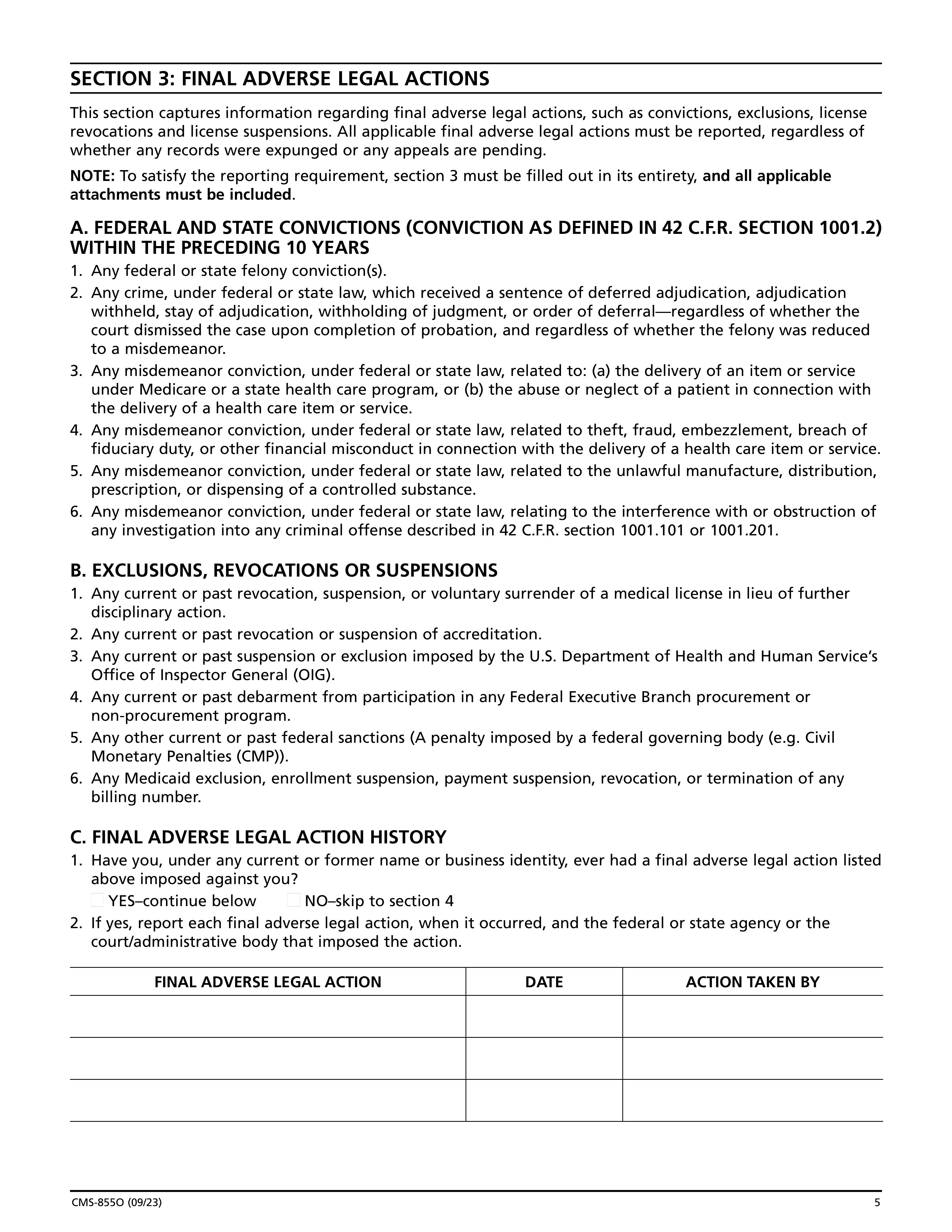
- Form CMS-855O: Use this if you are a physician or eligible professional (such as a retired doctor or a VA employee) who wants to order, certify, or prescribe services and drugs for Medicare beneficiaries, but you do not intend to submit claims for reimbursement yourself.
- Form CMS-855S: This is the essential application for Durable Medical Equipment, Prosthetics, Orthotics, and Supplies (DMEPOS) suppliers. You must use this form to obtain or maintain Medicare billing privileges, report changes in ownership, or revalidate your status with the National Supplier Clearinghouse.
- Form HFS 2243: Specifically for providers in the state of Illinois, this form is required to enroll in the Illinois Medical Assistance Program (Medicaid) to ensure you can be reimbursed for services provided to Medicaid patients.
Specialized Medical Assistance
Not all enrollment forms are for insurance. The Medical Baseline Allowance Application (SCE 14-746) is a specialized form for Southern California Edison customers. Choose this form if you or a member of your household has a qualifying medical condition that requires extra electricity or gas, allowing you to receive a lower utility rate for your essential medical equipment.
Form Comparison
| Form | Purpose | Who Files It | Primary Goal |
|---|---|---|---|
| Form CMS-40B, Application for Enrollment in Medicare Part B (Medical Insurance) | Enrolling in Medicare Part B for medical insurance coverage. | Individuals who missed automatic enrollment when they first became eligible. | Secure outpatient care and doctor visit coverage via CMS. |
| Form CMS-40B, Request for Enrollment in Medicare Part B (Medical Insurance) | Requesting Part B enrollment during specific enrollment periods. | Individuals already enrolled in Part A seeking medical insurance. | Activate medical insurance coverage through the Social Security Administration. |
| Form CMS-855O, Medicare Enrollment Application for Eligible Ordering, Certifying and Prescribing Physicians and Other Eligible Professionals | Enrolling to order or prescribe without billing Medicare directly. | Physicians, dentists, and retired doctors not seeking reimbursement. | Establish eligibility to order services for Medicare beneficiaries. |
| Form HFS 2243, Provider Enrollment Application Illinois Medical Assistance Program | Enrolling or re-enrolling providers in the Illinois Medicaid program. | Healthcare providers operating within the state of Illinois. | Authorize participation and reimbursement for Medicaid-related medical services. |
| Medical Baseline Allowance Application (Used for Medical Baseline Enrollment and Re-Certification) | Applying for lower energy rates due to medical conditions. | Southern California Edison customers with life-support or medical needs. | Receive additional electricity or gas at a reduced baseline rate. |
| Medicare Enrollment Application for Durable Medical Equipment, Prosthetics, Orthotics, and Supplies (DMEPOS) Suppliers, CMS-855S | Obtaining or maintaining Medicare billing privileges for equipment suppliers. | Suppliers of durable medical equipment, prosthetics, orthotics, and supplies. | Validate business credentials and accreditation for Medicare billing. |
| Medicare Enrollment Application for Durable Medical Equipment, Prosthetics, Orthotics, and Supplies (DMEPOS) Suppliers, Form CMS-855S | Reporting changes, revalidating, or reactivating DMEPOS billing privileges. | Medical equipment businesses managing their existing Medicare enrollment status. | Update ownership, location, or insurance details with Medicare contractors. |
Tips for medical enrollment forms
When filling out forms like the CMS-40B, ensure your name, Social Security number, and date of birth exactly match your existing Social Security or Medicare records. Even minor discrepancies in spelling or formatting can lead to significant processing delays or application rejection.
AI-powered tools like Instafill.ai can complete these complex medical enrollment forms in under 30 seconds with high accuracy. Your sensitive personal and professional data stays secure during the process, providing a massive time-saving advantage when managing multiple provider or patient applications.
For professional enrollment forms like CMS-855O or HFS 2243, always double-check that your National Provider Identifier (NPI) and state license numbers are current. Entering an expired or incorrect credential is one of the most common reasons for provider enrollment denials.
Many medical enrollment forms require secondary proof, such as proof of employer coverage or medical certifications from a physician. Scan these documents before you start filling out your form so you can quickly attach them to your digital submission or mail them with your printed PDF.
Some medical forms specifically require a 'wet' signature (ink on paper) or a specific digital certification. Before finishing, check the instructions to see if the form requires a physician's signature or a witness, which is common for Medical Baseline and DMEPOS applications.
For supplier forms like the CMS-855S, be extremely precise about ownership interest and managing employees. CMS requires full transparency regarding any individual or organization with 5% or more ownership to ensure compliance with federal healthcare regulations.
Frequently Asked Questions
Medical enrollment forms are used by individuals to sign up for health insurance coverage, such as Medicare, and by healthcare providers to register with state or federal programs. These documents ensure that patients receive benefits and that providers are authorized to bill for services or prescribe medications.
Form CMS-40B is specifically for individuals who want to enroll in Medicare Part B (Medical Insurance). It is typically used by those who already have Part A but delayed Part B because they had employer-sponsored coverage or are now applying during a Special Enrollment Period.
Providers in Illinois, for example, use Form HFS 2243 to enroll in the state's Medical Assistance Program. Most states have similar specific forms that allow healthcare professionals to participate in Medicaid and receive reimbursement for treating eligible patients.
Form CMS-855O is used by physicians and eligible professionals who do not want to bill Medicare for services but need to be in the system to order or certify services for patients. This is common for VA doctors, retired physicians, or dentists who prescribe Part D drugs for Medicare beneficiaries.
Suppliers of Durable Medical Equipment, Prosthetics, Orthotics, and Supplies (DMEPOS) must use Form CMS-855S to obtain or maintain Medicare billing privileges. This form is also used to report changes in ownership, add business locations, or to revalidate existing enrollment.
Customers with specific medical conditions or life-support equipment can use a Medical Baseline Allowance Application to receive energy at a lower rate. These forms usually require a doctor’s certification and must be submitted directly to the utility provider, such as Southern California Edison.
Yes, you can fill out medical enrollment forms using AI tools like Instafill.ai. These tools can accurately extract data from your supporting documents and place it into the correct fields on the PDF, reducing the risk of manual entry errors.
Using AI-powered services like Instafill.ai, most medical enrollment forms can be filled out in under 30 seconds. This significantly speeds up the process compared to manual typing, especially for complex forms like the CMS-855S.
Submission locations vary depending on the form; for example, Medicare enrollment forms are usually sent to the Social Security Administration or a specific Medicare Administrative Contractor (MAC). State-specific forms are typically submitted to the state's Department of Health or Human Services.
For Medicare, it is best to submit your application during your Initial Enrollment Period or a Special Enrollment Period to avoid late enrollment penalties. Providers should submit their enrollment applications well in advance of their intended start date to allow for background checks and verification.
If your business location, ownership, or contact information changes, you must usually submit a change of information request using the same enrollment form. Keeping this data current is vital to ensure uninterrupted billing privileges and consistent communication with health agencies.
Most medical enrollment forms require proof of identity, professional licenses, and sometimes business certifications or insurance documents. It is helpful to have these digital files ready before you begin the application process to ensure all data matches your official records.
Glossary
- Form Complexity Index
- Instafill’s 0–100 measure of how much effort a form takes to complete, calculated deterministically from the form’s own structure rather than estimated. It combines the number of fillable fields (the largest factor), how difficult those fields are to complete based on their type, the number of pages that contain fields, the amount of conditional “fill-only-if” logic, and how many sections the form is divided into, then adds modifiers for tables and repeating lists, bundled instruction pages, and dense page layouts. A higher score means the form is harder to fill out by hand. The forms in this category have a median Form Complexity Index of 60/100 (Moderate). See exactly how it is calculated.
- CMS (Centers for Medicare & Medicaid Services)
- The federal agency within the U.S. Department of Health and Human Services that administers the Medicare program and works with state governments to manage Medicaid.
- Medicare Part B
- A type of medical insurance that covers outpatient care, doctor services, and medical supplies that are not covered by hospital insurance.
- DMEPOS
- An acronym for Durable Medical Equipment, Prosthetics, Orthotics, and Supplies, which refers to medical equipment like wheelchairs or oxygen tanks used in a patient's home.
- Special Enrollment Period (SEP)
- A specific time outside of the standard enrollment windows when an individual can sign up for health insurance due to qualifying life events, such as losing employer coverage.
- Provider Enrollment
- The formal process where healthcare professionals or equipment suppliers apply to participate in government health programs so they can legally bill for services rendered to beneficiaries.
- Medical Baseline Allowance
- A program offered by utility companies that provides a higher quantity of energy at a lower rate for residential customers with qualifying medical conditions or life-support needs.
- Surety Bond
- A financial guarantee often required for medical equipment suppliers to ensure they comply with Medicare regulations and to protect the program against potential fraud or overpayment.
- Ordering and Certifying
- A status for physicians who do not bill Medicare for their own services but are registered to order medical equipment or certify that a patient needs specific healthcare services.