Yes! You can use AI to fill out Certification in Support of Request to be Excused from Jury Service Due to Severe Financial Hardship
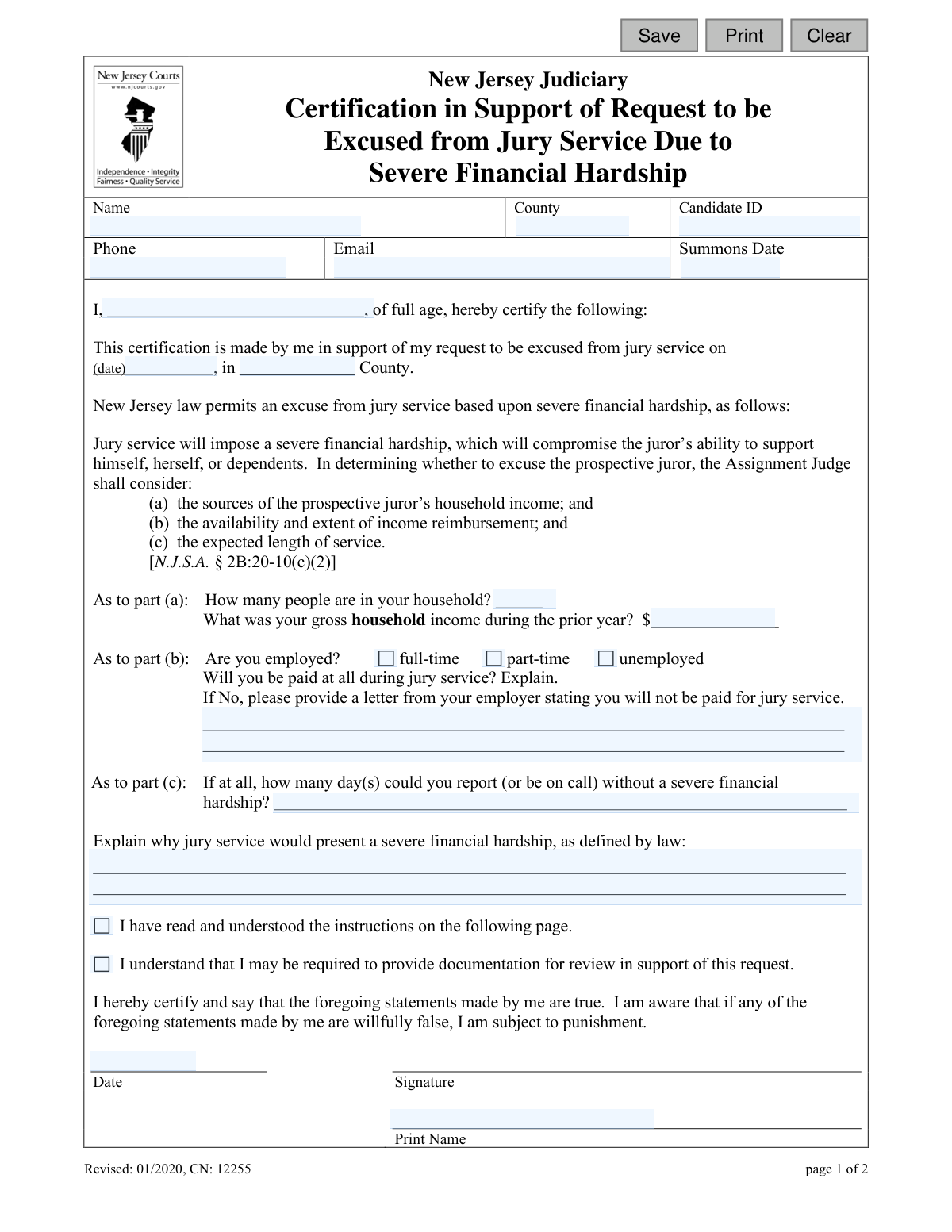
The Certification in Support of Request to be Excused from Jury Service Due to Severe Financial Hardship (CN 12255) is a legal document for individuals in New Jersey summoned for jury duty. It allows them to formally certify that serving would impose a severe financial hardship, compromising their ability to support themselves or their dependents. Today, this form can be filled out quickly and accurately using AI-powered services like Instafill.ai, which can also convert non-fillable PDF versions into interactive fillable forms.
CN 12255 is part of the
financial hardship forms, financial service forms, financial support forms and New Jersey forms categories on Instafill.
Our AI automatically handles information lookup, data retrieval, formatting, and form filling.
It takes less than a minute to fill out CN 12255 using our AI form filling.
Securely upload your data. Information is encrypted in transit and deleted immediately after the form is filled out.
Form specifications
| Form name: | Certification in Support of Request to be Excused from Jury Service Due to Severe Financial Hardship |
| Number of fields: | 24 |
| Number of pages: | 1 |
| Language: | English |
Instafill Demo: How to fill out PDF forms in seconds with AI
How to Fill Out CN 12255 Online for Free in 2026
Are you looking to fill out a CN 12255 form online quickly and accurately? Instafill.ai offers the #1 AI-powered PDF filling software of 2026, allowing you to complete your CN 12255 form in just 37 seconds or less.
Follow these steps to fill out your CN 12255 form online using Instafill.ai:
- 1 Navigate to Instafill.ai and upload or select the 'Certification in Support of Request to be Excused from Jury Service Due to Severe Financial Hardship' form.
- 2 Provide your personal and summons information, including your name, Candidate ID, phone number, email, and summons date.
- 3 Enter details about your financial situation, such as the number of people in your household and your gross household income for the prior year.
- 4 Specify your employment status (full-time, part-time, unemployed) and explain whether you will be paid during jury service.
- 5 Write a clear explanation of why jury service would create a severe financial hardship for you, as defined by New Jersey law.
- 6 Review all the information populated by the AI for accuracy, check the boxes to confirm you have read the instructions and understand you may need to provide documentation.
- 7 Digitally sign and date the certification, then download or submit the completed form as instructed by the court, preparing any supporting documents like employer letters or tax returns.
Our AI-powered system ensures each field is filled out correctly, reducing errors and saving you time.
Why Choose Instafill.ai for Your Fillable CN 12255 Form?
Speed
Complete your CN 12255 in as little as 37 seconds.
Up-to-Date
Always use the latest 2026 CN 12255 form version.
Cost-effective
No need to hire expensive lawyers.
Accuracy
Our AI performs 10 compliance checks to ensure your form is error-free.
Security
Your personal information is protected with bank-level encryption.
Frequently Asked Questions About Form CN 12255
This form is used to request an excuse from jury service in New Jersey due to severe financial hardship. It allows you to certify that serving on a jury would compromise your ability to support yourself or your dependents.
You should fill out this form if you have received a jury summons and believe that serving, even for a short time, would cause you a severe financial hardship. This is for people who need to be excused from reporting at all, not just for rescheduling.
You will need to provide your personal contact information, summons details, household size, and gross household income from the prior year. You must also explain your employment status and why jury service would be a severe financial hardship.
You do not need to attach documents when you first submit the form, but you must be prepared to provide them if the Assignment Judge requests them. This could include a redacted tax return, proof of public assistance, or a letter from your employer.
You should obtain a letter from your employer if you are employed but will not be paid at all during your jury service. The letter should state the company's policy on not paying employees for time spent on jury duty, and you must provide it if the court requests it.
A severe financial hardship is a situation where jury service would compromise your ability to support yourself or your dependents. The Assignment Judge considers your household income, any income reimbursement you might receive, and the expected length of service to make a determination.
The form asks how many days you could serve without a severe financial hardship, so you can specify that information. Even if your request to be excused entirely is denied, you can still request an excuse from a specific trial if its anticipated length would cause a hardship.
Not necessarily, as there is no single formula for granting an excuse. The Assignment Judge will evaluate your specific situation; an unemployed person might still be required to report if it does not interfere with employment opportunities.
The form does not specify the submission address, so you should contact the local jury management office for the county where you were summoned. Their contact information is typically included with your jury summons.
Submitting the form is the first step and does not guarantee you will be excused. The Assignment Judge will review your request and may ask for additional information or documentation before making a final decision.
Rescheduling simply moves your service to a later date, which you can do once without an explanation. Being excused for financial hardship means you are released from your jury service obligation entirely for this summons because serving at any time would be a severe burden.
Yes, services like Instafill.ai use AI to help you accurately auto-fill form fields, which can save you time and reduce errors. This is especially helpful for repetitive information like your name and contact details.
Simply upload the form to the Instafill.ai platform. The AI will identify the fields, and you can provide your information once to have it automatically and accurately filled into the correct spots on the form.
If you have a non-fillable or 'flat' PDF, you can use a service like Instafill.ai. It can convert the non-fillable PDF into an interactive, fillable form that you can easily complete on your computer.
Compliance CN 12255
Validation Checks by Instafill.ai
1
Candidate ID Presence and Format
This validation ensures that the 'Candidate ID' field is not empty and conforms to the expected format (e.g., numeric, alphanumeric). The Candidate ID is a crucial unique identifier that links the hardship request to the correct juror record in the system. A missing or invalid ID would prevent the form from being processed, leading to an automatic rejection of the request.
2
Juror Name and Printed Name Consistency
This check verifies that the juror's name is provided at the top of the form and that the 'Print Name' field near the signature is also filled out. It may also check for a reasonable match between the two names to confirm the identity of the person signing the certification. A missing or mismatched name would require correction as it compromises the integrity of the legal document.
3
Valid Date Format for All Date Fields
Ensures that all date fields, including 'Summons Date', 'Service Date', and 'Signature Date', are entered in a valid and consistent format (e.g., MM/DD/YYYY). This prevents data entry errors and ensures dates can be correctly interpreted and stored by the court's system. An invalid format would trigger an error message prompting the user to correct the entry before proceeding.
4
Logical Date Sequence
This validation checks that the 'Service Date' is on or after the 'Summons Date', and that the 'Signature Date' is not before the 'Summons Date'. This logical check prevents nonsensical or impossible date entries that would invalidate the request. If the dates are not in a logical sequence, the user will be prompted to review and correct them.
5
Valid Contact Information
This check validates that the provided 'Phone' number and 'Email' address adhere to standard formats (e.g., 10-digit phone number, email with '@' and a domain). It may also require at least one form of contact to be present. Accurate contact information is essential for the jury management office to communicate with the juror about their request, so invalid or missing data would halt the submission.
6
Household Size Numeric Validation
Confirms that the value entered for 'How many people are in your household?' is a positive integer. This number is a key factor in assessing the level of financial hardship. The validation prevents non-numeric or zero/negative values, which are invalid for this context and would require correction.
7
Gross Income Currency Format
This check ensures that the 'gross household income' is entered as a valid, non-negative number or currency value. This figure is a primary data point for the Assignment Judge's determination. The validation prevents non-numeric characters and ensures the data is usable for evaluation, prompting the user to fix any formatting errors.
8
Employment Status Selection
Verifies that the juror has selected one of the three mutually exclusive options for employment status: 'full-time', 'part-time', or 'unemployed'. This is a mandatory field that provides essential context for the financial hardship claim. Failure to select an option will prevent form submission until a choice is made.
9
Conditional Payment Explanation for Employed Jurors
This check ensures that if the juror indicates they are employed ('full-time' or 'part-time'), they must provide an explanation for whether they will be paid during jury service. This explanation is critical for assessing the actual financial impact of serving. The field should be treated as mandatory for employed individuals, and the form cannot be submitted without this information.
10
Hardship Explanation Completeness
Validates that the text field 'Explain why jury service would present a severe financial hardship' is not empty and contains a response of a reasonable minimum length. This explanation is the core justification for the request, and a blank or trivial response would make it impossible to evaluate. The submission will be blocked without a sufficient explanation.
11
Days Can Report Numeric Validation
Checks that the entry for 'how many day(s) could you report' is a valid non-negative integer, including zero. This information helps the court understand the juror's capacity and the severity of the hardship claim. Any non-numeric input should be rejected to maintain data integrity and ensure the response is clear.
12
Mandatory Acknowledgements Check
Verifies that both checkboxes ('I have read and understood the instructions...' and 'I understand that I may be required to provide documentation...') are ticked. These acknowledgements are legally significant, confirming the juror understands the process and their obligations. The form submission must be blocked until both are checked, as they are prerequisites for a valid certification.
Common Mistakes in Completing CN 12255
Applicants often forget to enter their Candidate ID or Summons Date from their original jury summons. This information is critical for the Jury Management Office to locate the juror's record and process the request. Without these identifiers, the form cannot be processed, leading to an automatic rejection and the requirement to appear for service as scheduled. To avoid this, have the original jury summons document in hand while filling out the form.
A frequent error is entering only the applicant's personal income instead of the total gross income for the entire household as requested. The court uses household income to assess the complete financial picture and determine if a hardship is severe. Submitting an incomplete or inaccurate income figure can weaken the claim or lead to denial if supporting documents show a discrepancy. Always calculate the total pre-tax income for all contributing members of the household.
The form explicitly states that if an applicant will not be paid during jury service, they must provide a letter from their employer confirming this policy. Many people check 'No' but fail to attach this mandatory documentation. This makes the claim of lost wages unsubstantiated and is a common reason for the court to deny the hardship request. Always request this letter from your HR department or manager as soon as you receive the summons.
Applicants often write general statements like 'I can't afford this' instead of providing a factual explanation as required by law. The court needs specific details on how jury service will compromise the ability to support oneself or dependents, such as the inability to pay for rent, utilities, or food. A vague explanation fails to meet the legal standard for 'severe financial hardship' and will likely be dismissed. Focus on the specific financial impact, not the emotional stress.
This form is for a permanent excuse from a specific summons due to severe hardship, not for simply rescheduling service to a more convenient date. People mistakenly use this complex certification to request a simple postponement, which has a much easier process. Using the wrong process wastes time and can result in a denial. Carefully read the instructions on the summons for how to request a standard postponement if that is all you need.
Forgetting to sign and date the certification is a simple but critical mistake that renders the entire document legally invalid. As this is a sworn statement subject to penalties for falsehood, an unsigned form has no legal weight. The Jury Management Office will immediately reject an unsigned request, and the applicant will be required to serve. Always perform a final review of the form to ensure the signature and date fields are complete.
People often enter their take-home (net) pay instead of their total pre-tax (gross) income, as they are more familiar with that number. However, the form specifically asks for gross household income from the prior year, which is the figure the court uses for its assessment. This error creates a discrepancy that will become apparent if the court requests a copy of your tax return, potentially damaging your credibility and leading to a denial. Refer to last year's tax documents for the correct gross income figure.
An applicant might check 'unemployed' but then describe a hardship based on lost income from freelance or gig work. This creates a contradiction that confuses the reviewer and undermines the request's credibility. It is crucial to select the employment status that best fits your situation and use the explanation field to clarify any nuances, such as being a self-employed contractor. Consistency between the checkbox and the written explanation is key for a successful request.
Leaving the phone number or email address fields blank is a common oversight. The Jury Management Office may need to contact the applicant to ask for clarification or request additional documentation. Without contact information, the office cannot resolve minor issues, which may force them to deny the request outright. Providing accurate and current contact information allows for communication that could save the request from being rejected.
Rushing through the form can lead to missed fields or checkboxes, such as the one confirming that the instructions have been read. An incomplete form signals to the reviewer that the applicant may not have been thorough or understood the gravity of the certification. This can lead to delays or rejection. AI-powered tools like Instafill.ai can help prevent this by converting flat PDFs into fillable forms and guiding users to ensure all mandatory fields are completed before submission.
Saved over 80 hours a year
“I was never sure if my IRS forms like W-9 were filled correctly. Now, I can complete the forms accurately without any external help.”
Kevin Martin Green
Your data stays secure with advanced protection from Instafill and our subprocessors

Robust compliance program
Transparent business model
You’re not the product. You always know where your data is and what it is processed for.
ISO 27001, HIPAA, and GDPR
Our subprocesses adhere to multiple compliance standards, including but not limited to ISO 27001, HIPAA, and GDPR.
Security & privacy by design
We consider security and privacy from the initial design phase of any new service or functionality. It’s not an afterthought, it’s built-in, including support for two-factor authentication (2FA) to further protect your account.
Fill out CN 12255 with Instafill.ai
Worried about filling PDFs wrong? Instafill securely fills certification-in-support-of-request-to-be-excused-from-jury-service-due-to-severe-financial-hardship forms, ensuring each field is accurate.