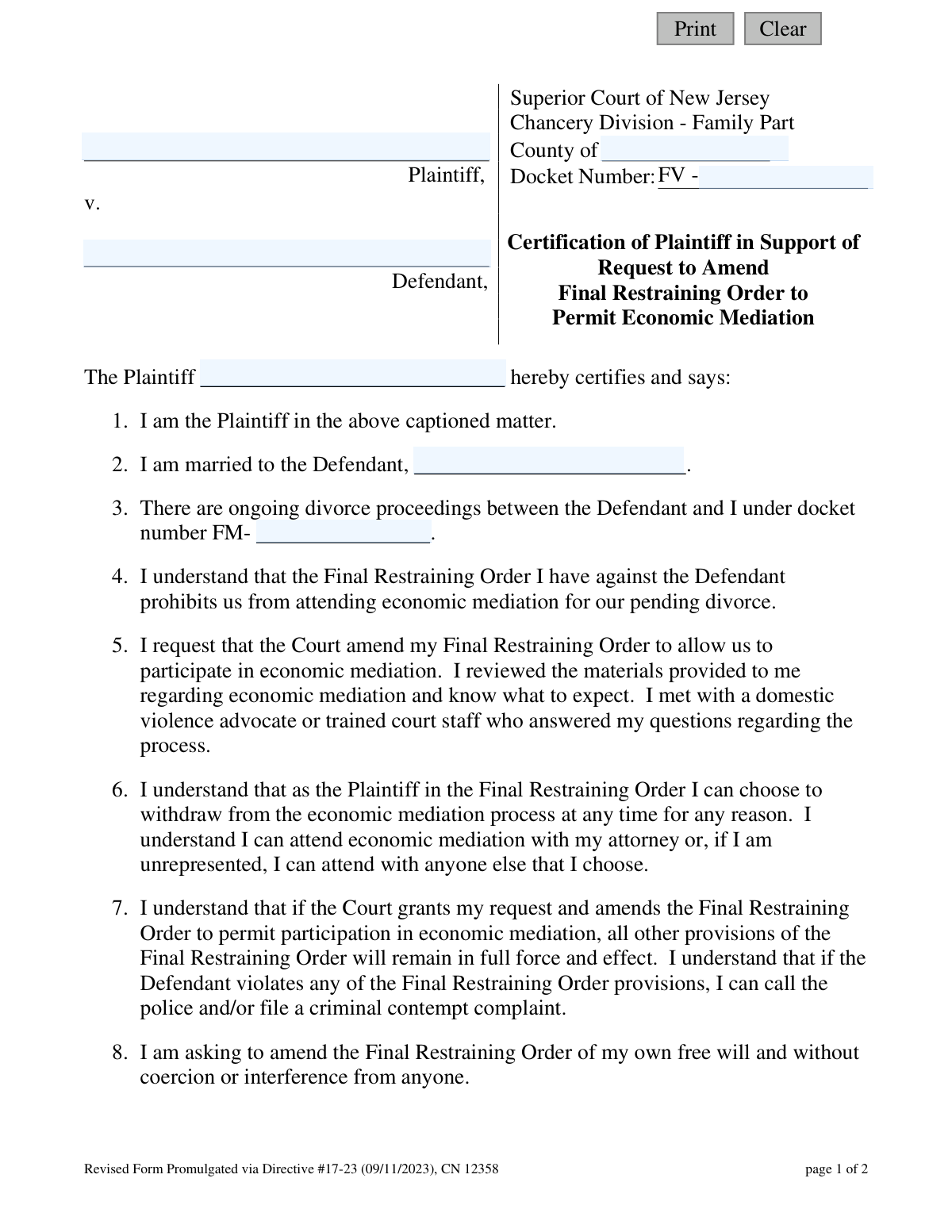
Yes! You can use AI to fill out DVEM - Certification of Plaintiff in Support of Request for Amendment of Final Restraining Order (FRO) to Allow Economic Mediation
The DVEM form is a legal document used in the Superior Court of New Jersey, Chancery Division - Family Part. It allows a plaintiff who has obtained a Final Restraining Order (FRO) to formally request that the court amend the order to permit them and the defendant to participate in economic mediation for their divorce proceedings. This certification affirms the plaintiff's voluntary and informed consent to this specific exception to the FRO's no-contact provisions. Today, this form can be filled out quickly and accurately using AI-powered services like Instafill.ai, which can also convert non-fillable PDF versions into interactive fillable forms.
Our AI automatically handles information lookup, data retrieval, formatting, and form filling.
It takes less than a minute to fill out DVEM using our AI form filling.
Securely upload your data. Information is encrypted in transit and deleted immediately after the form is filled out.
Form specifications
| Form name: | DVEM - Certification of Plaintiff in Support of Request for Amendment of Final Restraining Order (FRO) to Allow Economic Mediation |
| Number of fields: | 11 |
| Number of pages: | 1 |
| Language: | English |
Instafill Demo: How to fill out PDF forms in seconds with AI
How to Fill Out DVEM Online for Free in 2026
Are you looking to fill out a DVEM form online quickly and accurately? Instafill.ai offers the #1 AI-powered PDF filling software of 2026, allowing you to complete your DVEM form in just 37 seconds or less.
Follow these steps to fill out your DVEM form online using Instafill.ai:
- 1 Navigate to Instafill.ai and upload or select the 'DVEM - Certification of Plaintiff' form.
- 2 Use the AI assistant to populate key information, such as the County, Plaintiff's name, and Defendant's name.
- 3 Enter the specific Docket Numbers for both the Final Restraining Order (FV) and the ongoing divorce proceedings (FM).
- 4 Carefully read and confirm the pre-written statements in the certification, ensuring they accurately represent your voluntary request.
- 5 Use the platform's secure tools to electronically sign and date the certification in the designated fields.
- 6 Review the entire completed form for accuracy before downloading, printing, or submitting it to the appropriate court.
Our AI-powered system ensures each field is filled out correctly, reducing errors and saving you time.
Why Choose Instafill.ai for Your Fillable DVEM Form?
Speed
Complete your DVEM in as little as 37 seconds.
Up-to-Date
Always use the latest 2026 DVEM form version.
Cost-effective
No need to hire expensive lawyers.
Accuracy
Our AI performs 10 compliance checks to ensure your form is error-free.
Security
Your personal information is protected with bank-level encryption.
Frequently Asked Questions About Form DVEM
This form is used by a plaintiff to ask the court to amend their Final Restraining Order (FRO). The amendment's specific purpose is to allow the plaintiff and defendant to participate in economic mediation for their divorce case.
The plaintiff, who is the person protected by the Final Restraining Order (FRO), must fill out this form. It is for individuals who are also in divorce proceedings with the defendant and wish to attend economic mediation.
You will need to provide the county, your name as the plaintiff, the defendant's name, and the docket numbers for both the Final Restraining Order (FV docket) and the ongoing divorce proceedings (FM docket).
No, only the part of the FRO that prohibits economic mediation will be amended. All other protective provisions of your Final Restraining Order will remain in full force and effect.
As the plaintiff, you have the right to withdraw from the economic mediation process at any time and for any reason. You are not required to continue if you feel uncomfortable.
Yes, the form clarifies that you can attend mediation with your attorney. If you are unrepresented, you are permitted to attend with another support person of your choice.
If the defendant violates any other provision of the Final Restraining Order, you should call the police immediately. You can also file a criminal contempt complaint with the court.
The docket numbers are printed on your official court documents. The 'FV' number is on your Final Restraining Order, and the 'FM' number is on your divorce case filings.
Yes, by signing, you are certifying under penalty of punishment that your statements are true and that you are making this request voluntarily. It is a formal request to the court.
You must file the completed and signed form with the Superior Court of New Jersey, Chancery Division - Family Part, in the county where your case is being heard.
Yes, services like Instafill.ai use AI to help you accurately auto-fill form fields, which can save time and reduce errors. This is useful for ensuring names and docket numbers are entered correctly.
Simply upload the DVEM form to the Instafill.ai platform. The AI will identify the fields, allowing you to provide your information once to have it automatically and accurately placed throughout the document.
You can use a service like Instafill.ai, which can convert flat, non-fillable PDFs into interactive, fillable forms. This allows you to easily type your information directly into the fields before printing.
Compliance DVEM
Validation Checks by Instafill.ai
1
Ensures County is Specified
This check verifies that the 'County of' field (`typeCounty`) has been filled out. It is a mandatory field because the form must be filed in the correct jurisdiction's Superior Court. A missing county would result in the form being rejected or misrouted, causing significant delays in processing the request.
2
Ensures Plaintiff Name is Provided
This validation confirms that the Plaintiff's name (`plaName`) field is not left blank. The plaintiff is the individual making the certification, so their identity is fundamental to the document's validity. Without this information, the court cannot identify who is requesting the amendment to the Final Restraining Order (FRO).
3
Ensures Defendant Name is Provided
This check verifies that the Defendant's name (`defName`) has been entered. The FRO is an order against a specific defendant, and this field is crucial for correctly identifying the associated case and the other party involved. An empty defendant name field makes the certification ambiguous and legally insufficient.
4
Verifies Plaintiff and Defendant are Different Individuals
This logical check ensures that the value entered for the Plaintiff's name (`plaName`) is not identical to the value for the Defendant's name (`defName`). A person cannot have a restraining order against themselves. This validation prevents a logically impossible and invalid submission that would be immediately rejected by the court.
5
Confirms FV Docket Number Presence
This validation ensures that the docket number for the Final Restraining Order (`docketNo`) is provided. This number is the primary identifier for the legal case that the plaintiff is requesting to amend. Without the correct FV docket number, the court clerk cannot locate the existing FRO, making it impossible to process the amendment request.
6
Confirms FM Docket Number Presence
This check verifies that the docket number for the ongoing divorce proceedings (`docketNo2`) is entered, as stated in point #3 of the certification. This information is required to link the FRO amendment request to the related divorce case for which economic mediation is sought. A missing FM docket number would render the request incomplete and may lead to its denial.
7
Validates Signature Date Presence
This validation confirms that the signature date (`sigDt`) field is not empty. The date is a critical component of a legal certification, establishing when the statements were attested to be true. An undated certification is legally deficient and would be rejected by the court.
8
Ensures Signature Date is a Valid Date
This check validates that the input in the signature date field (`sigDt`) conforms to a recognized date format, such as MM/DD/YYYY. It prevents the submission of nonsensical data like 'yesterday' or 'abc'. A properly formatted date is required for official record-keeping and legal validity.
9
Prevents Future Signature Dates
This logical validation ensures the date entered in the `sigDt` field is not a future date. A person cannot certify a document on a day that has not yet occurred. This check prevents simple data entry errors and ensures the chronological integrity of the legal document.
10
Verifies Signature Name Matches Plaintiff Name
This crucial check compares the typed signature name (`sigName`) with the plaintiff's name (`plaName`) to ensure they are identical. This serves as a verification that the person signing the document is the same person identified as the plaintiff. A mismatch would indicate a potential error or that an unauthorized person is attempting to file the form, leading to its rejection.
11
Validates FV Docket Number Format
This check examines the format of the FV docket number (`docketNo`) to ensure it aligns with expected patterns, typically including numbers and potentially hyphens. While the exact format can vary, this validation helps catch obvious errors like entering a name or random letters. An incorrectly formatted docket number can prevent the court from locating the case file.
12
Validates FM Docket Number Format
This check examines the format of the FM docket number (`docketNo2`) to ensure it follows a plausible structure for a court docket number. It helps prevent the entry of clearly incorrect data. This validation ensures the information provided for the related divorce case is usable by the court system to cross-reference the proceedings.
Common Mistakes in Completing DVEM
Court docket numbers have a precise format, including prefixes like 'FV-' for the restraining order and 'FM-' for the divorce case. Applicants often omit these prefixes or enter the numbers incorrectly, which prevents the court clerk from locating the case file. This results in the form being rejected and returned, causing significant delays. To avoid this, meticulously copy the full docket numbers from your official court documents.
This form requires two distinct docket numbers: one for the Final Restraining Order (FRO) and another for the ongoing divorce proceedings. A frequent error is swapping these two numbers or entering the same number in both fields. This error creates major confusion for court staff and will halt the processing of the request until a corrected form is submitted. Carefully match the 'FV' docket number to the FRO field and the 'FM' docket number to the divorce field.
The plaintiff might mistakenly enter the county where they currently reside instead of the county where the court case was originally filed and is being heard. This causes the document to be routed to the wrong courthouse, leading to automatic rejection and lost time. Always verify the correct county of jurisdiction by looking at previous official court papers related to the case.
Plaintiffs sometimes use nicknames, initials, or spell their or the defendant's name differently than how it appears on the official court order. This creates ambiguity and can cause the court clerk to question the document's validity or fail to match it to the correct case file. To ensure acceptance, use the full, legal names for both plaintiff and defendant exactly as they are written on the original Final Restraining Order.
Point 5 requires the plaintiff to certify they have met with a domestic violence advocate or trained court staff to discuss the mediation process. Signing this without actually having the meeting constitutes a false certification and can lead to the request being denied. More importantly, it means the plaintiff proceeds without fully understanding their rights and safety options. Always complete all required consultations before signing the form.
A critical error is believing that this amendment pauses the entire FRO. The form clearly states in point 7 that all other provisions remain in full force and effect, and only the prohibition on contact for the purpose of economic mediation is lifted. Misunderstanding this can lead to unsafe situations, as any other contact remains a violation of the order. Carefully read and understand that the FRO is still fully enforceable outside of scheduled mediation sessions.
When filling out a PDF form on a computer, people often just type their name on the signature line, which is not a legally valid signature. This will cause the court to reject the document. The form must be physically signed with a pen or, if filed electronically, signed using a valid e-signature method compliant with the court's rules. A typed name in a standard font is insufficient.
Leaving critical fields like the county, a docket number, or the signature date blank is a primary reason for rejection by the court clerk. An incomplete form cannot be processed and will be returned, forcing the plaintiff to start over and delaying the entire process. To prevent this, double-check every field before submission. AI-powered form-filling tools like Instafill.ai can help by highlighting required fields and ensuring all necessary information is present.
The certification in point 8, stating the request is made 'of my own free will,' is a vital legal declaration. A plaintiff may feel pressured by the defendant, family, or circumstances to sign this form to resolve financial matters. Signing under coercion invalidates the certification and undermines the very purpose of the FRO, potentially placing the plaintiff at risk. A plaintiff should only sign if they genuinely feel safe and are making the choice freely, without outside interference.
Court forms are regularly updated, as noted by the 'Revised... (09/11/2023)' text on this document. Submitting an outdated version can lead to rejection because it may lack language required by new court directives. This wastes time and potentially filing fees. Always download the most current version of any form directly from the official state judiciary website before filling it out. If you have a flat PDF, a tool like Instafill.ai can often convert it into a fillable version.
Saved over 80 hours a year
“I was never sure if my IRS forms like W-9 were filled correctly. Now, I can complete the forms accurately without any external help.”
Kevin Martin Green
Your data stays secure with advanced protection from Instafill and our subprocessors

Robust compliance program
Transparent business model
You’re not the product. You always know where your data is and what it is processed for.
ISO 27001, HIPAA, and GDPR
Our subprocesses adhere to multiple compliance standards, including but not limited to ISO 27001, HIPAA, and GDPR.
Security & privacy by design
We consider security and privacy from the initial design phase of any new service or functionality. It’s not an afterthought, it’s built-in, including support for two-factor authentication (2FA) to further protect your account.
Fill out DVEM with Instafill.ai
Worried about filling PDFs wrong? Instafill securely fills dvem-certification-of-plaintiff-in-support-of-request-for-amendment-of-final-restraining-order-fro-to-allow-economic forms, ensuring each field is accurate.