
Yes! You can use AI to fill out Form EA-116, Order on Request to Continue Hearing (Temporary Restraining Order) (CLETS-TEA or TEF) (Elder or Dependent Adult Abuse Prevention)
Don't type 64 fields by hand. Tell our AI about yourself, or upload a document you already have, and it fills every field in seconds. You check it, then download, print or sign.
The AI does the filling. You just check it.
No typing into boxes, nothing to install.
What this form asks for
The AI fills all of it, from your answers or your documents.
The AI checks your answers before you download
14 checks built for this form, so a wrong date or a missing answer is caught before anyone else sees it.
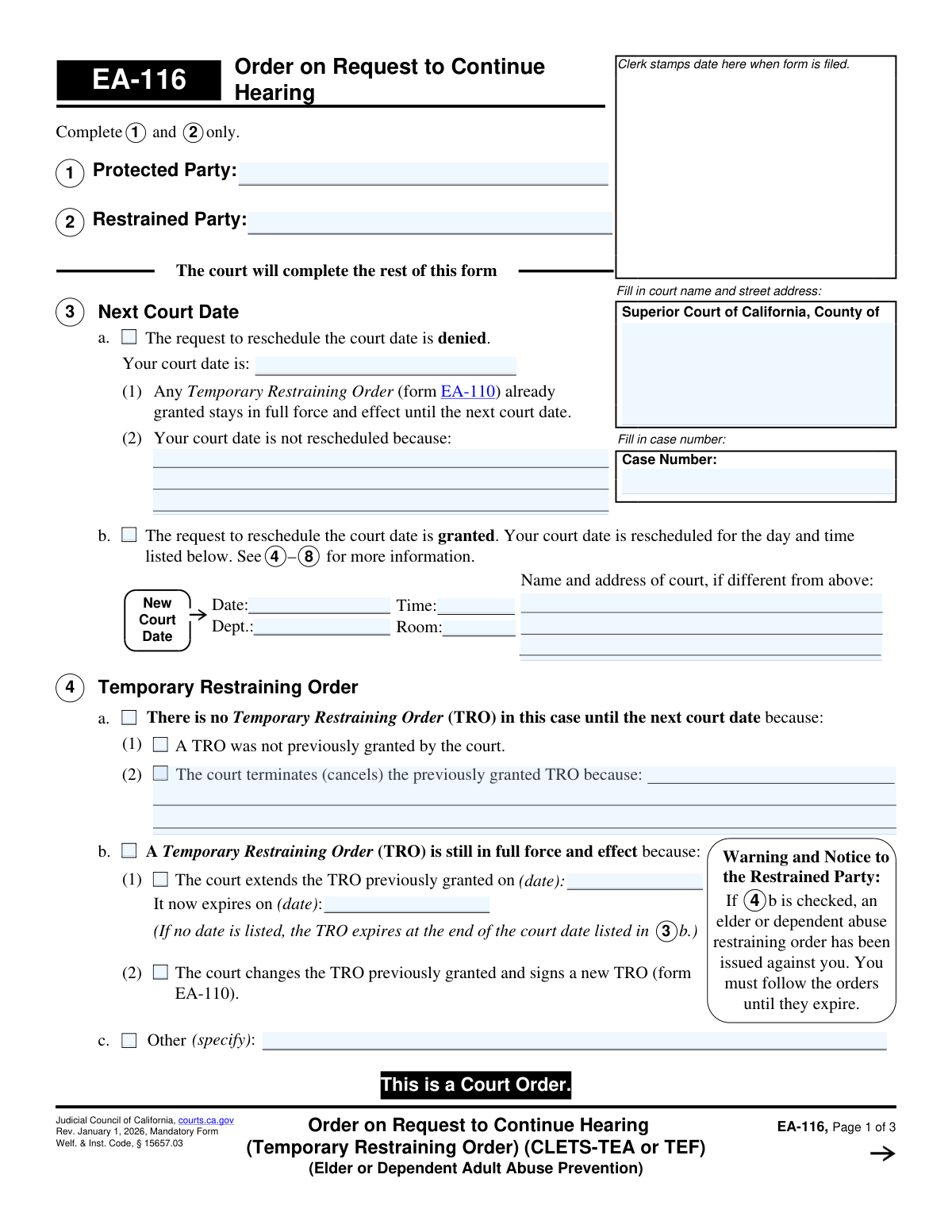
This check ensures that the 'Case Number' entered on page 1 is identical to the 'Case Number' on pages 2 and 3. Maintaining a consistent case number is critical for document integrity and ensures all pages are correctly associated with the proper legal file. If the numbers do not match, the form could be rejected by the clerk or cause confusion in case management.
Validates that the names of the 'Protected Party' (Box 1) and 'Restrained Party' (Box 2) are both filled in. These fields are fundamental to the order, as they legally identify the individuals involved in the proceeding. An order without clearly identified parties is unenforceable and would be rejected.
This check verifies that only one of the two primary options in section 3 is selected: either '3a. The request... is denied' or '3b. The request... is granted'. The court's decision on the continuance must be unambiguous. If both or neither are checked, the order is contradictory and legally invalid, requiring correction by the judicial officer.
If the continuance is granted (Box 3b is checked), this validation ensures that the 'Date', 'Time', and 'Dept.' for the new court date are all provided. This information is essential for all parties to know when and where to appear next. Failure to provide a complete new hearing schedule would make the order ineffective and lead to procedural chaos.
This check ensures that the new court 'Date' specified in Box 3b is a date in the future. Scheduling a hearing for a past date is a logical impossibility and would render the order invalid. This validation prevents clerical errors that would cause the order to be rejected and require re-issuance.
When a TRO is extended (Box 4b(1) is checked), this validates that the new expiration date is after the original grant date. The new expiration date must be a future date, and logically should be on or after the new court date specified in Box 3b. This ensures the protective order's timeline is legally sound and provides continuous protection.
And 8 more checks
- Conditional 'Other' Field Requirement
- Service Deadline Before New Hearing
- Mutually Exclusive Service Responsibility
- Attached Pages Count Format
- Logical Date Sequence for Signatures
- Denial Reason Requirement
- TRO Status Exclusivity
- Court Information Presence
Let AI fill out your EA-116
No typing. Every field filled in seconds, checked, ready to sign.
How to Fill Out EA-116 Online for Free in 2026
What the AI walks you through.
- Navigate to Instafill.ai and upload Form EA-116 or select it from the platform's template library.
- Use the AI assistant to identify and prepare the initial fields for court information, case number, and party details.
- Enter the name of the Superior Court, its address, and the case number in the designated boxes at the top of the form.
- Input the full name of the Protected Party in section 1 and the Restrained Party in section 2.
- Review the information you have entered for accuracy, as the rest of the form is to be completed by the court.
- Securely download or print the partially completed form, which is now ready to be filed with the court for the judge's review and order.
Common Mistakes in Completing EA-116
The ones the AI is built to catch.
Completing Sections Reserved for the Court
Entering an Incorrect or Incomplete Case Number
Using Incomplete or Incorrect Party Names
Misunderstanding the Form's Purpose
Failing to Properly Serve the Completed Order
Using an Obsolete Version of the Form
Submitting an Illegible Hand-Written Form
Providing Incorrect Court Information
Confusing the Protected and Restrained Parties
Frequently Asked Questions About EA-116
Is it really free for 7 days?
Can I fill other forms too?
How do I cancel?
How does the AI fill out EA-116?
What happens to my information?
How complex is EA-116 to fill out?
What is the purpose of Form EA-116?
Who is supposed to fill out this form?
How do I know if my court date was rescheduled?
If the hearing is postponed, is my Temporary Restraining Order (TRO) still active?
What happens if the request to continue the hearing is denied?
Do I need to give a copy of this order to the other person?
What does 'CLETS' mean on the form?
Do I have to pay to have the sheriff serve this order?
Can I use an AI tool to help me fill out this form?
How can I fill out Form EA-116 online?
The PDF of this form I downloaded is not fillable. What should I do?
How do I request an accommodation for a disability for my court date?
Get your EA-116 filled out by AI
$0 today. Cancel before Nov 1 and you pay nothing.
Other forms like this one
California court forms: Judicial Council of California Form SC-105, Request for Court Order and Answer (Small Claims), Judicial Council of California Form SC-120, Defendant’s Claim and ORDER to Go to Small Claims Court (Small Claims), Judicial Council of California Form SER-001, Request for Sheriff to Serve Court Papers, Judicial Council of California Form SER-001, Request for Sheriff to Serve Court Papers, Affidavit for Collection of Personal Property California Probate Code Section 13100, Form POS-040, Proof of Service—Civil, Declaration of Facts of Death (California Superior Court), declaration-of-marriage-for-court-proceeding-california-family-law, ADOPT-200, Adoption Request, ADOPT-200, Stepparent Adoption Request, ADOPT-210, Adoption Agreement, ADOPT-310, Contact After Adoption Agreement, Judicial Council of California Form ADOPT-200, Adoption Request, Form ADR-107, Mediation Attendance Sheet, Form ADR-110, Order Appointing Referee, Form ADR-109, Stipulation or Motion for Order Appointing Referee, Form ADR-102, Request for Trial De Novo After Judicial Arbitration, Form ADR-108, Referee's Report (Code Civ. Proc., §§ 638, 639), Form ADR-106, Petition to Confirm, Correct, or Vacate Contractual Arbitration Award, Form ADR-104, Rejection of Award and Request for Trial After Attorney-Client Fee Arbitration
restraining order forms: Form DV-100, Request for Domestic Violence Restraining Order, DV-100, Request for Domestic Violence Restraining Order (Domestic Violence Prevention), Judicial Council of California Form DV-110, Temporary Restraining Order (CLETS-TRO) (Domestic Violence Prevention), Form DV-116, Order on Request to Continue Court Hearing (Temporary Restraining Order) (CLETS-TRO) (Domestic Violence Prevention), Form DV-130, Restraining Order After Hearing (Order of Protection) (Domestic Violence Prevention), Form CH-110, Temporary Restraining Order (CLETS-TCH) (Civil Harassment Prevention), Form CH-120, Response to Request for Civil Harassment Restraining Orders, Form CH-130, Civil Harassment Restraining Order After Hearing (CLETS-CHO), Order on Request to Modify/Terminate Civil Harassment Restraining Order (Civil Harassment Prevention), Form CH-620, Response to Request to Modify/Terminate Civil Harassment Restraining Order (Civil Harassment Prevention), Form CIV-025, Application and Order for Reissuance of Order to Show Cause and Temporary Restraining Order, Form CD-190, Application for Temporary Restraining Order (Claim and Delivery), Order on Request to Continue Hearing (Temporary Restraining Order) (CLETS-TCH) (Civil Harassment Prevention), Form CH-610, Notice of Hearing on Request to Modify/Terminate Civil Harassment Restraining Order (Civil Harassment Prevention), Form CH-700, Request to Renew Restraining Order (Civil Harassment Prevention), Form CH-730, Order Renewing Civil Harassment Restraining Order (CLETS), Form DV-120, Response to Request for Domestic Violence Restraining Order (Domestic Violence Prevention), Form DV-300, Request to Change or End Restraining Order (Domestic Violence Prevention), Form DV-310, Notice of Court Hearing and Temporary Order to Change or End Restraining Order (Domestic Violence Prevention), Form DV-315, Request to Reschedule Hearing to Change or End Restraining Order (Domestic Violence Prevention)
Let AI fill out your EA-116
Your trial starts once a card is added. You pay nothing before Nov 1.
Our AI already knows this form, all 64 fields of it. Skip the typing: tell it about yourself, or upload what you have, and it fills the whole form in seconds.
- AI fills every field on all 3 pages, checkboxes included
- No typing into boxes: answer a few questions, or upload a document you already have, an old copy of this form, a photo of a document
- The AI checks the answers; you review and change anything before you download
- Download the finished PDF, print it, or sign it online
- Encrypted, and never used to train AI
Cancel before Nov 1 and you pay nothing.
A card is needed to start the trial. Cancel in two clicks from your account.
Terms · Privacy