Yes! You can use AI to fill out ACORD 50 CA (2004/07), California Insurance Identification Card
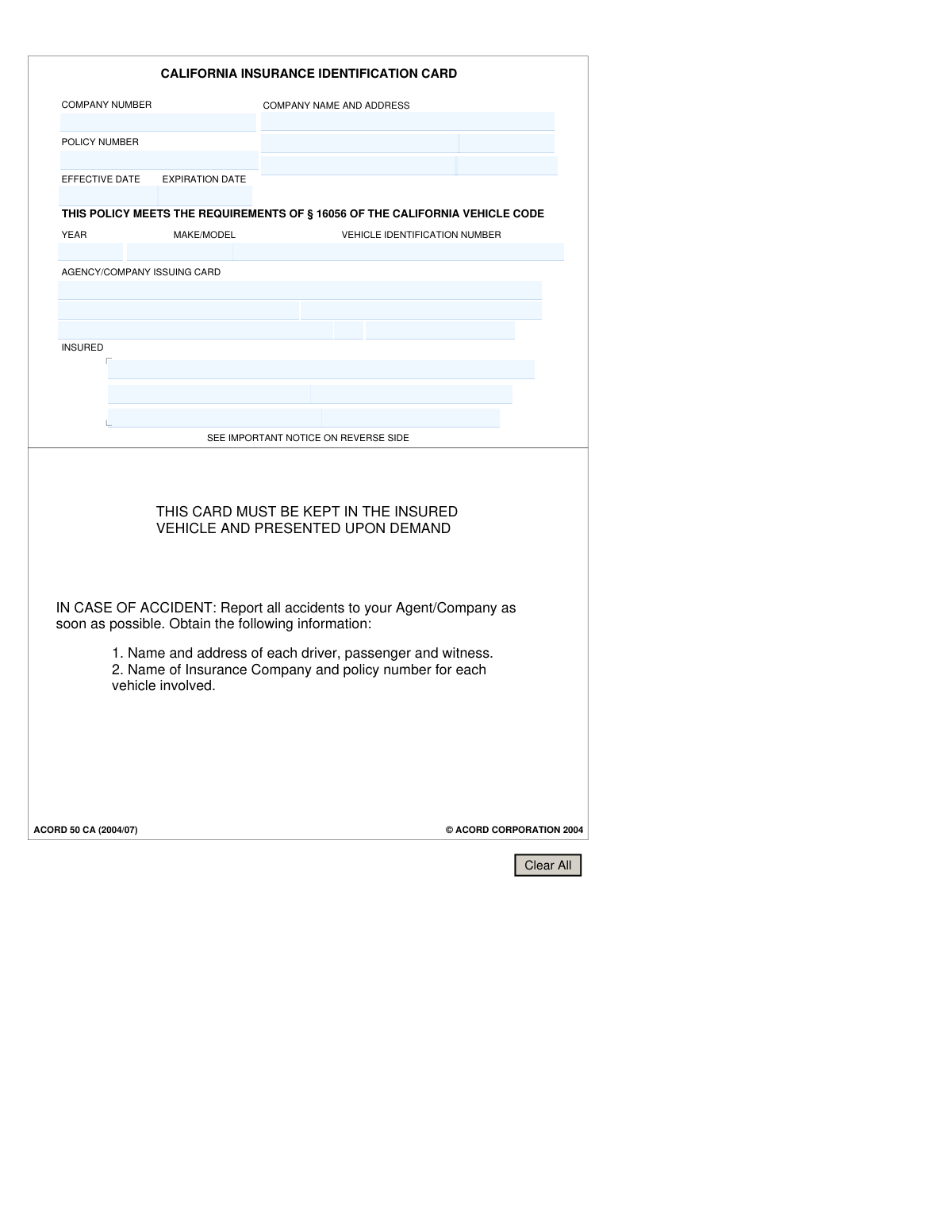
ACORD 50 CA is the standardized form used in California to serve as proof of vehicle insurance, as required by state law. It contains essential details about the insurance policy, the insured individual, the vehicle covered, and the insurance provider. Today, this form can be filled out quickly and accurately using AI-powered services like Instafill.ai, which can also convert non-fillable PDF versions into interactive fillable forms.
ACORD 50 CA is part of the
ACORD forms, California insurance forms and identification card forms categories on Instafill.
Our AI automatically handles information lookup, data retrieval, formatting, and form filling.
It takes less than a minute to fill out ACORD 50 CA using our AI form filling.
Securely upload your data. Information is encrypted in transit and deleted immediately after the form is filled out.
Form specifications
| Form name: | ACORD 50 CA (2004/07), California Insurance Identification Card |
| Number of fields: | 27 |
| Number of pages: | 1 |
| Language: | English |
More forms in ACORD forms
Instafill Demo: How to fill out PDF forms in seconds with AI
How to Fill Out ACORD 50 CA Online for Free in 2026
Are you looking to fill out a ACORD 50 CA form online quickly and accurately? Instafill.ai offers the #1 AI-powered PDF filling software of 2026, allowing you to complete your ACORD 50 CA form in just 37 seconds or less.
Follow these steps to fill out your ACORD 50 CA form online using Instafill.ai:
- 1 Navigate to Instafill.ai and upload or select the ACORD 50 CA form template.
- 2 Allow the AI to scan and identify all necessary fields, such as Insured Name, Policy Number, Vehicle Identification Number (VIN), and policy effective dates.
- 3 Provide the required information by answering simple questions. This includes details for the insurance company, the policyholder, and the specific vehicle (year, make, model, VIN).
- 4 The AI will automatically populate the insurance card with the information you provided, ensuring all data is placed in the correct locations.
- 5 Review the completed ACORD 50 CA card to verify that all names, dates, policy numbers, and vehicle details are accurate.
- 6 Download or print the completed California Insurance Identification Card to keep in the insured vehicle as required by law.
Our AI-powered system ensures each field is filled out correctly, reducing errors and saving you time.
Why Choose Instafill.ai for Your Fillable ACORD 50 CA Form?
Speed
Complete your ACORD 50 CA in as little as 37 seconds.
Up-to-Date
Always use the latest 2026 ACORD 50 CA form version.
Cost-effective
No need to hire expensive lawyers.
Accuracy
Our AI performs 10 compliance checks to ensure your form is error-free.
Security
Your personal information is protected with bank-level encryption.
Frequently Asked Questions About Form ACORD 50 CA
This card serves as official proof that your vehicle is insured in compliance with California state law. You are required to keep it in your vehicle and present it to law enforcement or other parties upon demand.
No, you do not fill out this card. Your insurance company or agent completes and issues it to you after you purchase or renew your auto insurance policy.
The form explicitly states that this card must be kept in the insured vehicle at all times. It's recommended to store it in your glove compartment with your vehicle registration.
The card contains essential details like the insured's name, policy number, policy effective and expiration dates, and information about the insured vehicle, including its year, make, model, and Vehicle Identification Number (VIN).
If you are in an accident, you should present this card to the other driver(s) and any responding law enforcement officers. It also serves as a reminder to collect the names, addresses, and insurance information of everyone involved.
Check the 'EFFECTIVE DATE' and 'EXPIRATION DATE' on the card. Your card is valid if the current date falls between these two dates.
If you lose your card, contact your insurance agent or company immediately to request a replacement. Most insurers also allow you to download or print a new card from their website or mobile app.
Yes, California law allows drivers to present proof of insurance electronically, such as on a smartphone. However, it is still a good idea to keep the physical card in your vehicle as a reliable backup.
Yes, typically your insurer will issue a separate identification card for each vehicle covered under your policy. Make sure the card in your vehicle matches that specific vehicle's VIN.
This is an industry-standard form identifier. 'ACORD' is the organization that creates standardized forms for the insurance industry, '50' is the form number for this type of card, and 'CA' specifies that it meets California requirements.
While you don't fill this card out yourself, AI services like Instafill.ai can help you manage it. You can use them to securely store a digital copy and quickly extract key information like your policy number or VIN when needed.
Simply upload a scan or photo of your Auto Insurance ID Card to Instafill.ai. The platform can automatically read and organize the information, giving you easy digital access to your policy details anytime.
You can upload the non-fillable PDF to a service like Instafill.ai. It uses AI to convert flat PDFs into interactive forms, which is useful if you want to add your own notes or annotations for personal record-keeping.
Compliance ACORD 50 CA
Validation Checks by Instafill.ai
1
Ensures Policy Number is Present
This check verifies that the 'POLICY NUMBER' field is not empty. The policy number is a critical unique identifier for the insurance contract, and its absence makes it impossible to look up coverage details or process claims. If this field is missing, the submission should be rejected as incomplete.
2
Validates Policy Number Format
This validation ensures the 'POLICY NUMBER' conforms to the expected format, which may include a specific length, prefix, or combination of letters and numbers. Correct formatting is essential for automated processing and database lookups. A policy number that fails this check may be a result of a typo or data entry error and should be flagged for manual review.
3
Validates Effective and Expiration Date Formats
This check confirms that both the 'EFFECTIVE DATE' and 'EXPIRATION DATE' fields are entered in a valid and recognizable date format, such as MM/DD/YYYY. Proper date formatting is fundamental for parsing and calculating the policy term. Submissions with invalid date formats cannot be processed and must be corrected.
4
Ensures Expiration Date is After Effective Date
This is a logical consistency check to verify that the 'EXPIRATION DATE' occurs after the 'EFFECTIVE DATE'. A policy cannot expire before it begins, and an inverted date range indicates a significant data entry error. This validation prevents the creation of invalid policy records and ensures the coverage period is logical.
5
Verifies Vehicle Identification Number (VIN) Standard Format
This check validates that the 'VEHICLE IDENTIFICATION NUMBER' is exactly 17 characters long and contains only alphanumeric characters, excluding I, O, and Q, as per the ISO 3779 standard. The VIN is the primary unique identifier for a vehicle, and an incorrect format prevents proper vehicle identification and verification. Submissions with invalid VINs should be rejected.
6
Performs VIN Checksum Validation
This validation calculates the checksum based on the first 16 characters of the VIN and compares it to the 9th character (the check digit). This mathematical check helps confirm the authenticity of the VIN and detects most single-digit typos or fraudulent numbers. A failed checksum indicates a high probability of an invalid VIN, requiring immediate correction.
7
Ensures Insured Name is Provided
This check verifies that the 'INSURED' field contains a value and is not empty. The name of the insured party is a fundamental piece of information required to identify who is covered by the policy. An insurance card without the insured's name is invalid and fails its primary purpose.
8
Verifies Insurance Company Name is Present
This validation ensures that the 'COMPANY NAME AND ADDRESS' field is populated. Knowing the underwriting insurance company is essential for verifying coverage, filing claims, and general correspondence. A submission lacking the company name is incomplete and cannot be processed.
9
Validates Vehicle Year Format and Range
This check ensures the 'YEAR' field contains a valid 4-digit number representing the vehicle's model year. The validation also checks if the year falls within a reasonable range, such as from 1950 to the current year plus two. This prevents nonsensical entries and ensures the vehicle data is accurate for rating and identification purposes.
10
Ensures Vehicle Make and Model are Specified
This validation confirms that the 'MAKE/MODEL' field is not left blank. This information is crucial for accurately identifying the specific vehicle covered by the policy, which impacts risk assessment and claim processing. A missing make or model makes the vehicle identification incomplete.
11
Checks for Active Policy Status
This logical check compares the current date with the policy's 'EFFECTIVE DATE' and 'EXPIRATION DATE' to determine if the policy is currently active. This is a critical business rule for verifying proof of insurance at a specific point in time, such as during a traffic stop or at the time of an accident. If the current date is outside the policy period, the card may be flagged as expired or not yet active.
12
Validates Company Number Format
This check verifies that the 'COMPANY NUMBER' field adheres to a predefined format, which is often a specific numeric code (e.g., NAIC code) used to uniquely identify the insurance carrier. Correct formatting ensures the company can be accurately identified in regulatory databases and internal systems. An invalid format could lead to misidentification of the insurer.
Common Mistakes in Completing ACORD 50 CA
People often transpose digits or misread characters (like 'O' for '0') when entering the policy number. This happens due to the length and complexity of the number, leading to failed verification by law enforcement or the DMV. An incorrect policy number can result in fines and be treated as if you have no proof of insurance, so always double-check it against your official policy documents.
The 17-character Vehicle Identification Number (VIN) is highly prone to transcription errors, such as swapping similar characters (I/1, O/0, S/5) or omitting a character. An incorrect VIN invalidates the insurance card for that specific vehicle, causing significant legal issues during a traffic stop or after an accident. To avoid this, carefully copy the VIN from the vehicle's registration or dashboard plate and verify it.
It's common for individuals to accidentally swap the policy's effective and expiration dates or use an incorrect date format (e.g., DD-MM-YYYY instead of MM-DD-YYYY). This can make a valid policy appear expired or not yet active, leading to citations for failure to provide proof of insurance. To prevent this, carefully read the field labels and confirm the dates against your insurance declaration page.
One of the most frequent mistakes is forgetting to replace the old insurance card in the vehicle upon policy renewal. Presenting an expired card during a traffic stop is the same as having no proof of insurance and can result in fines, vehicle impoundment, and license suspension. Always replace the card in your vehicle immediately upon receiving the new one for your renewal term.
Drivers may list a nickname or an incomplete version of their name, rather than the full legal name as it appears on the policy. This discrepancy can cause a police officer to question the validity of the coverage, especially if it doesn't match the driver's license. Ensure the name on the card is the full legal name of the primary insured person listed on the policy documents.
Errors often occur when listing the vehicle's make and model, such as using common abbreviations ('Chevy' for Chevrolet) or misspelling the model name. This creates a mismatch with the vehicle's official registration, which can lead to confusion and delays during verification. Always use the full, official make and model as stated on your vehicle registration to ensure consistency.
People frequently enter the name of their local insurance agent or broker in the 'COMPANY NAME' field instead of the underwriting insurance company. This can cause confusion and delays for authorities or other parties trying to verify coverage or file a claim. The card must list the official name of the national or regional insurance carrier that holds the policy.
When a temporary card is issued and filled out by hand, poor handwriting can render critical information like the policy number or VIN unreadable. An officer unable to read the card may not be able to verify coverage and could issue a citation. To avoid this, print clearly in block capitals or use a fillable form; tools like Instafill.ai can convert flat PDFs into fillable versions to ensure legibility.
Believing some information is non-essential, individuals might leave fields like 'COMPANY NUMBER' or the full company address empty. An incomplete card can be deemed invalid by law enforcement or cause major processing delays after an accident when that information is needed. It is crucial to fill out every required field; AI-powered form fillers like Instafill.ai can help by flagging mandatory fields that have been missed.
The 'COMPANY NUMBER' is a specific code (NAIC code) assigned to each insurance company for regulatory purposes, and it is often confused with the policy number or agency phone number. Entering the wrong number can prevent officials from correctly identifying your insurer in their database. This number is found on your policy declaration page and should be copied exactly to ensure accurate identification.
Saved over 80 hours a year
“I was never sure if my IRS forms like W-9 were filled correctly. Now, I can complete the forms accurately without any external help.”
Kevin Martin Green
Your data stays secure with advanced protection from Instafill and our subprocessors

Robust compliance program
Transparent business model
You’re not the product. You always know where your data is and what it is processed for.
ISO 27001, HIPAA, and GDPR
Our subprocesses adhere to multiple compliance standards, including but not limited to ISO 27001, HIPAA, and GDPR.
Security & privacy by design
We consider security and privacy from the initial design phase of any new service or functionality. It’s not an afterthought, it’s built-in, including support for two-factor authentication (2FA) to further protect your account.
Fill out ACORD 50 CA with Instafill.ai
Worried about filling PDFs wrong? Instafill securely fills acord-50-ca-200407-california-insurance-identification-card forms, ensuring each field is accurate.