Yes! You can use AI to fill out ACORD 82, Watercraft Application

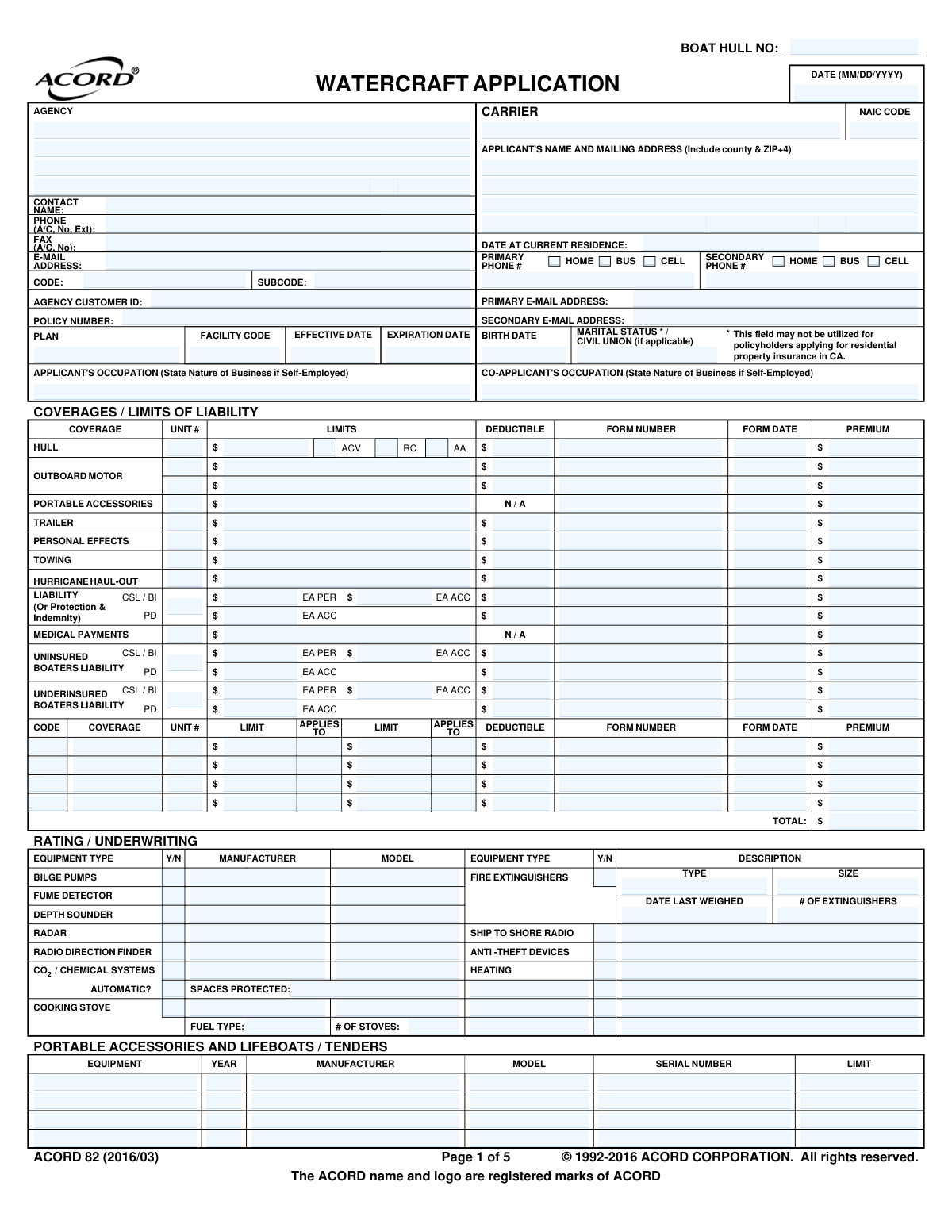
ACORD 82, the Watercraft Application, is a standardized insurance form used to collect detailed information from individuals applying for boat or personal watercraft insurance. It captures essential data about the applicant, the vessel, its operators, and the desired coverage, which insurers use to underwrite the policy and calculate premiums. This detailed application is crucial for securing appropriate and accurately priced insurance for your watercraft. Today, this form can be filled out quickly and accurately using AI-powered services like Instafill.ai, which can also convert non-fillable PDF versions into interactive fillable forms.
ACORD 82 is part of the ACORD forms and insurance application forms categories on Instafill.
Our AI automatically handles information lookup, data retrieval, formatting, and form filling.
It takes less than a minute to fill out ACORD 82 using our AI form filling.
Securely upload your data. Information is encrypted in transit and deleted immediately after the form is filled out.

Form specifications

Form name: ACORD 82, Watercraft Application
Number of fields: 723
Number of pages: 1
Language: English
main-image

Instafill Demo: How to fill out PDF forms in seconds with AI

How to Fill Out ACORD 82 Online for Free in 2026

Are you looking to fill out a ACORD 82 form online quickly and accurately? Instafill.ai offers the #1 AI-powered PDF filling software of 2026, allowing you to complete your ACORD 82 form in just 37 seconds or less.
Follow these steps to fill out your ACORD 82 form online using Instafill.ai:
  1. 1 Navigate to Instafill.ai and upload or select the ACORD 82 Watercraft Application form.
  2. 2 Provide your personal details, including name, address, and contact information, in the designated applicant section.
  3. 3 Enter comprehensive details about your watercraft, including hull information, engine/motor specifications, and trailer details as prompted by the interactive fields.
  4. 4 List all operators of the watercraft, providing their personal information, license details, and operating experience.
  5. 5 Specify the desired insurance coverages, limits, and deductibles for liability, hull, medical payments, and other options.
  6. 6 Review all the information auto-filled by the AI for accuracy, make any necessary corrections, and securely e-sign the application.
  7. 7 Download, print, or share the completed and signed ACORD 82 form directly with your insurance agent or carrier.

Our AI-powered system ensures each field is filled out correctly, reducing errors and saving you time.

Why Choose Instafill.ai for Your Fillable ACORD 82 Form?

Speed

Complete your ACORD 82 in as little as 37 seconds.

Up-to-Date

Always use the latest 2026 ACORD 82 form version.

Cost-effective

No need to hire expensive lawyers.

Accuracy

Our AI performs 10 compliance checks to ensure your form is error-free.

Security

Your personal information is protected with bank-level encryption.

Frequently Asked Questions About Form ACORD 82

This is the ACORD 82 Watercraft Application, used to apply for boat or personal watercraft insurance. The 'Personal Auto Application' title appears to be a recurring header error on the form, but the content is entirely focused on insuring a watercraft.

Anyone seeking to purchase a new insurance policy or obtain a quote for a boat, yacht, or personal watercraft (like a jet ski) needs to fill out this application. The applicant is the person who will be the primary named insured on the policy.

You will need detailed information about your watercraft, including its year, make, model, Hull Identification Number (HIN), and engine details. You'll also need personal information for all operators, including their driver's license numbers and any boating accident history.

The Hull Identification Number (HIN) is a unique 12-digit number assigned to every boat, similar to a VIN on a car. It is usually found on a metal or plastic plate on the stern (back) of the boat, typically on the upper right side.

Insurance companies often require a recent marine survey, especially for older, high-value, or custom-built vessels, to assess the boat's condition and value. An appraisal may also be needed to establish the boat's cost for coverage purposes.

An insurance binder provides temporary proof of insurance coverage while your full policy is being issued. If this section is filled out and signed by your agent, you have coverage starting from the effective date listed, subject to the policy's terms and conditions.

You must answer 'Yes' to this question if the boat is your primary home. This is a critical detail as it affects your risk profile and may require a specific type of 'liveaboard' policy or endorsement.

Yes, you must disclose all accidents and moving violations within the specified time frame, regardless of fault or whether a claim was filed. This information is verified by the insurance company and is material to your application.

Hull coverage insures your boat against physical damage to the vessel itself. Liability, also known as Protection & Indemnity (P&I), covers your legal obligations to third parties for bodily injury or property damage caused by your boat.

In the 'Operator's Experience' section, you should list the number of years you have been operating boats, even if you didn't own them. Be sure to also note any boating safety courses you've completed, as this can positively impact your application.

Yes, you can use AI-powered services like Instafill.ai to simplify and speed up the process. These tools can accurately auto-fill many of the fields on the form based on your provided information, saving you time and reducing errors.

Simply upload the ACORD 82 PDF to the Instafill.ai platform. The AI will make the form fillable and guide you through the questions, auto-filling information to help you complete the application quickly and accurately online.

You can use a service like Instafill.ai to make the form interactive. Just upload the flat PDF, and the tool will automatically detect the fields and convert them into a fillable format that you can complete and sign electronically.

Compliance ACORD 82
Validation Checks by Instafill.ai

1
Policy Period Dates Logic
This check validates that the 'Expiration Date' of the policy is chronologically after the 'Effective Date'. This is critical for defining a valid coverage period and preventing logically impossible policy terms. If this validation fails, the system should flag the dates as an error and require the user to correct them before submission, as a policy cannot end before it begins.
2
Applicant Age Verification
This validation calculates the age of the applicant and any listed operators based on their 'DATE OF BIRTH'. It ensures the individual is of a minimum legal age (e.g., 18) to enter into an insurance contract and is not an impossibly old age. This is crucial for legal compliance and risk assessment. A failure would prevent submission and prompt the user to enter a valid birth date.
3
Hull Identification Number (HIN) Format
This check verifies that the 'Hull Identification Number' (HIN) conforms to the standard 12-character format mandated by the U.S. Coast Guard since 1972. Correctly identifying the specific vessel is fundamental for underwriting, claims processing, and theft recovery. An invalid format would trigger an error, asking the user to re-check the HIN on the vessel's transom.
4
Conditional Explanation for 'Yes' Answers
This validation ensures that if any of the 'Y/N' questions in the General Information section (e.g., 'IS THE BOAT USED FOR RACING?') are answered 'YES', the corresponding explanation field is not left empty. These details are material to risk assessment and premium calculation. Failure to provide an explanation would result in a prompt requiring the user to elaborate on the 'YES' answer before the form can be processed.
5
Operator Accident/Conviction Detail Requirement
This check is triggered if the applicant answers 'YES' to the question 'HAS ANY OPERATOR... HAD A MOTOR VEHICLE OR BOATING ACCIDENT...'. It validates that at least one entry is made in the corresponding 'ACCIDENTS / CONVICTIONS' table with details like date and description. This information is essential for accurate underwriting and rating. If details are missing, the application is considered incomplete.
6
Boat Value Consistency
This validation compares the 'Cost New' and 'Present Value' fields for the boat hull and motor. It flags submissions where the 'Present Value' is higher than the 'Cost New', which is usually illogical due to depreciation. This helps prevent potential fraud and ensures the values provided are reasonable for underwriting. A warning or error would be displayed if the present value exceeds the new cost.
7
Email Address Format Validation
This check ensures that the values entered into the 'PRIMARY E-MAIL ADDRESS' and 'SECONDARY E-MAIL ADDRESS' fields match a standard email format (e.g., contains an '@' symbol and a domain). Valid email addresses are crucial for communication, policy document delivery, and billing notifications. An invalid format would prevent submission and prompt the user for a correctly formatted email.
8
ZIP Code Format Validation
This validation checks the ZIP code in the 'APPLICANT'S NAME AND MAILING ADDRESS' field to ensure it is a valid 5-digit or 9-digit (ZIP+4) format, as suggested by the form. A correct ZIP code is essential for accurate location-based rating and mail delivery of physical documents. An invalid format would trigger an error message requiring correction.
9
Lay-Up Period Date Consistency
This validation applies to the 'LAY-UP PERIOD' section and verifies that the 'End Date' is chronologically after the 'Start Date'. A logical lay-up period is required for calculating potential premium credits for when the boat is not in use. An illogical date range would be flagged as an error, requiring the user to correct the period.
10
Additional Interest Information Completeness
This check ensures that if an interest type like 'LOSS PAYEE' or 'LIENHOLDER' is selected in the 'ADDITIONAL INTEREST' section, the corresponding 'NAME AND ADDRESS' and 'REFERENCE / LOAN #' fields are also filled out. This information is legally required to protect the financial interest of lenders. An incomplete entry would halt processing until all required information for the additional interest is provided.
11
Boat Year and Purchase Date Logic
This logical check compares the 'YEAR' of the boat's manufacture with the 'DATE PURCHASED'. It ensures the purchase date is not earlier than the manufacturing year, which is a logical impossibility. This helps catch data entry errors and ensures the timeline of the asset is accurate. If the purchase date precedes the year of manufacture, an error message will be displayed.
12
Mandatory Applicant Information
This is a completeness check to verify that critical applicant information such as 'APPLICANT'S NAME AND MAILING ADDRESS', 'PHONE #', and 'BIRTH DATE' are not empty. This data is the absolute minimum required to identify the policyholder and begin the underwriting process. The form cannot be submitted if any of these mandatory fields are left blank.
13
Coverage and Limit/Deductible Relationship
This check ensures that when a coverage like 'HULL' or 'LIABILITY' is selected, a corresponding 'LIMIT' value is entered. It also can check that the 'DEDUCTIBLE' is not greater than the 'LIMIT'. These financial figures are the core of the insurance contract, defining the extent of coverage. Missing limits or illogical deductible amounts would be flagged for correction.
14
Social Security Number Format
This check verifies that the 'SOCIAL SECURITY #' for each operator is entered in the correct 9-digit format (either with or without hyphens). A valid SSN is often required for running motor vehicle reports and credit checks, which are part of the underwriting process. The system should flag an incorrectly formatted number and ensure the data is handled securely.

Common Mistakes in Completing ACORD 82

Entering an Incorrect Hull Identification Number (HIN)

The Hull Identification Number (HIN) is a unique 12-character serial number, and its length and mix of letters and numbers make it highly susceptible to typos or transposition errors. An incorrect HIN can cause significant delays, lead to the insurer quoting or covering the wrong vessel, and may result in the denial of a claim if the number on the policy doesn't match the boat. To avoid this, applicants should always copy the HIN directly from the metal or plastic plate on the boat's transom (upper right corner) rather than from memory or old paperwork.

Confusing 'Cost New' with 'Present Value'

Applicants often misunderstand the distinction between these two values, entering the price they paid for a used boat as its 'Cost New' or simply guessing the 'Present Value'. This mistake directly impacts the premium and, more importantly, the settlement amount in a total loss scenario. Being over-insured means paying an unnecessarily high premium, while being under-insured can lead to a major financial gap when trying to replace the vessel. 'Cost New' should be the original MSRP, while 'Present Value' (or Actual Cash Value) is the current market worth, which can be estimated using resources like the NADA guides for boats.

Failing to List All Operators and Household Members

A critical error is only listing the primary owner and forgetting other potential operators. The form requires listing 'all residents and dependents (licensed or not) and regular operators,' which includes spouses, teenage children, or friends who might use the boat. If an unlisted operator is involved in an accident, the insurance company may have grounds to deny the entire claim due to misrepresentation, leaving the boat owner personally liable for all damages. It is crucial to list anyone who could conceivably operate the vessel.

Omitting Explanations for 'YES' Answers

The form contains several sections with 'Yes/No' questions (e.g., regarding charter use, racing, or prior bankruptcies) that explicitly state 'EXPLAIN ALL "YES" RESPONSES'. Applicants frequently check 'YES' but neglect to fill in the corresponding explanation box. This renders the application incomplete and forces the underwriter to halt the quoting process to seek clarification, causing unnecessary delays in binding coverage. To prevent this, one should always provide a clear and detailed explanation immediately after checking 'YES'.

Providing Vague or Inaccurate 'Waters Navigated'

Applicants may not grasp the underwriting importance of this section, checking only 'Inland Waterways' when they also boat in coastal areas, or vice-versa. This information is vital for the insurer to assess the risk profile, as navigating the open ocean carries different risks than a small lake. Operating the boat in waters not declared on the policy can give the insurer grounds to deny a claim that occurs there. Always be thorough and disclose all potential navigation areas to ensure proper coverage.

Incorrectly Listing or Omitting an 'Additional Interest' (Lienholder)

When a boat is financed, the lender must be listed as a Loss Payee or Lienholder in the 'Additional Interest' section. Applicants often forget this step or enter the financial institution's name or address incorrectly. This can be a breach of the loan agreement and creates major problems during a claim, as the insurer will not know to include the lender on the settlement check, delaying the process of paying off the loan. Always have loan documents handy to copy the lender's information precisely.

Incomplete Disclosure of Accident and Loss History

The application requires disclosure of both motor vehicle and boating accidents for all operators, 'regardless of fault,' as well as any prior losses, 'whether or not paid by insurance.' Applicants may forget minor incidents or intentionally omit them, not realizing insurers verify this information through driving records and industry databases like C.L.U.E. Failure to disclose can lead to a higher premium after the fact, policy cancellation for material misrepresentation, or denial of a future claim.

Ignoring or Misstating the 'Lay-Up Period'

The 'Lay-Up Period' is a declared timeframe when the boat is in storage and not in use, which often results in a premium credit. Applicants may either forget to list these dates or, more riskily, use the boat during the declared lay-up period. If a policy includes a lay-up warranty, any claim occurring from use during that period will be denied. Accurately declaring a lay-up period ensures you receive the proper discount and understand the coverage restrictions.

Forgetting to Sign or Initial All Required Pages

This five-page document requires multiple initials and a final signature to be legally valid. It is common for applicants to miss the initial box for the 'Notice of Information Practices' or the main signature line on the final page. An unsigned application is not binding, meaning no coverage is in effect until it is properly executed. This simple oversight can leave an applicant uninsured. Using a tool like Instafill.ai, which can convert flat PDFs to fillable forms, often includes features that highlight all required signature fields to prevent this mistake.
Saved over 80 hours a year

“I was never sure if my IRS forms like W-9 were filled correctly. Now, I can complete the forms accurately without any external help.”

Kevin Martin Green

Your data stays secure with advanced protection from Instafill and our subprocessors

Robust compliance program

Transparent business model

You’re not the product. You always know where your data is and what it is processed for.

ISO 27001, HIPAA, and GDPR

Our subprocesses adhere to multiple compliance standards, including but not limited to ISO 27001, HIPAA, and GDPR.

Security & privacy by design

We consider security and privacy from the initial design phase of any new service or functionality. It’s not an afterthought, it’s built-in, including support for two-factor authentication (2FA) to further protect your account.

Fill out ACORD 82 with Instafill.ai

Worried about filling PDFs wrong? Instafill securely fills acord-82-watercraft-application forms, ensuring each field is accurate.