Yes! You can use AI to fill out General Liability and Builder's Risk Insurance Application

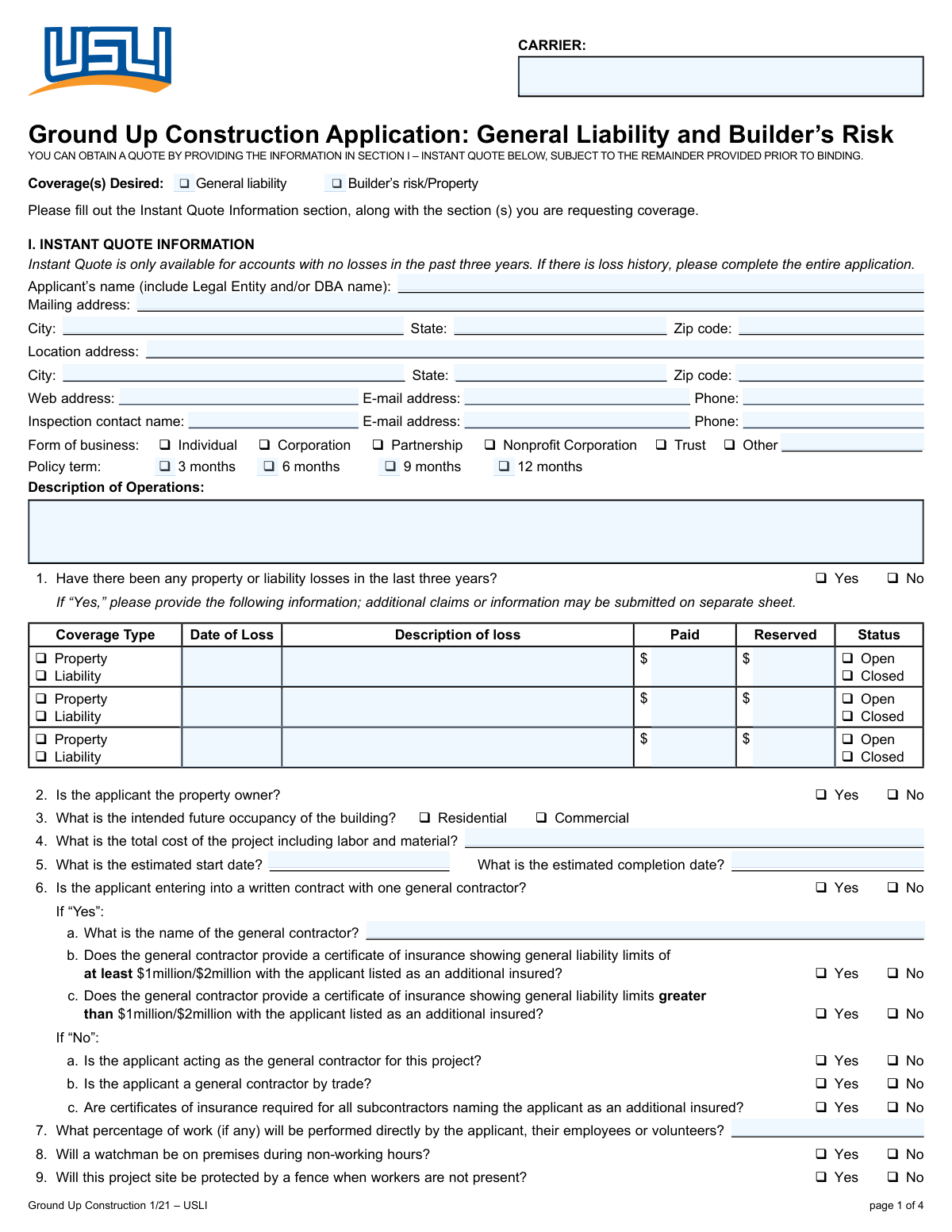
This form is a comprehensive application used by insurance carriers to gather essential details for underwriting general liability and builder's risk policies for construction projects. It collects information about the applicant, project scope, costs, timelines, contractor involvement, and specific risk exposures to determine eligibility and pricing. Today, this form can be filled out quickly and accurately using AI-powered services like Instafill.ai, which can also convert non-fillable PDF versions into interactive fillable forms.
Construction Insurance Application is part of the insurance application forms, insurance forms, liability application forms and liability insurance forms categories on Instafill.
Our AI automatically handles information lookup, data retrieval, formatting, and form filling.
It takes less than a minute to fill out Construction Insurance Application using our AI form filling.
Securely upload your data. Information is encrypted in transit and deleted immediately after the form is filled out.

Form specifications

Form name: General Liability and Builder's Risk Insurance Application
Number of fields: 167
Number of pages: 4
Filled form examples: Form Construction Insurance Application Examples
Language: English
main-image

Instafill Demo: How to fill out PDF forms in seconds with AI

How to Fill Out Construction Insurance Application Online for Free in 2026

Are you looking to fill out a CONSTRUCTION INSURANCE APPLICATION form online quickly and accurately? Instafill.ai offers the #1 AI-powered PDF filling software of 2026, allowing you to complete your CONSTRUCTION INSURANCE APPLICATION form in just 37 seconds or less.
Follow these steps to fill out your CONSTRUCTION INSURANCE APPLICATION form online using Instafill.ai:
  1. 1 Navigate to Instafill.ai and upload or select the General Liability and Builder's Risk Insurance Application.
  2. 2 Provide applicant details, including contact information, business entity type, and desired policy term. The AI can assist by pre-filling known information.
  3. 3 Enter a detailed description of your operations and disclose any property or liability losses from the past three years.
  4. 4 Supply comprehensive project information, such as total cost, start/completion dates, and details about the general contractor and their insurance.
  5. 5 Answer the series of yes/no questions regarding specific project risks, such as demolition, blasting, or work on filled ground.
  6. 6 List any additional interests like mortgagees or loss payees, and select your desired liability limits and deductibles.
  7. 7 Review all the information populated by the AI for accuracy, then electronically sign and date the application to complete the process.

Our AI-powered system ensures each field is filled out correctly, reducing errors and saving you time.

Why Choose Instafill.ai for Your Fillable Construction Insurance Application Form?

Speed

Complete your Construction Insurance Application in as little as 37 seconds.

Up-to-Date

Always use the latest 2026 Construction Insurance Application form version.

Cost-effective

No need to hire expensive lawyers.

Accuracy

Our AI performs 10 compliance checks to ensure your form is error-free.

Security

Your personal information is protected with bank-level encryption.

Frequently Asked Questions About Form Construction Insurance Application

This form is an application used to request General Liability and/or Builder's Risk/Property insurance coverage for a construction project. It gathers detailed information about the applicant, the project, and any associated risks.

Any individual or business entity, such as a property owner or contractor, who is seeking insurance coverage for a construction project needs to complete this application.

The 'Mailing Address' is where you receive correspondence and official notices. The 'Location Address' is the physical street address of the actual construction project site being insured.

You should check the 'Other (specify)' box and write in 'LLC' or 'Limited Liability Company' in the provided space for 'Other (Form of Business)'.

The form provides space to detail up to three losses. If you have more, list the three most significant ones and attach a separate sheet with the details for any additional losses.

You should answer 'No' to the question 'Entering into written contract with one general contractor'. Then, complete the following section by indicating that you are acting as the general contractor and specify your insurance requirements for any subcontractors you hire.

An Additional Interest is a person or organization, other than you, who has a financial stake in the insured property, such as a lender (mortgagee) or property manager. You should list them to ensure they are covered or notified under the policy as required by your contracts.

The Protection Class is a rating from 1-10 that indicates the fire protection capabilities of the area where the project is located. You can typically obtain this information from the local fire department or your insurance agent.

If you are hiring a single general contractor, you need to provide their name and confirm they will provide a Certificate of Insurance (COI) with specific liability limits, naming you as an additional insured.

Yes, you must answer Question 12 honestly. You need to disclose if any insurance coverage has been cancelled or non-renewed within the past three years.

Yes, services like Instafill.ai use AI to accurately auto-fill form fields from your saved information, which can save you significant time and help prevent errors.

You can use a service like Instafill.ai, which can convert a scanned image or a non-fillable PDF into an interactive, fillable form. You can then complete, sign, and share it digitally.

Compliance Construction Insurance Application
Validation Checks by Instafill.ai

1
Conditional Requirement for Loss Details
This check verifies that if the applicant indicates a loss history by selecting 'Yes' for 'Loss History', then the details for at least the first loss (Date of Loss, Description, Amount) are provided. This is crucial for underwriting to accurately assess risk based on past claims. If this validation fails, the form submission should be blocked, and the user prompted to either provide loss details or change the answer to 'No'.
2
Logical Sequence of Project Dates
This validation ensures that the 'Estimated Completion Date' is on or after the 'Estimated Start Date'. This maintains logical data integrity and is essential for determining the policy term and premium calculation. An invalid date sequence would require the user to correct the dates before the form can be submitted, preventing nonsensical project timelines.
3
Conditional Requirement for 'Other' Business Entity
This check ensures that if the 'Other (specify)' checkbox for Business Entity is selected, the corresponding text field 'Other (Form of Business)' is not empty. This is necessary to properly classify the applicant's legal structure for legal and coverage purposes. Failure to provide this detail would result in an incomplete and potentially inaccurate policy, so the user must be prompted to specify the business type.
4
General Contractor Information Dependency
This validation confirms that if the applicant answers 'Yes' to 'Entering into written contract with one general contractor', the 'General contractor name' field must be filled out. This information is vital for understanding project management structure and potential third-party liability. If the name is missing, the submission should be halted with a message requiring the user to provide the contractor's name.
5
Exclusive Selection for Business Entity
This validation ensures that the user selects only one option from the available business entity types (Individual, Corporation, Partnership, etc.). Selecting multiple entities is logically impossible and would create ambiguity in identifying the named insured. The form interface should use radio buttons or a similar control to enforce this, and a backend check should confirm only one value is submitted.
6
Standard Email Address Format
This check verifies that the 'Email Address' and 'Inspection Contact Email' fields contain values that conform to a standard email format (e.g., [email protected]). This is critical for ensuring that all electronic correspondence, including policy documents and billing notices, can be successfully delivered. An invalid format would trigger an error message, asking the user to correct the email address before proceeding.
7
Valid US ZIP Code Format
This validation ensures that all ZIP code fields ('Mailing Zip Code', 'Location Zip Code', etc.) contain either a 5-digit or 9-digit (ZIP+4) numeric value. Correct ZIP codes are essential for address verification, mail delivery, and determining rating territories for premium calculation. An invalid entry would prompt the user for correction to ensure data accuracy.
8
Minimum Coverage Type Selection
This validation ensures that the applicant has selected at least one type of coverage, either 'General liability' or 'Builder's risk/Property'. An application without a requested coverage type is incomplete and cannot be processed. If no coverage is selected, the form submission should be rejected with a message instructing the user to choose at least one coverage option.
9
Valid Total Project Cost
This check verifies that the 'Total Project Cost' is a positive numerical value greater than zero. This figure is a primary factor in calculating premiums for Builder's Risk coverage and assessing the overall scale of the project. A zero, negative, or non-numeric value is invalid and would prevent accurate quoting, so the user must enter a valid cost.
10
Additional Interest Completeness
This validation ensures that if any interest type (AI, LP, M, W) is checked for an 'Additional Interest' entry, the corresponding 'Name' and 'Address' fields for that entry are also filled. This is legally required to properly add the party to the policy and define their rights. An incomplete entry would make the endorsement invalid, so the system must require all necessary details before submission.
11
Required Applicant Signature
This check verifies that the 'Applicant signature' field is not empty. The signature is a legal attestation that the information provided is true and correct, and it represents the applicant's formal request for insurance. Without a signature, the application is not legally binding and cannot be processed, so its presence is mandatory for submission.
12
Standard Date Format
This validation ensures that all date fields, such as 'Date of Loss', 'Estimated Start Date', and 'date' (signature date), are entered in a consistent and recognizable format (e.g., MM/DD/YYYY). Proper date formatting is essential for data processing, calculating policy terms, and establishing timelines for claims. The system should reject invalid formats and guide the user to enter the date correctly.
13
General Contractor Role Consistency
This validation checks for logical contradictions in the general contractor section. If the applicant answers 'Yes' to 'Entering into written contract with one general contractor', they should not also be able to answer the subsequent questions intended for when the answer is 'No' (e.g., 'Applicant acting as general contractor'). This ensures the information about project management is clear and unambiguous, which is critical for assessing liability.
14
Valid Percentage Range for Work Performed
This check ensures that the value entered in 'Percent of Work Performed by Applicant' is a number between 0 and 100, inclusive. This percentage is a key underwriting factor for determining the applicant's direct exposure and how much work is being subcontracted. A value outside this logical range is impossible and must be corrected before submission.

Common Mistakes in Completing Construction Insurance Application

Confusing Mailing and Location Addresses

Applicants often enter the same address for both mailing and location, even when the project site is different from their correspondence address. The location address is critical for risk assessment and rating, while the mailing address is for communication. This mistake can lead to incorrect policy rating, delayed communications, and issues with site inspections. Always double-check that the physical project address is entered in the 'Location Address' fields and the correspondence address is in the 'Mailing Address' fields.

Providing a Vague 'Description of Operations'

Entering a generic term like 'Construction' in the 'Description of Operations' field is a common error. Underwriters require specific details about the scope of work, materials used, and types of jobs to accurately assess risk. A vague description will result in processing delays as the underwriter will have to request more information, and it could lead to incorrect pricing or even claim denials if the actual operations were not fully disclosed. Be as detailed as possible, describing the specific nature of the construction project.

Incomplete or Inaccurate Loss History Reporting

When an applicant checks 'Yes' for prior losses, they frequently fail to fill out all the required details for each incident, such as the date, a full description, and the amounts paid versus reserved. This incomplete information makes it impossible for the underwriter to evaluate the risk profile, causing the application to be rejected or delayed. To avoid this, if you have had losses, ensure every field for each loss is filled out completely and accurately before submission.

Mishandling the Conditional General Contractor Section

This section's logic ('If Yes...'/'If No...') often confuses applicants, leading them to skip required follow-up questions. For instance, an applicant might state they are not hiring a general contractor but then fail to answer whether they are acting as the GC themselves. These errors create ambiguity about project oversight and risk management, which can result in incorrect coverage, higher premiums, or application delays. Carefully follow the conditional paths to ensure all relevant questions are answered.

Incorrectly Listing Additional Interests

A frequent mistake is to list the name of an additional interest (like a lender or property owner) without checking the box that defines their relationship (AI, LP, M, W). Without this designation, the party is not properly added to the policy with the correct rights and protections. This can lead to breaches of contract and significant financial exposure if a claim occurs. Always provide the full legal name and address, and check the appropriate box to specify the party's interest in the policy.

Mismatching Applicant Name and Business Entity

Applicants sometimes enter a personal name under 'Applicant Name' while selecting 'Corporation' or 'LLC' as the business entity, or vice versa. The applicant name must be the exact legal name of the entity seeking insurance, as it appears on official documents. A mismatch can result in the policy being issued to the wrong legal entity, potentially voiding coverage in the event of a claim. Ensure the applicant name precisely matches the legal structure selected.

Understating the 'Total Project Cost'

When filling out 'Total Project Cost,' many applicants mistakenly enter only the cost of materials or hard construction costs, omitting soft costs like labor, permits, and architectural fees. The figure should represent the total completed value of the project. Understating this value can lead to being underinsured and facing significant coinsurance penalties in the event of a major loss, leaving you with large out-of-pocket expenses. Always calculate the full, all-inclusive cost of the project.

Rushing Through the Yes/No Eligibility Questions

The form includes a long list of critical yes/no questions about high-risk exposures like blasting, demolition, or work on filled ground. Applicants often rush this section and check 'No' to everything without careful reading, risking misrepresentation. An incorrect 'No' answer for an activity that later causes a loss can be grounds for the insurer to deny the claim entirely. Read every question carefully and answer truthfully to ensure your policy is valid.

Misinterpreting 'Percent of Work Performed by Applicant'

This field is often misunderstood, especially by applicants acting as their own general contractor. They may enter '100%' thinking it refers to the work they oversee, when it actually means the work physically performed by their direct employees. This misrepresentation affects the assessment of subcontracted risk and can lead to incorrect premium calculations. To avoid this, only include the percentage of work your own employees will perform, not work you subcontract out.

Selecting Multiple Contradictory Options

On forms that are not digitally validated, it's common for users to accidentally check multiple boxes for a single-choice question, such as selecting both a '$1,000' and '$2,500' deductible, or checking both 'Frame' and 'Fire Resistive' for construction type. This creates an ambiguous and invalid submission that cannot be processed. This results in delays until the applicant clarifies their choice. Using an AI-powered form-filling tool like Instafill.ai can prevent this by converting checkboxes to radio buttons for single-choice questions, ensuring only one option can be selected.
Saved over 80 hours a year

“I was never sure if my IRS forms like W-9 were filled correctly. Now, I can complete the forms accurately without any external help.”

Kevin Martin Green

Your data stays secure with advanced protection from Instafill and our subprocessors

Robust compliance program

Transparent business model

You’re not the product. You always know where your data is and what it is processed for.

ISO 27001, HIPAA, and GDPR

Our subprocesses adhere to multiple compliance standards, including but not limited to ISO 27001, HIPAA, and GDPR.

Security & privacy by design

We consider security and privacy from the initial design phase of any new service or functionality. It’s not an afterthought, it’s built-in, including support for two-factor authentication (2FA) to further protect your account.

Fill out Construction Insurance Application with Instafill.ai

Worried about filling PDFs wrong? Instafill securely fills general-liability-and-builders-risk-insurance-application forms, ensuring each field is accurate.