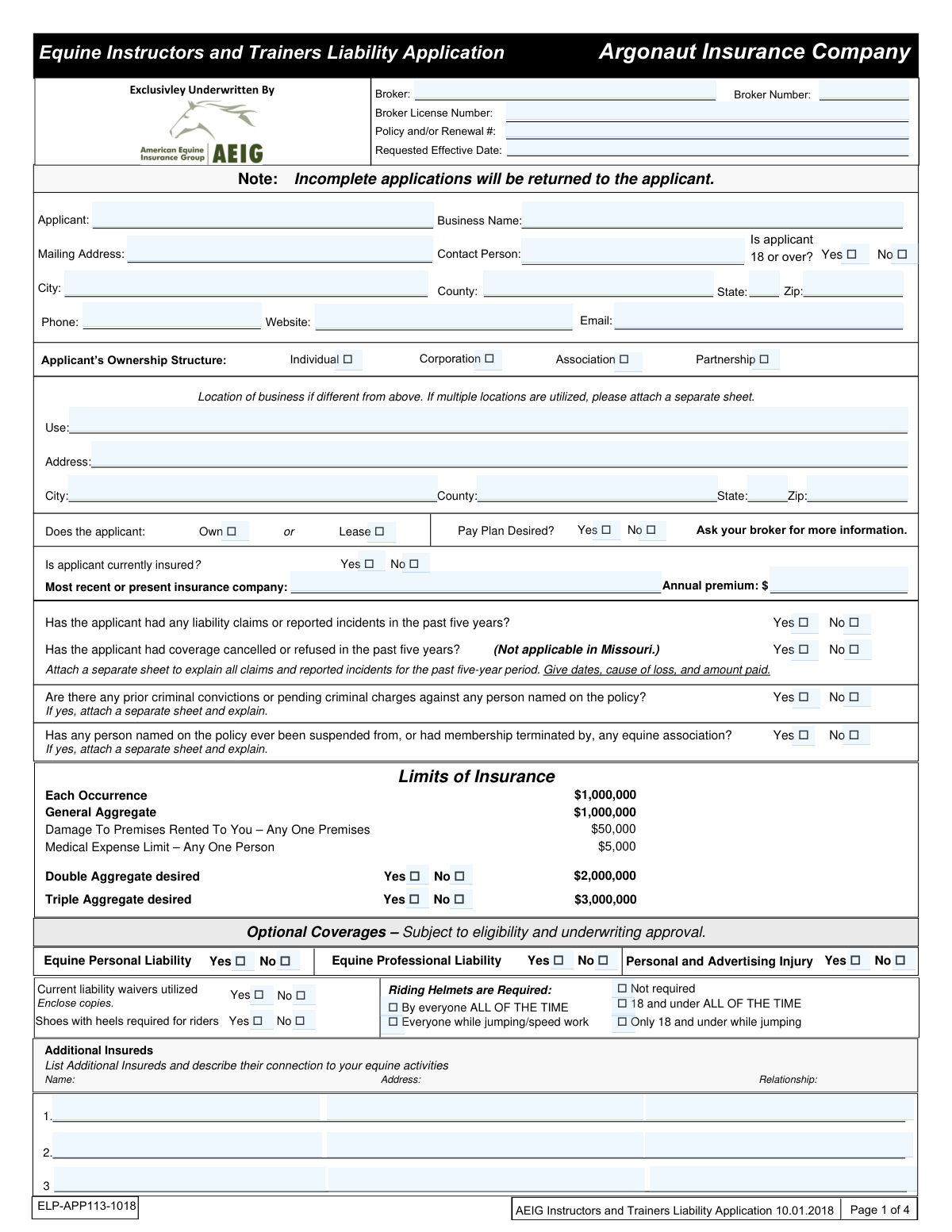
Yes! You can use AI to fill out Argonaut Insurance Company, AEIG Instructors and Trainers Liability Application
The AEIG Instructors and Trainers Liability Application, form ELP-APP113-1018, is a document used by equine instructors, trainers, and other professionals to apply for liability insurance through Argonaut Insurance Company. This application gathers detailed information about the applicant's business operations, experience, revenue, and specific equine activities to underwrite a policy that protects them from financial loss due to claims. Today, this form can be filled out quickly and accurately using AI-powered services like Instafill.ai, which can also convert non-fillable PDF versions into interactive fillable forms.
Our AI automatically handles information lookup, data retrieval, formatting, and form filling.
It takes less than a minute to fill out ELP-APP113-1018 using our AI form filling.
Securely upload your data. Information is encrypted in transit and deleted immediately after the form is filled out.
Form specifications
| Form name: | Argonaut Insurance Company, AEIG Instructors and Trainers Liability Application |
| Number of pages: | 4 |
| Language: | English |
| Categories: | insurance forms, insurance application forms |
Instafill Demo: How to fill out PDF forms in seconds with AI
How to Fill Out ELP-APP113-1018 Online for Free in 2026
Are you looking to fill out a ELP-APP113-1018 form online quickly and accurately? Instafill.ai offers the #1 AI-powered PDF filling software of 2026, allowing you to complete your ELP-APP113-1018 form in just 37 seconds or less.
Follow these steps to fill out your ELP-APP113-1018 form online using Instafill.ai:
- 1 Navigate to Instafill.ai and upload or select the AEIG Instructors and Trainers Liability Application.
- 2 Provide your personal and business contact information, ownership structure, and details about your business premises.
- 3 Describe your equine operations in detail, including your experience, types of activities (instruction, training, sales), and annual gross revenues for each.
- 4 Answer the history questions regarding prior insurance, liability claims, and any criminal or association-related disciplinary actions.
- 5 Select your desired insurance limits and choose any optional coverages, such as Care, Custody, or Control (CCC), specifying the limits needed.
- 6 Review the fraud warnings, electronically sign the declaration, and date the application to certify its accuracy.
- 7 Use the AI assistant to double-check the form for completeness and consistency before submitting it to your broker or the insurance company.
Our AI-powered system ensures each field is filled out correctly, reducing errors and saving you time.
Why Choose Instafill.ai for Your Fillable ELP-APP113-1018 Form?
Speed
Complete your ELP-APP113-1018 in as little as 37 seconds.
Up-to-Date
Always use the latest 2026 ELP-APP113-1018 form version.
Cost-effective
No need to hire expensive lawyers.
Accuracy
Our AI performs 10 compliance checks to ensure your form is error-free.
Security
Your personal information is protected with bank-level encryption.
Frequently Asked Questions About Form ELP-APP113-1018
This form is an application for equine professionals, such as instructors and trainers, to obtain liability insurance coverage from Argonaut Insurance Company. It gathers detailed information about your operations to determine eligibility and calculate premiums.
Any individual or business entity providing professional equine services like instruction, training, clinics, judging, or horse sales should complete this application to seek liability coverage.
CCC coverage protects you financially if a non-owned horse in your care is injured or dies and you are held legally liable. You should select this coverage if you train, board, or transport horses that belong to your clients.
It is critical to declare all your equine-related activities, as the form states that any exposures not declared are not covered by the policy. Failing to disclose an activity could result in the denial of a future claim related to it.
You must check 'Yes' to the question about past claims and attach a separate sheet detailing each incident from the past five years. Be sure to include the date, the cause of the loss, and the amount paid.
You must attach separate sheets to explain any 'Yes' answers regarding past claims, criminal history, or equine association issues. If you use liability waivers in your business, you are also required to enclose copies.
The form has a section for one business location, but if you use multiple locations, you must attach a separate sheet with the address and details for each additional facility.
To get coverage for an equestrian day camp, you must check 'Yes' in the activities section and also complete the separate 'Equestrian Day Camp Supplemental Application'. This standard application alone does not cover day camp activities.
No, the application explicitly states in bold, capitalized letters that 'NO COVERAGE WILL BE PROVIDED FOR COMMERCIAL TRAIL RIDING ACTIVITIES!'. You would need to seek a different type of policy for that specific exposure.
This application should be completed and submitted through your insurance broker, whose information is required at the top of the form. Your broker can provide specific submission instructions and advise you on the expected timeline for underwriting and approval.
The form clearly states that incomplete applications will be returned to the applicant. To avoid delays in processing, ensure every required field is filled out and all necessary supplemental documents are attached before submission.
An Additional Insured is a person or organization, such as a landlord of a facility you lease, who is granted coverage under your policy for liability arising from your work. You should list anyone who contractually requires you to add them to your insurance policy.
Yes, AI-powered services like Instafill.ai can help you complete this application more efficiently. These tools use AI to accurately auto-fill form fields based on your information, saving you time and reducing the risk of errors.
To fill this form using Instafill.ai, you can upload the PDF to their platform. The AI will identify all the fields, allowing you to provide your information once and have it automatically and accurately placed throughout the document.
If you have a non-fillable or 'flat' PDF, you can use a service like Instafill.ai to make it interactive. Simply upload the file, and their technology will convert it into a fillable form that you can easily complete and sign online.
Compliance ELP-APP113-1018
Validation Checks by Instafill.ai
1
Conditional Requirement for Prior Insurance Details
This check ensures that if the applicant indicates they are currently insured by selecting 'Yes', they must also provide the name of the 'Most Recent or Current Insurance Company' and the 'Annual Premium'. This information is crucial for underwriting to assess the applicant's insurance history and risk profile. If the fields are left blank after selecting 'Yes', the form submission should be flagged as incomplete.
2
Logical Consistency of Experience Years
This validation compares the 'Years experience with horses' against the 'Professional years operating this type of an operation'. The number of professional years cannot be greater than the total years of experience with horses. This check prevents logical impossibilities in the application data, ensuring the information provided is credible. A failure would require the applicant to correct the entered values.
3
Verification of Total Annual Gross Revenue Calculation
This check validates that the value entered in the 'Total Annual Gross Revenue' field is the correct sum of the individual revenue streams (Training, Riding Instruction, Horse Sales, Riding Clinics, Officiating). This ensures mathematical accuracy and provides a reliable total for premium calculation and risk assessment. If the sum does not match the total, an error should be displayed, prompting the user to review their revenue entries.
4
Requirement for Adverse History Explanation
This validation confirms that if an applicant answers 'Yes' to questions regarding past liability claims, criminal convictions, equine association suspensions, or coverage cancellations, a corresponding explanation or attachment is provided. These are material facts for underwriting, and their absence can lead to policy denial or mispricing. The system should flag the submission as incomplete if a 'Yes' answer lacks the required explanation.
5
Trigger for Equestrian Day Camp Supplemental Application
This check identifies if the applicant has selected 'Yes' for 'Equestrian Day Camps'. If 'Yes' is selected, the system must flag that the separate 'Equestrian Day Camp Supplemental Application' is required for the submission to be complete. This is a critical workflow validation to ensure all necessary documentation for high-risk activities is collected before underwriting proceeds.
6
Consistency Check for CCC Horse Value vs. Selected Limit
This validation ensures that the 'Maximum value of an individual non-owned horse' entered by the applicant does not exceed the 'Maximum Limit Per Horse' of the selected Care, Custody, or Control (CCC) coverage option. This prevents a situation where the applicant is underinsured for the value of the horses in their care. An error would force the applicant to either lower the stated maximum value or select a higher CCC coverage limit.
7
Validation of Requested Effective Date
This check verifies that the 'Requested Effective Date' is a valid date and is not in the past. Insurance policies cannot be backdated through a standard application, so the effective date must be today or a future date. This prevents administrative and legal issues related to the start of the coverage period. An invalid or past date would block submission until corrected.
8
Applicant Age Verification
This validation confirms that the applicant is 18 years of age or older. Since minors cannot legally enter into contracts, this is a fundamental check for the validity of the insurance application. If the applicant selects 'No', the application should be immediately flagged for manual review or rejection, as a legal guardian's involvement would be necessary.
9
Horse Sales Count Summation
This check ensures the 'Total' number of horses sold annually is equal to the sum of horses 'Owned by you' and 'Owned by others'. This is a simple data integrity check to ensure the numbers provided are consistent and accurate. A mismatch would indicate a data entry error that needs to be corrected by the applicant before proceeding.
10
Conditional Broker Signature for New Hampshire
This validation enforces a state-specific requirement. If the applicant's 'State' is entered as 'NH' (New Hampshire), the system must verify that the 'Broker Signature' and 'Broker Signature Date' fields are completed. This ensures compliance with state regulations noted on the form. If the state is NH and the signature is missing, the application is incomplete.
11
Mutually Exclusive Aggregate Limit Selection
This check ensures that an applicant cannot select 'Yes' for both 'Double Aggregate desired' and 'Triple Aggregate desired'. These are mutually exclusive options for setting the policy's general aggregate limit. The system should only allow one of these checkboxes to be selected at a time to prevent ambiguity in the requested coverage.
12
Completeness of Conditional Business Location Address
This validation rule checks the 'Business Location if different from above' section. If any field within this section (e.g., Address, City) is filled out, the system must then require all other address fields (Address, City, County, State, Zip) in that section to be completed. This ensures a full and usable address is provided, preventing incomplete location data from being submitted.
13
Mandatory Applicant Signature and Date
This is a final, critical check to ensure the 'Applicant's Signature' and 'Applicant Signature Date' fields are not empty. The signature and date are legally required to attest to the truthfulness of the application's contents and to form a binding contract. An application without a signature is invalid and must be rejected.
14
Conditional Requirement for CCC Section Fields
This validation ensures that the entire 'CARE, CUSTODY, OR CONTROL (CCC)' section, including limit selection and horse details, is only active and required if the applicant first answers 'Yes' to 'Is CARE, CUSTODY, OR CONTROL (CCC) coverage desired?'. If the answer is 'No', these fields should be disabled or ignored. This logic prevents users from filling out an irrelevant section and ensures data is only collected when necessary.
Common Mistakes in Completing ELP-APP113-1018
Applicants often check 'Yes' to questions about prior liability claims, criminal convictions, or equine association suspensions but forget to attach the required separate sheet with a detailed explanation. This oversight is common because the instruction is easy to miss while focusing on the main questions. An application without these mandatory attachments is considered incomplete and will be returned, significantly delaying the underwriting process and the start of coverage. To avoid this, create a checklist of all required attachments as you fill out the form and ensure they are all included before submission.
A frequent error occurs in the 'Annual Gross Revenues from Equine Activities' section where the sum of the individual revenue sources (Training, Riding Instruction, Horse Sales, etc.) does not match the 'Total Annual Gross Revenue' figure. This usually happens due to simple calculation errors or estimating figures inconsistently. Discrepancies in financial data can raise red flags for underwriters, leading to processing delays or requests for clarification. Always use a calculator to sum the individual revenue streams to ensure the total is accurate before entering it.
Applicants indicate that they use liability waivers by checking 'Yes' but then fail to enclose copies with their submission as instructed. This mistake happens because the applicant may not have the documents readily available when completing the form and forgets to include them later. Submitting without the waivers prevents the underwriter from assessing a key risk management practice, resulting in an incomplete application that will be sent back. Before submitting, confirm that physical or digital copies of your current liability waivers are attached.
Applicants sometimes provide a vague or overly brief response in the 'Description of your operation' field. They might assume the underwriter understands their business, but this lack of detail can lead to misinterpretation of the risks involved or require follow-up questions, delaying the quote. Since coverage is limited to disclosed activities, a poor description could even lead to a future claim being denied. To prevent this, provide a clear, comprehensive summary of all services you offer, the types of clients you serve, and the nature of your facility.
In the 'Care, Custody, or Control (CCC)' section, applicants may check 'Yes' to desiring coverage but then fail to select a specific limit option from the table. This complex section can be confusing, causing applicants to overlook the second step of choosing a premium/limit combination. Without a selected limit, the underwriter cannot price the policy, rendering the application incomplete. Carefully review the CCC section, select 'Yes' if coverage is desired, and then ensure one of the numbered limit options is clearly checked.
A critical mistake is not listing every single equine activity, especially if it's not explicitly asked about elsewhere on the form. The application clearly warns that 'EXPOSURES NOT DECLARED ARE NOT COVERED.' An applicant might forget to mention a minor or infrequent activity, but this omission could lead to a devastating uncovered claim. To avoid this, brainstorm all services you provide, even occasionally, and list them in the final section or on an extra page to ensure full transparency and proper coverage.
Submitting the application without the applicant's signature and the date in the 'DECLARATION' section is a simple but very common error. Applicants may rush through the final page or overlook the signature line, but an unsigned application is legally invalid and cannot be processed. This will cause an immediate rejection and require the form to be re-submitted, delaying coverage. Always perform a final review of the last page to ensure the signature and date fields are completed. AI-powered tools like Instafill.ai can highlight required signature fields to prevent this oversight.
Applicants may provide conflicting information between different parts of the form, such as stating they offer 'Riding Instruction' but then entering '$0' for 'Riding Instruction' revenue. This also occurs with horse counts, where the number of horses used for lessons doesn't align with the total number of owned/leased horses. These inconsistencies signal carelessness and force the underwriter to halt processing and seek clarification. Review the completed form to ensure all related fields are consistent and logical. Using a tool like Instafill.ai can help by cross-referencing data entries to flag potential inconsistencies.
People often make mistakes with conditional fields, either by leaving a field blank when it's required or filling one out when it should be skipped. For example, an applicant might check 'Yes' to 'Is applicant currently insured?' but then leave the 'Most recent or present insurance company' field blank. This missing information stops the underwriting process. To avoid this, read each instruction carefully. AI form-filling tools like Instafill.ai are designed to handle this logic automatically, showing or requiring fields only when appropriate based on your previous answers.
An applicant might list 'Riding Clinics' as an activity but fail to understand the note stating that coverage is not provided for clinic dates that have not been declared to the company in advance. They might assume listing the activity is sufficient, which could lead to an uncovered event. This is a policy condition, not just an application question. To ensure coverage, you must not only disclose the activity on the application but also provide written notice of specific clinic dates to the insurance company before they occur.
Saved over 80 hours a year
“I was never sure if my IRS forms like W-9 were filled correctly. Now, I can complete the forms accurately without any external help.”
Kevin Martin Green
Your data stays secure with advanced protection from Instafill and our subprocessors

Robust compliance program
Transparent business model
You’re not the product. You always know where your data is and what it is processed for.
ISO 27001, HIPAA, and GDPR
Our subprocesses adhere to multiple compliance standards, including but not limited to ISO 27001, HIPAA, and GDPR.
Security & privacy by design
We consider security and privacy from the initial design phase of any new service or functionality. It’s not an afterthought, it’s built-in, including support for two-factor authentication (2FA) to further protect your account.
Fill out ELP-APP113-1018 with Instafill.ai
Worried about filling PDFs wrong? Instafill securely fills argonaut-insurance-company-aeig-instructors-and-trainers-liability-application forms, ensuring each field is accurate.