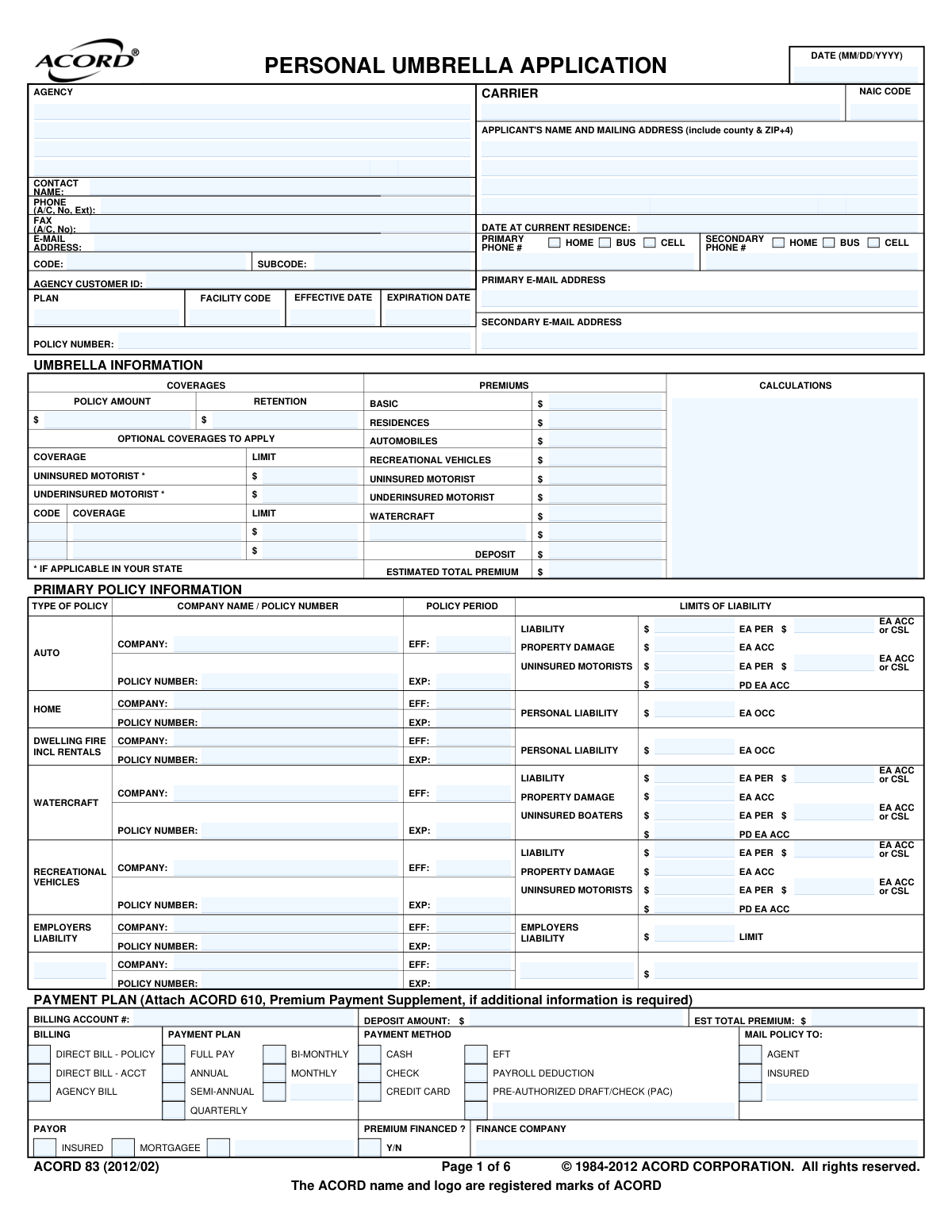
Yes! You can use AI to fill out ACORD 83, Personal Umbrella Application
ACORD Form 83 is the standardized Personal Umbrella Application used by insurance agencies to gather necessary information from individuals seeking to purchase or renew an umbrella liability policy. This policy provides extra liability coverage above the limits of existing homeowners, auto, and watercraft insurance policies, offering crucial financial protection against large claims or lawsuits. Today, this form can be filled out quickly and accurately using AI-powered services like Instafill.ai, which can also convert non-fillable PDF versions into interactive fillable forms.
Our AI automatically handles information lookup, data retrieval, formatting, and form filling.
It takes less than a minute to fill out ACORD 83 using our AI form filling.
Securely upload your data. Information is encrypted in transit and deleted immediately after the form is filled out.
Form specifications
| Form name: | ACORD 83, Personal Umbrella Application |
| Number of fields: | 621 |
| Number of pages: | 1 |
| Language: | English |
More forms in ACORD forms
Instafill Demo: How to fill out PDF forms in seconds with AI
How to Fill Out ACORD 83 Online for Free in 2026
Are you looking to fill out a ACORD 83 form online quickly and accurately? Instafill.ai offers the #1 AI-powered PDF filling software of 2026, allowing you to complete your ACORD 83 form in just 37 seconds or less.
Follow these steps to fill out your ACORD 83 form online using Instafill.ai:
- 1 Navigate to Instafill.ai and upload or select the ACORD 83 Personal Umbrella Application.
- 2 Provide your personal details, including name, address, contact information, and list all household members and operators of vehicles/watercraft.
- 3 Enter detailed information about your primary insurance policies, such as auto, home, and watercraft, including the carrier, policy number, and liability limits.
- 4 List all owned, leased, or occupied properties, vehicles (including recreational vehicles), and watercraft.
- 5 Complete the General Information and Operator Information sections by answering questions about employment, potential risks (like pools or animals), and driving history.
- 6 Carefully review the state-specific disclosures for Uninsured/Underinsured Motorist (UM/UIM) coverage, make your selections, and initial where required.
- 7 Review the entire application for accuracy, electronically sign the applicant's statement, and submit the completed form to your agent or insurance carrier.
Our AI-powered system ensures each field is filled out correctly, reducing errors and saving you time.
Why Choose Instafill.ai for Your Fillable ACORD 83 Form?
Speed
Complete your ACORD 83 in as little as 37 seconds.
Up-to-Date
Always use the latest 2026 ACORD 83 form version.
Cost-effective
No need to hire expensive lawyers.
Accuracy
Our AI performs 10 compliance checks to ensure your form is error-free.
Security
Your personal information is protected with bank-level encryption.
Frequently Asked Questions About Form ACORD 83
This form is used to apply for a personal umbrella insurance policy. This type of policy provides additional liability coverage over and above the limits of your existing home, auto, and other personal insurance policies.
You should consider applying for an umbrella policy if your personal assets exceed the liability limits of your current policies, or if you have increased risk factors like owning a pool, having a teen driver, or owning rental properties.
You will need your current primary insurance policies for home, auto, watercraft, and any other properties. The form requires you to list the insurance company, policy number, and liability limits for each of these underlying policies.
You must list all licensed drivers in your household, including yourself, your spouse, children, and any other residents. You should also include anyone who does not live with you but regularly operates your vehicles or watercraft.
Yes, you must answer 'Yes' to question 5 in the 'General Information' section and provide details. These items are considered significant liability risks, and failing to disclose them could jeopardize your coverage.
You must disclose any business or professional activities on the application. A personal umbrella policy typically excludes business liability, so your agent will need this information to determine if you need a separate commercial policy or a special endorsement.
Insurers use your driving history to assess risk and determine your premium. You must disclose all accidents and violations for all listed operators, as the insurance company will verify this information with official motor vehicle records.
This section is where you choose to accept or reject Uninsured/Underinsured Motorist (UM/UIM) coverage for your umbrella policy. This coverage protects you if you are injured by a driver with insufficient or no insurance.
A binder provides temporary insurance coverage until your official policy is issued. Your agent will complete the 'Insurance Binder' section on page 6 if coverage is bound, indicating the effective date and time.
After you complete and sign the application, you should return it to your insurance agent. Your agent will review it for completeness and submit it to the insurance carrier for underwriting.
Yes, services like Instafill.ai use AI to auto-fill form fields accurately and save time. This is especially useful for entering repetitive information like names and addresses or when applying for multiple policies.
You can upload the Personal Umbrella Application PDF to the Instafill.ai platform. The service will make the document interactive, allowing you to type your information directly into the fields, save your progress, and download the completed form.
If you have a non-fillable or 'flat' PDF, Instafill.ai can convert it into an interactive, fillable form. This allows you to complete it digitally without needing to print, write by hand, and scan.
Compliance ACORD 83
Validation Checks by Instafill.ai
1
Policy Period Logical Consistency
This check ensures that the policy 'Expiration Date' is chronologically after the 'Effective Date'. An umbrella policy cannot expire before it starts. This validation is critical for creating a valid contract period and preventing data entry errors that could lead to disputes over coverage dates. If validation fails, the system should flag the date fields and prevent submission until corrected.
2
Primary Policy Liability Limit Sufficiency
Validates that the liability limits for each underlying primary policy (Auto, Home, Watercraft, etc.) meet the carrier's minimum required amounts to qualify for an umbrella policy. Umbrella policies require a certain level of primary coverage before they take effect. Failure to meet these minimums makes the applicant ineligible, and the system should reject the application or flag it for underwriter review with a clear message indicating which policy's limits are insufficient.
3
Conditional Explanation for 'Yes' Responses
This check verifies that for every question in the 'General Information' section answered with 'YES', the corresponding 'Explain' field is not empty. These questions (e.g., 'Any swimming pool?', 'Any employees?') represent significant risk factors that require detailed information for proper underwriting. If a 'YES' is present without an explanation, the form submission should be blocked until the user provides the necessary details.
4
Social Security Number Format
Ensures that the Social Security Number entered for any operator is in the valid XXX-XX-XXXX format. This check maintains data integrity and consistency for a critical piece of personal identification used for underwriting and identity verification. An invalid format could halt the quoting process or lead to incorrect record-matching, so the system should provide real-time feedback on the format as the user types.
5
Driver's License and Age Consistency
This validation cross-references an operator's 'Date of Birth' with their 'Date Licensed'. It ensures the date licensed is a plausible date after the operator reached legal driving age (e.g., at least 15-16 years after their date of birth). This logical check helps catch significant data entry errors. If the licensed date precedes the driver's 16th birthday, the system should display an error and require correction.
6
Active Primary Policy Coverage
Verifies that the policy periods (Effective and Expiration dates) of all listed primary policies are current and do not have gaps. The umbrella policy's effective date must fall within the active period of each underlying policy. This is crucial because a lapse in primary coverage would expose the umbrella carrier to unintended risk. The system should flag any primary policies that are expired or not yet effective.
7
Applicant Address Completeness
Checks that the applicant's mailing address is fully populated, specifically including the county and a ZIP+4 format as requested on the form. A complete and accurate address is essential for all legal correspondence, policy document delivery, and correct rating based on territory. If the address is incomplete, the system should prompt the user to provide the missing components before proceeding.
8
Mandatory Signature and Date
This check confirms that the 'Applicant's Signature' and 'Date' fields on the final page are not empty. The signature is a legal requirement that indicates the applicant attests to the accuracy of the information provided. An unsigned application is not legally binding, so the system must prevent submission if these fields are not completed.
9
Conditional Requirement for Accident/Violation Details
Ensures that if the question 'Has any auto accident or liability loss...occurred' or 'Any operators convicted for any traffic violations' is answered 'YES', the corresponding details table is filled out. This information is fundamental to risk assessment and premium calculation. The validation should prevent submission until the required description, date, and driver details for each incident are provided.
10
Asset and Primary Policy Cross-Reference
This validation ensures that for every vehicle, watercraft, or property listed in their respective sections, there is a corresponding primary policy listed in the 'Primary Policy Information' section. This confirms that all major assets being covered by the umbrella have underlying insurance. If an asset is listed without a corresponding policy, the system should generate a warning or error.
11
State-Specific UM/UIM Acknowledgment
Validates that if the applicant's address is in a state with specific Uninsured/Underinsured Motorist (UM/UIM) disclosure requirements (e.g., Indiana, Kansas, Louisiana), the appropriate selection has been made and initialed. This is a legal compliance check to ensure the applicant has been properly offered and has acknowledged their UM/UIM coverage choices. The system should make this section mandatory based on the applicant's state.
12
Premium and Deposit Amount Logic
This check verifies that the 'Deposit Amount' is a valid number and is less than or equal to the 'Est Total Premium'. A deposit cannot be greater than the total cost of the policy. This prevents simple data entry mistakes and ensures financial data is logical before processing. If the deposit exceeds the premium, an error message should be displayed.
13
Email Address Format Validation
This check ensures that any value entered into the 'Primary E-mail Address' or 'Secondary E-mail Address' fields conforms to a standard email format (e.g., [email protected]). Correct email addresses are vital for digital communication, policy delivery, and billing notifications. The system should provide immediate feedback if the entered text does not appear to be a valid email address.
14
Phone Number Format and Requirement
Validates that the primary phone number is provided and follows the expected format, such as ten digits, possibly with parentheses and hyphens. A primary contact number is essential for the agency or carrier to communicate with the applicant regarding their policy. The system should require at least one phone number and enforce a consistent format for data quality.
Common Mistakes in Completing ACORD 83
Applicants often enter incorrect policy numbers, liability limits, or carrier names for their underlying auto and home policies, usually from memory. Incorrect limits are especially problematic, as an umbrella policy requires specific minimums; falling short can lead to application rejection or a critical gap in coverage. To avoid this, gather all current policy declaration pages before starting, and use tools like Instafill.ai which can securely store and auto-fill this data accurately.
The form requires listing all household members and regular operators, but applicants frequently forget to include newly licensed teens, college students, or even a nanny who uses a family car. This omission is a material misrepresentation that could give the insurer grounds to deny a future claim. To prevent this, carefully list every individual who has regular access to your vehicles, regardless of how often they drive.
When listing properties, vehicles, and watercraft, it's common for applicants to forget assets they don't use daily, such as a rental property, a vacant lot, a classic car, or a small boat. Failing to disclose these assets means they are not properly underwritten and may not be covered, potentially leading to a denied claim and policy cancellation for misrepresentation. Always conduct a full review of all owned or leased assets before completing this section.
The 'General Information' section contains numerous yes/no questions, and the form requires a detailed explanation for every 'Yes' response. A common error is checking 'Yes' without providing the required context in the remarks section, often due to simple oversight. This forces the underwriter to halt the process and request more information, causing significant delays in binding coverage.
Many applicants with home-based businesses, side hustles, or a single rental property incorrectly answer 'No' to questions about business activities. They may not consider these activities formal 'businesses,' but for insurance purposes, they represent a change in risk. This misrepresentation can void coverage for any incident related to that undisclosed business activity, leaving the applicant personally liable.
The Uninsured/Underinsured Motorist (UM/UIM) selection page is a legally binding document that is often complex and state-specific. Applicants make errors by initialing the wrong option, forgetting to initial altogether, or not understanding the coverage they are selecting or rejecting. An error here can have devastating financial consequences after an accident with an uninsured or underinsured driver, so it's vital to read each option carefully.
Applicants are required to disclose their history of accidents and traffic violations, but people may forget minor incidents or misunderstand what needs to be reported. Insurers verify this information using official reports (like CLUE and MVRs), and any discrepancy can lead to application denial, a last-minute premium increase, or policy cancellation for misrepresentation. It is always best to be thorough and honest.
An application is not a valid legal document until it is properly signed, initialed, and dated in all required places. Applicants often miss an initial box on the UM/UIM page or forget to sign the final page, rendering the application incomplete and preventing the policy from being issued. If the form is a non-fillable PDF, AI tools like Instafill.ai can convert it to a fillable version and highlight required fields to ensure nothing is missed.
The form specifically requests the applicant's full mailing address, including the county and ZIP+4 code, for accurate rating and record-keeping. Many people omit the county or don't know their full nine-digit ZIP code, which can cause processing and mail delivery delays. To avoid this, use a verification tool or an AI-powered form filler like Instafill.ai, which can automatically format addresses correctly.
The question 'Any employees?' is often misinterpreted by applicants who don't realize that regular nannies, housekeepers, or gardeners are considered domestic employees for insurance purposes. Not disclosing these individuals can create a significant liability exposure, as a work-related injury could result in a claim being denied. If you pay anyone for regular services at your home, you must disclose them on the application.
Saved over 80 hours a year
“I was never sure if my IRS forms like W-9 were filled correctly. Now, I can complete the forms accurately without any external help.”
Kevin Martin Green
Your data stays secure with advanced protection from Instafill and our subprocessors

Robust compliance program
Transparent business model
You’re not the product. You always know where your data is and what it is processed for.
ISO 27001, HIPAA, and GDPR
Our subprocesses adhere to multiple compliance standards, including but not limited to ISO 27001, HIPAA, and GDPR.
Security & privacy by design
We consider security and privacy from the initial design phase of any new service or functionality. It’s not an afterthought, it’s built-in, including support for two-factor authentication (2FA) to further protect your account.
Fill out ACORD 83 with Instafill.ai
Worried about filling PDFs wrong? Instafill securely fills acord-83-personal-umbrella-application forms, ensuring each field is accurate.