Fill out European visa forms
with AI.
European visa forms are the foundational documents required for international travelers, business professionals, and students seeking entry into the Schengen Area or other European nations. These forms are designed to provide consular authorities with a comprehensive overview of an applicant’s identity, travel history, and financial means. Because these documents serve as the primary legal record for your application, ensuring every field is completed accurately is vital; even minor discrepancies can lead to significant processing delays or a formal visa denial.
By continuing, you acknowledge Instafill's Privacy Policy and agree to get occasional product update and promotional emails.
About European visa forms
Typically, these forms are needed by non-EU citizens who do not fall under visa-waiver agreements and are planning short-term stays for tourism, business, or family visits. For instance, the Schengen Visa Application Form is the standard requirement for anyone traveling through the 29 member countries, requiring specific details on flight itineraries and local accommodations. Navigating these requirements can be daunting, especially when dealing with multi-language layouts or non-fillable PDF formats that require precise data entry.
To simplify this process, tools like Instafill.ai use AI to fill these forms in under 30 seconds, ensuring that your data is handled both accurately and securely. This allows you to focus on the logistics of your trip rather than the repetitive task of manual data entry, providing a reliable way to prepare your documentation for submission to the embassy or consulate.
Every form on this page can be completed without typing. Instafill is form filling software that reads a PDF and fills it for you — including flat and scanned documents that carry no fillable fields at all.
Forms in This Category
The forms in this category have a median Form Complexity Index of 54/100 (Moderate), measured across 1 forms by field count, input difficulty, length, conditional logic and structure. See how it is calculated.
| Form Name | Pages | FCI | |
|---|---|---|---|
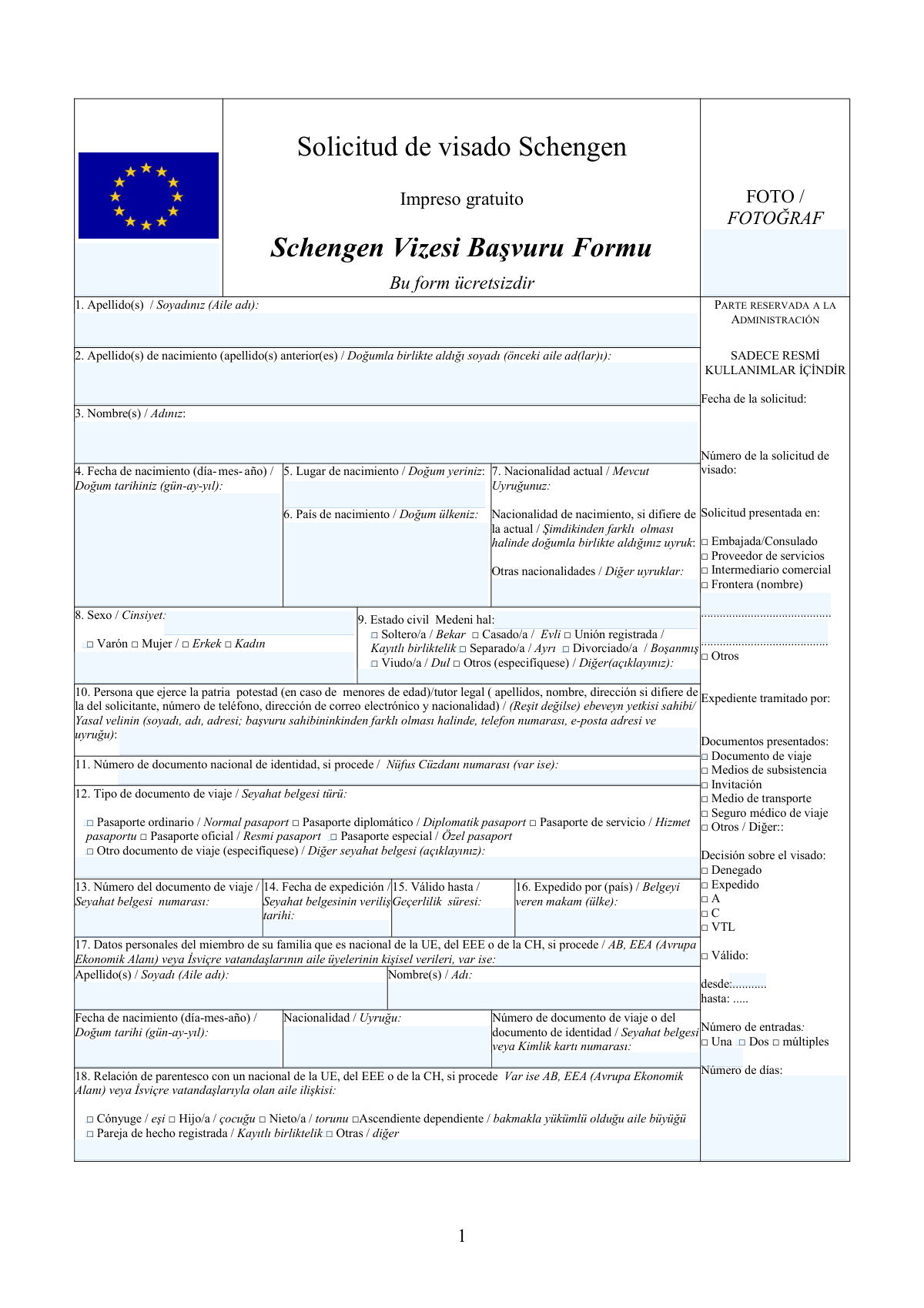
| 1. | Solicitud de visado Schengen, Schengen Visa Application Form | 4 | Moderate 54 |
- Enterprise-grade security & data encryption
- 99%+ accuracy powered by AI
- 1,000+ forms from all industries
- Complete forms in under 60 seconds
How to Choose the Right Form
Understanding the Universal Schengen Form
If you are planning a trip to Europe for less than 90 days, the Solicitud de visado Schengen (Schengen Visa Application Form) is the primary document you need. This standardized form is accepted by all member states within the Schengen Area, including popular destinations like Spain, France, Germany, and Italy. Because this form is used across multiple countries, it is designed to gather comprehensive data regarding your travel history and financial status.
When to Use This Form
The Schengen Visa Application Form is specifically designed for "short-stay" visits. You should choose this form if your travel purpose falls into one of the following categories:
- Tourism and Leisure: Visiting landmarks, vacationing, or exploring multiple European countries.
- Business Travel: Attending corporate meetings, trade fairs, or professional conferences.
- Visiting Family or Friends: Staying with relatives or acquaintances residing in the Schengen Zone.
- Short-term Studies or Research: Participating in educational courses or training programs that last less than three months.
- Airport Transit: Passing through the international zone of a Schengen airport to reach a non-Schengen destination.
Schengen Visa vs. National Visas
It is important to distinguish between a uniform Schengen visa and a National (Type D) visa before you begin filling out your paperwork:
- Select the Schengen Form: If your total stay is 90 days or less within any 180-day period across the entire zone.
- Look Elsewhere: If you intend to work, live, or study in a specific European country for more than 90 days. In these cases, you will typically need a country-specific National Visa form rather than the standard Schengen application.
Completing Your Application
Because the Solicitud de visado Schengen is a multi-language document, it requires precision. Using Instafill.ai, you can easily navigate the fields and ensure your data is legible and correctly formatted. This is especially helpful for the "Purpose of Journey" and "Member State of First Entry" sections, where accuracy is vital for a successful approval.
Form Comparison
| Form | Purpose | Who Files It | Stay Duration |
|---|---|---|---|
| Solicitud de visado Schengen, Schengen Visa Application Form | Applying for short-term entry into any of the 29 Schengen Area member countries. | Non-EU citizens from countries that do not have a visa-waiver agreement with Schengen. | Allows for visits up to 90 days within any 180-day period for tourism or business. |
Tips for European visa forms
Double-check that every entry, especially your name and passport number, matches your travel document exactly. Even minor typos or name variations can lead to processing delays or immediate rejection by consular officers.
If you plan to visit multiple countries, apply through the consulate of the country where you will spend the most time. If stays are equal, use the form for your first point of entry into the Schengen Area to avoid jurisdictional confusion.
AI-powered tools like Instafill.ai can complete these forms in under 30 seconds with high accuracy, saving you from repetitive manual entry. Your data stays secure during the process, making it a reliable choice for handling sensitive travel documents.
Calculate your total days carefully to ensure they do not exceed the 90-day limit within any 180-day period. Providing a clear itinerary that aligns with your requested dates helps demonstrate a well-planned trip to the authorities.
When filling out the section on travel costs, be specific about whether you are self-funding or have a sponsor. Ensure the boxes you check align perfectly with the bank statements or sponsorship letters you intend to submit with your application.
Always save a copy of your completed application before submission for your personal records. Having a reference of exactly what you stated helps you stay consistent during your visa interview and simplifies the process for future renewals.
Frequently Asked Questions
Travelers from non-Schengen countries that do not have a visa-waiver agreement with the European Union must complete these forms. This typically applies to individuals planning short stays for tourism, business, or family visits within the Schengen Area.
You should generally apply to the consulate of the country where you will spend the most time during your trip. If you plan to spend an equal amount of time in multiple countries, you should submit your application to the country that serves as your first point of entry into the Schengen Area.
It is generally recommended to submit your application at least 15 days before your intended travel date, though you can apply up to six months in advance. Applying early is advisable to account for varying processing times at different consulates and embassies.
Yes, AI tools like Instafill.ai can automate the process of filling out European visa forms by accurately extracting data from your source documents and placing it into the correct fields. This technology ensures that complex multi-language forms are completed precisely and are ready for submission.
While requirements vary, most applications require a valid passport, proof of travel insurance, a flight itinerary, and evidence of financial means. You may also need to provide proof of accommodation and a cover letter explaining the purpose of your trip.
When using AI-powered platforms like Instafill.ai, completing a standard European visa form can take under 30 seconds. The system handles the data entry automatically, significantly reducing the time and effort compared to manual typing.
Yes, the Schengen Visa Application Form is a standardized document used by all member countries within the Schengen Area. While the form itself is uniform, the specific supporting documentation or the submission process might vary slightly depending on the individual country's consulate.
A short-stay (Schengen) visa allows for travel within the area for up to 90 days within a 180-day period for purposes like tourism or business. A long-stay national visa is required if you intend to work, study, or live in a specific European country for more than 90 days.
Completed forms are typically submitted to the embassy, consulate, or an officially designated visa application center of the country you intend to visit. Many countries now use third-party service providers to handle the initial collection of forms and biometric data.
Most consulates prefer forms to be typed or completed digitally to ensure legibility and reduce processing errors. Using online tools to generate a clean, printed PDF is often the most reliable way to present your information to consular officers.
Glossary
- Form Complexity Index
- Instafill’s 0–100 measure of how much effort a form takes to complete, calculated deterministically from the form’s own structure rather than estimated. It combines the number of fillable fields (the largest factor), how difficult those fields are to complete based on their type, the number of pages that contain fields, the amount of conditional “fill-only-if” logic, and how many sections the form is divided into, then adds modifiers for tables and repeating lists, bundled instruction pages, and dense page layouts. A higher score means the form is harder to fill out by hand. The forms in this category have a median Form Complexity Index of 54/100 (Moderate). See exactly how it is calculated.
- Schengen Area
- A zone of 29 European countries that have officially abolished all passport and other types of border control at their mutual borders, allowing for seamless travel between member states.
- Short-stay Visa (Type C)
- The most common visa for the Schengen Area, allowing a person to travel for tourism, business, or family visits for up to 90 days within any 180-day period.
- Main Destination
- The specific member state where the applicant intends to spend the most time or where the primary purpose of the trip is located, which determines where the application must be submitted.
- Travel Medical Insurance (TMI)
- A mandatory insurance policy for visa applicants that covers medical emergencies and repatriation with a minimum coverage of €30,000 across all Schengen countries.
- Biometric Data
- Digital fingerprints and a specialized photograph collected during the application process and stored in the Visa Information System (VIS) to verify identity at borders.
- Multiple Entry Visa
- A visa that allows the holder to enter and exit the Schengen Area several times during its validity, provided they do not exceed the 90-day limit within any 180-day window.
- Proof of Subsistence
- Financial documentation, such as bank statements or salary slips, demonstrating that the applicant has enough money to support themselves for the duration of their stay.
- Letter of Invitation
- A formal document provided by a host (friend, family, or company) in the destination country that confirms the applicant's purpose of visit and may include a guarantee of accommodation.