Fill out legal summons forms
with AI.
Legal summons forms serve as the official notice required to initiate a civil action within the judicial system. These documents are fundamental to the principle of due process, ensuring that any individual or entity being sued is formally notified of the allegations against them and informed of their legal obligations. In federal court proceedings, forms such as the AO 440 (Summons in a Civil Action) are mandatory for establishing the court's jurisdiction over a defendant and setting the timeline for a formal response to a complaint.
By continuing, you acknowledge Instafill's Privacy Policy and agree to get occasional product update and promotional emails.
About legal summons forms
Typically, these forms are utilized by plaintiffs or their legal representatives at the very beginning of a lawsuit. Whether you are dealing with a contract dispute, a personal injury claim, or a complex corporate litigation matter, the summons must be prepared with absolute precision. Errors in the defendant’s name or the specific court details can lead to significant procedural delays or even the dismissal of a case. Because these documents require specific, repetitive data, many legal professionals now look for ways to streamline the drafting process while maintaining high standards of accuracy.
To simplify this stage of litigation, tools like Instafill.ai use AI to fill these forms in under 30 seconds, handling sensitive data accurately and securely. This allows users to focus on the merits of their case rather than the administrative burden of manual data entry.
Every form on this page can be completed without typing. Instafill is form filling software that reads a PDF and fills it for you — including flat and scanned documents that carry no fillable fields at all.
Forms in This Category
The forms in this category have a median Form Complexity Index of 46/100 (Moderate), measured across 2 forms by field count, input difficulty, length, conditional logic and structure. See how it is calculated.
| Form Name | Pages | FCI | |
|---|---|---|---|
| 1. | AO 440, Summons in a Civil Action | 2 | Basic 45 |
| 2. | Form FL-115, Proof of Service of Summons (Family Law—Uniform Parentage—Custody and Support) | 1 | Moderate 46 |
- Enterprise-grade security & data encryption
- 99%+ accuracy powered by AI
- 1,000+ forms from all industries
- Complete forms in under 60 seconds
How to Choose the Right Form
Navigating federal legal procedures requires precision, and selecting the correct summons form is the first step in ensuring your civil action proceeds correctly. In this category, the primary focus is on federal civil litigation and the mandatory documentation required to notify defendants of a pending lawsuit.
When to Use Form AO 440
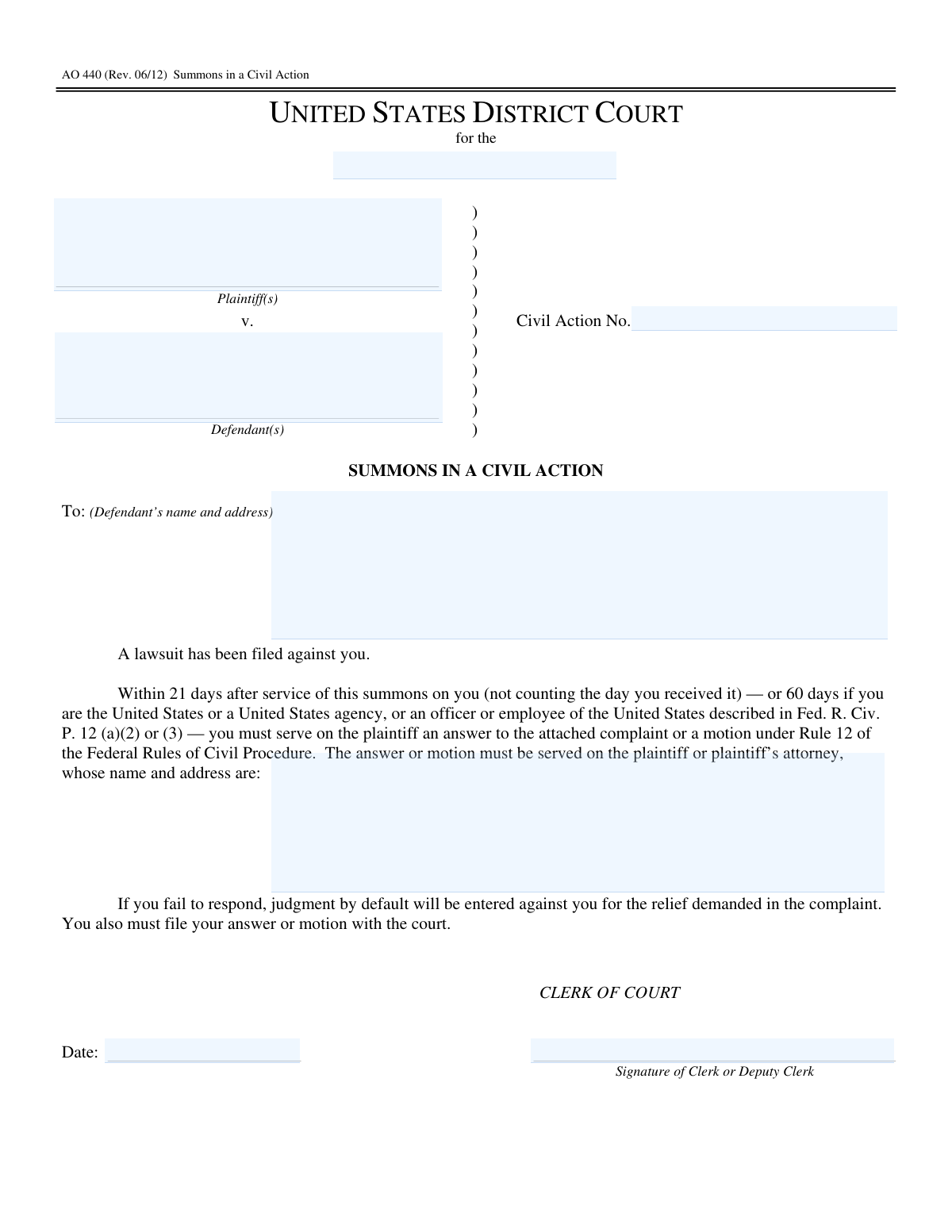
The AO 440, Summons in a Civil Action is the standard document designed for use in United States District Courts. You should select this form if your legal situation meets the following criteria:
- Federal Jurisdiction: Your case is being filed in a federal court rather than a state or local court. Cases involving federal laws, constitutional issues, or parties from different states (diversity jurisdiction) typically require this form.
- Commencing a Lawsuit: You have already filed a formal complaint and now need to provide official notice to the defendant(s) to establish the court's jurisdiction over them.
- Establishing Timelines: You need to clearly communicate the legal deadline—typically 21 days—by which the defendant must file an answer or a motion to avoid a default judgment.
Key Information for the AO 440
To ensure your AO 440 is processed correctly by the court clerk, have the following details ready before using our AI tools:
- The Court Location: The specific federal district and division where the case is filed (e.g., Southern District of New York).
- Case Number: The unique identifier assigned to your case by the clerk’s office.
- Defendant Details: Accurate names and service addresses for each party being served.
Streamlining the Filing Process
Because the AO 440, Summons in a Civil Action is a jurisdictional document, errors in the defendant's name or the court's designation can lead to significant delays or challenges regarding the service of process. Using Instafill’s AI-powered filler helps ensure that all fields are mapped accurately and that the final PDF is professional and legible. If you are working with a non-fillable version provided by a specific district, our AI can also convert it into an interactive format to simplify your preparation.
Form Comparison
| Form | Primary Purpose | Jurisdiction | Who Files It |
|---|---|---|---|
| AO 440, Summons in a Civil Action | Formal notification to defendants of a lawsuit and required response timeframe. | Federal level cases filed within United States District Courts. | The plaintiff or their legal counsel once the complaint is filed. |
Tips for legal summons forms
Double-check that the names of the plaintiff and defendant match exactly what is listed on the formal complaint. Even minor spelling errors or incorrect addresses can lead to significant delays in service or legal challenges regarding the validity of the summons.
Legal summons forms typically specify a strict timeframe, such as 21 or 60 days, for the defendant to respond. Failing to track this date accurately can result in a default judgment, so it is vital to calculate and record the deadline as soon as the form is issued.
After the summons is delivered, the server must complete the Proof of Service section to confirm the defendant was legally notified. Incomplete or incorrectly signed service details are a common reason for courts to reject filing proof, stalling the legal process.
Filling out complex legal forms manually can be time-consuming and prone to human error. AI-powered tools like Instafill.ai can complete these forms in under 30 seconds with high accuracy, ensuring your data stays secure while saving you valuable time during the litigation process.
The information on the summons, including the court location and case number, must perfectly align with the accompanying civil complaint. Organizing these documents together ensures that the court clerk can process your filing without administrative rejections or requests for clarification.
If your lawsuit involves multiple parties, you must generally issue a unique summons for every individual or entity named as a defendant. Grouping multiple defendants onto a single form is a common mistake that can invalidate the service process for the additional parties.
Ensure the summons correctly identifies the specific United States District Court and division where the case is being filed. Using a form for the wrong jurisdiction or failing to specify the correct court branch can lead to the document being returned by the clerk's office.
Frequently Asked Questions
A legal summons, such as Form AO 440, serves as an official notice to a defendant that a lawsuit has been filed against them in a United States District Court. It informs the party of their legal obligation to respond to the complaint within a set timeframe and explains that a default judgment may be entered if they fail to act.
The plaintiff, or the person initiating the lawsuit, is responsible for preparing the summons form. Once the form is completed, it must be presented to the clerk of the court for signature and seal before it can be officially served to the defendant.
This form is required at the commencement of a civil lawsuit in federal court to satisfy the constitutional requirement of due process. It ensures the court has established jurisdiction over the defendant and that the defendant has been properly notified of the claims against them.
The complaint is a document that outlines the legal claims and facts of the case, while the summons is the formal court order notifying the defendant of the action. While they are typically served together, the summons specifically focuses on the deadline and procedure for the defendant's response.
After the clerk signs and seals the summons, it must be 'served' on the defendant according to federal rules of civil procedure. This is usually performed by a professional process server or an individual over 18 who is not a party to the case, and proof of this service must be filed with the court.
If a defendant fails to file a formal response or 'answer' within the timeframe specified on the summons, the plaintiff may request a default judgment. This allows the court to rule in favor of the plaintiff because the defendant failed to contest the allegations within the legal deadline.
Yes, AI-powered tools like Instafill.ai can be used to fill out legal summons forms accurately. These tools can extract data from your existing case documents and place it into the correct fields on the form in under 30 seconds, reducing the risk of manual entry errors.
When using AI automation, completing a standard summons form like the AO 440 takes less than 30 seconds. The process involves uploading your source information, which the AI then uses to populate the PDF fields precisely and efficiently.
Yes, a separate summons form must generally be prepared for each individual or entity named as a defendant in the lawsuit. Each party is entitled to their own formal notice to ensure they are individually informed of the legal proceedings and their specific obligations.
Yes, the summons must include the name and address of the court where the action is being filed, as well as the name and address of the plaintiff's attorney or the plaintiff themselves if they are representing themselves. This ensures the defendant knows exactly where to send their legal response.
Glossary
- Form Complexity Index
- Instafill’s 0–100 measure of how much effort a form takes to complete, calculated deterministically from the form’s own structure rather than estimated. It combines the number of fillable fields (the largest factor), how difficult those fields are to complete based on their type, the number of pages that contain fields, the amount of conditional “fill-only-if” logic, and how many sections the form is divided into, then adds modifiers for tables and repeating lists, bundled instruction pages, and dense page layouts. A higher score means the form is harder to fill out by hand. The forms in this category have a median Form Complexity Index of 46/100 (Moderate). See exactly how it is calculated.
- Service of Process
- The formal procedure of delivering legal documents, such as a summons and complaint, to a defendant to ensure they are legally notified of a lawsuit.
- Default Judgment
- A binding court ruling issued in favor of the plaintiff when a defendant fails to respond to a summons or appear in court within the legally required timeframe.
- Plaintiff
- The person or entity that initiates a lawsuit by filing a complaint and requesting a summons from the court.
- Defendant
- The individual, company, or organization being sued or served with a summons to answer a legal claim.
- Proof of Service
- A document filed with the court, often on the back of the AO 440 form, that provides sworn evidence that the summons was correctly delivered to the defendant.
- Complaint
- The initial legal document filed alongside the summons that outlines the facts of the case and the specific legal claims against the defendant.
- Waiver of Service
- A formal agreement where the defendant voluntarily acknowledges the lawsuit and agrees to forgo formal delivery of the summons by a process server.
- Answer
- The formal written response the defendant must file with the court after receiving a summons to address the allegations made in the complaint.