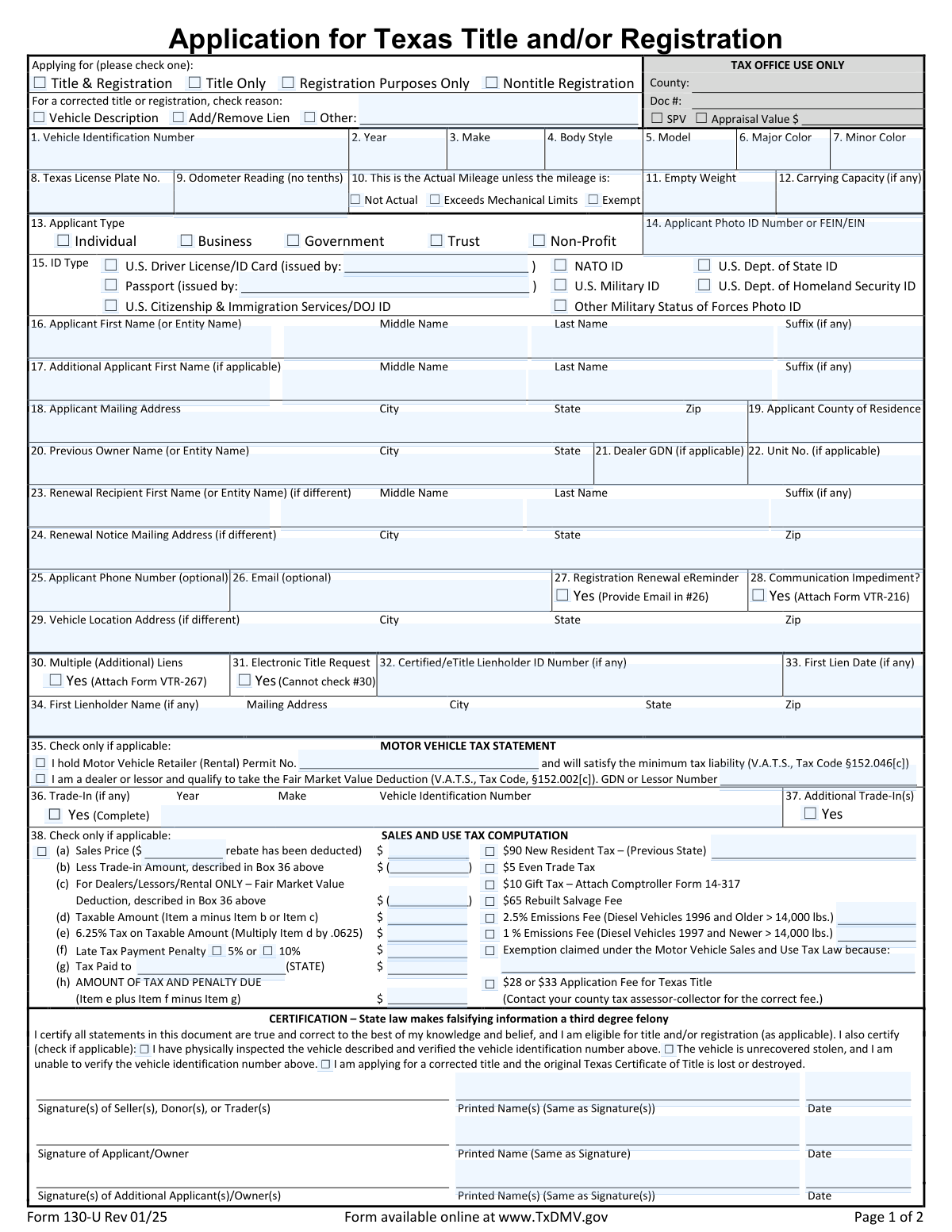
Yes! You can use AI to fill out Form 130-U, Application for Texas Title and/or Registration
Form 130-U, the Application for Texas Title and/or Registration, is the official document used in Texas to apply for a vehicle title, registration, or both. Submitting this form is essential for establishing legal ownership of a vehicle, transferring ownership, or registering a vehicle brought in from another state. Completing this multi-section form accurately is critical for avoiding delays and penalties. Today, this form can be filled out quickly and accurately using AI-powered services like Instafill.ai, which can also convert non-fillable PDF versions into interactive fillable forms.
Form 130-U is part of the
registration forms, Texas title forms and title application forms categories on Instafill.
Our AI automatically handles information lookup, data retrieval, formatting, and form filling.
It takes less than a minute to fill out Form 130-U using our AI form filling.
Securely upload your data. Information is encrypted in transit and deleted immediately after the form is filled out.
Form specifications
| Form name: | Form 130-U, Application for Texas Title and/or Registration |
| Number of fields: | 98 |
| Number of pages: | 1 |
| Filled form examples: | Form Form 130-U Examples |
| Language: | English |
More forms in Registration forms
Instafill Demo: How to fill out PDF forms in seconds with AI
How to Fill Out Form 130-U Online for Free in 2026
Are you looking to fill out a FORM 130-U form online quickly and accurately? Instafill.ai offers the #1 AI-powered PDF filling software of 2026, allowing you to complete your FORM 130-U form in just 37 seconds or less.
Follow these steps to fill out your FORM 130-U form online using Instafill.ai:
- 1 Navigate to Instafill.ai and upload or select the Form 130-U, Application for Texas Title and/or Registration.
- 2 Provide vehicle details such as the VIN, year, make, model, and odometer reading in the designated fields.
- 3 Enter the applicant's personal information, including name, address, and a valid form of photo ID number.
- 4 Complete the lienholder information section if the vehicle is financed, providing the lienholder's name and address.
- 5 Fill out the Motor Vehicle Tax Statement, calculating the sales and use tax due based on the sales price and any trade-ins.
- 6 Review all entered information for accuracy, then use the AI tool to generate the completed form for printing and signing by all required parties (applicant, seller, etc.).
- 7 Submit the signed form along with any required fees and supporting documents to your local county tax assessor-collector's office.
Our AI-powered system ensures each field is filled out correctly, reducing errors and saving you time.
Why Choose Instafill.ai for Your Fillable Form 130-U Form?
Speed
Complete your Form 130-U in as little as 37 seconds.
Up-to-Date
Always use the latest 2026 Form 130-U form version.
Cost-effective
No need to hire expensive lawyers.
Accuracy
Our AI performs 10 compliance checks to ensure your form is error-free.
Security
Your personal information is protected with bank-level encryption.
Frequently Asked Questions About Form Form 130-U
This form is used to apply for a Texas vehicle title, registration, or both. It is required when you purchase a vehicle, move to Texas with your vehicle, or need to make corrections to an existing Texas title.
The new owner (applicant) of the vehicle must complete and sign the form. For private sales, the seller or donor must also sign the application to certify the transfer of ownership.
You must submit the completed application to your county tax assessor-collector's office within 30 days of the vehicle purchase date or of establishing Texas residency to avoid late penalties.
You will need the completed form, a government-issued photo ID, proof of ownership (like the original title signed over to you), and proof of Texas liability insurance. Additional documents may be required depending on the transaction, such as a gift affidavit or lien information.
New residents must apply for a Texas title and registration within 30 days. You will need to get your vehicle inspected, complete this form, and pay a $90 new resident tax instead of the standard 6.25% sales tax.
If you receive a vehicle as a gift from an immediate family member, you will owe a $10 gift tax. You must also complete and attach the Comptroller's Affidavit of Motor Vehicle Gift Transfer (Form 14-317), signed by both you and the donor.
SPV applies to private-party sales of used vehicles and is used to calculate sales tax. The tax is computed on the greater of the sales price or 80% of the vehicle's SPV, which helps ensure a fair tax assessment based on the vehicle's market value.
Enter the mileage as shown on the odometer in Box 9. In Box 10, you must check the 'Not Actual' or 'Exceeds Mechanical Limits' box to accurately reflect the status of the vehicle's mileage.
The completed application and all supporting documents must be submitted in person to your local county tax assessor-collector's office. Payment for taxes and fees is due at the time of submission.
Yes, services like Instafill.ai use AI to help you accurately auto-fill form fields, which can save time and reduce errors. This ensures all required information is entered correctly before you print and sign.
Simply upload the Form 130-U PDF to the Instafill.ai platform. The AI will identify the fields, allowing you to type your information directly into the interactive form before downloading the completed document for printing and signing.
You can use a service like Instafill.ai, which can convert flat, non-fillable PDFs into interactive, fillable forms. This allows you to easily type your information on the computer before printing the completed document for submission.
You should check the 'Registration Purposes Only' box at the top of the form. This allows you to register and operate the vehicle in Texas without surrendering your out-of-state title and being issued a new Texas title.
Checking the 'Electronic Title Request' box means you are opting to have your title held securely in the TxDMV database instead of receiving a paper certificate. This is not an option if there are multiple liens on the vehicle.
Compliance Form 130-U
Validation Checks by Instafill.ai
1
Validates Vehicle Identification Number (VIN) Format
This check ensures the 'Vehicle Identification Number' in field 1 is exactly 17 characters long and contains only valid alphanumeric characters (0-9, A-Z, excluding I, O, and Q in certain positions). The VIN is a unique global identifier for the vehicle, and an incorrect VIN will lead to a failed registration or title application. If the validation fails, the user must be prompted to correct the VIN before submission.
2
Ensures Exclusive Application Type Selection
This validation verifies that the applicant has selected one and only one checkbox from the 'Applying for' section (e.g., 'Title & Registration', 'Title Only'). Selecting none would result in an incomplete application, while selecting multiple would create ambiguity. If this check fails, the form should display an error message requiring the user to select a single, specific application type.
3
Requires Email for eReminder Subscription
This check confirms that if the 'Registration Renewal eReminder' checkbox (field 27) is marked 'Yes', the 'Applicant Email Address' field (field 26) is not empty and contains a validly formatted email address. This is crucial for ensuring the applicant can receive the requested electronic notifications. If the email field is empty or invalid, the system should prevent submission and highlight the email field for correction.
4
Prevents Conflicting Lien Selections
This validation enforces the rule that the 'Electronic Title Request' checkbox (field 31) and the 'Multiple (Additional) Liens' checkbox (field 30) cannot be checked simultaneously, as noted on the form. This prevents a logical contradiction in the application data. If a user attempts to check both, an immediate error should be displayed, forcing them to choose only one of the two options.
5
Verifies Trade-In Details are Provided
This check ensures that if the 'Trade-In (if any)' checkbox is selected, the corresponding 'Trade-In Vehicle Description' fields (Year, Make, and Vehicle Identification Number) are all filled out. This information is required to process the trade-in and correctly calculate sales tax. If the trade-in box is checked but the details are missing, the application should be flagged as incomplete.
6
Validates First Lien Date Format and Logic
This check verifies that the 'First Lien Date' (field 33), if provided, is in a valid date format (e.g., MM/DD/YYYY) and is not a future date. An invalid or future date is not logically possible for a lien that has already been established. Failure of this validation should prompt the user to enter a valid past or present date.
7
Requires Previous State for New Resident Tax
This validation ensures that if the '$90 New Resident Tax' checkbox is selected in the tax computation section, the associated '(Previous State)' text field is filled out. This information is necessary to confirm eligibility for the new resident tax rate. If the checkbox is selected but the state is missing, the system should prompt the user to provide the name of the previous state of registration.
8
Validates Applicant ID Number based on Applicant Type
This check ensures the 'Applicant Photo ID Number or FEIN/EIN' (field 14) corresponds to the 'Applicant Type' (field 13). If 'Individual' is selected, the ID should match a personal ID format; if 'Business,' 'Government,' 'Trust,' or 'Non-Profit' is selected, the ID should be validated as a Federal Employer Identification Number (FEIN/EIN). This ensures the correct type of identification is recorded for the legal entity applying, and a mismatch should trigger an error.
9
Verifies Sales Tax Calculation
This check automatically calculates and verifies the values in the 'SALES AND USE TAX COMPUTATION' section. It should confirm that the 'Taxable Amount' (Item d) correctly equals the 'Sales Price' (Item a) minus the 'Trade-in Amount' (Item b) or 'Fair Market Value Deduction' (Item c). It should also verify that '6.25% Tax on Taxable Amount' (Item e) is the correct result of multiplying Item d by 0.0625. If the calculation is incorrect, the system should flag the error for review or correction.
10
Requires Reason for 'Other' Correction
This validation confirms that if the 'Other' checkbox is selected under the 'corrected title or registration' section, the adjacent text field for specifying the reason is not left empty. This ensures that the reason for the correction is properly documented and understood by the processing agency. If the checkbox is ticked but the reason is missing, the user should be required to provide a description.
11
Validates Odometer Reading and Status
This check ensures the 'Odometer Reading' (field 9) is a numerical value and contains no tenths, as specified. It also checks for logical consistency; for example, if the vehicle year suggests it is a very new model, an 'Exceeds Mechanical Limits' status might be flagged for review. An invalid format should prevent submission, while a logical inconsistency could raise a warning.
12
Ensures Attachment for Gift Tax
This validation checks if the '$10 Gift Tax' box is selected. If it is, the system should generate a notification or requirement flag indicating that the 'Comptroller Form 14-317' must be attached to the submission. This serves as a procedural check to prevent applications from being submitted without mandatory supporting documentation, which would cause processing delays or rejection.
13
Validates Diesel Emissions Fee Logic
This check verifies that the correct emissions fee is selected based on the vehicle's model year. If the 'Vehicle Year' (field 2) is 1996 or older, only the '2.5% Emissions Fee' checkbox should be selectable. If the year is 1997 or newer, only the '1% Emissions Fee' checkbox should be selectable. This prevents incorrect fee assessment based on the rules stated on the form.
14
Validates Signature Date Logic
This check ensures that the 'Applicant/Owner Signature Date' is a valid date and is not in the future. Furthermore, it should be on or after the 'First Lien Date' (field 33), if one is provided. This maintains the logical timeline of events recorded on the form. An invalid date should trigger an error and require correction before the form can be finalized.
Common Mistakes in Completing Form 130-U
Applicants often miscalculate the motor vehicle tax due in the 'Sales and Use Tax Computation' section. This happens because they are unsure whether to apply the standard 6.25% tax, the $90 New Resident Tax, the $10 Gift Tax, or if they qualify for an exemption. Incorrect calculations, especially regarding the use of Standard Presumptive Value (SPV) for private sales, will lead to the application being rejected by the tax office, requiring resubmission with the correct payment and causing significant delays.
This form requires original signatures from the applicant(s) and the seller(s). A common mistake is forgetting to obtain the seller's signature at the time of sale, which can be difficult to get later. Another error is having signatures that do not match the printed names or the names on the supporting ID. Missing or invalid signatures will immediately invalidate the application, halting the title and registration process until all parties have correctly signed.
The 17-digit Vehicle Identification Number (VIN) is frequently entered with transposed letters or numbers. This is a critical error because the VIN is the unique identifier for the vehicle. A mistake in the VIN will result in a title being issued for the wrong vehicle or the application being rejected, requiring a new form and potentially a vehicle inspection to verify the correct VIN. Double-check the VIN against the vehicle's VIN plate and the seller's title document.
In field 9, applicants often include the tenths of a mile, even though the instructions specify 'no tenths.' Furthermore, they may fail to check the appropriate box if the mileage is 'Not Actual' or 'Exceeds Mechanical Limits.' An incorrect odometer statement is a federal offense and can lead to legal penalties, as well as rejection of the form. It is crucial to accurately report the mileage as whole numbers and certify its status correctly.
The applicant's name entered in field 16 must exactly match the name on the government-issued photo ID provided. People often use nicknames, omit middle names, or have slight variations that cause a mismatch. This discrepancy will cause the tax office to reject the application for identity verification reasons. To avoid this, ensure the full legal name is used, precisely as it appears on the driver's license or passport being presented.
When a vehicle is financed, applicants often fail to provide the complete and correct lienholder information in fields 32-34. This includes the lienholder's full name, mailing address, and the specific Lienholder ID Number. Missing or inaccurate data prevents the state from properly recording the lien, which means the lender's interest is not secured and the title cannot be issued correctly, causing major delays for all parties. This information should be obtained from the loan agreement.
This application frequently requires other forms or documents to be submitted with it. For example, a gift transfer requires Comptroller Form 14-317, and declaring a communication impediment requires Form VTR-216. Applicants often overlook these requirements, leading to an incomplete submission. Always review the entire form for mentions of required attachments to ensure you arrive at the tax office with all necessary paperwork.
Applicants who trade in a vehicle as part of the purchase often forget to complete the 'Trade-In' section (Box 36). Failing to provide the year, make, and VIN of the trade-in means the trade-in allowance cannot be deducted from the sales price. This results in the applicant paying a significantly higher amount of sales tax than necessary. To avoid overpayment, this section must be filled out completely if a trade-in is part of the transaction.
At the top of the form, applicants must select the purpose of the application, such as 'Title & Registration,' 'Title Only,' or 'Registration Purposes Only.' Many people do not understand the specific legal and practical differences between these options. For example, selecting 'Title Only' when you intend to drive the vehicle on public roads is a mistake that will require another visit to the tax office to apply for registration. Understanding these distinctions is key to a smooth process.
The form asks for multiple addresses, including the applicant's mailing address (18), county of residence (19), and vehicle location address (29). A common error is confusing these fields, especially if the applicant uses a P.O. Box or if the vehicle is kept at a different location. This can lead to renewal notices and other official correspondence being sent to the wrong place. AI-powered tools like Instafill.ai can help prevent these errors by auto-filling and validating address information. If the form is a non-fillable PDF, Instafill.ai can also convert it into an interactive, fillable version.
Saved over 80 hours a year
“I was never sure if my IRS forms like W-9 were filled correctly. Now, I can complete the forms accurately without any external help.”
Kevin Martin Green
Your data stays secure with advanced protection from Instafill and our subprocessors

Robust compliance program
Transparent business model
You’re not the product. You always know where your data is and what it is processed for.
ISO 27001, HIPAA, and GDPR
Our subprocesses adhere to multiple compliance standards, including but not limited to ISO 27001, HIPAA, and GDPR.
Security & privacy by design
We consider security and privacy from the initial design phase of any new service or functionality. It’s not an afterthought, it’s built-in, including support for two-factor authentication (2FA) to further protect your account.
Fill out Form 130-U with Instafill.ai
Worried about filling PDFs wrong? Instafill securely fills form-130-u-application-for-texas-title-andor-registration-1 forms, ensuring each field is accurate.