Yes! You can use AI to fill out Affidavit of Death for Transferring Title on Property Listed in a Transfer on Death Deed

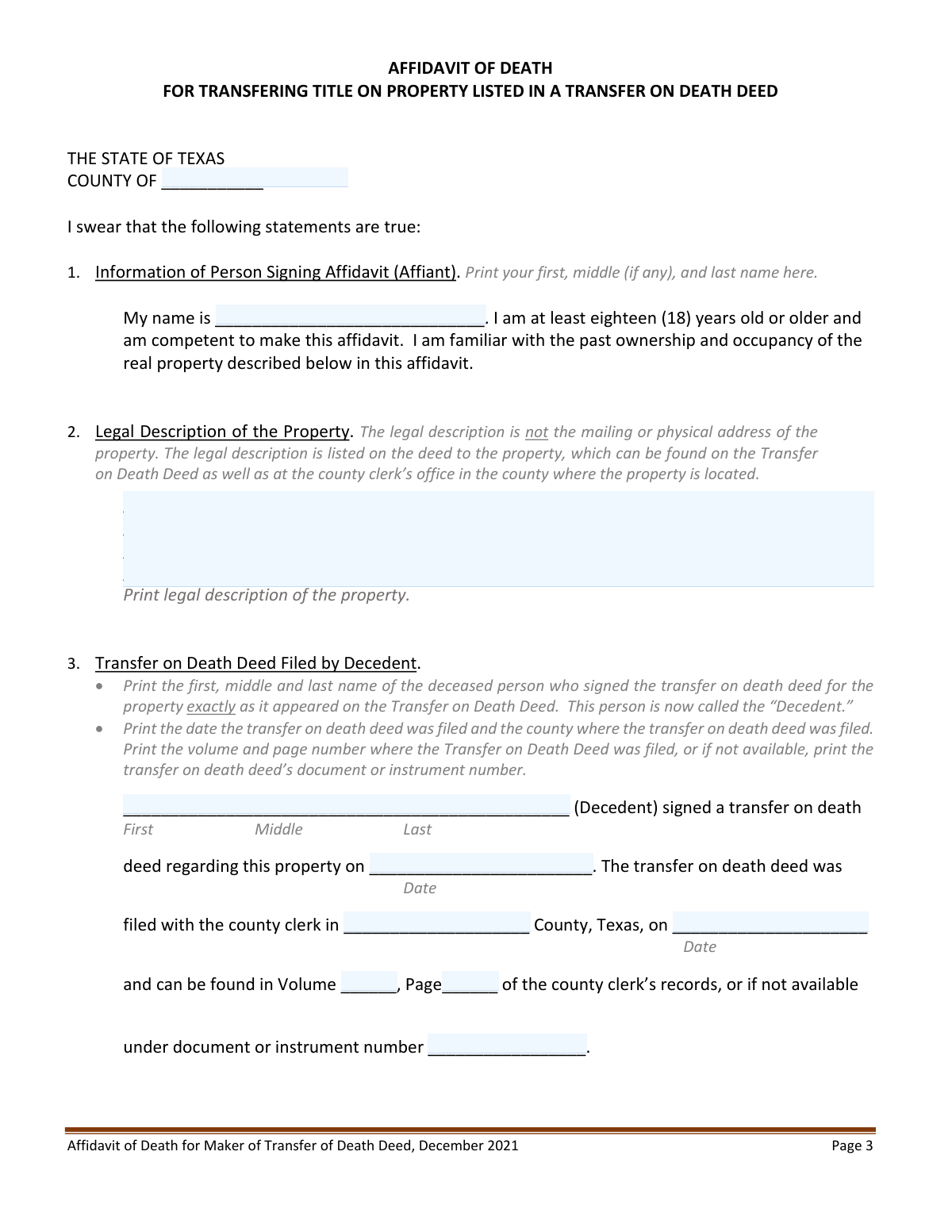
An Affidavit of Death is a sworn statement filed to formally record the death of a property owner and transfer title to the beneficiary named in a pre-existing Transfer on Death Deed. This form is crucial in Texas for the beneficiary to gain legal ownership, without which they cannot sell the property, get tax exemptions, or use it as collateral. Today, this form can be filled out quickly and accurately using AI-powered services like Instafill.ai, which can also convert non-fillable PDF versions into interactive fillable forms.
Affidavit of Death (Texas) is part of the property transfer forms, Texas title forms, title transfer forms and transfer on death forms categories on Instafill.
Our AI automatically handles information lookup, data retrieval, formatting, and form filling.
It takes less than a minute to fill out Affidavit of Death (Texas) using our AI form filling.
Securely upload your data. Information is encrypted in transit and deleted immediately after the form is filled out.

Form specifications

Form name: Affidavit of Death for Transferring Title on Property Listed in a Transfer on Death Deed
Number of fields: 42
Number of pages: 1
Language: English
main-image

Instafill Demo: How to fill out PDF forms in seconds with AI

How to Fill Out Affidavit of Death (Texas) Online for Free in 2026

Are you looking to fill out a AFFIDAVIT OF DEATH (TEXAS) form online quickly and accurately? Instafill.ai offers the #1 AI-powered PDF filling software of 2026, allowing you to complete your AFFIDAVIT OF DEATH (TEXAS) form in just 37 seconds or less.
Follow these steps to fill out your AFFIDAVIT OF DEATH (TEXAS) form online using Instafill.ai:
  1. 1 Navigate to Instafill.ai and upload the Texas Affidavit of Death form or select it from the template library.
  2. 2 Provide your personal information as the Affiant (the person signing the affidavit).
  3. 3 Enter the full legal description of the property exactly as it appears on the original Transfer on Death Deed.
  4. 4 Input the details of the deceased person (the Decedent) and information about the original Transfer on Death Deed, such as filing date and location.
  5. 5 Review all the information auto-populated by the AI for accuracy, including names, dates, and property details.
  6. 6 Download the completed form. Do not sign it yet; you must sign it in the presence of a notary.
  7. 7 Take the unsigned form to a notary public for signature and acknowledgement, then file the original, notarized affidavit with the county clerk where the property is located.

Our AI-powered system ensures each field is filled out correctly, reducing errors and saving you time.

Why Choose Instafill.ai for Your Fillable Affidavit of Death (Texas) Form?

Speed

Complete your Affidavit of Death (Texas) in as little as 37 seconds.

Up-to-Date

Always use the latest 2026 Affidavit of Death (Texas) form version.

Cost-effective

No need to hire expensive lawyers.

Accuracy

Our AI performs 10 compliance checks to ensure your form is error-free.

Security

Your personal information is protected with bank-level encryption.

Frequently Asked Questions About Form Affidavit of Death (Texas)

This form is used by a named beneficiary to claim legal ownership of a property after the owner who created a Transfer on Death Deed has passed away. Filing this affidavit is required to officially transfer the property's title to the beneficiary.

A named beneficiary on a Transfer on Death Deed must fill out this form after the property owner has died. The person completing and signing the affidavit is known as the 'affiant'.

The legal title to the property will not transfer to you. Without legal title, you cannot sell the property, get property tax exemptions, or use the property as collateral for a loan.

The legal description is on the original Transfer on Death Deed and the property's main deed, not the mailing address. You can get a copy from the county clerk’s office where the property is located to ensure it is entered correctly.

If the file-stamped copy of the deed does not have a volume and page number, you should use the instrument or document number instead. This information can be found on a copy of the deed obtained from the county clerk's office.

Yes, it is mandatory. Do not sign or date the Affidavit of Death until you are physically present before a notary public, who will then complete the acknowledgement section.

You must file the original, notarized Affidavit of Death with the county clerk's office in the county where the property is located. Be sure to bring a copy for your records, personal identification, and money for the filing fee.

An alternate beneficiary can only inherit the property if all primary beneficiaries died before the property owner or within 120 hours of the owner's death. If any primary beneficiary survives past that 120-hour period, they will inherit the property.

No. After filing the affidavit, you will still need to provide other acceptable proof of death, like a death certificate, to a title company before you can sell the property or use it as collateral.

You should enter the name and mailing address of the beneficiary who is the new property owner. The county clerk will mail the recorded affidavit back to this address.

Yes, services like Instafill.ai use AI to auto-fill form fields accurately and save time. This can help you complete the form with greater efficiency and fewer errors before printing it for notarization.

Simply upload the Affidavit of Death PDF to the Instafill.ai platform. The AI will make the document interactive, allowing you to easily provide your information to auto-fill the fields before you download and print it.

You can use a service like Instafill.ai, which is designed to convert flat, non-fillable PDFs into interactive forms. This allows you to type your information directly into the fields on your computer.

Compliance Affidavit of Death (Texas)
Validation Checks by Instafill.ai

1
Ensures Date of Death is Chronologically Correct
This validation confirms that the Decedent's Date of Death is not a future date. It is a critical check to prevent fraudulent or erroneous filings based on anticipated events. If a future date is entered, the form submission will be rejected, as an affidavit of death can only be filed for a death that has already occurred.
2
Verifies Date of Death is After TODD Filing Date
This check ensures the Decedent's Date of Death occurred on or after the date the Transfer on Death Deed (TODD) was filed. A TODD is only effective if the owner dies after the deed has been properly recorded. An affidavit filed for a death that occurred before the deed was filed would be legally invalid, so this check prevents the creation of a void instrument.
3
Confirms TODD Filing Date is After Signing Date
This validation checks that the date the Transfer on Death Deed was filed with the county clerk is on or after the date it was signed by the Decedent. It is logically impossible to file a legal document before it has been signed. This check prevents simple data entry errors that could call the validity of the filing into question.
4
Requires Legal Description of Property
This check verifies that the 'Legal Description of the Property' field is not empty. The legal description is the only way to uniquely and officially identify the real property being transferred. Without it, the affidavit is meaningless and cannot be used to transfer title, so this field is mandatory for the document to have any legal effect.
5
Mandates County Clerk Record Identifier
This validation ensures that the user provides either a Document/Instrument Number, or both a Volume and Page Number. These numbers are essential for locating the original Transfer on Death Deed in the county's public records. Failure to provide a valid identifier makes it impossible to link this affidavit to the correct deed, rendering the filing ineffective.
6
Validates Paired Entry for Volume and Page Numbers
This check ensures that if a 'Volume Number' is provided, a 'Page Number' is also provided, and vice-versa. Volume and page numbers are always used as a pair to locate a document in older record-keeping systems. An incomplete pair is unusable, so this validation prevents submission with partial, un-actionable information.
7
Requires Full Decedent Name
This check confirms that the Decedent's full name field is not left blank. The name must match the name on the original Transfer on Death Deed to establish a clear chain of title. An affidavit without the Decedent's name is invalid and cannot be processed by the county clerk or a title company.
8
Ensures Completeness of Place of Death
This validation verifies that the City, County, and State fields for the Decedent's place of death are all filled in. This information is a required component of the official record and is often used for cross-referencing with a death certificate. Incomplete information can lead to delays or rejection of the affidavit.
9
Requires Beneficiary Name for Document Return
This check ensures the 'Beneficiary's Name' field in the 'After recording, please return to' section is not empty. The county clerk uses this information to mail the officially recorded document back to the new property owner. Without a name, the document could be lost, depriving the beneficiary of the official proof of their new title.
10
Validates Beneficiary Mailing Address Completeness
This validation confirms that the beneficiary's street address and city/state/zip fields are filled out. A complete address is necessary for the county clerk to return the recorded affidavit. If the address is incomplete, the beneficiary may not receive the document, which is their proof of ownership.
11
Validates Date of Death Format
This check ensures that the provided Month, Day, and Year for the Decedent's death form a valid calendar date (e.g., not February 30). Using separate fields for date components can lead to invalid combinations. This validation prevents the recording of a legally nonsensical date on a public document.
12
Validates TODD Filed Date Format
This check ensures the 'Date Filed' for the Transfer on Death Deed is a valid date in a recognized format (e.g., MM/DD/YYYY). An invalid date format would be rejected by the system to prevent recording incorrect or ambiguous data. This maintains the integrity of the information being entered into the public record.
13
Requires TODD Filing County
This validation ensures the 'County' where the Transfer on Death Deed was filed is specified. The property's location determines the correct county for filing, and this information is crucial for locating the original deed. An affidavit without the county is incomplete and cannot be processed.
14
Validates Beneficiary ZIP Code Format
This check verifies that the ZIP code provided in the beneficiary's mailing address is a valid 5-digit or 9-digit (ZIP+4) number. A correct ZIP code is essential for efficient mail delivery by the USPS. This validation helps ensure the recorded document is successfully returned to the beneficiary without postal delays or errors.

Common Mistakes in Completing Affidavit of Death (Texas)

Signing the Affidavit Before a Notary is Present

This mistake occurs when the affiant signs and dates the document before meeting with the notary public. The entire purpose of notarization is for the notary to witness the act of signing. A pre-signed document cannot be legally notarized, rendering the affidavit invalid and causing it to be rejected by the county clerk, which delays the entire property transfer process. To avoid this, do not sign or date the form until you are physically in front of the notary and they instruct you to do so.

Using a Mailing Address Instead of the Legal Property Description

People often mistakenly write the property's street address in the 'Legal Description' section, but these are not the same. The legal description is a specific, formal description used in public records to locate the property. An incorrect legal description can cause the affidavit to be rejected or, worse, create a 'cloud on the title,' which is a serious legal issue that requires lawyers to resolve. To prevent this, you must copy the legal description exactly as it appears on the original Transfer on Death Deed.

Entering an Inconsistent or Incorrect Decedent Name

The affiant may use a common nickname, a shortened version of the name, or misspell the name of the deceased person (the 'Decedent'). The form requires the Decedent's name to be written exactly as it appeared on the original Transfer on Death Deed to ensure a clear and unbroken chain of title in the county records. Any discrepancy can lead to the filing being rejected or creating ambiguity in the property records, requiring further legal action to correct.

Providing Incomplete or Incorrect TODD Filing Information

In Section 3, the form requires the volume, page, and/or instrument number where the original Transfer on Death Deed (TODD) was filed. Affiants often struggle to find this information or transcribe it incorrectly. This reference number is the county clerk's primary method for linking the affidavit to the original deed. Without this exact information, the affidavit cannot be properly indexed, rendering the filing ineffective and preventing the legal transfer of the property title.

Confusing the Various Date Fields on the Form

The affidavit requires several different dates: the date the TODD was signed, the date it was filed, the date of death, and the date the affidavit itself is signed. It is easy to get these dates mixed up or enter them in the wrong fields. An incorrect date can invalidate the legal timeline of events, causing the county clerk to question or reject the document and delay the transfer of ownership. Always gather all source documents (the TODD, death certificate) beforehand to ensure each date is entered accurately.

Submitting the Form with Illegible Handwriting

Since this is a non-fillable PDF that will likely be printed and filled out by hand, illegible handwriting is a common problem, especially in the complex legal description section. If the county clerk cannot read the names, dates, or property description, they may refuse to record the document. Even if recorded, errors from misinterpretation can create significant title defects that are expensive to fix later. To avoid this, print clearly in block letters or use a tool like Instafill.ai, which can convert the non-fillable PDF into a typed, perfectly legible, and fillable version.

Incorrectly Filling Out the Notary Section

The section titled 'Acknowledgement and Affidavit' is clearly marked 'FOR NOTARY TO COMPLETE'. However, some individuals mistakenly attempt to fill this section out themselves, assuming they must complete every box on the page. This action invalidates the notarization, as this section is legally reserved for the notary public to fill out and stamp. A document with a user-filled notary block will be immediately rejected, requiring the affiant to start the process over with a new form.

Filing the Instruction Pages with the Affidavit

The document includes two pages of detailed instructions followed by the two-page affidavit form. In a rush or due to oversight, people sometimes submit all four pages to the county clerk for filing. This clutters the official public record with unnecessary information and increases the filing fees, which are typically charged on a per-page basis. To avoid this, carefully separate the instruction pages (pages 1-2) and only bring the completed, notarized affidavit itself (pages 3-4) for filing.

Omitting or Using an Incorrect 'After Recording, Return to' Address

This section dictates where the county clerk will mail the official, stamped copy of the affidavit after it has been recorded. Affiants may forget to fill this out or enter an old or incomplete mailing address for the beneficiary. This can result in the official proof of new ownership being lost in the mail or severely delayed, creating problems if the beneficiary needs to sell the property, get a loan, or prove ownership. Always double-check that the beneficiary's full, current mailing address is entered correctly.

Entering the Wrong County in the Deed Information Section

The form requires the name of the county where the Transfer on Death Deed was filed, which must be the county where the property is located. An affiant might mistakenly enter the county where they live or where the decedent died, if different. Filing an affidavit that references the wrong county records makes it completely ineffective for the intended property. This critical error will stop the title transfer process entirely, as the document will not be linked to the correct property's chain of title.
Saved over 80 hours a year

“I was never sure if my IRS forms like W-9 were filled correctly. Now, I can complete the forms accurately without any external help.”

Kevin Martin Green

Your data stays secure with advanced protection from Instafill and our subprocessors

Robust compliance program

Transparent business model

You’re not the product. You always know where your data is and what it is processed for.

ISO 27001, HIPAA, and GDPR

Our subprocesses adhere to multiple compliance standards, including but not limited to ISO 27001, HIPAA, and GDPR.

Security & privacy by design

We consider security and privacy from the initial design phase of any new service or functionality. It’s not an afterthought, it’s built-in, including support for two-factor authentication (2FA) to further protect your account.

Fill out Affidavit of Death (Texas) with Instafill.ai

Worried about filling PDFs wrong? Instafill securely fills affidavit-of-death-for-transferring-title-on-property-listed-in-a-transfer-on-death-deed forms, ensuring each field is accurate.