Fill out Texas title forms
with AI.
Texas title forms are the essential legal documents required to establish vehicle ownership and maintain proper registration within the state. Managed by the Texas Department of Motor Vehicles (TxDMV), these forms ensure that every vehicle on the road is accurately accounted for and that the state's motor vehicle records remain up to date. Completing these documents correctly is vital for calculating appropriate taxes and fees, as well as securing a clean legal title that protects the interests of both buyers and sellers.
By continuing, you acknowledge Instafill's Privacy Policy and agree to get occasional product update and promotional emails.
About Texas title forms
Most residents encounter these forms during significant life events, such as purchasing a new or used vehicle, moving to Texas from another state, or transferring a vehicle title to a family member. Situations involving the sale of a private vehicle or the registration of an out-of-state car require specific documentation, most notably the Application for Texas Title and/or Registration (Form 130-U). Having the right paperwork ready is the first step in a smooth transition at the county tax office or DMV.
Navigating government paperwork can be time-consuming, but modern digital solutions have streamlined the process significantly. Tools like Instafill.ai use AI to fill these Texas vehicle forms in under 30 seconds, handling sensitive data accurately and securely. This practical approach allows you to complete your registration requirements quickly and reduces the likelihood of errors that could delay your title processing.
Every form on this page can be completed without typing. Instafill is form filling software that reads a PDF and fills it for you — including flat and scanned documents that carry no fillable fields at all.
Forms in This Category
The forms in this category have a median Form Complexity Index of 60/100 (Moderate), measured across 2 forms by field count, input difficulty, length, conditional logic and structure. See how it is calculated.
| Form Name | Pages | FCI | |
|---|---|---|---|
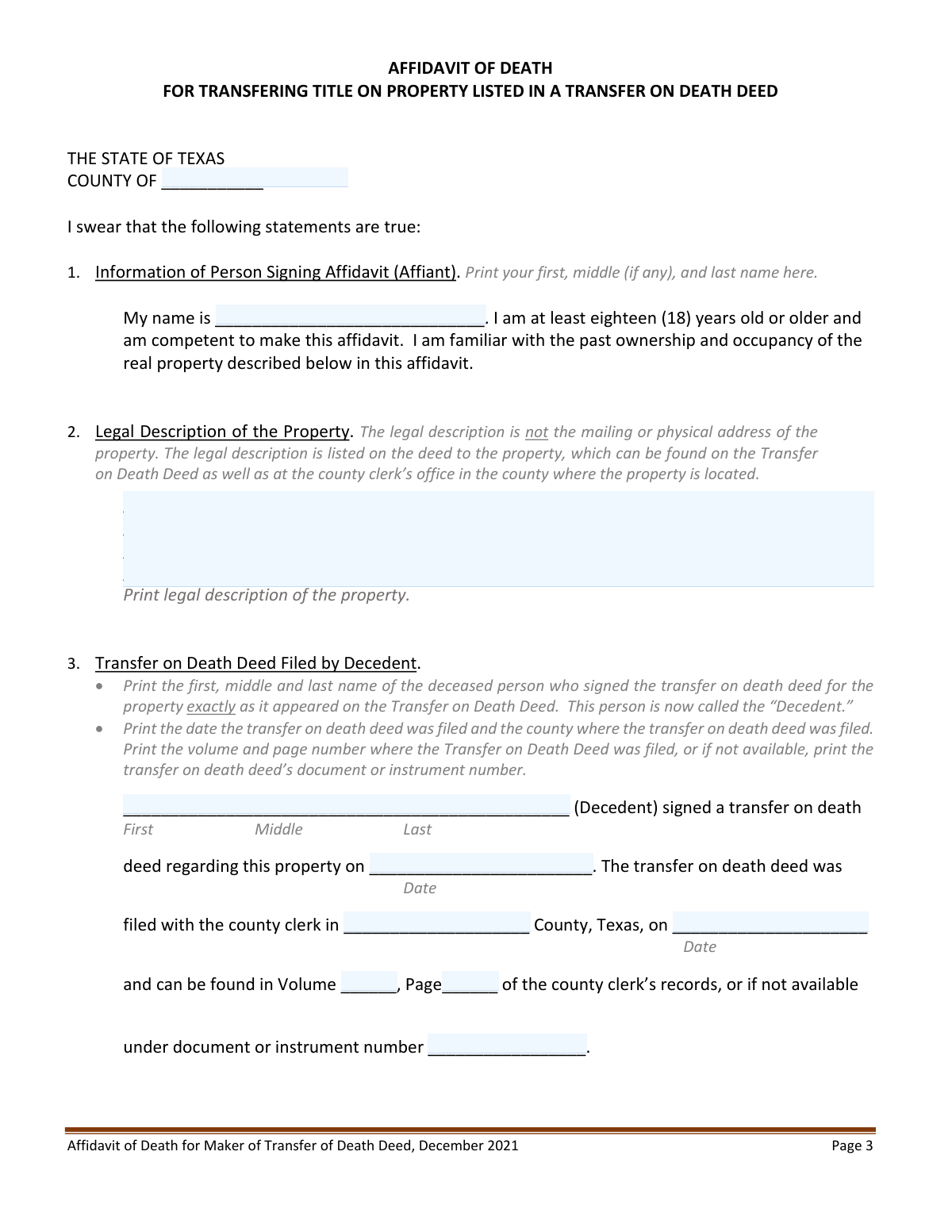
| 1. | Affidavit of Death for Transferring Title on Property Listed in a Transfer on Death Deed | 1 | Basic 36 |
| 2. | Form 130-U, Application for Texas Title and/or Registration | 1 | Moderate 60 |
- Enterprise-grade security & data encryption
- 99%+ accuracy powered by AI
- 1,000+ forms from all industries
- Complete forms in under 60 seconds
How to Choose the Right Form
Navigating Texas DMV requirements is often simpler than it appears, as most major vehicle transactions center around a single, versatile document. Whether you are a long-time resident or a newcomer to the Lone Star State, understanding when to use the primary title application is key to a smooth experience at the county tax office.
Buying, Selling, or Transferring Ownership
If you have recently purchased a vehicle from a private seller, received one as a gift, or inherited a vehicle, Form 130-U, Application for Texas Title and/or Registration is the mandatory document required to establish legal ownership. It acts as the formal request to the Texas Department of Motor Vehicles (TxDMV) to issue a new title in your name.
- Private Sales: Use this form to record the sales price and calculate the motor vehicle sales tax due.
- Gifts: This form is necessary even when no money changes hands to ensure the state records reflect the new owner.
Moving to Texas from Out-of-State
New residents are required to register their vehicles in Texas within 30 days of establishing residency. You will use Form 130-U to apply for both a Texas title and your initial registration simultaneously. This ensures your vehicle meets state standards and allows you to receive your Texas license plates and registration sticker.
Correcting or Updating Title Information
If your current title contains errors—such as a misspelled name, an incorrect VIN, or an outdated odometer reading—you must file Form 130-U to request a corrected title. Maintaining an accurate title is vital for insurance purposes and ensures you won't face hurdles when you eventually decide to sell the vehicle.
Registration Changes
While standard yearly renewals are handled separately, Form 130-U is required if you are registering a vehicle for the first time in Texas or if you need to change the registration class (for example, switching a vehicle from commercial to passenger use).
Using Instafill.ai allows you to complete Form 130-U digitally, ensuring every field is legible and accurate, which helps prevent delays or rejections at the DMV.
Form Comparison
| Form | Primary Purpose | Who Files It | Common Scenarios |
|---|---|---|---|
| Form 130-U, Application for Texas Title and/or Registration | Establishes legal vehicle ownership and registers the vehicle for Texas road use. | Vehicle buyers, new residents, or owners transferring a vehicle title. | Used for new purchases, out-of-state transfers, or correcting title data. |
Tips for Texas title forms
Texas requires an accurate odometer disclosure for most vehicle transfers to prevent title discrepancies. Double-check the mileage on the vehicle’s dashboard before entering it on Form 130-U to ensure it matches the physical reading exactly.
When filling out the sales price, ensure it reflects the actual amount paid to avoid issues with the Texas Comptroller. Keep in mind that for private party sales, the state may use the Standard Presumptive Value (SPV) to calculate taxes if the sales price is significantly lower than the market value.
A common reason for processing delays is a missing signature from either the buyer or the seller. Review the form to ensure all parties have signed and dated the document in the correct sections before submitting it to the county tax office.
AI-powered tools like Instafill.ai can complete Texas title forms in under 30 seconds with high accuracy, significantly reducing the risk of manual entry errors. Your data stays secure during the process, making it a reliable and fast solution for managing multiple vehicle registrations.
Form 130-U is rarely submitted alone; you will typically need a valid government-issued ID, proof of Texas insurance, and a passing vehicle inspection report. Having these documents organized and ready will streamline your visit to the tax assessor-collector’s office.
The information on your application must perfectly match the details listed on the existing vehicle title, including the Vehicle Identification Number (VIN). Any discrepancies in the VIN or owner names can lead to the application being rejected or requiring additional corrective affidavits.
Frequently Asked Questions
Form 130-U, the Application for Texas Title and/or Registration, is the essential document for most vehicle transactions in the state. It is used to transfer ownership, register a vehicle for the first time, or update information on an existing title record.
You must complete these forms whenever a vehicle's ownership changes, such as during a private sale, a gift transfer, or an inheritance. It is also required when moving to Texas with a vehicle previously registered in another state.
Completed forms and supporting documentation are typically submitted to the County Tax Assessor-Collector’s office in the county where you reside. Some counties allow for mail-in submissions, while others require an in-person visit to process the paperwork.
Yes, modern AI tools like Instafill.ai can process Texas title forms by accurately extracting data from your source documents and placing it into the correct fields. This technology helps eliminate manual entry errors and ensures the form is completed according to current requirements.
Using AI-powered services, you can complete complex documents like Form 130-U in under 30 seconds. The AI quickly identifies the necessary information from your ID or bill of sale and populates the PDF automatically, saving significant time compared to manual typing.
Generally, both the seller and the buyer must sign the form to acknowledge the transfer of ownership and the accuracy of the sales price. In cases of a gift or certain specialized transfers, additional signatures or supplemental affidavits may be required by the TxDMV.
Along with the title application, you usually need the original vehicle title, proof of valid liability insurance, and a government-issued ID. If the vehicle was purchased, you may also need a bill of sale to verify the purchase price for motor vehicle tax calculations.
In Texas, you generally have 30 days from the date of sale to transfer the title and pay any associated motor vehicle sales tax. Failing to file within this timeframe may result in financial penalties or late fees imposed by the state.
While Form 130-U is the primary application, out-of-state vehicles also require a vehicle inspection report from a certified Texas inspection station. You must provide the out-of-state title or registration receipt as proof of prior ownership during the application process.
If there is an active lien, the lienholder’s information must be recorded in the designated section of the title form. Once the loan is paid off, the lienholder will typically release the title to the owner, who can then apply for a new title that shows no liens.
Glossary
- Form Complexity Index
- Instafill’s 0–100 measure of how much effort a form takes to complete, calculated deterministically from the form’s own structure rather than estimated. It combines the number of fillable fields (the largest factor), how difficult those fields are to complete based on their type, the number of pages that contain fields, the amount of conditional “fill-only-if” logic, and how many sections the form is divided into, then adds modifiers for tables and repeating lists, bundled instruction pages, and dense page layouts. A higher score means the form is harder to fill out by hand. The forms in this category have a median Form Complexity Index of 60/100 (Moderate). See exactly how it is calculated.
- TxDMV
- The Texas Department of Motor Vehicles, the state agency responsible for vehicle registration, titling, and regulating the motor vehicle industry.
- VIN
- A unique 17-character Vehicle Identification Number that serves as a serial number for the vehicle and is required on all title applications.
- Lienholder
- A person or financial institution, such as a bank or credit union, that holds a legal claim on a vehicle until the loan is paid in full.
- Standard Presumptive Value (SPV)
- The state-calculated market value of a used vehicle, used to determine the amount of sales tax due when the purchase price is lower than the vehicle's worth.
- Odometer Disclosure Statement
- A formal declaration of the vehicle's mileage at the time of transfer, required to prevent fraud and ensure accurate record-keeping.
- Title Brand
- A permanent notation on a vehicle's title indicating a specific status or history, such as 'Salvage', 'Rebuilt', or 'Flood Damage'.
- VTR
- The Vehicle Titles and Registration division of the TxDMV, which is the specific office that processes Form 130-U and other ownership documents.
- Affidavit of Motor Vehicle Gift Transfer
- A supplemental document used in Texas when a vehicle is gifted between eligible family members to pay a flat $10 tax instead of standard sales tax.