Fill out transfer on death forms
with AI.
Transfer on Death (TOD) forms are essential estate planning tools that allow individuals to designate beneficiaries for their financial assets. Unlike traditional wills that may require a lengthy court-supervised probate process, a TOD designation ensures that assets like brokerage accounts, mutual funds, and non-retirement holdings pass directly to your heirs upon your passing. By clearly outlining who should receive your investments, these documents provide peace of mind and help your loved ones avoid the legal complexities and costs often associated with settling an estate.
By continuing, you acknowledge Instafill's Privacy Policy and agree to get occasional product update and promotional emails.
About transfer on death forms
These forms are typically required by investors holding individual or joint accounts at major financial institutions such as TIAA, Vanguard, or Fidelity. Whether you are setting up a new brokerage account or updating your existing estate plan, beneficiary designation forms are necessary to ensure your financial legacy is handled according to your wishes. Common situations include naming a spouse or children as primary beneficiaries on a non-retirement account or designating a successor for a 529 college savings plan. Keeping these designations current is vital, especially after major life events like marriage, divorce, or the birth of a child.
Managing financial paperwork can be daunting, but tools like Instafill.ai use AI to fill these forms in under 30 seconds with high accuracy and security. Whether you are completing a TIAA Brokerage Agreement or a Vanguard TOD Plan form, the platform simplifies the process by handling the data entry for you, ensuring your estate planning documents are ready for submission without the manual hassle.
Every form on this page can be completed without typing. Instafill is form filling software that reads a PDF and fills it for you — including flat and scanned documents that carry no fillable fields at all.
Forms in This Category
The forms in this category have a median Form Complexity Index of 52/100 (Moderate), measured across 10 forms by field count, input difficulty, length, conditional logic and structure. See how it is calculated.
| Form Name | Pages | FCI | |
|---|---|---|---|
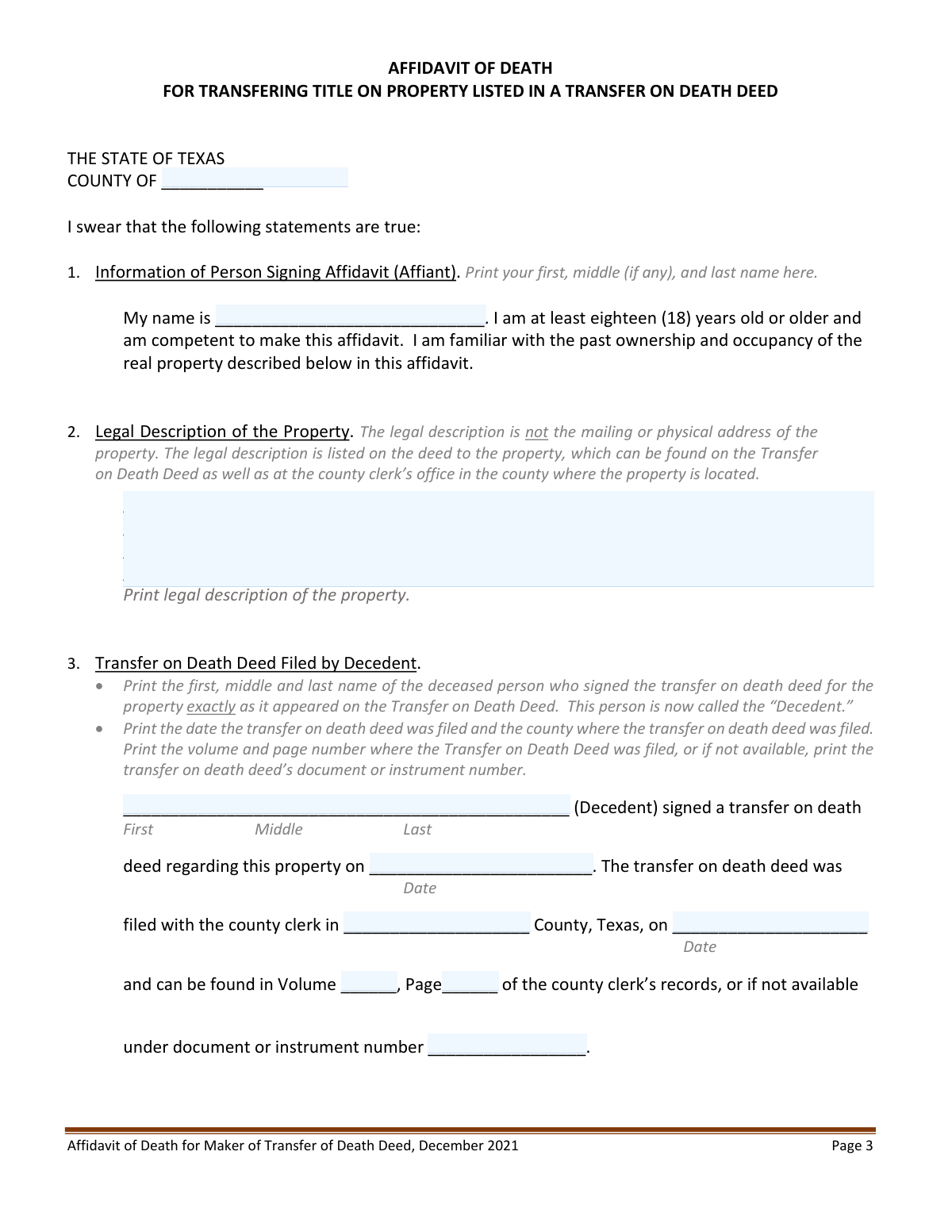
| 1. | Affidavit of Death for Transferring Title on Property Listed in a Transfer on Death Deed | 1 | Basic 36 |
| 2. | Beneficiaries — Nonretirement Transfer on Death | 1 | Basic 43 |
| 3. | Form F11004, TIAA Brokerage Individual Transfer on Death Account Agreement | 1 | – |
| 4. | Individual Transfer on Death Account Agreement (03-25) | 1 | Moderate 59 |
| 5. | Individual Transfer on Death Account Agreement (09-25) | 1 | Moderate 57 |
| 6. | Texas Transfer on Death Deed (Revocable) | 1 | Moderate 52 |
| 7. | The Vanguard 529 College Savings Plan Transfer Due to Death of Account Owner Form | 1 | Basic 36 |
| 8. | TIAA Brokerage Joint Transfer on Death Account Agreement | 1 | – |
| 9. | Transfer on Death Letter of Authorization | 1 | Simple 28 |
| 10. | Vanguard Transfer on Death Plan Form | 1 | Complex 64 |
- Enterprise-grade security & data encryption
- 99%+ accuracy powered by AI
- 1,000+ forms from all industries
- Complete forms in under 60 seconds
How to Choose the Right Form
Choosing by Financial Institution
The most critical factor in selecting the correct form is identifying where your assets are currently held. Most brokerage firms require their own proprietary documentation to bypass probate.
- TIAA Accounts: If you hold an individual brokerage account, use Form F11004, TIAA Brokerage Individual Transfer on Death Account Agreement. For accounts owned by two people, select the TIAA Brokerage Joint Transfer on Death Account Agreement.
- Vanguard Accounts: For general brokerage or mutual fund assets, use the Vanguard Transfer on Death Plan Form. However, if you are specifically managing a college fund, you must use The Vanguard 529 College Savings Plan Transfer Due to Death of Account Owner Form.
- Fidelity Accounts: Use the Beneficiaries — Nonretirement Transfer on Death form for individual or joint non-retirement accounts to specify your heirs.
- Pershing Accounts: Select the Individual Transfer on Death Account Agreement if your broker-dealer uses Pershing as a clearing agent.
Setting Up vs. Claiming Assets
Most forms in this category are for account owners who want to plan ahead. However, the correct form depends on whether you are the owner or the beneficiary:
- To Designate Beneficiaries: Use the "Agreement" or "Plan" forms (such as the Vanguard Transfer on Death Plan Form) to ensure your heirs receive assets directly without a lengthy court process.
- To Claim Assets as a Beneficiary: If you are the person inheriting funds from a deceased individual's Merrill Lynch account, you will specifically need the Transfer on Death Letter of Authorization to authorize the distribution of assets into your name.
Account Ownership Type
- Individual Owners: Most standard forms, like the Individual Transfer on Death Account Agreement, are designed for accounts with a single owner.
- Joint Owners: If you own an account with a spouse or partner, ensure you use a joint-specific form like the TIAA Brokerage Joint Transfer on Death Account Agreement to ensure the instructions take effect after the last surviving owner passes.
Form Comparison
| Form | Account Type | Primary Purpose | Filing Timing |
|---|---|---|---|
| Beneficiaries — Nonretirement Transfer on Death | Individual or joint non-retirement brokerage accounts. | Designate beneficiaries to ensure assets bypass the probate process. | Completed by the account owner during their lifetime. |
| Form F11004, TIAA Brokerage Individual Transfer on Death Account Agreement | Individual taxable brokerage accounts held with TIAA. | Appoint beneficiaries for direct transfer of brokerage assets. | Filed by the individual owner before their death. |
| Individual Transfer on Death Account Agreement | Individual accounts cleared through Pershing LLC broker-dealers. | Establish TOD registration to name specific account heirs. | Executed by the owner for estate planning purposes. |
| Individual Transfer on Death Account Agreement | Individual brokerage accounts at participating financial institutions. | Contractual agreement to transfer assets directly to beneficiaries. | Submitted by the account holder while still living. |
| The Vanguard 529 College Savings Plan Transfer Due to Death of Account Owner Form | Vanguard 529 College Savings Plan accounts only. | Transfer account ownership to a successor or estate authorized individual. | Filed by survivors after the account owner has passed. |
| TIAA Brokerage Joint Transfer on Death Account Agreement | Jointly owned brokerage accounts held with TIAA. | Designate primary and contingent beneficiaries for joint assets. | Signed by joint owners while they are still living. |
| Transfer on Death Letter of Authorization | Merrill Lynch accounts with existing TOD designations. | Authorize the distribution of assets to the named beneficiaries. | Completed by beneficiaries after the original owner's death. |
| Vanguard Transfer on Death Plan Form | Nonretirement mutual fund and brokerage accounts at Vanguard. | Register beneficiaries for direct asset transfer upon owner's death. | Submitted by the account owner to update estate plans. |
Tips for transfer on death forms
Double-check the legal names, Social Security numbers, and dates of birth for all designated beneficiaries. Even a minor typo can lead to significant delays or legal disputes during the asset transfer process, potentially requiring court intervention to resolve.
Don't stop at naming primary beneficiaries; always include contingent (secondary) options. If your primary beneficiary passes away before you, having a backup ensures the assets still bypass probate and go directly to your second choice rather than defaulting to your general estate.
AI-powered tools like Instafill.ai can complete these complex transfer on death forms in under 30 seconds with high accuracy. These tools automate the data entry process while ensuring your sensitive financial information stays secure, making it much easier to manage multiple accounts across different institutions.
When dividing assets among multiple people, ensure the total percentage allocated adds up to exactly 100%. Financial institutions like Vanguard and TIAA will often reject forms with inconsistent math, forcing you to restart the entire submission process.
Confirm whether your account is registered as Individual, Joint Tenants with Rights of Survivorship, or Tenants by the Entirety before choosing a form. Using an Individual TOD form for a Joint account—or vice versa—can invalidate the designation and complicate the transition for your heirs.
Make it a habit to review your TOD forms after marriage, divorce, or the birth of a child. Beneficiary designations on these forms typically override instructions left in a will, so keeping them current is the only way to ensure your assets are distributed according to your current wishes.
Frequently Asked Questions
A Transfer on Death (TOD) form is a legal document that allows an account owner to designate beneficiaries to receive their assets directly upon their passing. These forms are commonly used for brokerage accounts, mutual funds, and other non-retirement holdings to ensure a smooth transition of ownership. By naming beneficiaries, the assets can bypass the often lengthy and expensive probate process.
The form you need depends on how your account is registered. If you are the sole owner, you should use Form F11004, the TIAA Brokerage Individual Transfer on Death Account Agreement. For accounts held with a spouse or partner, you will likely need the TIAA Brokerage Joint Transfer on Death Account Agreement to ensure assets transfer only after the last surviving owner passes.
Yes, you can use AI-powered tools like Instafill.ai to complete these forms quickly and accurately. These tools can extract relevant data from your source documents and place it directly into the form fields, ensuring that complex legal documents like TOD agreements are finished without manual errors.
While a will covers your entire estate, a TOD designation applies specifically to a single financial account and takes precedence over a will for that asset. The main benefit is speed, as TOD assets are transferred directly to beneficiaries without waiting for court approval or probate. This provides your heirs with faster access to funds for immediate needs.
Manually filling out multiple estate planning forms can be time-consuming, but using AI tools like Instafill.ai can reduce the process to under 30 seconds. The AI accurately maps your information to the correct sections of the PDF, allowing you to manage multiple account designations in a fraction of the time.
Yes, most financial institutions like Vanguard, Fidelity, and Merrill Lynch allow you to name multiple primary and contingent beneficiaries. You can typically specify the percentage of the account each person should receive, provided the total equals 100%. Contingent beneficiaries are also important as they receive the assets if the primary beneficiaries are no longer living.
In the event of the death of a Vanguard 529 College Savings Plan account owner, you must use the 'Transfer Due to Death of Account Owner' form. This document formally transfers the management of the college savings funds to a designated successor or an authorized individual. This ensures the educational funds remain available for the intended student beneficiary.
Most of the forms in this category, such as those from Pershing or Fidelity, are specifically for non-retirement accounts. Retirement accounts like IRAs and 401(k)s usually have their own separate beneficiary designation processes. It is important to verify that the form you are using matches the specific account type you wish to protect.
Many financial institutions require a notary public or a Medallion Signature Guarantee to verify the account owner's identity before accepting a TOD agreement. This is a security measure to prevent unauthorized changes to your estate plan. Always check the specific instructions on the form, as requirements vary between companies like Pershing and TIAA.
Completed forms should be submitted directly to the financial institution that holds the account, such as Vanguard, Merrill Lynch, or Fidelity. Many institutions now offer secure online portals for digital uploads, though some may still require you to mail the original paper document to their processing center. Failure to submit the form to the institution will result in the TOD designation not being recognized.
Yes, you can update your beneficiaries at any time by filing a new Transfer on Death form with your financial institution. The most recently submitted and accepted form will generally supersede any previous versions. It is recommended to review these designations periodically, especially after major life events like marriage, divorce, or the birth of a child.
Glossary
- Form Complexity Index
- Instafill’s 0–100 measure of how much effort a form takes to complete, calculated deterministically from the form’s own structure rather than estimated. It combines the number of fillable fields (the largest factor), how difficult those fields are to complete based on their type, the number of pages that contain fields, the amount of conditional “fill-only-if” logic, and how many sections the form is divided into, then adds modifiers for tables and repeating lists, bundled instruction pages, and dense page layouts. A higher score means the form is harder to fill out by hand. The forms in this category have a median Form Complexity Index of 52/100 (Moderate). See exactly how it is calculated.