Yes! You can use AI to fill out Individual Transfer on Death Account Agreement

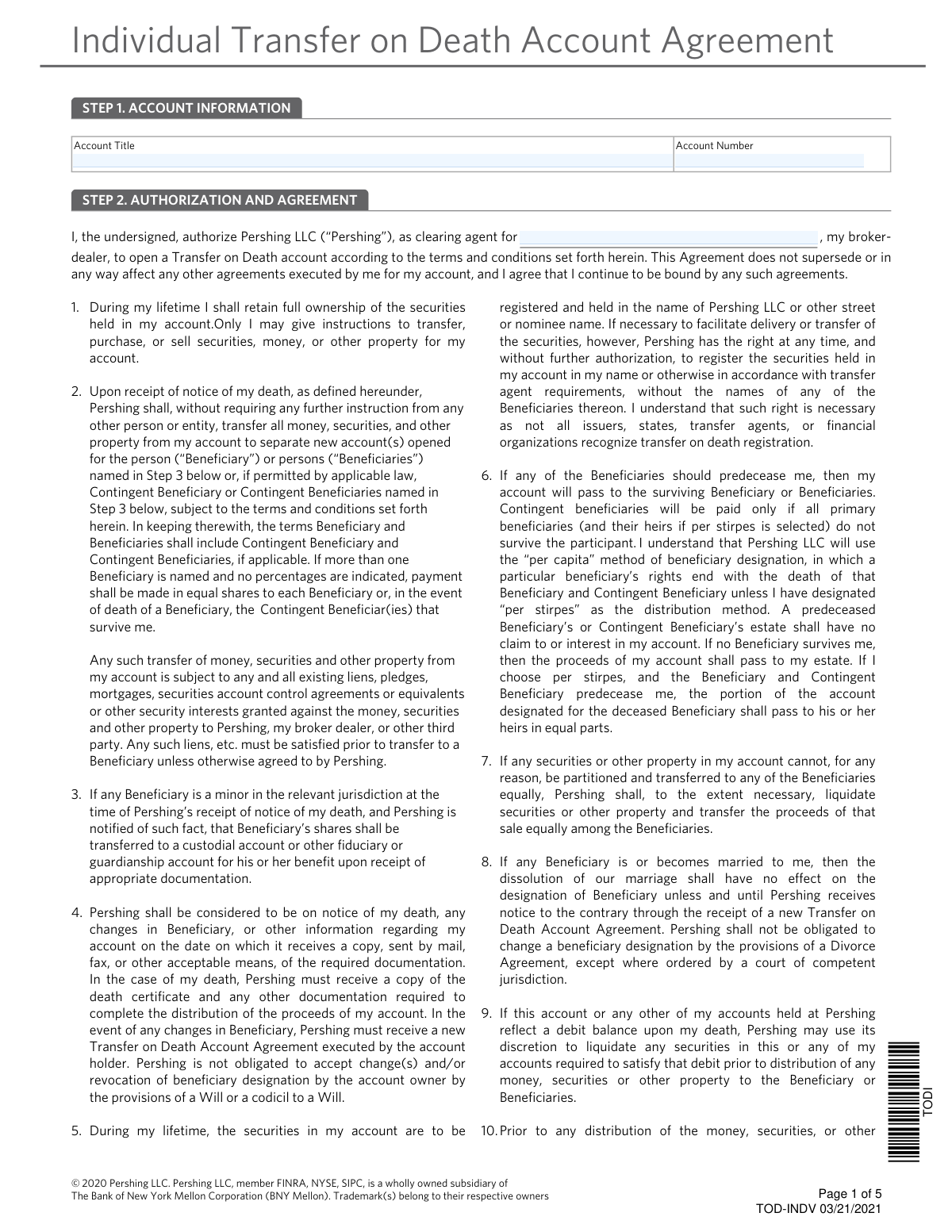
This form is a legal agreement with Pershing LLC, a clearing agent for broker-dealers, to establish an Individual Transfer on Death (TOD) account. It allows the account owner to designate beneficiaries who will automatically inherit the account's assets upon the owner's death, bypassing the often lengthy probate process. Completing this agreement is a crucial step in estate planning for a seamless transfer of securities and funds. Today, this form can be filled out quickly and accurately using AI-powered services like Instafill.ai, which can also convert non-fillable PDF versions into interactive fillable forms.
Our AI automatically handles information lookup, data retrieval, formatting, and form filling.
It takes less than a minute to fill out TOD-INDV using our AI form filling.
Securely upload your data. Information is encrypted in transit and deleted immediately after the form is filled out.

Form specifications

Form name: Individual Transfer on Death Account Agreement
Number of pages: 1
Language: English
Categories: account transfer forms, transfer forms
main-image

Instafill Demo: How to fill out PDF forms in seconds with AI

How to Fill Out TOD-INDV Online for Free in 2026

Are you looking to fill out a TOD-INDV form online quickly and accurately? Instafill.ai offers the #1 AI-powered PDF filling software of 2026, allowing you to complete your TOD-INDV form in just 37 seconds or less.
Follow these steps to fill out your TOD-INDV form online using Instafill.ai:
  1. 1 Navigate to Instafill.ai and upload or select the Individual Transfer on Death Account Agreement form.
  2. 2 Use the AI assistant to accurately input your account information, including the account title and number in Step 1.
  3. 3 Carefully designate your primary and contingent beneficiaries in Step 3, providing their names, contact information, and the percentage of assets they are to receive.
  4. 4 If you select a 'per stirpes' distribution, specify a 'Responsible Individual' in Step 4 to provide instructions on your behalf.
  5. 5 Determine if spousal consent is required based on your state of residence and beneficiary designations, and have your spouse sign in Step 5 if necessary.
  6. 6 Review all entered information for accuracy, then electronically sign and date the agreement in Step 6 to finalize your TOD account setup.

Our AI-powered system ensures each field is filled out correctly, reducing errors and saving you time.

Why Choose Instafill.ai for Your Fillable TOD-INDV Form?

Speed

Complete your TOD-INDV in as little as 37 seconds.

Up-to-Date

Always use the latest 2026 TOD-INDV form version.

Cost-effective

No need to hire expensive lawyers.

Accuracy

Our AI performs 10 compliance checks to ensure your form is error-free.

Security

Your personal information is protected with bank-level encryption.

Frequently Asked Questions About Form TOD-INDV

This form allows an individual account owner to designate beneficiaries to automatically inherit the assets in their brokerage account upon death, which can help avoid the probate process. The account owner retains full control of the account during their lifetime.

Any individual who holds a brokerage account cleared through Pershing LLC and wishes to specify who will receive the account's assets upon their death should complete this agreement.

You must provide each beneficiary's full name, date of birth, Social Security or Tax ID number, relationship to you, and full address. You also need to assign a specific percentage of the account assets to each beneficiary.

To change a beneficiary, you must complete and submit a new Individual Transfer on Death Account Agreement. Changes made in a will or other document will not be accepted for this account.

Primary beneficiaries are the first people designated to receive the account assets. Contingent beneficiaries will only inherit the assets if all of the primary beneficiaries have passed away before the account owner.

Choosing 'per stirpes' means that if a beneficiary predeceases you, their share of the account will pass to their heirs. If not selected, the share is divided among the other surviving primary beneficiaries.

You must have your spouse sign the consent section if you are married, live in a community property state (e.g., AZ, CA, TX, WA), and have designated someone other than your spouse as the sole primary beneficiary.

If a beneficiary is a minor, their share will be transferred into a custodial or guardianship account for their benefit upon receipt of the appropriate legal documentation.

To initiate the transfer, Pershing must receive a copy of your death certificate and any other documentation required to complete the distribution to your beneficiaries.

Divorce does not automatically remove your ex-spouse as a beneficiary. You must submit a new, updated Transfer on Death Account Agreement to formally change the designation.

A Responsible Individual must be named if you choose the 'per stirpes' option. This person is authorized to give instructions to Pershing regarding the distribution of assets to a deceased beneficiary's heirs.

Yes, services like Instafill.ai use AI to auto-fill form fields accurately and save time. This can help you complete the agreement more efficiently and with fewer errors.

You can upload the PDF to the Instafill.ai platform, which will make the document interactive. You can then type your information directly into the fields and print the completed form for your signature.

You can use a service like Instafill.ai, which can convert flat, non-fillable PDFs into interactive forms. This allows you to easily type your information online before printing.

Compliance TOD-INDV
Validation Checks by Instafill.ai

1
Account Owner Signature and Date Requirement
Verifies that the Account Owner's signature, printed name, and signature date in Step 6 are all present. These fields are mandatory to execute the agreement and make it legally binding. Failure to provide a complete signature and date will result in the rejection of the form, as the owner's consent and agreement to the terms cannot be confirmed.
2
Minimum Primary Beneficiary Requirement
Ensures that at least one Primary Beneficiary is designated in Step 3 with all required information (Name, DOB/Date of Trust, SSN/TIN). The entire purpose of a Transfer on Death (TOD) agreement is to name a beneficiary to receive the assets. If no beneficiary is named, the agreement is purposeless and cannot be processed.
3
Primary Beneficiary Percentage Summation
This check validates the percentage allocations for primary beneficiaries. If percentages are provided, their sum must equal exactly 100%. The form allows for equal distribution if no percentages are listed, so this check also ensures that either all beneficiaries have a percentage or none do, preventing an ambiguous mix. An incorrect sum would make it impossible to distribute the assets according to the owner's wishes.
4
Contingent Beneficiary Percentage Summation
Validates that if any contingent beneficiaries are listed, the sum of their specified percentages equals exactly 100%. The form explicitly requires this for the contingent section. This is critical for ensuring a clear line of succession if all primary beneficiaries predecease the account owner, preventing legal disputes over asset distribution.
5
Responsible Individual for Per Stirpes Designation
Checks that if the 'Per Stirpes' option is selected for any beneficiary, the 'Responsible Individual' field in Step 4 is filled out. The form states this individual is needed to provide instructions to Pershing regarding the distribution to a deceased beneficiary's heirs. Missing this information when 'Per Stirpes' is chosen creates an operational ambiguity that could delay or complicate the settlement of the account.
6
Spousal Consent Signature Requirement
Verifies that if the 'Yes' box is checked in the Spousal Consent section (Step 5), the spouse's printed name, signature, and signature date are all provided. This is a critical legal requirement in community property states to waive the spouse's rights to the assets. An incomplete spousal consent section when required will invalidate the non-spouse beneficiary designation and lead to form rejection.
7
Spousal Consent Logic Verification
This check cross-references the beneficiary list with the spousal consent question. If the account owner resides in a community property state, is married, and has designated someone other than their spouse as a primary beneficiary (or the spouse is not the 100% beneficiary), the 'Yes' box in Step 5 must be checked. This validation prevents the circumvention of legal spousal rights and ensures compliance with state laws. A mismatch will flag the form for correction.
8
Beneficiary Tax ID Format and Presence
Validates that the 'Social Security or Tax ID Number' for each listed beneficiary is present and follows the correct format (9 digits for SSN or TIN). This number is essential for tax reporting purposes and for uniquely identifying the beneficiary when opening their new account. An invalid or missing number will halt the account setup process for the beneficiary.
9
Beneficiary Date of Birth Validity
Ensures the 'Date of Birth or Date of Trust' for each beneficiary is a valid date and is not in the future. This information is crucial for identity verification and for determining if a beneficiary is a minor at the time of transfer, which triggers special handling rules (Clause 3). An invalid date would prevent proper processing and could lead to legal complications.
10
Account Number Presence
Checks that the 'Account Number' field is populated on the form. This number is the primary identifier for the account to which this TOD agreement applies. Without a valid account number, the agreement cannot be linked to the correct assets, making the entire document void and unenforceable.
11
Signature Date Validity
Verifies that the signature dates for both the account owner and the spouse (if applicable) are valid dates and are not in the future. The date establishes when the agreement was executed. A future or invalid date would call the timing and validity of the agreement into question, requiring correction before the form can be accepted.
12
Duplicate Beneficiary Prohibition
Scans all primary and contingent beneficiary entries to ensure the same individual (identified by SSN/TIN) is not listed more than once. Listing a person in multiple roles (e.g., as both a primary and contingent beneficiary) or twice in the same category is ambiguous and likely an error. This check prevents confusion and ensures the distribution plan is clear and executable.
13
Account Owner Cannot Be Beneficiary
Validates that the account owner is not listed as a primary or contingent beneficiary on their own account. It is logically and legally impossible for an individual to inherit from themselves. This check catches a fundamental error in the form's completion that would make the designation invalid.

Common Mistakes in Completing TOD-INDV

Incorrect Beneficiary Percentage Allocation

Users often make calculation errors when assigning percentages to multiple beneficiaries, resulting in a total that is not exactly 100% for either the primary or contingent groups. This invalidates the allocation instructions and can cause significant delays or legal disputes during the asset transfer process. To avoid this, carefully double-check that the percentages for all primary beneficiaries add up to 100%, and do the same for the contingent beneficiaries.

Incomplete Beneficiary Identification Information

Failing to provide a complete Social Security Number (SSN) or Tax ID Number (TIN), full legal name, and date of birth for each beneficiary is a frequent error. This often happens when the filer doesn't have the information readily available. Missing data makes it difficult or impossible for the financial institution to identify and contact beneficiaries, which can halt the transfer of assets and require legal intervention to resolve.

Misunderstanding the 'Per Stirpes' Designation

Many individuals check the 'Per Stirpes' box without fully understanding its legal implications, which directs a deceased beneficiary's share to their direct descendants. This can lead to an asset distribution that contradicts the account holder's actual intentions, potentially including or excluding heirs unexpectedly. It is crucial to understand that 'Per Capita' (the default) distributes the share among surviving beneficiaries, while 'Per Stirpes' passes it down the family line.

Forgetting to Appoint a 'Responsible Individual'

If 'Per Stirpes' is selected for any beneficiary in Step 3, the account holder must designate a 'Responsible Individual' in Step 4 to guide the distribution process. People often complete Step 3 but overlook this corresponding requirement in Step 4. Without this designation, the firm must rely on the estate's executor, which can slow down the process and may not align with the account holder's wishes for managing complex distributions.

Ignoring the Spousal Consent Requirement

Account holders who are married, reside in a community property state, and name someone other than their spouse as the sole beneficiary often fail to obtain their spouse's signature in Step 5. This oversight can render the beneficiary designation legally contestable by the surviving spouse, potentially overriding the account holder's wishes. Always review the list of community property states and complete this section if your circumstances apply.

Omitting the Account Number

The account number is required in Step 1 and on the header of every page, but it is frequently left blank. This simple omission prevents the firm from linking the legal document to the correct financial account, leading to immediate rejection of the form. To prevent this, ensure the account number is accurately entered in all required fields before submission. AI-powered tools like Instafill.ai can help populate repetitive fields automatically to prevent such errors.

Using Informal Names for Beneficiaries

Entering a nickname or an abbreviated name (e.g., 'Mike' instead of 'Michael') for a beneficiary is a common mistake that can create serious identity verification problems later. The name on the form must exactly match the beneficiary's full legal name as it appears on their government-issued ID. Any discrepancy can complicate and delay the transfer of assets upon the account holder's death.

Confusing Primary and Contingent Beneficiaries

Users sometimes misunderstand the distinction between primary and contingent beneficiaries, listing individuals in the wrong section or failing to grasp that contingent beneficiaries only inherit if all primary beneficiaries have predeceased the account owner. This can lead to an unintended order of inheritance. Carefully plan and designate who should be the first to inherit (primary) and who should be the backup (contingent).

Missing Signatures and Dates

Forgetting to sign and date the form in Step 6 is a critical error that renders the entire agreement invalid. Similarly, if spousal consent is required, a missing spousal signature in Step 5 also invalidates the designation. An unsigned form has no legal standing and will be returned, leaving the account without a valid TOD instruction until a properly executed form is received.

Providing Incomplete Address Information

Beneficiary addresses are often entered incompletely, missing an apartment number, zip code, or using a P.O. Box when a physical address is needed. This makes it difficult for the institution to locate the beneficiary to provide required notices and transfer assets. Always provide the beneficiary's complete, current mailing address. Since this form is a non-fillable PDF, tools like Instafill.ai can convert it into a fillable version and use address auto-completion to ensure accuracy.
Saved over 80 hours a year

“I was never sure if my IRS forms like W-9 were filled correctly. Now, I can complete the forms accurately without any external help.”

Kevin Martin Green

Your data stays secure with advanced protection from Instafill and our subprocessors

Robust compliance program

Transparent business model

You’re not the product. You always know where your data is and what it is processed for.

ISO 27001, HIPAA, and GDPR

Our subprocesses adhere to multiple compliance standards, including but not limited to ISO 27001, HIPAA, and GDPR.

Security & privacy by design

We consider security and privacy from the initial design phase of any new service or functionality. It’s not an afterthought, it’s built-in, including support for two-factor authentication (2FA) to further protect your account.

Fill out TOD-INDV with Instafill.ai

Worried about filling PDFs wrong? Instafill securely fills individual-transfer-on-death-account-agreement forms, ensuring each field is accurate.