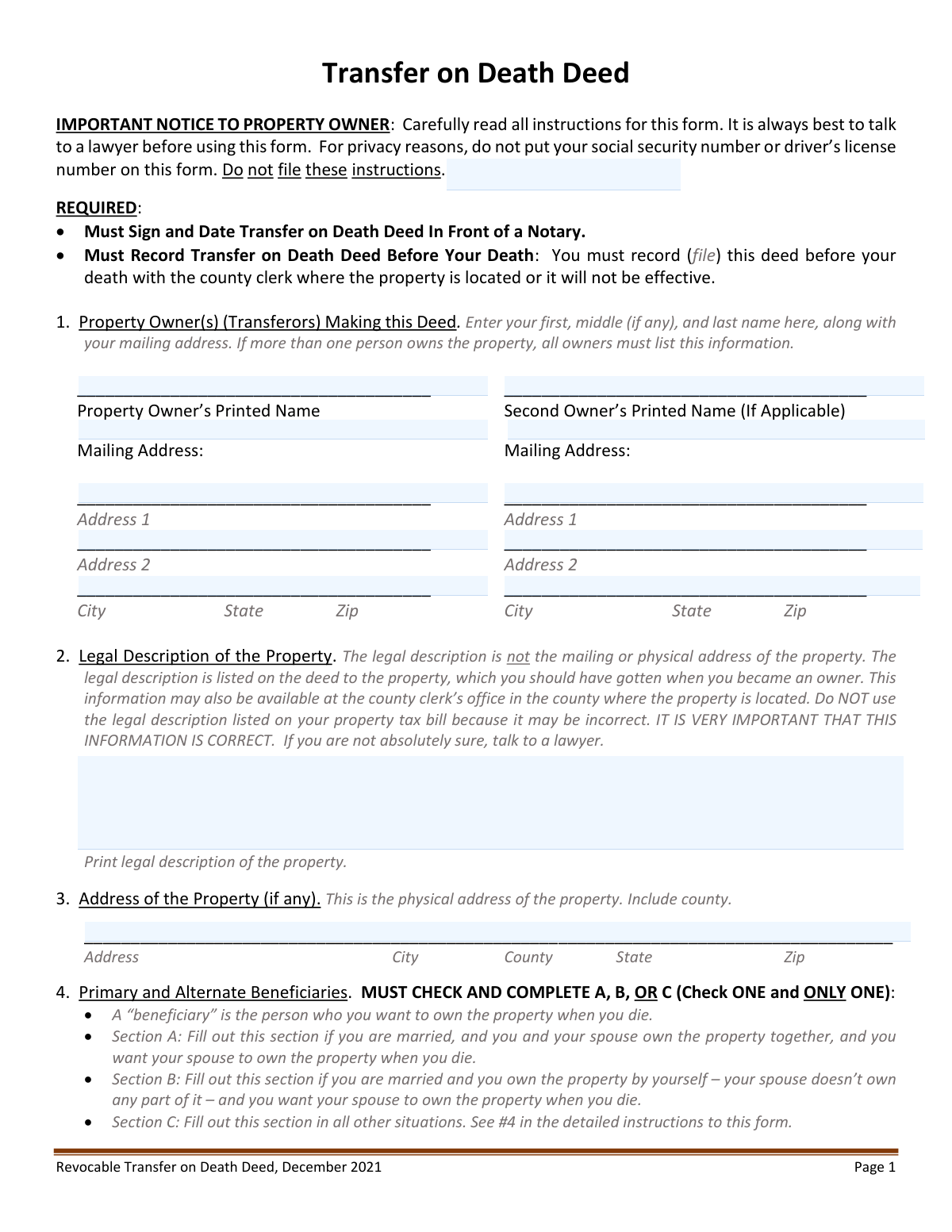
Yes! You can use AI to fill out Texas Transfer on Death Deed (Revocable)

A Transfer on Death Deed (TODD) is a legal instrument that allows a property owner to designate a beneficiary to receive their real estate directly upon their death, bypassing the often lengthy and expensive probate court process. This deed does not affect the owner's rights to the property during their lifetime, and it can be revoked or changed. Today, this form can be filled out quickly and accurately using AI-powered services like Instafill.ai, which can also convert non-fillable PDF versions into interactive fillable forms for your convenience.
Transfer on Death Deed is part of the transfer on death forms category on Instafill.
Our AI automatically handles information lookup, data retrieval, formatting, and form filling.
It takes less than a minute to fill out Transfer on Death Deed using our AI form filling.
Securely upload your data. Information is encrypted in transit and deleted immediately after the form is filled out.

Form specifications

Form name: Texas Transfer on Death Deed (Revocable)
Number of fields: 66
Number of pages: 1
Language: English
main-image

Instafill Demo: How to fill out PDF forms in seconds with AI

How to Fill Out Transfer on Death Deed Online for Free in 2026

Are you looking to fill out a TRANSFER ON DEATH DEED form online quickly and accurately? Instafill.ai offers the #1 AI-powered PDF filling software of 2026, allowing you to complete your TRANSFER ON DEATH DEED form in just 37 seconds or less.
Follow these steps to fill out your TRANSFER ON DEATH DEED form online using Instafill.ai:
  1. 1 Navigate to Instafill.ai and upload or select the Texas Transfer on Death Deed form.
  2. 2 Provide the full name(s) and mailing address(es) of the property owner(s) exactly as they appear on the current deed.
  3. 3 Enter the complete and accurate legal description of the property, as found on the existing deed, along with its physical address and county.
  4. 4 Choose one of the three options (A, B, or C) to designate your primary and alternate beneficiaries based on your marital status and intentions.
  5. 5 Carefully fill in the beneficiary details and initial the sub-options to clarify how the property should be distributed if a beneficiary predeceases you.
  6. 6 Review all the information you've entered for accuracy, then download the completed deed.
  7. 7 Sign and date the form in the presence of a notary public, and then file the original document with the county clerk's office where the property is located before your death.

Our AI-powered system ensures each field is filled out correctly, reducing errors and saving you time.

Why Choose Instafill.ai for Your Fillable Transfer on Death Deed Form?

Speed

Complete your Transfer on Death Deed in as little as 37 seconds.

Up-to-Date

Always use the latest 2026 Transfer on Death Deed form version.

Cost-effective

No need to hire expensive lawyers.

Accuracy

Our AI performs 10 compliance checks to ensure your form is error-free.

Security

Your personal information is protected with bank-level encryption.

Frequently Asked Questions About Form Transfer on Death Deed

A Transfer on Death Deed is a simple way to transfer your real estate, like a house or land, to a specific person upon your death. It allows the property to pass to your beneficiary without going through the lengthy and often costly probate court process.

Any property owner in Texas who wants to designate a beneficiary to automatically inherit their real property upon their death should fill out this form. It is an alternative to passing property through a will.

No, it does not affect your property rights during your lifetime. You can still sell the property, use it as collateral for a loan, or make any other decisions about it, and the beneficiary has no legal rights to it until your death.

The legal description is the official description of the property's boundaries, which is different from its mailing address. You must copy this information exactly from the deed you received when you became the owner, not from a property tax bill, as that may be incomplete.

A properly executed and recorded Transfer on Death Deed will override, or 'trump,' your will. The beneficiary named in this deed will receive the property, not the person named in your will.

You must sign the deed in front of a notary public. After it is notarized, you must file (record) the original deed with the county clerk's office in the county where the property is located before your death for it to be legally effective.

Select Option A if you and your spouse own the property together and want the survivor to inherit. Choose Option B if you are married but own the property alone and want your spouse to inherit. Select Option C for all other cases, such as if you are single or want to leave your property to someone other than your spouse.

Yes, this deed is revocable. You can cancel it by filing a 'Cancellation of Transfer on Death Deed' form or by filing a new, updated Transfer on Death Deed with the county clerk.

The beneficiary inherits the property subject to any existing debts, including mortgages and liens. Upon your death, the beneficiary becomes responsible for paying those debts.

An alternate beneficiary is the person you choose to inherit the property if your first-choice (primary) beneficiary dies before you do. Naming an alternate ensures your wishes are still carried out without the property going through probate.

Yes, services like Instafill.ai use AI to help you accurately auto-fill form fields, which saves time and reduces the chance of errors. However, for legal advice on your specific situation, it is always best to consult a lawyer.

You can upload the Transfer on Death Deed PDF to the Instafill.ai platform. Their service will make the document interactive, allowing you to type your information directly into the fields before printing the completed form for notarization and filing.

You can use a service like Instafill.ai to convert the flat, non-fillable PDF into an interactive form. Simply upload the document, and their technology will allow you to easily type your information into the correct fields online.

Compliance Transfer on Death Deed
Validation Checks by Instafill.ai

1
Exclusive Beneficiary Option Selection
This check ensures that in Section 4, exactly one of the checkboxes for options A, B, or C is selected. These options represent mutually exclusive scenarios for defining beneficiaries (e.g., married co-owners, single owner leaving to spouse, or other situations). If zero or more than one option is selected, the form is logically inconsistent and cannot be processed, as the intended line of inheritance is ambiguous.
2
Property Owner Information Completeness
This validation verifies that the first Property Owner's full name and complete mailing address (Address, City, State, Zip) are provided in Section 1. This information is legally required to identify the transferor and establish the deed's origin. An incomplete owner section would render the deed invalid and unrecordable.
3
Legal Description Presence
This check confirms that the 'Legal Description of the Property' field in Section 2 is not empty. The legal description is the official identifier for the real estate and is distinct from the mailing address; its accuracy is paramount for the deed to be legally effective. Failure to provide a legal description makes it impossible to identify the property being transferred, thus voiding the deed.
4
Physical Property Address Completeness
This validation ensures that the physical address of the property in Section 3, including the county, is fully entered. While the legal description is the primary identifier, the physical address is crucial for cross-referencing, tax purposes, and general location identification. An incomplete address can cause delays and confusion during the recording process.
5
Option A Logic: Two Owners Required
This is a consistency check that triggers if Option A in Section 4 is selected. It verifies that two distinct property owners are listed in Section 1, as Option A is specifically for married couples who own the property together. If Option A is checked but only one owner is listed, the selection is invalid and indicates a user error in either Section 1 or Section 4.
6
Option A Logic: Alternate Beneficiary Required
If Option A is selected, this check ensures that at least one Alternate Beneficiary's name and mailing address are provided. In this scenario, the surviving spouse is the primary beneficiary, but an alternate is required to define who inherits the property if both spouses are deceased. Without an alternate, the disposition of the property would be unclear if the spouses die simultaneously or in quick succession.
7
Option B Logic: Spouse Name Required
When Option B is selected in Section 4, this validation confirms that the Spouse's Printed Name and mailing address are filled out. Option B is for a sole property owner who wishes to leave the property to their spouse, making the spouse the primary beneficiary. If the spouse's information is missing, the primary beneficiary designation is incomplete and the deed cannot fulfill its purpose.
8
Option C Logic: Primary Beneficiary Required
If Option C is selected, this check verifies that at least one Primary Beneficiary's name and mailing address are provided. This option is the catch-all for situations not covered by A or B, and its core purpose is to name a non-spouse or specific primary heir. Failure to name a primary beneficiary in this section makes the entire deed pointless, as there is no one designated to receive the property.
9
Contingent Transfer Initial Selection
This check validates the 'Transfer on Death' subsections within Options A, B, and C, where the owner must initial their choice for how a deceased beneficiary's share is handled. It ensures that for each required choice, exactly one option is initialed, not zero or both. This initial is a binding legal instruction, and ambiguity would create significant legal challenges in distributing the property.
10
Signature and Printed Name Consistency
This validation compares the 'Owner’s Printed Name' in the signature block (Section 5) against the owner's name provided in Section 1. The names must match to ensure the person signing the deed is the same person identified as the property owner. A mismatch could suggest fraud or a clerical error that could invalidate the document.
11
Conditional Second Owner Signature
This check is triggered if a 'Second Owner' is listed in Section 1. It verifies that the 'Second Owner’s Signature' and 'Second Owner’s Printed Name' fields in Section 5 are completed. If the property is jointly owned, all owners must sign the deed for it to be valid; a missing signature from one owner would prevent the transfer of their share of the property.
12
Return Address Presence
This validation ensures the 'After recording, please return to' section is fully filled out with a name and complete mailing address. This is a practical but important step, as the county clerk uses this address to mail the official, recorded copy of the deed back to the owner. Missing information would mean the owner does not receive the recorded document, which contains critical filing information.
13
Prohibited Personal Information Scan
This check scans all free-text fields for patterns that match Social Security Numbers (###-##-####) or driver's license numbers. The form instructions explicitly forbid including this information for privacy and identity theft reasons, as the final document is a public record. Flagging this information prevents sensitive data from being exposed publicly.
14
Valid Signature Date
This check verifies that the date entered in the signature block is a valid, correctly formatted date and is not a date in the future. The signature date establishes when the document was executed by the owner. An invalid or future date would call the authenticity and timing of the notarization and recording into question, potentially invalidating the deed.

Common Mistakes in Completing Transfer on Death Deed

Using an Incorrect or Incomplete Legal Description

This mistake occurs when filers use the property's mailing address or the abbreviated description from a tax bill instead of the full legal description from the existing deed. This can render the Transfer on Death Deed invalid or create a cloud on the title, as the property is not unambiguously identified. To avoid this, you must copy the exact legal description from the most recent deed to the property; this information is also on file at the county clerk's office. AI-powered tools like Instafill.ai can help by providing validation checks to ensure the format of the legal description is correct before submission.

Signing the Deed Before Notarization

Many people sign and date the document as soon as they complete it, but the form explicitly requires the signature to be witnessed by a notary public. A deed that is signed before the filer is in the presence of the notary cannot be properly notarized and will be rejected by the county clerk or invalidated later. Always wait to sign and date the document until you are physically in front of the notary and they have instructed you to do so.

Failure to Record the Deed Before Death

A Transfer on Death Deed has no legal effect until it is filed (recorded) with the county clerk in the county where the property is located. People often complete and notarize the form but then store it in a safe place, assuming it is finalized. If the property owner dies before the deed is recorded, the document is void, and the property will likely have to go through the probate process as dictated by the owner's will or state law. Always take the notarized original to the county clerk's office for recording immediately after it is executed.

Entering an Incorrect Property Owner Name

Filers often write their current name, but the instructions require the name to be written exactly as it appears on the deed they received when they acquired the property. A name mismatch can cause title issues and complications when the beneficiary attempts to claim the property. To prevent this, locate your current deed and copy your name precisely, using 'AKA' (also known as) for your current name if it has changed. Using a tool like Instafill.ai can help by saving previously used legal names and ensuring consistency across documents.

Selecting the Wrong Beneficiary Scenario (A, B, or C)

The form presents three distinct scenarios for beneficiary designation based on marital status and ownership, but filers may get confused and check the wrong box. For example, an unmarried person might fill out Section A (for married co-owners), creating a legally nonsensical and invalid provision. This leads to ambiguity and potential litigation. Carefully read the descriptions for Sections A, B, and C to ensure you are completing the one that matches your exact situation.

Missing Co-Owner Signature on Jointly Owned Property

When a property is owned by more than one person (e.g., a married couple in Section A), all owners listed on the current deed must sign the Transfer on Death Deed. Often, only one owner will sign, believing they can act for the other. This makes the deed ineffective for transferring the entire property and may only transfer the signing owner's partial interest, contrary to the intended outcome. Ensure all owners sign the document in front of a notary.

Failing to Initial Contingency Clauses

Sections A, B, and C contain critical contingency clauses that require the filer to initial their choice for how the property should be distributed if a beneficiary dies before them. People often overlook these small initial boxes, leaving the choice blank or, conversely, initialing both options. This creates ambiguity that can void the deed or lead to court intervention to interpret the owner's intent. Carefully review each 'Transfer on Death' subsection and place your initials in ONE blank only, as instructed.

Filing the Instruction Pages with the Official Deed

The form packet includes several pages of instructions that are not part of the legal deed itself. Filers sometimes submit the entire packet to the county clerk for recording. This clutters the public record, may cause confusion, and results in higher recording fees, which are often charged per page. To avoid this, carefully separate the instruction pages (marked 'Do not file this page') from the actual deed pages before going to the clerk's office.

Leaving the 'After Recording, Return to' Section Blank

After the county clerk records the deed, they mail the original document back to the person and address specified in the 'After Recording, Return to' box. If this section is left blank or contains an old address, the owner may never receive the recorded original, which contains important filing information needed for future reference. Always fill this section out with a current, reliable name and mailing address. AI form-fillers like Instafill.ai can autofill this information accurately from your profile.

Trying to Fill Out a Non-Fillable PDF by Hand

Legal forms like this are often provided as flat, non-fillable PDFs, forcing users to print them and fill them out by hand. This leads to illegible handwriting, mistakes, and smudges, which can cause the document to be rejected by the county clerk. Using a tool like Instafill.ai can convert these non-fillable PDFs into interactive, fillable forms, allowing you to type information clearly and accurately, reducing the chance of data entry errors and rejection.
Saved over 80 hours a year

“I was never sure if my IRS forms like W-9 were filled correctly. Now, I can complete the forms accurately without any external help.”

Kevin Martin Green

Your data stays secure with advanced protection from Instafill and our subprocessors

Robust compliance program

Transparent business model

You’re not the product. You always know where your data is and what it is processed for.

ISO 27001, HIPAA, and GDPR

Our subprocesses adhere to multiple compliance standards, including but not limited to ISO 27001, HIPAA, and GDPR.

Security & privacy by design

We consider security and privacy from the initial design phase of any new service or functionality. It’s not an afterthought, it’s built-in, including support for two-factor authentication (2FA) to further protect your account.

Fill out Transfer on Death Deed with Instafill.ai

Worried about filling PDFs wrong? Instafill securely fills texas-transfer-on-death-deed-revocable forms, ensuring each field is accurate.