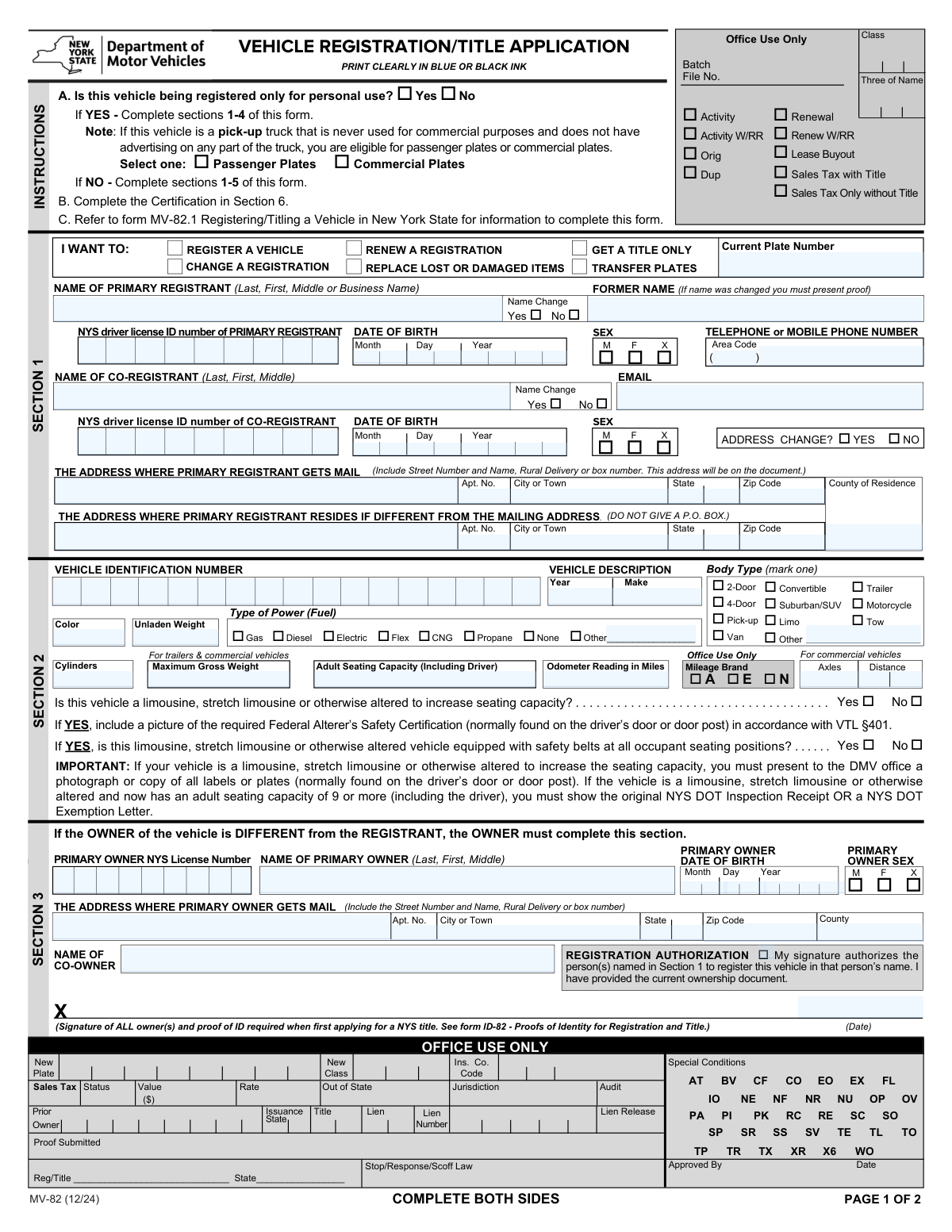
Yes! You can use AI to fill out Form MV-82, Vehicle Registration/Title Application
Form MV-82 is the official New York State Department of Motor Vehicles (DMV) application for vehicle registration and titling. It is a comprehensive document used for various transactions, including new vehicle registrations, renewals, title-only applications, and transferring plates. Completing this form accurately is essential for legally operating a vehicle in New York State. Today, this form can be filled out quickly and accurately using AI-powered services like Instafill.ai, which can also convert non-fillable PDF versions into interactive fillable forms.
MV-82 is part of the
registration forms, title application forms, vehicle registration forms and vehicle title forms categories on Instafill.
Our AI automatically handles information lookup, data retrieval, formatting, and form filling.
It takes less than a minute to fill out MV-82 using our AI form filling.
Securely upload your data. Information is encrypted in transit and deleted immediately after the form is filled out.
Form specifications
| Form name: | Form MV-82, Vehicle Registration/Title Application |
| Number of fields: | 129 |
| Number of pages: | 2 |
| Language: | English |
More forms in Registration forms
Instafill Demo: How to fill out PDF forms in seconds with AI
How to Fill Out MV-82 Online for Free in 2026
Are you looking to fill out a MV-82 form online quickly and accurately? Instafill.ai offers the #1 AI-powered PDF filling software of 2026, allowing you to complete your MV-82 form in just 37 seconds or less.
Follow these steps to fill out your MV-82 form online using Instafill.ai:
- 1 Navigate to Instafill.ai and upload your MV-82 form or select it from their template library.
- 2 Provide your personal details for Section 1, including your name, address, and NYS driver license ID number. Add co-registrant information if applicable.
- 3 Enter the vehicle's details in Section 2, such as the VIN, year, make, color, body type, and fuel type.
- 4 If the vehicle owner is different from the registrant, complete the owner's information in Section 3.
- 5 Answer the questions in Sections 4 and 5 regarding vehicle modifications, damage disclosure, and non-personal vehicle use.
- 6 Carefully review all the information populated by the AI to ensure it is correct and complete.
- 7 Electronically sign and date the certification in Section 6 to finalize your application before submission.
Our AI-powered system ensures each field is filled out correctly, reducing errors and saving you time.
Why Choose Instafill.ai for Your Fillable MV-82 Form?
Speed
Complete your MV-82 in as little as 37 seconds.
Up-to-Date
Always use the latest 2026 MV-82 form version.
Cost-effective
No need to hire expensive lawyers.
Accuracy
Our AI performs 10 compliance checks to ensure your form is error-free.
Security
Your personal information is protected with bank-level encryption.
Frequently Asked Questions About Form MV-82
Form MV-82 is the New York State Vehicle Registration/Title Application. It is used to register a new vehicle, renew or change a registration, transfer plates, or apply for a vehicle title only.
Any individual or business in New York State who needs to register a vehicle, renew a registration, transfer license plates, or obtain a vehicle title from the Department of Motor Vehicles (DMV) must complete this form.
The registrant is the person whose name the vehicle is registered under, while the owner holds the legal title. If you are both the owner and registrant, you only need to complete Section 1; if they are different people, the owner must also complete and sign Section 3.
Not necessarily. If your pickup truck is never used for commercial purposes and has no advertising on it, you have the option to choose either passenger plates or commercial plates on the form.
You will need your NYS driver license ID number, the vehicle's year, make, color, Vehicle Identification Number (VIN), and odometer reading. You will also need proof of ownership (like a title) and proof of NYS auto liability insurance.
You must provide a photo of the Federal Alterer’s Safety Certification label from the driver’s door post. If the vehicle now seats 9 or more people, you must also present an original NYS DOT Inspection Receipt or an official Exemption Letter.
This section is to declare if the vehicle was so severely damaged that repair costs exceed 75% of its pre-accident retail value. If 'Yes,' the vehicle needs an anti-theft examination before registration, and its title will be marked 'Rebuilt Salvage'.
You must submit the completed and signed form, along with all required supporting documents and payment for fees, to a New York State DMV office.
Personal use means the vehicle is not used for any business purpose. If the vehicle is used for activities like transporting passengers for a fee, as a taxi, or for a business, you must select 'No' for personal use and complete Section 5.
Yes, services like Instafill.ai use AI to help you accurately auto-fill forms like the MV-82. This can save you time and help prevent common errors.
You can use a service like Instafill.ai to fill the form online. Simply upload the MV-82 PDF to their platform, and it will become an interactive form that you can type into directly.
If you have a non-fillable PDF, you can use a tool like Instafill.ai to convert it into an interactive, fillable form. This allows you to type your information neatly into the fields before printing.
Yes, you can add a second person as a co-registrant in Section 1. You will need to provide their full name, NYS driver license ID number, date of birth, and other required personal details.
Enter your P.O. Box in the 'mailing address' section. Then, enter your physical street address in the 'residence address' section, as P.O. Boxes are not permitted for the residence address.
Compliance MV-82
Validation Checks by Instafill.ai
1
Validates Vehicle Identification Number (VIN) Format
This check ensures the Vehicle Identification Number (VIN) is exactly 17 characters long and contains only alphanumeric characters (0-9 and A-Z, excluding I, O, and Q). The VIN is a unique global identifier, and an incorrect one prevents proper titling, registration, and history checks. If the VIN fails validation, the user must correct it before submission, as it is a critical field for identifying the vehicle.
2
Ensures Current Plate Number is Provided When Required
This validation checks that the 'Current Plate Number' field is filled out if the user selects 'Renew a registration', 'Change a registration', 'Replace Lost or Damaged Items', or 'Transfer Plates'. This information is essential for the DMV to locate the existing vehicle record that is being modified. A failure to provide the plate number will result in an error message prompting the user to enter it before proceeding.
3
Requires Former Name if Name Change is Indicated
This check verifies that if the 'Name Change - Yes' box is checked for the primary registrant, the 'FORMER NAME' field is not empty. This is crucial for maintaining a clear chain of identity and linking the new registration to previous records. If this validation fails, the user will be prompted to either provide their former name or uncheck the 'Name Change' box.
4
Validates Registrant Minimum Age
This check calculates the age of the primary registrant based on the entered Date of Birth and ensures they meet the minimum legal age to register a vehicle in New York State (typically 16 or 18). This prevents applications from minors who are not legally permitted to own or register a vehicle. If the applicant is underage, the submission will be blocked with an explanation of the age requirement.
5
Prohibits P.O. Box for Residence Address
This validation ensures that the address entered in 'THE ADDRESS WHERE PRIMARY REGISTRANT RESIDES' does not contain 'P.O. Box' or similar text. A physical residence address is legally required to establish jurisdiction for taxes, law enforcement, and other regulations. If a P.O. Box is detected, the system will display an error message instructing the user to provide a valid physical street address.
6
Verifies Cylinder Count for Electric Vehicles
This is a logical consistency check that verifies the 'Cylinders' field is empty, zero, or N/A if the 'Type of Power (Fuel)' is selected as 'Electric'. Electric vehicles do not have cylinders, so entering a value would indicate a data entry error. This check improves data quality and prevents incorrect vehicle specifications from being recorded.
7
Ensures 'Other' Field Specification
This validation rule checks that if the 'Other' checkbox is selected for 'Body Type' or 'Type of Power (Fuel)', the corresponding text field to describe the 'Other' type is not left blank. This ensures complete and specific information is captured when the standard options do not apply. Failure to provide a description will result in a prompt asking the user to specify the 'Other' type.
8
Co-Registrant Data Completeness Check
This check ensures that if a name is entered in the 'NAME OF CO-REGISTRANT' field, then the 'NYS driver license ID number of CO-REGISTRANT' and the co-registrant's 'DATE OF BIRTH' fields are also completed. This rule enforces the collection of all necessary identifying information for any individual being added to the registration. If the co-registrant's name is present but other required details are missing, the form will not be accepted.
9
Conditional Requirement for Commercial Vehicle Fields
This validation checks that if the vehicle is identified as commercial (e.g., 'Commercial Plates' selected, or a non-personal use is chosen), then the 'Maximum Gross Weight', 'Axles', and 'Distance' fields are filled. These fields are critical for determining the correct registration fees and ensuring compliance with commercial vehicle regulations. If the vehicle is personal, these fields should be empty.
10
Owner Information Section Integrity
This check validates that if any field within Section 3 (Owner Information) is filled out, then all required fields in that section (Owner Name, DOB, Address) must be completed. This section is only for when the owner is different from the registrant. This rule prevents partial, unusable owner data from being submitted and ensures a complete record is provided when necessary.
11
Taxi Use and Jurisdiction Specification
This validation ensures that if 'Operates as a taxi' is checked in the 'NON-PERSONAL VEHICLE USE' section, then one of the three options in the 'TAXIS ONLY' section must also be selected. This is a logical dependency that forces the user to specify the taxi's operating jurisdiction, which is critical for regulatory and fee purposes. An error will be shown if the specific taxi use is not provided.
12
NYS Driver License ID Number Format
This check verifies that the 'NYS driver license ID number' for both the primary and co-registrant follows the standard 9-digit numeric format. This ensures the ID number is valid and can be used to cross-reference DMV records accurately. An invalid format would prevent the system from verifying the registrant's identity and driving status, so submission is blocked until a validly formatted number is entered.
13
Damage Disclosure Follow-Up Requirement
This validation checks the response to the 'Has the vehicle been wrecked...' question. If the user answers 'Yes', the system flags the application to indicate that an anti-theft examination is required before registration can be completed and that the resulting title will be branded 'Rebuilt Salvage'. This is a business rule that ensures compliance with state law regarding salvaged vehicles.
14
Altered Vehicle Safety Belt Confirmation
This check ensures that if the question 'Is this vehicle a limousine, stretch limousine or otherwise altered...' is answered 'Yes', the subsequent question 'is this...vehicle equipped with safety belts at all occupant seating positions?' must also be answered. This is critical for safety compliance and legal requirements for altered vehicles. The submission will be halted until this required safety information is provided.
Common Mistakes in Completing MV-82
The form requires the primary registrant's name in 'Last, First, Middle' format. Applicants often default to the more common 'First, Middle, Last' order, which can cause data entry mismatches with DMV records. This can delay processing as the information may not align with the provided NYS driver license ID. To avoid this, carefully read the field label and enter your last name first, followed by a comma. AI-powered tools like Instafill.ai can automatically format names correctly based on form requirements.
This form has separate sections for a mailing address and a residence address if they differ. A common error is either leaving the residence address section blank when it is different, or filling it out unnecessarily when it is the same as the mailing address. This can lead to important DMV correspondence being sent to the wrong location. Always verify if your physical residence is different from your P.O. Box or mailing address and complete the form accordingly.
The 17-character VIN is unique to the vehicle and must be 100% accurate. Mistakes often happen from misreading characters (e.g., '5' for 'S', '1' for 'I') or transposing numbers. An incorrect VIN will result in an immediate application rejection, as it identifies the wrong vehicle or no vehicle at all. Double-check the VIN on both the vehicle's dashboard plate and your ownership documents before entering it, ensuring no spaces or hyphens are used.
Applicants frequently overlook Section 3 when the vehicle's legal owner is different from the person registering it (e.g., a parent owning a car for a child). They assume the registrant section is sufficient, but failing to complete the owner section and obtain the owner's signature leads to an incomplete application. If you are not the legal owner on the title, you must have the owner complete and sign Section 3. This is a critical step for authorization.
The form requires the 'Unladen Weight' for all vehicles and 'Maximum Gross Weight' for commercial vehicles. Many people guess this number or leave it blank, but it is essential for determining registration fees and vehicle class. An incorrect weight can lead to overpayment or underpayment and potential legal issues if operating a commercial vehicle. This information can be found on the driver's side door jamb sticker or in the owner's manual.
The form clearly states 'COMPLETE BOTH SIDES' and 'PAGE 1 OF 2' / 'PAGE 2 OF 2'. When filling out a paper copy, it is very common for applicants to complete the first page and forget the second, which contains the critical Damage Disclosure, Vehicle Use, and signature sections. This guarantees rejection. Always flip the form over and ensure every required field on both pages is filled out. Using a digital tool like Instafill.ai, which can convert flat PDFs into fillable versions, ensures you see and complete all sections sequentially.
At the top of the form, the applicant must check a box to indicate the purpose of the application (e.g., 'Register a Vehicle', 'Renew a Registration'). Forgetting to make a selection leaves the DMV clerk guessing what service is being requested, causing processing to halt immediately. This simple oversight is a frequent cause of rejection. Before submitting, always review this section to ensure your intended action is clearly marked.
The certification in Section 6 requires the applicant's signature, and additional signatures may be needed for co-registrants or if the owner is different from the registrant (Section 3). Forgetting to sign the form is one of the most common and easily avoidable reasons for an application to be returned. Before submitting, review all pages for 'Sign Here' fields and ensure all necessary parties have signed in the correct places.
The form provides a specific note for pick-up trucks used for non-commercial purposes, allowing the choice between 'Passenger Plates' and 'Commercial Plates'. Applicants often miss this note or don't understand the implications, leading them to make no selection or an incorrect one. This can affect insurance rates and where the vehicle can be legally driven (e.g., certain parkways). Carefully read the note and select the plate type that best fits your vehicle's use.
Section 5 details various non-personal uses (e.g., taxi, livery, farm vehicle), each with specific legal and insurance requirements. Applicants may not be aware of the nuances and check the wrong box or fail to provide required DOT permit numbers. This can result in improper registration, inadequate insurance coverage, and significant fines. If your vehicle is used for any business purpose, research the specific requirements for that use before completing this section.
The form allows applicants to note a name change and provide a former name. However, a common mistake is checking the 'Yes' box for a name change but failing to submit the required supporting legal documents, such as a marriage certificate, divorce decree, or court order. The DMV cannot process a name change without official proof, so the application will be held or rejected. Always attach copies of the necessary documentation if your name differs from what is on your existing ID or title.
The question regarding damage exceeding 75% of the vehicle's value determines if a 'Rebuilt Salvage' brand is applied to the title. Applicants may not understand how to calculate this, or may answer 'No' to avoid the branding, even if it's true. This is a serious offense. Answering incorrectly can lead to legal penalties and issues when selling the vehicle later. If the vehicle has sustained major damage, consult with your insurance adjuster or a mechanic for the official repair estimate to answer accurately.
Saved over 80 hours a year
“I was never sure if my IRS forms like W-9 were filled correctly. Now, I can complete the forms accurately without any external help.”
Kevin Martin Green
Your data stays secure with advanced protection from Instafill and our subprocessors

Robust compliance program
Transparent business model
You’re not the product. You always know where your data is and what it is processed for.
ISO 27001, HIPAA, and GDPR
Our subprocesses adhere to multiple compliance standards, including but not limited to ISO 27001, HIPAA, and GDPR.
Security & privacy by design
We consider security and privacy from the initial design phase of any new service or functionality. It’s not an afterthought, it’s built-in, including support for two-factor authentication (2FA) to further protect your account.
Fill out MV-82 with Instafill.ai
Worried about filling PDFs wrong? Instafill securely fills form-mv-82-vehicle-registrationtitle-application forms, ensuring each field is accurate.