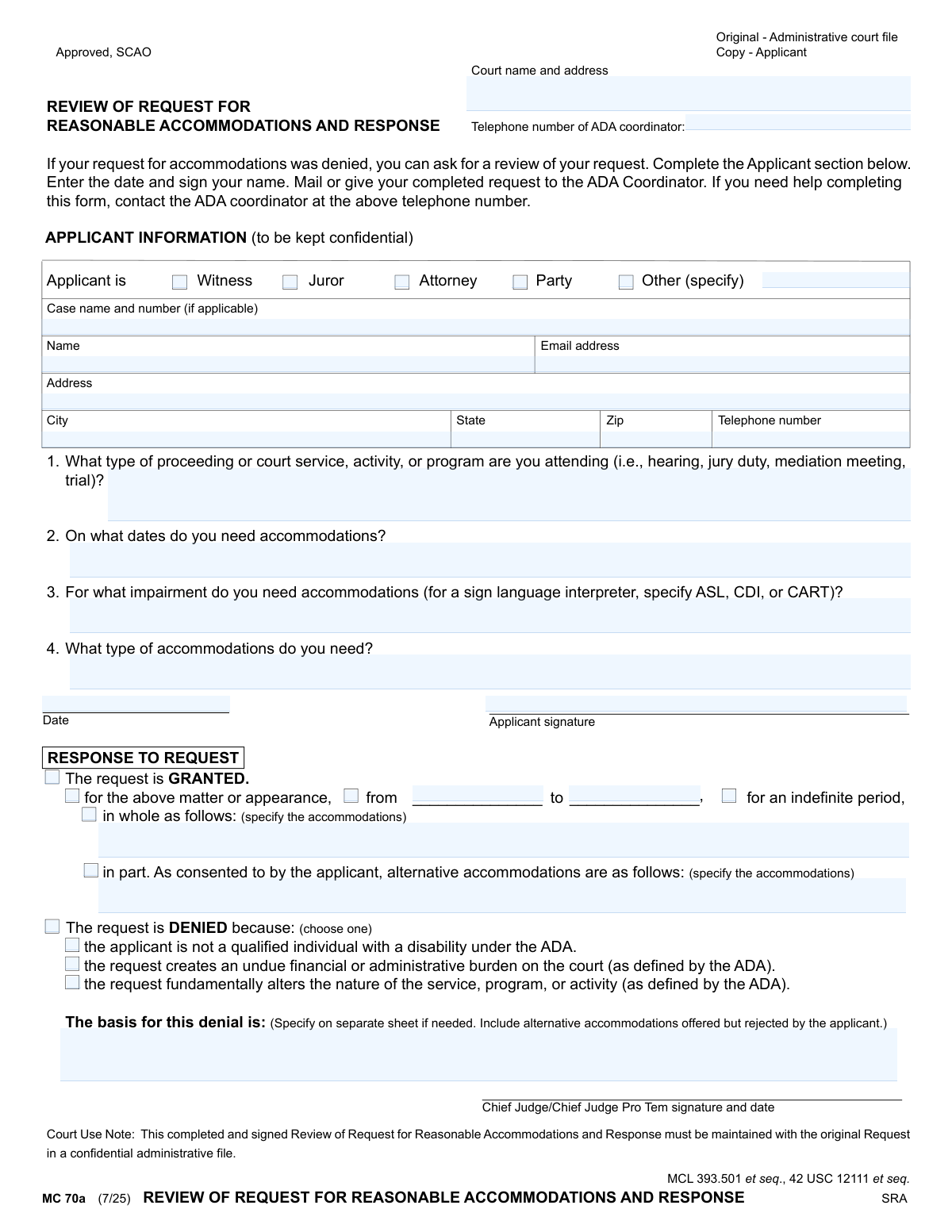
Yes! You can use AI to fill out MC 70a, Review of Request for Reasonable Accommodations and Response

The Review of Request for Reasonable Accommodations and Response, form MC 70a, is a legal document used to appeal a court's decision to deny a request for accommodations under the Americans with Disabilities Act (ADA). It allows an applicant, such as a juror, witness, or party in a case, to have their request formally re-evaluated by a chief judge. Today, this form can be filled out quickly and accurately using AI-powered services like Instafill.ai, which can also convert non-fillable PDF versions into interactive fillable forms.
MC 70a is part of the court response forms and Michigan court forms categories on Instafill.
Our AI automatically handles information lookup, data retrieval, formatting, and form filling.
It takes less than a minute to fill out MC 70a using our AI form filling.
Securely upload your data. Information is encrypted in transit and deleted immediately after the form is filled out.

Form specifications

Form name: MC 70a, Review of Request for Reasonable Accommodations and Response
Number of fields: 37
Number of pages: 1
Language: English
main-image

Instafill Demo: How to fill out PDF forms in seconds with AI

How to Fill Out MC 70a Online for Free in 2026

Are you looking to fill out a MC 70A form online quickly and accurately? Instafill.ai offers the #1 AI-powered PDF filling software of 2026, allowing you to complete your MC 70A form in just 37 seconds or less.
Follow these steps to fill out your MC 70A form online using Instafill.ai:
  1. 1 Navigate to Instafill.ai and upload or select the MC 70a form.
  2. 2 Provide your personal details, including your role in the court proceeding (e.g., witness, juror) and any applicable case information.
  3. 3 Describe the court proceeding, the dates you require accommodations, and the specific impairment for which you need assistance.
  4. 4 Clearly state the type of accommodations you originally requested.
  5. 5 Review all the information populated by the AI to ensure accuracy and completeness.
  6. 6 Electronically sign and date the form in the designated applicant signature section.
  7. 7 Download the completed form to mail or deliver to the court's ADA Coordinator as instructed.

Our AI-powered system ensures each field is filled out correctly, reducing errors and saving you time.

Why Choose Instafill.ai for Your Fillable MC 70a Form?

Speed

Complete your MC 70a in as little as 37 seconds.

Up-to-Date

Always use the latest 2026 MC 70a form version.

Cost-effective

No need to hire expensive lawyers.

Accuracy

Our AI performs 10 compliance checks to ensure your form is error-free.

Security

Your personal information is protected with bank-level encryption.

Frequently Asked Questions About Form MC 70a

This form is used to request a review if your initial request for reasonable accommodations at a court was denied. You, the applicant, should complete the top section to appeal the decision.

Anyone whose request for accommodations was denied by the court can fill out this form to ask for a review. This includes witnesses, jurors, attorneys, parties to a case, or others attending a court proceeding.

You will need your personal contact details, the case name and number if applicable, and information about the court proceeding. You must also describe your impairment and the specific accommodations you need.

Once you have completed and signed the applicant section, you should mail or give the form to the court's ADA Coordinator. Their contact information should be listed at the top of the form.

The form advises you to contact the ADA Coordinator if you need assistance. The coordinator's telephone number is provided at the top of the form for this purpose.

Yes, the form states that applicant information is kept confidential. The completed form is maintained separately in a confidential administrative file, not in the public court file.

A judge will review your request and either grant it in whole or in part, or deny it. The court's response, including the reason for any denial, will be documented on the bottom half of the form.

The form lists three potential reasons for denial: the court determines you are not a qualified individual with a disability under the ADA, the request creates an undue burden, or it fundamentally alters the court's service.

The case name and number are only required 'if applicable'. If you are requesting accommodations for a service like jury duty that isn't tied to a specific case, you can leave that field blank.

You should be as specific as possible to ensure your needs are clearly understood. For example, if you need a sign language interpreter, the form asks you to specify ASL, CDI, or CART.

Yes, services like Instafill.ai use AI to help you accurately auto-fill form fields, which can save you time and reduce errors. This is especially helpful for filling in your personal and case information.

Simply upload the form to the Instafill.ai platform. The AI will identify the fields, allowing you to provide your information once and have it automatically and accurately placed in the correct sections of the form.

You can use a service like Instafill.ai to solve this problem. Instafill.ai can convert flat, non-fillable PDFs into interactive, fillable forms that you can easily complete on your computer.

Yes, the form requires your signature and the date to be considered a valid request for review. After filling it out, you must print it and sign it before submitting it to the ADA Coordinator.

Compliance MC 70a
Validation Checks by Instafill.ai

1
Ensures Applicant Type is Selected
Checks that at least one checkbox for the applicant's role (Witness, Juror, Attorney, Party, Other) is selected. This information is critical for understanding the context of the accommodation request and ensuring the applicant is eligible for court-related services. If no type is selected, the form cannot be processed as the applicant's standing is unknown.
2
Requires Specification for 'Other' Applicant Type
Validates that if the 'Other' checkbox is selected for the applicant type, the corresponding 'Specify' text field is not empty. This prevents incomplete or ambiguous data entry, ensuring the court understands the applicant's specific role when it doesn't fit standard categories. Failure to specify results in an incomplete request that cannot be properly evaluated.
3
Validates Applicant Contact Information Completeness
Ensures that the applicant's name, address, city, state, zip, and telephone number fields are all filled out. This contact information is mandatory for official correspondence, including sending the final response to the request. A submission with missing contact details would prevent the court from communicating its decision to the applicant.
4
Validates Email Address Format
Checks that the value entered in the 'Email address' field follows the standard format for an email address (e.g., '[email protected]'). While optional, if an email is provided, it must be valid to be used for communication. An invalid format would lead to failed email delivery and communication breakdowns.
5
Validates Telephone Number Format
Verifies that the applicant's 'Telephone number' and the 'Telephone number of ADA coordinator' fields adhere to a standard 10-digit phone number format. This ensures the numbers are syntactically correct and can be used to establish contact. An incorrectly formatted number is unusable and hinders communication.
6
Validates ZIP Code Format
Confirms that the 'Zip' code field contains either a 5-digit or 9-digit (ZIP+4) numeric value. A valid ZIP code is essential for the accurate and timely delivery of mailed correspondence regarding the accommodation request. An invalid ZIP code will result in returned mail and significant delays.
7
Ensures Core Request Details are Provided
Validates that the applicant has provided details for the proceeding type, dates accommodation is needed, the specific impairment, and the type of accommodation requested. This information forms the core of the request and is absolutely necessary for the court to review and make a determination. A request missing any of these details is incomplete and cannot be processed.
8
Requires Applicant Signature and Date
Checks for the presence of the applicant's signature and the date of signature. The signature legally attests to the information provided, and the date establishes a timestamp for the request. A submission without a signature and date is considered invalid and cannot be officially filed or reviewed.
9
Validates Signature Date is Not in the Future
Ensures the 'Date' provided alongside the applicant's signature is a valid date that is not in the future. This check maintains the chronological integrity of the legal process and prevents post-dating of official documents. A future date would render the submission invalid until that date is reached.
10
Ensures a Definitive Response Decision is Made
In the 'RESPONSE TO REQUEST' section, this validation ensures that exactly one of the 'GRANTED' or 'DENIED' options is selected by the court official. This is critical for providing a clear and unambiguous outcome to the applicant. The response is invalid if both or neither option is chosen.
11
Requires Denial Basis if Request is Denied
If the 'DENIED' checkbox is selected, this validation confirms that at least one reason for denial is checked and that 'The basis for this denial is' text field is filled out. The ADA requires that denials of reasonable accommodations be accompanied by a specific reason. Failure to provide this basis makes the denial legally insufficient.
12
Requires Accommodation Details if Request is Granted
If the 'GRANTED' checkbox is selected, this check ensures the specific details of the accommodation are provided. If granted 'in whole', the 'in whole as follows' text box must be filled; if granted 'in part', the 'alternative accommodations are as follows' text box must be filled. This provides clarity to the applicant on exactly what will be provided by the court.
13
Validates Granted Accommodation Date Range
If the request is granted for a specific period ('from...to' is selected), this validation ensures both a start date and an end date are provided. It also checks that the end date is on or after the start date. This prevents logical errors and ambiguity in defining the duration for which the accommodations will be provided.
14
Ensures Granted Accommodation Duration is Specified
When a request is marked as 'GRANTED', this check verifies that one of the duration options ('for the above matter or appearance', 'from...to', or 'for an indefinite period') is selected. This is crucial for defining the scope and timeframe of the approved accommodation. Without a specified duration, the grant is ambiguous and difficult to implement.

Common Mistakes in Completing MC 70a

Using the Review Form for an Initial Request

A primary mistake is using this form to make a first-time request for accommodations. The form is explicitly titled 'Review of Request' and is intended for applicants whose initial request was denied. Submitting an initial request on this form will lead to its rejection and cause significant delays in getting the needed accommodations.

Providing a Vague or Unspecific Accommodation Request

Applicants often write general requests like 'help with hearing' in the 'accommodations' field instead of being specific. This forces the court to guess what is needed, potentially leading to incorrect or insufficient support. To avoid this, clearly state the exact accommodation, such as 'a personal amplification device for the courtroom' or 'a seat in the front row to facilitate lip-reading'.

Forgetting to Include the Case Name and Number

When the accommodation is for a specific legal proceeding, applicants frequently forget to enter the 'Case name and number'. This omission makes it difficult for court staff to link the request to the correct file and schedule, causing delays in processing. Always have your case documents handy and double-check that the case number is entered accurately to ensure your request is handled efficiently.

Failing to Specify the Type of Sign Language Interpreter

The form explicitly prompts applicants to specify the type of interpreter needed (ASL, CDI, or CART) in the 'Impairment' field, yet many simply write 'sign language interpreter'. This is a critical error because these services are distinct and require different professionals, which can lead to the wrong type of support being scheduled. Always specify the exact communication service you require to ensure effective communication during the proceeding.

Entering Ambiguous or Incomplete Dates

Stating 'next week' or only providing a single date for a multi-day proceeding is a common error in the 'Dates' field. This can result in accommodations being arranged for the wrong day or for only part of the required time. Clearly list all specific dates and times (e.g., 'October 25, 2024, 9:00 AM to 5:00 PM, and October 26, 2024, 1:00 PM to 4:00 PM') to ensure continuous coverage.

Submitting an Unsigned or Undated Form

An unsigned or undated form is legally invalid and will be rejected, halting the review process entirely. This often happens when people are in a hurry to complete and submit the document. Always perform a final review of the form to ensure your signature and the current date are in the designated fields before mailing it to the ADA Coordinator.

Providing Incorrect or Outdated Contact Information

Entering an old phone number or an infrequently checked email address is a frequent error that can have serious consequences. If the court has questions or needs to discuss alternative accommodations, they will be unable to reach the applicant, potentially resulting in a denial. AI-powered form filling tools like Instafill.ai can help prevent this by auto-filling saved, verified contact information, ensuring accuracy.

Filling Out Court-Use-Only Sections

Applicants sometimes mistakenly fill out the 'RESPONSE TO REQUEST' section, which is reserved for the judge or court administrator. This can cause confusion, may require the form to be redone, and slows down the entire process. Applicants should only complete the 'APPLICANT INFORMATION' section and the four questions below it, then sign and date the form.

Selecting 'Other' Applicant Type Without Providing Details

When identifying their role, applicants may check the 'Other' box but fail to write a description in the 'specify' field. This leaves the court guessing about their connection to the proceedings (e.g., family member, support person), which can impact the context of the accommodation request. If your role isn't listed, you must provide a clear, concise description to avoid confusion.

Submitting the Form to the Wrong Office

The instructions specify mailing or giving the completed request to the ADA Coordinator, whose phone number is listed at the top. A common process error is to mail the form to the general court clerk's office or another department. This can lead to the form being lost or significantly delayed in reaching the correct person for review.
Saved over 80 hours a year

“I was never sure if my IRS forms like W-9 were filled correctly. Now, I can complete the forms accurately without any external help.”

Kevin Martin Green

Your data stays secure with advanced protection from Instafill and our subprocessors

Robust compliance program

Transparent business model

You’re not the product. You always know where your data is and what it is processed for.

ISO 27001, HIPAA, and GDPR

Our subprocesses adhere to multiple compliance standards, including but not limited to ISO 27001, HIPAA, and GDPR.

Security & privacy by design

We consider security and privacy from the initial design phase of any new service or functionality. It’s not an afterthought, it’s built-in, including support for two-factor authentication (2FA) to further protect your account.

Fill out MC 70a with Instafill.ai

Worried about filling PDFs wrong? Instafill securely fills mc-70a-review-of-request-for-reasonable-accommodations-and-response forms, ensuring each field is accurate.