
Yes! You can use AI to fill out Form CR-417, Response by District Attorney to Petition to Terminate Sex Offender Registration
Don't type 39 fields by hand. Tell our AI about yourself, or upload your driver's license, and it fills every field in seconds. You check it, then download, print or sign.
The AI does the filling. You just check it.
No typing into boxes, nothing to install.
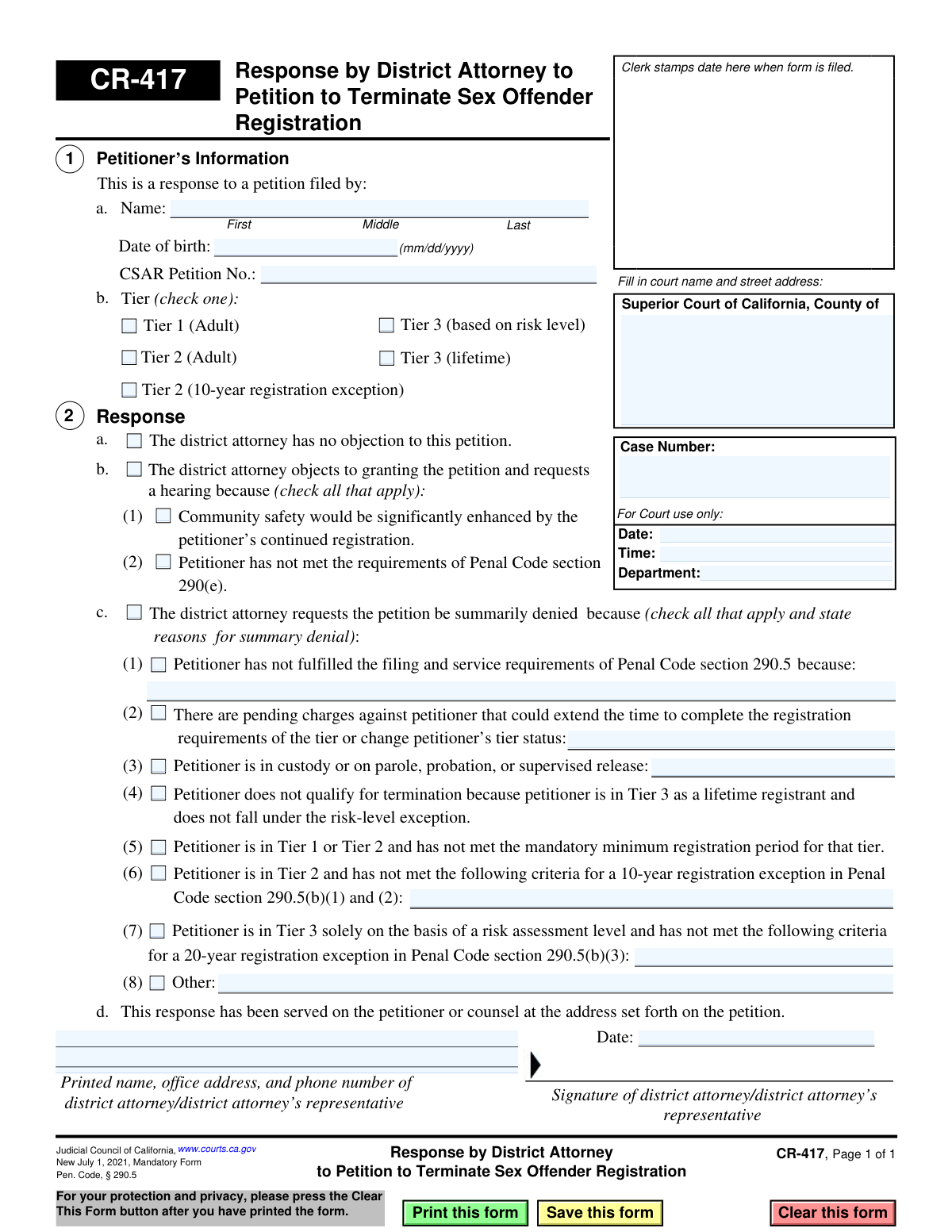
What this form asks for
The AI fills all of it, from your answers or your documents.
The AI checks your answers before you download
13 checks built for this form, so a wrong date or a missing answer is caught before anyone else sees it.
This check ensures that the 'Case Number' field is populated. The case number is a critical unique identifier for court proceedings, and its absence would make it impossible to associate this response with the correct case file. If this validation fails, the form cannot be correctly filed and will be rejected.
Validates that the petitioner's First and Last names are provided in Section 1a. A full name is required for the legal identification of the individual who filed the original petition. Failure to provide a complete name could lead to misidentification or rejection of the form due to ambiguity.
Ensures the 'Date of birth' in Section 1a is entered in a valid MM/DD/YYYY format and represents a date in the past. This is crucial for verifying the petitioner's identity against official records. An invalid format or a future date would indicate a data entry error and prevent proper processing.
This check verifies that exactly one 'Tier' checkbox is selected in Section 1b. A petitioner can only belong to a single registration tier at a time, and this selection is fundamental to determining the legal standards for termination. Selecting zero or multiple tiers makes the response logically invalid.
Validates that only one of the primary response options in Section 2 is chosen: 'a. no objection', 'b. objects', or 'c. requests summary denial'. These options are mutually exclusive, and selecting more than one creates a contradictory and legally ambiguous response. The form must clearly state one single course of action requested by the District Attorney.
If the District Attorney checks box 2b, indicating an objection, this validation ensures at least one of the subsequent reasons (2b(1) or 2b(2)) is also checked. An objection must be substantiated with a specific reason as outlined on the form. Failure to provide a reason makes the objection incomplete and invalid.
And 7 more checks
- Summary Denial Reason Requirement
- Conditional Explanation for Summary Denial (Filing/Service)
- Conditional Explanation for 'Other' Summary Denial Reason
- Logical Consistency for Tier 3 Lifetime Denial
- Signature Date Validity
- District Attorney Information Completeness
- Signature Presence
Let AI fill out your CR-417
No typing. Every field filled in seconds, checked, ready to sign.
How to Fill Out CR-417 Online for Free in 2026
What the AI walks you through.
- Navigate to Instafill.ai and upload or select Form CR-417.
- Enter the Superior Court information, including the county and street address, along with the specific case number.
- Input the petitioner's information, including their full name, date of birth, and their designated registration tier.
- Select the District Attorney's response by checking the box for 'no objection,' 'objection,' or 'request for summary denial.'
- If objecting or requesting summary denial, check all applicable reasons and provide detailed written explanations in the spaces provided.
- The District Attorney or their representative must date, print their name and office details, and sign the form.
- Review all the information for accuracy before saving, printing, and filing the completed form with the court and serving it on the petitioner.
Common Mistakes in Completing CR-417
The ones the AI is built to catch.
Incorrect or Incomplete Case Information
Petitioner Information Mismatch
Incorrect Tier Classification
Contradictory Response Selections
Omitting Required Explanations for Objections
Providing Vague or Unsubstantiated Justifications
Failure to Confirm Service on Petitioner
Missing Signature, Date, or Contact Information
Using an Outdated Version of the Form
Illegible Handwriting on Scanned Forms
Frequently Asked Questions About CR-417
Is it really free for 7 days?
Can I fill other forms too?
How do I cancel?
How does the AI fill out CR-417?
What happens to my information?
How complex is CR-417 to fill out?
What is the purpose of Form CR-417?
Who is supposed to fill out this form?
What does it mean if the District Attorney checks box 2a, 'has no objection'?
What happens if the DA objects and requests a hearing (box 2b)?
What is the difference between an objection (2b) and a request for summary denial (2c)?
What are some common reasons the DA might request a summary denial?
I received a completed Form CR-417. What should I do now?
What does it mean if the DA claims 'Community safety would be significantly enhanced' by my continued registration?
What if I disagree with the DA's response on the form?
Can I use an AI tool like Instafill.ai to fill out Form CR-417?
How can Instafill.ai help me with my petition to terminate sex offender registration?
What can I do if the PDF of Form CR-417 I received is not fillable?
What information is required in Section 1, 'Petitioner's Information'?
Get your CR-417 filled out by AI
$0 today. Cancel before Nov 1 and you pay nothing.
Other forms like this one
California court forms: Judicial Council of California Form SC-105, Request for Court Order and Answer (Small Claims), Judicial Council of California Form SC-120, Defendant’s Claim and ORDER to Go to Small Claims Court (Small Claims), Judicial Council of California Form SER-001, Request for Sheriff to Serve Court Papers, Judicial Council of California Form SER-001, Request for Sheriff to Serve Court Papers, Affidavit for Collection of Personal Property California Probate Code Section 13100, Form POS-040, Proof of Service—Civil, Declaration of Facts of Death (California Superior Court), declaration-of-marriage-for-court-proceeding-california-family-law, ADOPT-200, Adoption Request, ADOPT-200, Stepparent Adoption Request, ADOPT-210, Adoption Agreement, ADOPT-310, Contact After Adoption Agreement, Judicial Council of California Form ADOPT-200, Adoption Request, Form ADR-107, Mediation Attendance Sheet, Form ADR-110, Order Appointing Referee, Form ADR-109, Stipulation or Motion for Order Appointing Referee, Form ADR-102, Request for Trial De Novo After Judicial Arbitration, Form ADR-108, Referee's Report (Code Civ. Proc., §§ 638, 639), Form ADR-106, Petition to Confirm, Correct, or Vacate Contractual Arbitration Award, Form ADR-104, Rejection of Award and Request for Trial After Attorney-Client Fee Arbitration
District court forms: Form AO 240, Application to Proceed in District Court Without Prepaying Fees or Costs, Form AO 239, Application to Proceed in District Court Without Prepaying Fees or Costs, In Forma Pauperis Affidavit/Petition (AOPC 622A) – Pennsylvania Magisterial District Court, In Forma Pauperis Affidavit Petition (AOPC 622A) — Pennsylvania Magisterial District Court, Taxing District Complaint (Local Property Tax), Supreme Court of New Jersey Disciplinary Review Board Notice of Appeal From a District Fee Arbitration Committee Determination
court response forms: Form MC 03, Answer, Civil, Request for Reasonable Accommodations and Response, MC 70a, Review of Request for Reasonable Accommodations and Response, Form CH-120, Response to Request for Civil Harassment Restraining Orders, Form CH-178, Response to Request for Release of Minor's Confidential Information (Civil Harassment Prevention), Form CH-620, Response to Request to Modify/Terminate Civil Harassment Restraining Order (Civil Harassment Prevention), Form DV-120, Response to Request for Domestic Violence Restraining Order (Domestic Violence Prevention), Form DV-178, Response to Request for Release of Minor's Confidential Information (Domestic Violence Prevention), Form EA-720, Response to Request to Renew Restraining Order (Elder or Dependent Adult Abuse Prevention), Form CR-402, Prosecuting Agency's Response to Petition/Application Under Health and Safety Code Section 11361.8—Adult Crimes, Form EA-250, Proof of Service of Response by Mail (Elder or Dependent Adult Abuse Prevention), Form EA-320, Response to Request for Elder or Dependent Adult Restraining Order Allowing Contact, Form CH-720, Response to Request to Renew Restraining Order (Civil Harassment Prevention), Form DV-720, Response to Request to Renew Restraining Order (Domestic Violence Prevention), Form EA-120, Response to Request for Elder or Dependent Adult Abuse Restraining Orders, Form FL-220, Response to Petition to Determine Parental Relationship (Uniform Parentage), Judicial Council of California Form GV-020, Response to Gun Violence Emergency Protective Order (Gun Violence Prevention), Form GV-120, Response to Petition for Gun Violence Restraining Order, Form FL-270, Response to Petition for Custody and Support of Minor Children, Form SC-224, Response to Declaration of Default in Payment of Judgment (Small Claims)
Let AI fill out your CR-417
Your trial starts once a card is added. You pay nothing before Nov 1.
Our AI already knows this form, all 39 fields of it. Skip the typing: tell it about yourself, or upload what you have, and it fills the whole form in seconds.
- AI fills every field on the form, checkboxes included
- No typing into boxes: answer a few questions, or upload your driver's license, an old copy of this form, a photo of a document
- The AI checks the answers; you review and change anything before you download
- Download the finished PDF, print it, or sign it online
- Encrypted, and never used to train AI
Cancel before Nov 1 and you pay nothing.
A card is needed to start the trial. Cancel in two clicks from your account.
Terms · Privacy