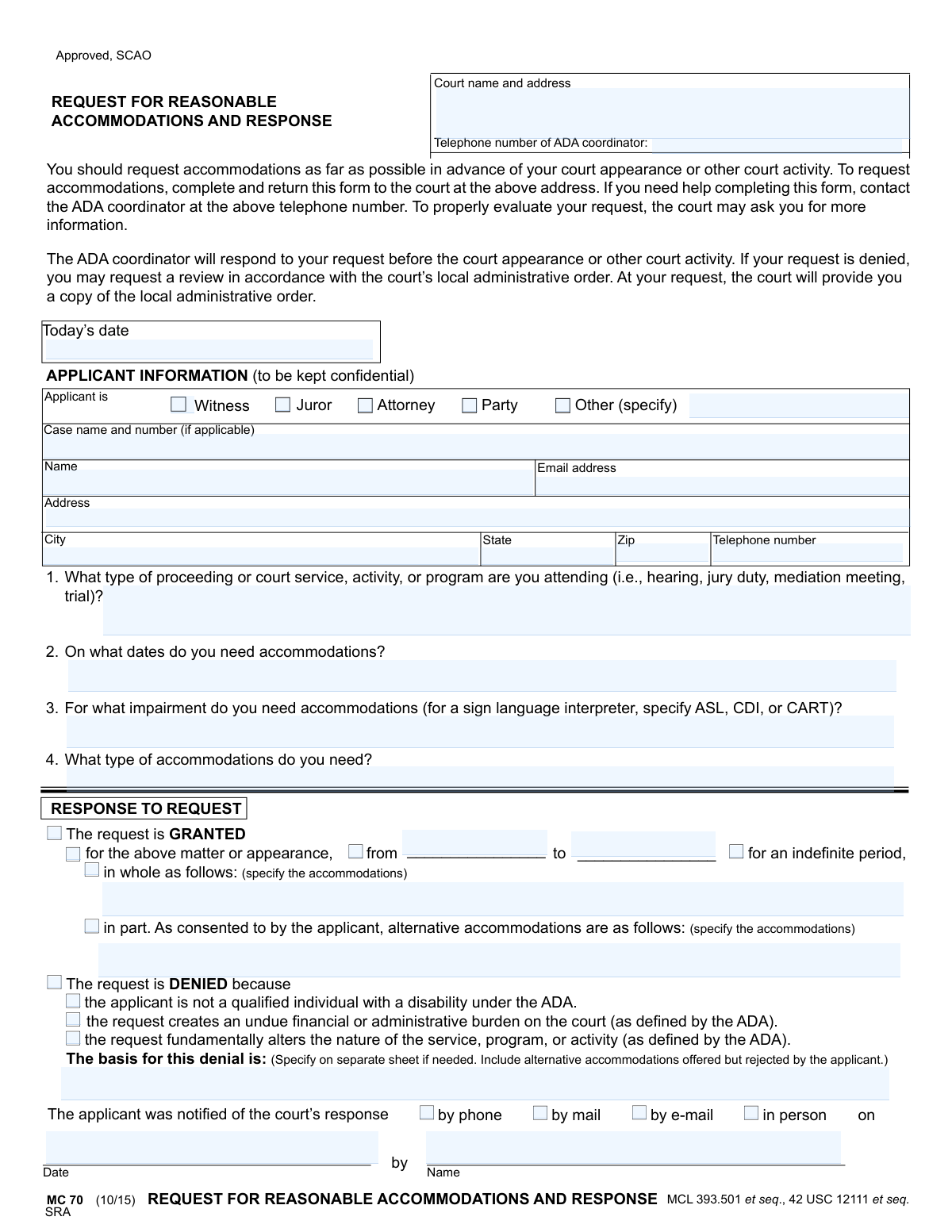
Yes! You can use AI to fill out Request for Reasonable Accommodations and Response
Form MC 70, Request for Reasonable Accommodations and Response, is a legal document used within the Michigan court system for individuals with disabilities to formally request necessary accommodations under the Americans with Disabilities Act (ADA). This ensures they have equal access to court proceedings, services, and activities. Today, this form can be filled out quickly and accurately using AI-powered services like Instafill.ai, which can also convert non-fillable PDF versions into interactive fillable forms.
Our AI automatically handles information lookup, data retrieval, formatting, and form filling.
It takes less than a minute to fill out MC 70 using our AI form filling.
Securely upload your data. Information is encrypted in transit and deleted immediately after the form is filled out.
Form specifications
| Form name: | Request for Reasonable Accommodations and Response |
| Number of fields: | 42 |
| Number of pages: | 1 |
| Language: | English |
Instafill Demo: How to fill out PDF forms in seconds with AI
How to Fill Out MC 70 Online for Free in 2026
Are you looking to fill out a MC 70 form online quickly and accurately? Instafill.ai offers the #1 AI-powered PDF filling software of 2026, allowing you to complete your MC 70 form in just 37 seconds or less.
Follow these steps to fill out your MC 70 form online using Instafill.ai:
- 1 Navigate to Instafill.ai and upload or select the MC 70 form.
- 2 Provide your personal details and the relevant case information, including the court name, case number, and your role (e.g., party, witness).
- 3 Specify the type of court proceeding you will be attending and the exact date(s) for which you need accommodations.
- 4 Clearly state your impairment and describe the specific type of accommodation required to ensure your full participation.
- 5 Review all the information you've entered for accuracy and completeness with the help of the AI assistant.
- 6 Download the completed form, sign it, and submit it to the court's ADA coordinator at the address provided on the form.
Our AI-powered system ensures each field is filled out correctly, reducing errors and saving you time.
Why Choose Instafill.ai for Your Fillable MC 70 Form?
Speed
Complete your MC 70 in as little as 37 seconds.
Up-to-Date
Always use the latest 2026 MC 70 form version.
Cost-effective
No need to hire expensive lawyers.
Accuracy
Our AI performs 10 compliance checks to ensure your form is error-free.
Security
Your personal information is protected with bank-level encryption.
Frequently Asked Questions About Form MC 70
This form is used to request accommodations for a disability when you need to attend a court proceeding or participate in a court-related activity, ensuring you have equal access to court services.
Anyone with a disability who needs an accommodation to participate in a court activity should use this form. This includes parties to a case, witnesses, jurors, attorneys, and others attending court services.
You should submit this form as far in advance as possible before your scheduled court appearance or activity. This gives the court enough time to review your request and make the necessary arrangements.
You should return the completed form to the court address listed at the top of the form. If you are unsure, contact the court's ADA coordinator for guidance.
You can request any reasonable accommodation needed for your impairment, such as a sign language interpreter (ASL, CDI, or CART), assistive listening devices, or a physically accessible location. Be specific about what you need in Section 4 of the form.
If you need assistance completing the form, you can contact the court's ADA coordinator at the telephone number provided at the top of the form.
Yes, the form states that the applicant information you provide, including details about your impairment, will be kept confidential.
The court's ADA coordinator will review your request and provide a response before your scheduled court activity. The response will indicate whether your request has been granted, partially granted, or denied.
If your request is denied, you have the right to request a review of the decision. You can ask the court for a copy of its local administrative order, which outlines the review process.
You only need to provide a case name and number if your request is related to a specific case you are involved in. If you are requesting an accommodation for a general service like jury duty, this may not be applicable.
Yes, services like Instafill.ai use AI to help you accurately auto-fill form fields, which can save you time and reduce errors.
You can use a service like Instafill.ai to easily fill out the Request for Reasonable Accommodations form online. Simply upload the form, and the tool will guide you through filling in the required fields.
If you have a non-fillable PDF, you can use a service like Instafill.ai to convert it into an interactive, fillable form. This allows you to type your information directly onto the form before printing it for submission.
Compliance MC 70
Validation Checks by Instafill.ai
1
Valid and Current 'Today's Date'
Checks if the 'Today’s date' field contains a valid date in a standard format (e.g., MM/DD/YYYY). It also verifies that the date is not in the distant past or future, ensuring the request is current. An invalid or illogical date could cause processing delays or rejection of the form as it may not reflect the actual submission date.
2
Conditional 'Other' Applicant Type Specification
This validation ensures that if the 'Other' checkbox is selected in the 'Applicant is' section, the corresponding 'specify' text field is not empty. This is crucial for the court to understand the applicant's role in the proceeding. Failure to specify when 'Other' is selected will result in an error, prompting the user to provide the necessary information.
3
At Least One Contact Method Provided
Verifies that the applicant has provided at least one valid method of contact: a full mailing address, a valid email address, or a valid telephone number. This is essential for the court to communicate with the applicant regarding their request. If no contact information is provided, the form submission should be blocked, as the court would have no way to respond.
4
Standard Phone Number Formatting
This check validates that the applicant's 'Telephone number' field contains a valid 10-digit number, potentially with optional formatting like parentheses, hyphens, or spaces. It ensures the number is legitimate and usable for communication. An incorrectly formatted number would prevent the court from making contact by phone.
5
Valid Email Address Syntax
This rule ensures the value entered in the 'Email address' field follows the standard email format (e.g., [email protected]). This is critical for ensuring that electronic communications from the court, such as the response to the request, are deliverable. An invalid email address would lead to communication failure and could delay the accommodation process.
6
Valid US ZIP Code Format
This validation checks that the 'Zip' field contains either a 5-digit or a 9-digit (ZIP+4) numerical code. Correct ZIP codes are essential for ensuring any mailed correspondence from the court reaches the applicant without delay. An invalid ZIP code could result in returned mail and a failure to communicate the court's decision.
7
Completeness of Core Accommodation Request
This check verifies that the applicant has filled out all essential fields for the request: 'Type of proceeding', 'Dates do you need accommodations', 'Impairment', and 'Type of accommodations'. Without this information, the court cannot properly evaluate the request. The form should not be submittable until these critical details are provided.
8
Logical Accommodation Date Range
This validation ensures the 'Dates do you need accommodations' are in the future, not in the past. It is important because accommodations are requested for upcoming events. A request for a past date is illogical and would be rejected, so this check prevents invalid submissions from being processed.
9
Required Justification for 'Denied' Response
This validation applies to the court's response section. If the 'DENIED' option is selected, the system must confirm that one of the three denial reasons is checked and that the 'Basis for this denial' text area contains an explanation. This is a critical due process check to ensure the applicant is properly informed of the reason for the denial.
10
Logical Consistency for 'Granted' Response
This check is for the court's response section. If the 'GRANTED' option is selected, the system must verify that either a date range ('from' and 'to'), or the 'indefinite period' checkbox is selected. Additionally, it must ensure that the specific accommodations are detailed in either the 'in whole' or 'in part' text areas, ensuring the response is complete and unambiguous.
11
Valid 'Granted' Accommodation Date Sequence
This validation is for the court's response section. If the request is granted for a specific period by entering dates in the 'from' and 'to' fields, it checks that the 'from' date is not later than the 'to' date. This prevents logical errors in the response that could confuse the applicant or create scheduling conflicts.
12
Mandatory Notification Method Selection
This validation applies to the court's response section. It ensures that when a response is finalized, at least one notification method ('by phone,' 'by mail,' 'by e-mail,' 'in person') is checked. This creates a record of how the applicant was informed of the decision. Failing to select a method would leave the communication record incomplete.
13
Completeness of Notification Details
This check ensures that if a notification method is selected in the response section, the corresponding 'Date' of notification and the 'Name' of the court staff member who provided it are also filled in. This provides a complete audit trail of the communication. An incomplete record could cause issues if there is a dispute about whether or when the applicant was notified.
14
Valid State Abbreviation or Name
This check ensures the 'State' field in the applicant's address contains a valid U.S. state, territory, or district. It can be validated against a list of two-letter abbreviations (e.g., MI, CA, NY) or full names. This is crucial for mail deliverability and maintaining accurate address records.
Common Mistakes in Completing MC 70
Applicants often forget to include the case name and number or enter it with typos. This is a critical error as it prevents court staff from linking the accommodation request to the correct legal proceeding, leading to significant delays or the request not being processed at all. To avoid this, carefully copy the full case name and number from official court documents. AI-powered tools like Instafill.ai can help by saving and accurately auto-filling this information across multiple documents.
In the 'What type of accommodations do you need?' section, applicants may write something general like 'help with my disability.' This is insufficient for the court to act upon and will likely result in the request being delayed for clarification or denied. Be as specific as possible, such as 'a wheelchair-accessible witness stand,' 'a CART provider for real-time transcription,' or 'documents provided in large-print format (18-point font).'
The form advises requesting accommodations 'as far as possible in advance,' but many people wait until the last minute. Arranging for specific services, such as a sign language interpreter or modifying a physical space, requires time and coordination. A late submission may mean the court cannot fulfill the request before the scheduled appearance, potentially forcing a postponement or leaving the applicant without necessary support.
A simple typo in an email address or phone number can completely derail the process, as the ADA coordinator may need to ask for clarification or provide an update. If the court cannot reach the applicant, the request may be denied or improperly fulfilled due to a lack of information. Always double-check that your name, phone number, and email address are current and entered without errors. Using a tool like Instafill.ai can help prevent typos by auto-filling validated contact details.
Applicants frequently leave the 'On what dates do you need accommodations?' field blank or write something ambiguous like 'for my hearing.' This forces the court to guess or follow up, causing delays. It is crucial to list the specific date(s) and, if known, the time(s) of the proceeding to ensure resources are scheduled correctly.
The form requires applicants to identify as a 'Witness,' 'Juror,' 'Attorney,' 'Party,' or 'Other.' Forgetting to check a box leaves the court unsure of the context of the request. The type of accommodation needed can vary significantly depending on whether you are observing from the gallery, testifying as a witness, or serving on a jury, so this information is essential for proper planning.
When asked for the 'type of proceeding,' applicants might write 'court' or 'my case.' This is not specific enough for the court to understand the context and duration of the need. Always specify the exact event, such as 'jury selection,' 'motion hearing,' 'settlement conference,' or 'multi-day trial,' to ensure the accommodation is provided for the correct event and duration.
The form specifically prompts for ASL, CDI, or CART, yet many people just write 'signer' or 'hearing impaired.' Not specifying the exact service needed (e.g., American Sign Language interpreter, Certified Deaf Interpreter, or Communication Access Realtime Translation) can lead to the wrong resource being assigned. This can result in a complete communication breakdown during the court proceeding, defeating the purpose of the request.
While applicants may be hesitant to share medical details, providing too little information in the 'For what impairment do you need accommodations?' field can hinder the process. For example, just writing 'vision' is less helpful than 'low vision requiring documents in large print.' Providing clear, concise information helps the court understand the basis for the request and provide the most effective accommodation without requiring invasive follow-up questions.
If an applicant downloads a generic PDF version of this form online, the 'Court name and address' and 'Telephone number of ADA coordinator' fields may be blank. Failing to fill these in means the form has no destination and cannot be processed. If the form is a non-fillable PDF, tools like Instafill.ai can convert it into a fillable version, making it easy to add this crucial routing information before submission.
Saved over 80 hours a year
“I was never sure if my IRS forms like W-9 were filled correctly. Now, I can complete the forms accurately without any external help.”
Kevin Martin Green
Your data stays secure with advanced protection from Instafill and our subprocessors

Robust compliance program
Transparent business model
You’re not the product. You always know where your data is and what it is processed for.
ISO 27001, HIPAA, and GDPR
Our subprocesses adhere to multiple compliance standards, including but not limited to ISO 27001, HIPAA, and GDPR.
Security & privacy by design
We consider security and privacy from the initial design phase of any new service or functionality. It’s not an afterthought, it’s built-in, including support for two-factor authentication (2FA) to further protect your account.
Fill out MC 70 with Instafill.ai
Worried about filling PDFs wrong? Instafill securely fills request-for-reasonable-accommodations-and-response forms, ensuring each field is accurate.