Yes! You can use AI to fill out Taxing District Complaint (Local Property Tax)
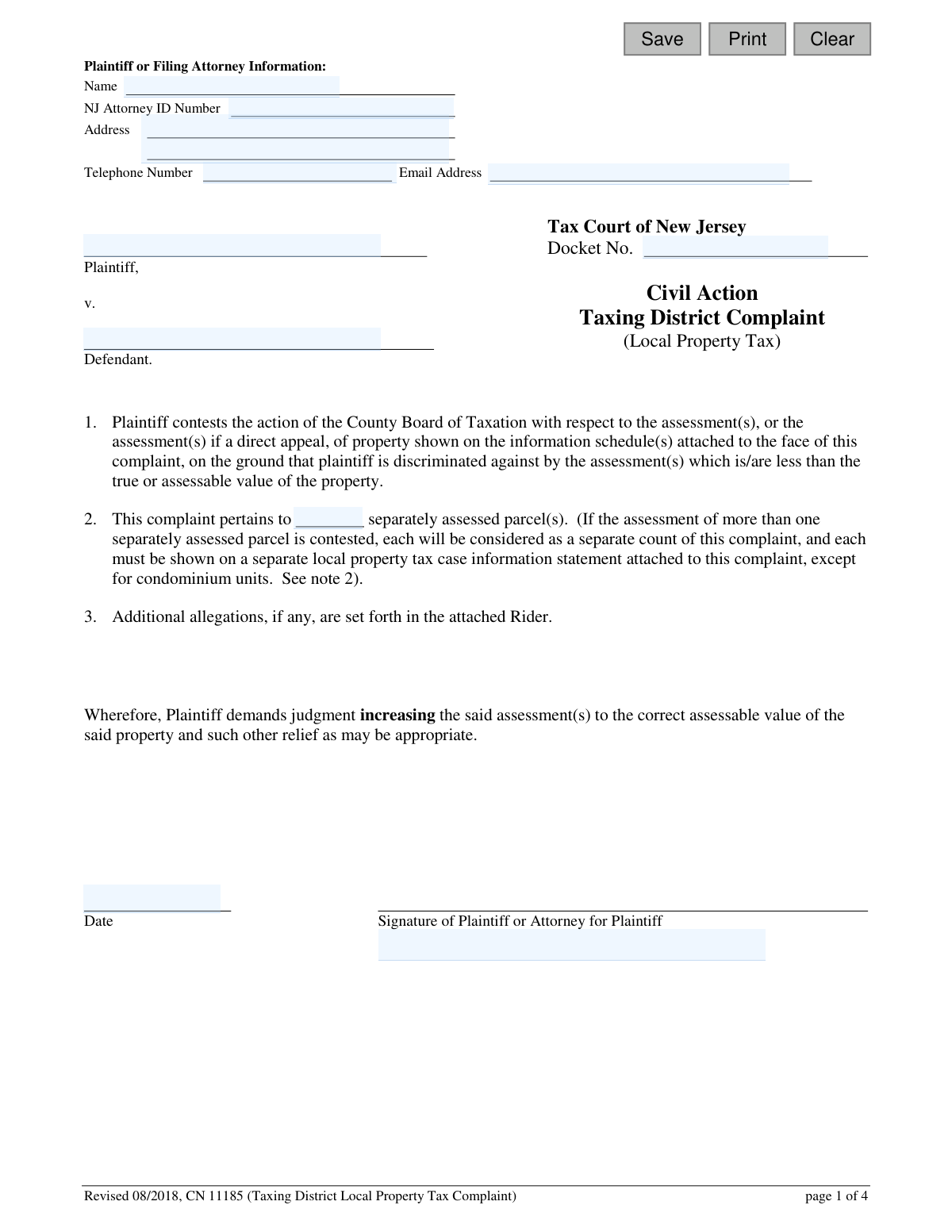
This form, officially known as the Taxing District Complaint (Local Property Tax), is filed with the Tax Court of New Jersey by a taxing district (the plaintiff) to contest a property tax assessment. The district uses this form to argue that a property has been assessed at a value lower than its true worth and to demand a judgment increasing the assessment. Today, this form can be filled out quickly and accurately using AI-powered services like Instafill.ai, which can also convert non-fillable PDF versions into interactive fillable forms.
CN 11185 is part of the
District court forms, New Jersey forms and property tax forms categories on Instafill.
Our AI automatically handles information lookup, data retrieval, formatting, and form filling.
It takes less than a minute to fill out CN 11185 using our AI form filling.
Securely upload your data. Information is encrypted in transit and deleted immediately after the form is filled out.
Form specifications
| Form name: | Taxing District Complaint (Local Property Tax) |
| Number of fields: | 29 |
| Number of pages: | 1 |
| Language: | English |
Instafill Demo: How to fill out PDF forms in seconds with AI
How to Fill Out CN 11185 Online for Free in 2026
Are you looking to fill out a CN 11185 form online quickly and accurately? Instafill.ai offers the #1 AI-powered PDF filling software of 2026, allowing you to complete your CN 11185 form in just 37 seconds or less.
Follow these steps to fill out your CN 11185 form online using Instafill.ai:
- 1 Navigate to Instafill.ai and upload or select the 'Taxing District Complaint (Local Property Tax)' form.
- 2 Use the AI assistant to accurately input the Plaintiff (Taxing District) and Filing Attorney's information, including name, address, and NJ Attorney ID.
- 3 Enter the Defendant (taxpayer) information, the Tax Court Docket Number (if known), and specify the number of separately assessed parcels the complaint pertains to.
- 4 Complete the main body of the complaint, which states the demand for judgment to increase the property assessment to its correct value.
- 5 Fill out the 'Proof of Service' section, certifying that copies of the complaint were served to the defendant taxpayer, the taxing district's assessor, and the county board of taxation administrator.
- 6 Carefully review all entered data for accuracy, then digitally sign and date the complaint in the designated fields.
- 7 Download the completed form, gather all required attachments (like the Case Information Statement and County Board Judgment), and file the package with the Tax Court Management Office.
Our AI-powered system ensures each field is filled out correctly, reducing errors and saving you time.
Why Choose Instafill.ai for Your Fillable CN 11185 Form?
Speed
Complete your CN 11185 in as little as 37 seconds.
Up-to-Date
Always use the latest 2026 CN 11185 form version.
Cost-effective
No need to hire expensive lawyers.
Accuracy
Our AI performs 10 compliance checks to ensure your form is error-free.
Security
Your personal information is protected with bank-level encryption.
Frequently Asked Questions About Form CN 11185
This form is used by a New Jersey taxing district (like a town or city) to file a complaint with the Tax Court, arguing that a property's tax assessment is too low and should be increased to its correct value.
The Plaintiff is the taxing district itself. The Defendant is the property owner whose assessment the district is challenging as being too low.
You must submit the completed complaint form, a Local Property Tax Case Information Statement (CIS-LP), the Proof of Service form, a copy of the County Board of Taxation's judgment, and the correct filing fee.
The Proof of Service section is your sworn statement certifying that you have sent a copy of the complaint to the defendant taxpayer, the tax assessor, and the administrator of the county board of taxation.
For an appeal of a County Board decision, the complaint must be received by the Tax Court within 45 days of the action. For direct appeals to the Tax Court (on high-value properties), the deadline is typically April 1 of the tax year.
You must treat each separately assessed parcel as a separate count and attach a separate Local Property Tax Case Information Statement for each one. The only exception is for condominium units, which can be grouped on a single statement with an attached schedule.
A direct appeal is permitted for properties with assessments exceeding $1,000,000, or for added/omitted assessments over $750,000. This allows the taxing district to bypass the County Board of Taxation.
Shortly after your complaint is docketed, you will receive a Case Management Notice. This notice will contain your docket number, important deadlines, the anticipated trial month, and contact information for your case manager.
Yes, you must redact (remove) confidential personal identifiers like Social Security numbers, driver's license numbers, and active financial account numbers from all documents before filing with the court.
Yes, the form will not be processed until you submit the correct filing fee. The fee must be made payable to the 'Treasurer, State of New Jersey' and enclosed with your complaint.
Yes, services like Instafill.ai can use AI to help you auto-fill form fields accurately and efficiently, saving time and reducing the chance of errors.
You can use a service like Instafill.ai to upload the PDF and fill it out directly in your web browser. This allows you to easily type information into the fields and add a digital signature.
If you have a non-fillable or 'flat' PDF, you can upload it to Instafill.ai. The platform's technology can convert it into an interactive, fillable form that you can complete and save online.
If there was no attorney in the County Board proceeding, you must serve the taxpayer directly by personal service or by certified/registered mail. Use the address from the County Board petition or the last known address on the municipal tax duplicate.
Compliance CN 11185
Validation Checks by Instafill.ai
1
NJ Attorney ID Format and Requirement
This check validates that if an attorney's name is provided, the 'NJ Attorney ID Number' field is also filled and follows the expected format for New Jersey bar members. This is crucial for verifying the attorney's credentials and standing with the bar. A failure in this validation would prevent submission until a valid ID is entered, ensuring only authorized individuals file on behalf of a plaintiff.
2
Filer Contact Information Completeness
This validation ensures that the 'Name', 'Address', and 'Telephone Number' fields for the plaintiff or filing attorney are not empty. Complete contact information is essential for the Tax Court to communicate official notices, scheduling information, and other case-related correspondence. If this information is missing, the form cannot be processed, as it would be impossible to contact the filing party.
3
Email Address Format
This check verifies that the value entered in the 'Email Address' field conforms to a standard email format (e.g., [email protected]). An invalid email address will lead to failed electronic communications, which are critical for timely case management notices. If the format is incorrect, the user will be prompted to correct it before the form can be submitted.
4
Parcel Count Integrity
This validation ensures the 'separately assessed parcel(s)' field contains a positive integer greater than or equal to one. The number of parcels is a critical piece of data that determines the scope of the complaint and the required number of attached Case Information Statements. An invalid or empty value would make it impossible to docket the case correctly, so the submission is blocked until a valid number is provided.
5
Party Identification Requirement
This check confirms that both the 'Plaintiff' and 'Defendant' name fields are filled. These fields identify the primary parties in the civil action and are fundamental for creating a valid case record. A complaint cannot be filed without clearly identifying who is suing whom, so submission is blocked if either field is empty.
6
Main Complaint Signature and Date Presence
This validation ensures that both the signature and date fields at the end of the main complaint section are completed. A signature legally affirms the contents of the complaint, and the date establishes the timeline of the filing. An unsigned or undated complaint is legally deficient and will be rejected, so this check is mandatory for submission.
7
Proof of Service Completeness
This check verifies that all three required service sections in the 'Proof of Service' are fully completed, including the date, the entity served, and the method of service. The rules require service on the taxpayer, the assessor, and the county board administrator, and failure to provide proof for all three invalidates the filing. The system will flag any incomplete section and prevent submission.
8
Exclusive Service Method Selection
For each of the three service instances on the 'Proof of Service' page, this check ensures that exactly one method of service ('personally' OR 'by registered or certified mail') is selected. This prevents ambiguity regarding how service was effectuated. If zero or both options are selected for any instance, the user will be required to make a single, clear choice.
9
Proof of Service Date Chronology
This validation compares the dates of service ('PosDt1', 'PosDt2', 'PosDt3') with the signature date on the Proof of Service form ('sigDtPos'). The dates of service must be on or before the date the Proof of Service is signed. This logical check ensures the filer is certifying actions that have already occurred, which is critical for the affidavit's validity.
10
Proof of Service Signature and Date Requirement
This check ensures the signature and date fields at the bottom of the 'Proof of Service' section are filled. The signature certifies under penalty of perjury that the service information is true, making it a legally binding statement. An unsigned Proof of Service is invalid, so the form submission will be blocked until these fields are completed.
11
Jurisdictional Entity Identification
This validation requires that the 'taxing district' and 'County Board of Taxation' fields within the Proof of Service section are filled. These fields identify the specific government entities involved in the dispute and confirm they were properly notified. Without this information, the court cannot verify jurisdiction or proper service, so the submission is halted until the fields are completed.
12
Uniform Date Format
This check ensures that all date fields throughout the form are entered in a valid and consistent format (e.g., MM/DD/YYYY). Standardizing date formats is essential for accurate record-keeping and preventing data interpretation errors in the court's case management system. The user will be prompted to correct any non-conforming dates before proceeding.
13
Logical Date Sequence: Complaint vs. Service
This validation checks that the main complaint signature date ('sigDt') is on or before the dates of service ('PosDt1', 'PosDt2', 'PosDt3'). A complaint must be signed and finalized before it can be legally served on other parties. This check prevents a logical impossibility and ensures the procedural steps are recorded in the correct chronological order.
Common Mistakes in Completing CN 11185
This form requires the filer to serve the complaint on four separate parties: the defendant taxpayer, the clerk of the taxing district, the assessor, and the county board of taxation administrator. A common mistake is failing to serve all four parties or using an incorrect service method (e.g., regular mail instead of certified mail). An incomplete or improperly executed Proof of Service can lead to the dismissal of the complaint for lack of jurisdiction, wasting significant time and resources.
The checklist on page 4 clearly lists several mandatory attachments, including the Local Property Tax Case Information Statement (CIS-LP), a copy of the County Board of Taxation Judgment, and the correct filing fee. Filers often overlook one or more of these documents, leading to an immediate rejection of the filing. To avoid this, create a checklist and double-check that every required document is included before submission.
This is a 'Taxing District Complaint,' meaning the Plaintiff is the municipality or taxing district, and the Defendant is the property owner/taxpayer whose assessment is being challenged. Filers can easily reverse these roles, which makes the complaint legally defective and subject to dismissal. It is crucial to correctly identify the 'Taxing District' as the Plaintiff and the property owner as the 'Defendant' in the case caption.
The form states that the complaint will not be processed without the correct filing fee but refers filers to Tax Court Rule 8:12 instead of listing the amount. This ambiguity often leads to filers submitting an incorrect amount, causing their complaint to be returned and delaying the case. Always verify the current fee schedule with the New Jersey Courts before sending payment to prevent processing delays.
The form specifies strict deadlines, such as filing within 45 days of the County Board's action or by April 1 for most direct appeals. Missing a statutory deadline is a fatal error that typically cannot be corrected, resulting in the permanent loss of the right to appeal for that tax year. Filers must meticulously track these dates and file well in advance to account for any potential mail or processing delays.
An unsigned or undated complaint or Proof of Service is not legally valid and will be rejected by the court. This simple oversight often occurs when filers are rushing or dealing with multiple documents. To prevent this, make it a final step to review every signature and date line on both the main complaint (page 1) and the Proof of Service (page 2) before filing.
The instructions for handling multiple properties are complex; a separate Case Information Statement (CIS) is required for each parcel, except for condominium units which have their own specific procedure. Filers often mistakenly submit one complaint for multiple, non-condo properties without the required individual attachments. This results in an incomplete filing that will be returned, requiring correction and resubmission.
As per Rule 1:38-7, filers are required to redact personal identifiers like Social Security numbers, driver's license numbers, and full financial account numbers. Many people, especially self-represented litigants, are unaware of this rule or forget to review their documents for sensitive data. Submitting unredacted information creates a privacy risk and violates court rules, and the court staff will not perform this task for the filer.
When the complaint is filed by an attorney, their New Jersey Attorney ID Number is a required piece of information. Forgetting to include this number can cause administrative delays as court staff must look up the information to properly process the filing. This can be easily avoided by ensuring all fields in the 'Plaintiff or Filing Attorney Information' section are completed accurately.
The form outlines specific monetary thresholds for filing a complaint directly with the Tax Court, bypassing the County Board of Taxation (e.g., assessments over $1,000,000). A common error is filing a direct appeal for a property that does not meet these strict criteria. Such a complaint will be rejected for lack of jurisdiction, forcing the filer to refile at the county level, potentially after the deadline has already passed.
Saved over 80 hours a year
“I was never sure if my IRS forms like W-9 were filled correctly. Now, I can complete the forms accurately without any external help.”
Kevin Martin Green
Your data stays secure with advanced protection from Instafill and our subprocessors

Robust compliance program
Transparent business model
You’re not the product. You always know where your data is and what it is processed for.
ISO 27001, HIPAA, and GDPR
Our subprocesses adhere to multiple compliance standards, including but not limited to ISO 27001, HIPAA, and GDPR.
Security & privacy by design
We consider security and privacy from the initial design phase of any new service or functionality. It’s not an afterthought, it’s built-in, including support for two-factor authentication (2FA) to further protect your account.
Fill out CN 11185 with Instafill.ai
Worried about filling PDFs wrong? Instafill securely fills taxing-district-complaint-local-property-tax forms, ensuring each field is accurate.