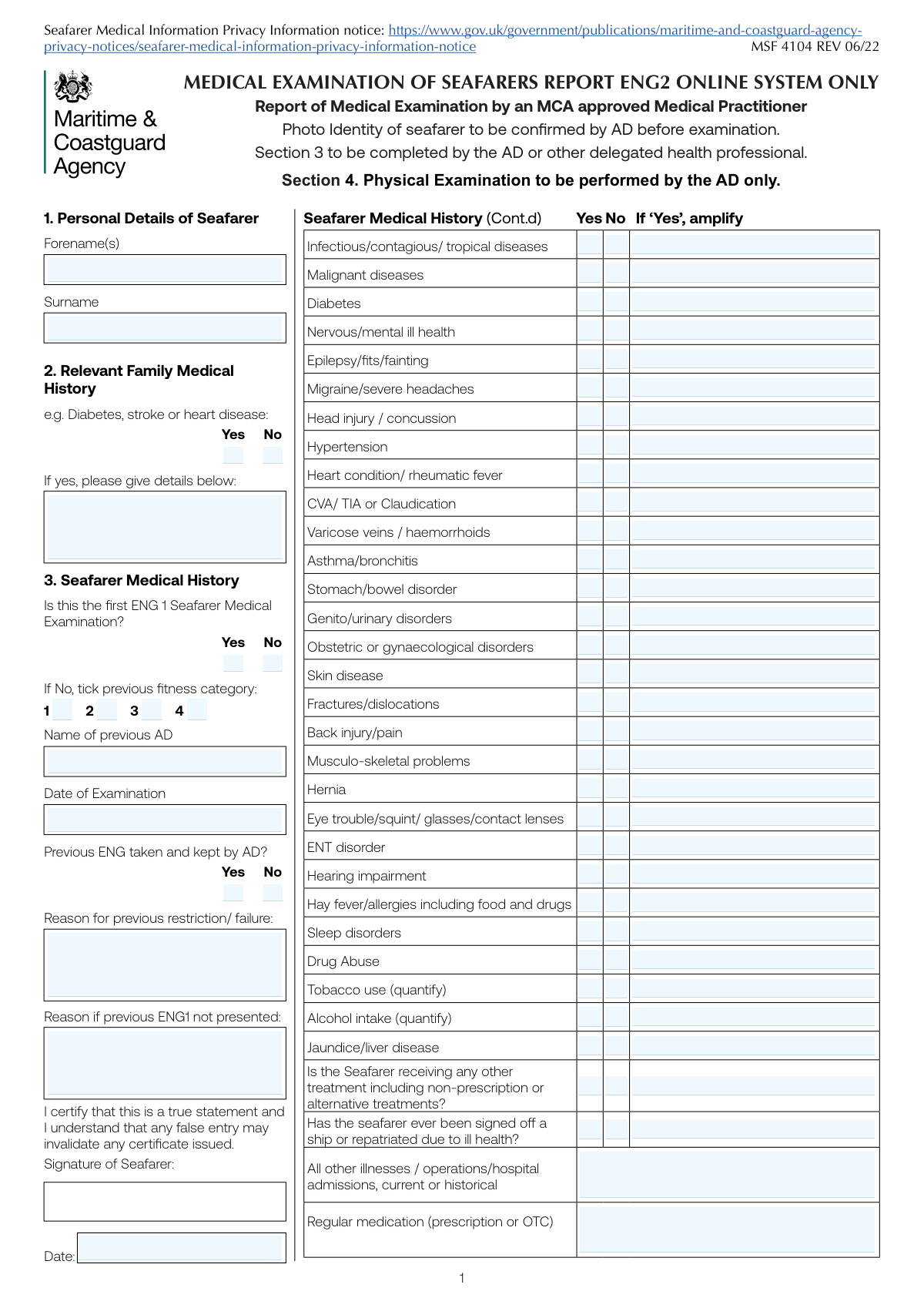
Yes! You can use AI to fill out MSF 4104, Medical Examination of Seafarers Report (ENG2)
Form MSF 4104, also known as the ENG2 report, is a detailed medical examination record for seafarers, mandated by the UK's Maritime and Coastguard Agency (MCA). It is a critical document used by approved medical practitioners to assess and report on a seafarer's physical and mental fitness, ensuring they meet the required health standards for life at sea. Today, this form can be filled out quickly and accurately using AI-powered services like Instafill.ai, which can also convert non-fillable PDF versions into interactive fillable forms.
MSF 4104 / ENG2 is part of the
Medi-Cal forms, medical forms, medical report forms, seafarer forms and VA medical forms categories on Instafill.
Our AI automatically handles information lookup, data retrieval, formatting, and form filling.
It takes less than a minute to fill out MSF 4104 / ENG2 using our AI form filling.
Securely upload your data. Information is encrypted in transit and deleted immediately after the form is filled out.
Form specifications
| Form name: | MSF 4104, Medical Examination of Seafarers Report (ENG2) |
| Number of fields: | 176 |
| Number of pages: | 2 |
| Language: | English |
More forms in Medi-Cal forms
Instafill Demo: How to fill out PDF forms in seconds with AI
How to Fill Out MSF 4104 / ENG2 Online for Free in 2026
Are you looking to fill out a MSF 4104 / ENG2 form online quickly and accurately? Instafill.ai offers the #1 AI-powered PDF filling software of 2026, allowing you to complete your MSF 4104 / ENG2 form in just 37 seconds or less.
Follow these steps to fill out your MSF 4104 / ENG2 form online using Instafill.ai:
- 1 Navigate to Instafill.ai and upload or select the MSF 4104 / ENG2 form.
- 2 The seafarer uses the AI assistant to accurately input their personal details, family medical history, and previous examination information in Sections 1 and 2.
- 3 The seafarer completes the detailed medical history questionnaire in Section 3, answering all yes/no questions and providing amplified details for any conditions as prompted by the tool.
- 4 The MCA-approved doctor (AD) inputs the physical examination findings from Section 4, including height, weight, blood pressure, and urine test results.
- 5 The doctor completes the system-by-system physical examination checklist, noting any abnormalities and indicating if extra tests are required.
- 6 The seafarer and the doctor digitally sign and date the form in the designated sections to certify the accuracy of the information provided and the examination results.
- 7 Review all entered information for accuracy before finalizing and submitting the report through the ENG2 online system as required.
Our AI-powered system ensures each field is filled out correctly, reducing errors and saving you time.
Why Choose Instafill.ai for Your Fillable MSF 4104 / ENG2 Form?
Speed
Complete your MSF 4104 / ENG2 in as little as 37 seconds.
Up-to-Date
Always use the latest 2026 MSF 4104 / ENG2 form version.
Cost-effective
No need to hire expensive lawyers.
Accuracy
Our AI performs 10 compliance checks to ensure your form is error-free.
Security
Your personal information is protected with bank-level encryption.
Frequently Asked Questions About Form MSF 4104 / ENG2
The MSF 4104 form is the official Report of Medical Examination for Seafarers, used by a Maritime and Coastguard Agency (MCA) approved doctor to record the results of your ENG1 medical exam. It is used to determine your medical fitness to work at sea.
The seafarer is responsible for completing the personal details and medical history in Section 3. The MCA-approved doctor (AD) or a delegated health professional completes the physical examination findings in Section 4.
You must provide truthful information about your personal and family medical history, including any past or present illnesses, injuries, surgeries, allergies, and regular medications. You also need to quantify any tobacco and alcohol use.
You must bring a valid photo ID, such as a passport or discharge book. If this is not your first ENG1, you should also bring your previous medical certificate.
If you tick 'Yes' for any condition, 'amplify' means you must provide more specific details in the adjacent box. This includes the nature of the condition, dates, treatment, and current status.
You must declare that you have had a previous ENG1 exam and provide details such as your previous fitness category, the name of the previous doctor, and the date of that examination.
By signing the form, you certify that the medical history you have provided is a true and complete statement. Providing false information can invalidate any medical certificate issued based on the examination.
The physical examination, performed only by the Approved Doctor, includes measuring your height, weight, pulse, and blood pressure, as well as conducting a urine test. The doctor will also systematically check your body systems like heart, lungs, and vision.
Yes, services like Instafill.ai use AI to help you accurately auto-fill your personal details and medical history. This can save time and help ensure the information you provide to the doctor is accurate and complete.
You can use a platform like Instafill.ai to upload and fill out the seafarer-completed sections of the form electronically. This allows you to type your information neatly before printing it for your appointment with the doctor.
If you have a non-fillable PDF, you can use Instafill.ai to convert it into an interactive, fillable form. This makes it easy to enter your information digitally before your examination.
AD stands for 'Approved Doctor'. This is a medical practitioner who has been officially approved by the MCA to conduct seafarer medical examinations.
You should report any significant hereditary conditions in your close family, such as diabetes, stroke, or heart disease. This information helps the doctor assess any potential genetic risks to your health.
Compliance MSF 4104 / ENG2
Validation Checks by Instafill.ai
1
Ensures Amplification for 'Yes' Answers in Medical History
This check verifies that for every medical condition in the Seafarer Medical History section (rows 1-31) where the 'Yes' box is checked, the corresponding 'If ‘Yes’, amplify' text field is not empty. This is crucial for the Approved Doctor (AD) to understand the full context and severity of the condition to make an accurate fitness assessment. A failure would result in an incomplete medical history, potentially leading to the form being rejected and requiring the seafarer to provide the missing information.
2
Validates Previous Examination Details for Non-First-Time ENG1
This validation ensures that if the seafarer indicates this is not their first ENG1 examination by selecting 'No', then the fields for 'Previous fitness category', 'Name of previous AD', and 'Date of Examination' are all completed. This information is vital for continuity of care and understanding the seafarer's medical history over time. If these fields are empty, the form submission would be flagged as incomplete, preventing the AD from properly assessing changes in the seafarer's health status.
3
Verifies Date Format and Chronological Consistency
This check confirms that all date fields ('Date of examination by previous AD', 'Seafarer Signature Date', 'Date' of doctor's signature) are in a valid format (e.g., DD/MM/YYYY). It also cross-references these dates to ensure logical consistency, such as the previous examination date being before the current examination date. Incorrect or illogical dates can invalidate the legal standing of the document and cause significant processing delays.
4
Validates BMI Calculation Against Height and Weight
This check automatically calculates the Body Mass Index (BMI) using the provided 'Height' (in meters) and 'Weight' (in kilos) and compares it to the value entered in the 'BMI' field. This ensures the accuracy of the BMI, which is a key indicator of health and fitness for duty. A discrepancy would trigger a warning, prompting the user to review and correct the height, weight, or BMI values to ensure the assessment is based on correct data.
5
Checks for Realistic Physical Examination Values
This validation verifies that the numeric values entered for 'Height', 'Weight', 'Pulse rate', and 'Blood pressure' fall within a medically plausible range for an adult human. For example, it would flag a pulse rate of 300 or a weight of 1000 kg as likely errors. This check acts as a safeguard against data entry mistakes that could lead to a flawed medical assessment and incorrect fitness determination.
6
Requires Details for Abnormal Physical Examination Findings
This validation ensures that for each item in the Physical Examination section (Teeth, ENT, Skin, etc.), if the 'Yes' box is ticked (indicating an abnormality), the corresponding details field is populated. This is critical for documenting the nature of the abnormality and any required follow-up. Failure to provide details for a noted abnormality would result in an incomplete report, requiring clarification from the examining doctor.
7
Ensures Findings are Documented When Extra Tests are Required
This check verifies that if the 'Extra tests required' checkbox is ticked for any category in the Physical Examination section, the associated text field for findings and attachments is not empty. This rule ensures that the reason for ordering extra tests and the plan for reviewing them are clearly documented. An empty details field would create ambiguity and could halt the certification process until the necessary information is provided.
8
Confirms All Medical History Yes/No Questions are Answered
This validation ensures that for every condition listed in the Seafarer Medical History table (rows 1-31), either the 'Yes' or 'No' checkbox has been selected. Leaving a question unanswered creates ambiguity and results in an incomplete medical declaration. This check is essential to confirm the seafarer has reviewed and responded to all health questions, which is a prerequisite for a valid medical assessment.
9
Verifies All Physical Examination Yes/No Categories are Completed
This validation confirms that for each system reviewed in the Physical Examination section (Teeth, ENT, Skin, etc.), the examining doctor has selected either 'Yes' or 'No'. This ensures a comprehensive examination has been documented and no area was overlooked. An incomplete section would suggest a partial examination and would require the doctor to complete the report before it can be processed.
10
Validates Doctor's Name and Signature Date
This check ensures that the 'Doctor name (BLOCK LETTERS)' field is filled and the 'Date' field next to the doctor's signature is completed and valid. The doctor's identity and the date of examination are legally required components of the medical report. Missing information would invalidate the form and prevent the issuance of the seafarer's medical certificate.
11
Requires Details for Positive Family Medical History
This validation confirms that if the 'Yes' checkbox is selected for 'Relevant Family Medical History', the corresponding details text box is filled out. Understanding hereditary risk factors is an important part of the overall health assessment. If the 'Yes' box is checked but no details are provided, the form would be considered incomplete and flagged for correction.
12
Ensures Quantification of Tobacco and Alcohol Use
This check verifies that if 'Yes' is selected for 'Tobacco use (quantify)' or 'Alcohol intake (quantify)', the corresponding quantification field is filled with a specific amount. This specific data is more valuable for risk assessment than a simple yes/no answer. Failure to quantify usage would prompt the user to provide the necessary details for a complete health profile.
13
Ensures Seafarer's Full Name is Provided
This validation confirms that both the 'Forename(s)' and 'Surname' fields in the Personal Details section are filled out. A complete and accurate name is fundamental for correctly identifying the seafarer and linking the medical report to their official records. An incomplete name would render the form invalid and prevent the issuance of a medical certificate.
14
Confirms Seafarer Signature Date is Present
This validation ensures the 'Date' field next to the 'Signature of Seafarer' is filled out and contains a valid date. The seafarer's signature and date certify that the provided medical history is a true statement. A missing or invalid date compromises the validity of this declaration and would cause the form to be rejected until completed.
Common Mistakes in Completing MSF 4104 / ENG2
A frequent error is checking 'Yes' for a medical condition in the history checklist but failing to provide the required details in the 'If 'Yes', amplify' column. This often happens when applicants rush or assume the checkbox alone is sufficient. This omission makes the form incomplete, forcing the doctor to halt the examination to request the missing information, which can cause significant delays in issuing the medical certificate.
Applicants often provide unhelpful, non-specific answers for tobacco and alcohol use, such as 'socially' or 'occasionally', when the form explicitly asks to 'quantify' intake. This ambiguity prevents the doctor from accurately assessing health risks, leading to further questioning and potential delays. To avoid this, calculate and provide specific figures, such as cigarettes smoked per day or alcohol units consumed per week.
Seafarers may fail to declare past surgeries, hospitalizations, or significant injuries, believing they are no longer relevant if they have recovered. This is a serious error, as the signed declaration certifies the form is a true statement, and non-disclosure can invalidate the certificate if discovered later. It is crucial to disclose all major past events and let the doctor determine their relevance for a valid and safe assessment.
When renewing a certificate, applicants often forget key details from their previous ENG1, such as the doctor's name, date of examination, or the reason for a prior restriction. This happens due to poor personal record-keeping. The absence of this information prevents the new doctor from reviewing the seafarer's medical history progression, potentially leading to delays while records are tracked down.
Applicants may list non-hereditary conditions or provide insufficient detail, such as writing 'heart disease' without specifying the relative or their age at diagnosis. This section is intended to identify genetic predispositions, and vague information prevents a proper risk assessment. To be effective, provide details on major hereditary conditions (e.g., diabetes, stroke) in immediate family members (parents, siblings), including the condition and age of onset.
A common mistake is listing only prescription drugs while omitting regularly used over-the-counter (OTC) medications, vitamins, or herbal supplements. People often don't consider these as 'real' medicine, but they can have side effects or interact with other drugs. This omission can compromise the medical assessment; therefore, a complete list of all substances taken regularly must be provided.
Using a nickname or failing to include all middle names as they appear on official identification is a critical error. The name on the medical certificate must exactly match the seafarer's passport and other official documents. Any discrepancy can lead to serious issues with employers, immigration, and port authorities, potentially delaying or preventing boarding.
Applicants sometimes provide contradictory information, such as denying a heart condition but listing heart medication in the 'Regular medication' section. This occurs due to carelessness or forgetting the link between a medication and its corresponding diagnosis. Such inconsistencies raise red flags for the doctor, eroding trust and requiring a lengthy clarification process that delays certification.
When filling out a printed PDF, illegible handwriting, or writing outside the designated fields can make the information unusable. This is equivalent to leaving a field blank and forces the medical staff to guess or request a new form, causing delays and potential data entry errors. Using a tool like Instafill.ai can convert a non-fillable PDF into a typed, cleanly formatted document, eliminating these issues.
Many applicants sign the certification statement as a mere formality without thoroughly reviewing their answers. The signature is a legally binding confirmation that all information is true and complete. An undiscovered error or omission can lead to the invalidation of the certificate and serious professional or legal consequences for making a false declaration.
In the detail fields, applicants may use slang or overly vague terms like 'bad back' or 'a touch of sugar' instead of the proper medical diagnosis. This happens when they don't know the correct term or try to downplay a condition's severity. This ambiguity prevents the doctor from accurately assessing the condition, potentially leading to an incorrect fitness decision or requiring a time-consuming re-interview to clarify the history.
Saved over 80 hours a year
“I was never sure if my IRS forms like W-9 were filled correctly. Now, I can complete the forms accurately without any external help.”
Kevin Martin Green
Your data stays secure with advanced protection from Instafill and our subprocessors

Robust compliance program
Transparent business model
You’re not the product. You always know where your data is and what it is processed for.
ISO 27001, HIPAA, and GDPR
Our subprocesses adhere to multiple compliance standards, including but not limited to ISO 27001, HIPAA, and GDPR.
Security & privacy by design
We consider security and privacy from the initial design phase of any new service or functionality. It’s not an afterthought, it’s built-in, including support for two-factor authentication (2FA) to further protect your account.
Fill out MSF 4104 / ENG2 with Instafill.ai
Worried about filling PDFs wrong? Instafill securely fills msf-4104-medical-examination-of-seafarers-report-eng2 forms, ensuring each field is accurate.