How to register a moped in California with Form REG 230
To register a moped in California, you fill out DMV Form REG 230, Motorized Bicycle (Moped) Instructions/Application, and mail it with a $28 check or money order to the DMV's Special Processing Unit in Sacramento. The DMV sends back a moped license plate and an identification card. There is no title and no annual renewal. The form only works if the vehicle meets California's definition of a moped, so start there.
At a glance
- Form REG 230, Motorized Bicycle (Moped) Instructions/Application (Rev. 1/2015)
- Issued by California Department of Motor Vehicles
- Who files The owner of a moped never licensed in California, a new owner, or an owner replacing a plate or ID card
- Where it goes By mail to the DMV Special Processing Unit, Sacramento
- Fee $28 (VC §5036), once; no annual renewal
- Catalog forms REG 230, Motorized Bicycle (Moped) Instructions/Application, REG 256, Statement of Facts
- Form categories California DMV forms, Vehicle registration forms
Check that your vehicle is a moped
Section 2 of REG 230 asks four yes-or-no questions, taken from the moped definition in California Vehicle Code §406:
| Question on REG 230 | What it means |
|---|---|
| Two-wheel or three-wheel device? | No four-wheelers |
| Fully operative pedals for human power, or powered solely by electrical energy? | A gas moped needs working pedals; an electric one does not |
| Automatic transmission and a motor with less than 4 gross brake horsepower? | No manual gearbox, small motor |
| Maximum speed of 30 miles per hour on level ground? | Top speed, not the speed you plan to ride |
If every answer is Yes, the vehicle is a moped and REG 230 is the right form. If any answer is No, it is not a moped under §406, and the form sends you to the Application for Registration (REG 343) to register it as a motorcycle or other vehicle instead.
The 30 mph limit matters after registration too. The DMV's registration manual says a moped that can go faster than 30 mph is subject to registration as a motor-driven cycle, and an owner cited for going over 30 mph has to apply for that registration and pay its fees. The same applies from the first ride after a modification that raises the top speed above 30 mph.
What you need before you start
- Vehicle details The vehicle identification number (VIN) and the engine number, plus the make and model. The DMV requires a VIN to license a moped. If yours has none, the DMV's Special Processing Unit assigns one, and the instructions for marking it on the moped come printed on the ID card.
- Your ID Your California driver license or ID card number, and your full legal name and address.
- The fee A $28 check or money order. The form says not to send cash.
The DMV publishes the current REG 230 as a fillable PDF. The revision printed at the bottom is REV. 1/2015.
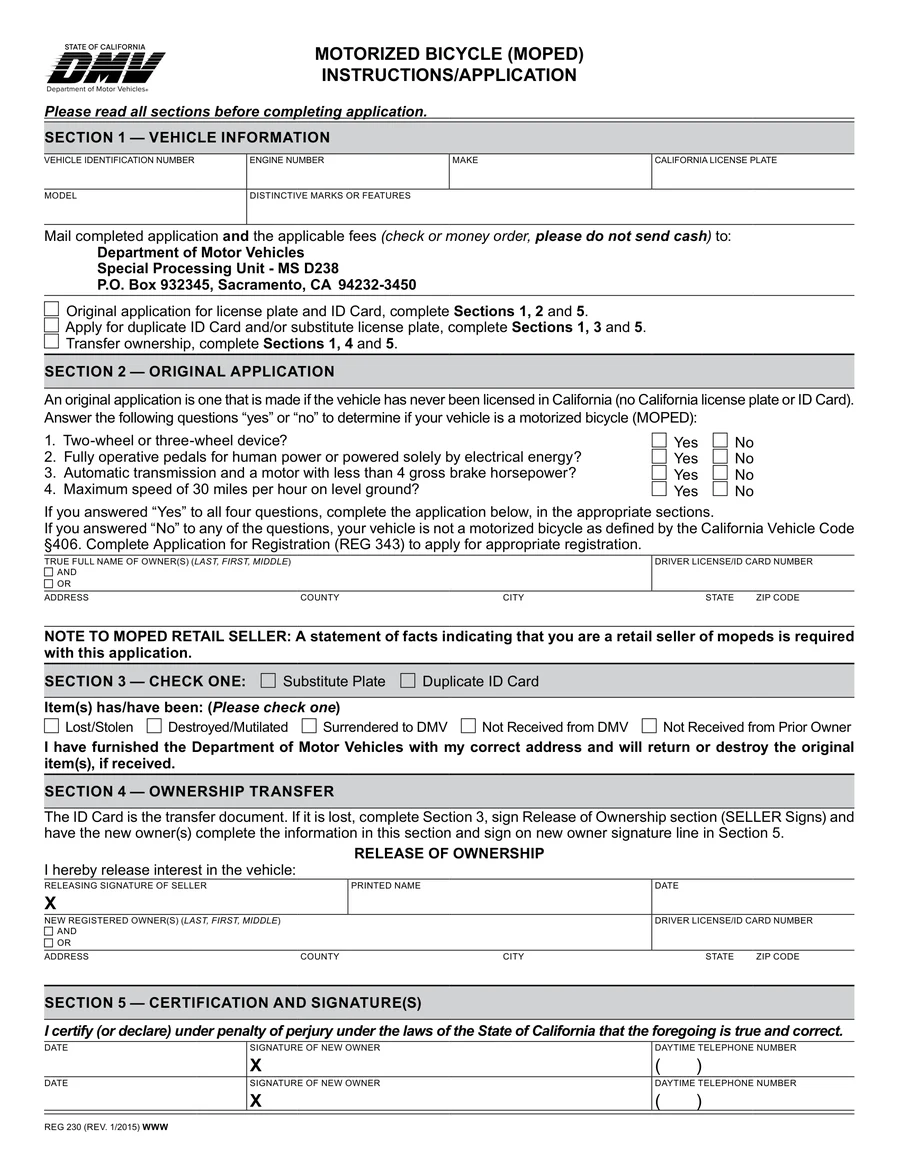
REG 230 is one page with five sections. Which ones you fill depends on why you are filing:
A first registration (the moped has never had a California plate or ID card): Sections 1, 2 and 5.
A substitute plate or duplicate ID card: Sections 1, 3 and 5.
A change of owner: Sections 1, 4 and 5.
Fill out the form, section by section
Section 1, Vehicle Information. The VIN, engine number, make and model, and any distinctive marks or features. The "California License Plate" box is for a moped that already has a California plate, as on a transfer or a replacement ID card.
Section 2, Original Application. Answer the four eligibility questions, then the owner's true full name (last, first, middle), driver license or ID card number, address and county. For two owners, check AND or OR between the names. A retail seller of mopeds must also attach a Statement of Facts (REG 256) saying so.
Section 3, Substitute Plate or Duplicate ID Card. Check which item you need and why: lost or stolen, destroyed or mutilated, surrendered to the DMV, not received from the DMV, or not received from the prior owner.
Section 4, Ownership Transfer. The moped's ID card is its transfer document. The seller signs the release of ownership and the new owner fills in their name, license number and address. If the ID card is lost, the form asks you to complete Section 3 as well. The plate stays on the moped when it changes hands.
Section 5, Certification and Signature(s). Sign and date under penalty of perjury and add a daytime phone number.
To fill the form on screen, the REG 230 moped application on Instafill.ai completes it from the details you give it, for you to check before you sign and mail it.
Mail it with the fee
The address is printed on the form:
Department of Motor Vehicles
Special Processing Unit - MS D238
P.O. Box 932345
Sacramento, CA 94232-3450
The DMV's registration fees table lists the same $28 moped fee (VC §5036) for each of four transactions: an original registration, a transfer, a replacement plate and a replacement ID card. No late penalty or use tax is charged on a moped application, according to the DMV manual.
After you register
You receive a moped license plate and an ID card. Keep the ID card: it is what you sign over when you sell the moped. Mopeds are not subject to annual renewal, so there is nothing to pay again unless you transfer the moped or replace the plate or card.
Registration does not license the rider. The DMV's page on motorcycles, mopeds and scooters says that to ride a moped you need a motorcycle license (Class M1 or M2), must be at least 16 years old and must wear a helmet. Insurance is not required to register a moped.