Yes! You can use AI to fill out Motorized Bicycle (Moped) Instructions/Application (REG 230)

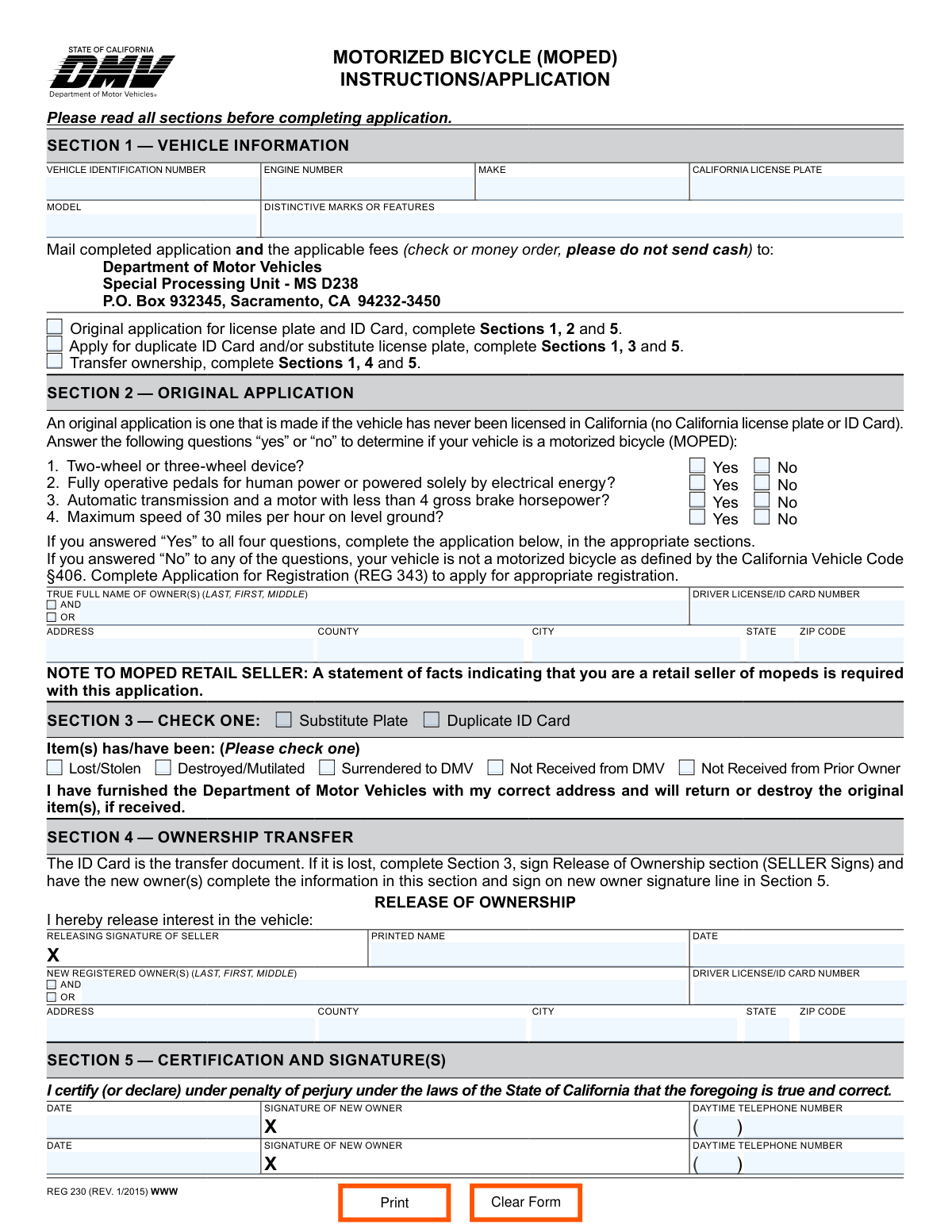
REG 230 is a California Department of Motor Vehicles application for motorized bicycles (mopeds) used for three main purposes: original issuance of a moped license plate and ID card, replacement of a lost/damaged plate or ID card, and ownership transfer. The form includes a qualification checklist to confirm the vehicle meets the California Vehicle Code §406 definition of a moped. It is important because the moped ID card serves as the ownership/transfer document, and the DMV uses the information to issue or update records and credentials.
Our AI automatically handles information lookup, data retrieval, formatting, and form filling.
It takes less than a minute to fill out REG 230 using our AI form filling.
Securely upload your data. Information is encrypted in transit and deleted immediately after the form is filled out.

Form specifications

Form name: Motorized Bicycle (Moped) Instructions/Application (REG 230)
Number of pages: 1
Filled form examples: Form REG 230 Examples
Language: English
main-image

Instafill Demo: filling out a legal form in seconds

How to Fill Out REG 230 Online for Free in 2026

Are you looking to fill out a REG 230 form online quickly and accurately? Instafill.ai offers the #1 AI-powered PDF filling software of 2026, allowing you to complete your REG 230 form in just 37 seconds or less.
Follow these steps to fill out your REG 230 form online using Instafill.ai:
  1. 1 Choose the purpose of your filing: original application (Section 2), duplicate ID card/substitute plate (Section 3), or ownership transfer (Section 4), and note which sections you must complete along with Sections 1 and 5.
  2. 2 Complete Section 1 (Vehicle Information): enter the VIN, engine number, make, model, California license plate (if any), and any distinctive marks/features.
  3. 3 If applying for an original moped plate/ID card, complete Section 2: answer the four “yes/no” moped definition questions and, if eligible, enter the true full name(s) of owner(s), driver license/ID number(s), and full address details.
  4. 4 If requesting replacements, complete Section 3: select substitute plate and/or duplicate ID card, indicate whether the item was lost/stolen, destroyed/mutilated, surrendered, or not received, and acknowledge you will return/destroy the original if found.
  5. 5 If transferring ownership, complete Section 4: seller signs the Release of Ownership, then the new owner(s) provide name(s), driver license/ID number(s), and address information.
  6. 6 Complete Section 5 (Certification and Signatures): new owner(s) sign and date under penalty of perjury and provide daytime telephone number(s).
  7. 7 Prepare payment (check or money order; no cash) and mail the completed application and applicable fees to the DMV Special Processing Unit address listed on the form.

Our AI-powered system ensures each field is filled out correctly, reducing errors and saving you time.

Why Choose Instafill.ai for Your Fillable REG 230 Form?

Speed

Complete your REG 230 in as little as 37 seconds.

Up-to-Date

Always use the latest 2026 REG 230 form version.

Cost-effective

No need to hire expensive lawyers.

Accuracy

Our AI performs 10 compliance checks to ensure your form is error-free.

Security

Your personal information is protected with bank-level encryption.

Frequently Asked Questions About Form REG 230

This form is used to apply for a California moped license plate and ID card, request a duplicate ID card and/or substitute plate, or transfer ownership of a moped. It is specifically for vehicles that meet California’s definition of a motorized bicycle (moped).

Use this form if you own a moped and need an original California plate/ID card, a replacement plate/ID card, or to transfer ownership to a new owner. The correct sections depend on what you are requesting.

In Section 2, you must answer “Yes” to all four questions: it’s a 2- or 3-wheel device, has fully operative pedals or is powered solely by electrical energy, has an automatic transmission and less than 4 gross brake horsepower, and has a max speed of 30 mph on level ground. If any answer is “No,” you must use Application for Registration (REG 343) instead.

You’ll need the Vehicle Identification Number (VIN), engine number, make, model, and any distinctive marks/features. If the moped already has a California license plate, include that plate number as well.

For an original application, complete Sections 1, 2, and 5. An original application is for a vehicle that has never been licensed in California (no CA plate or ID card).

Complete Sections 1, 3, and 5. In Section 3, check whether you need a substitute plate, a duplicate ID card, or both (as applicable).

Complete Sections 1, 4, and 5. The seller signs the Release of Ownership in Section 4, and the new owner completes their information and signs in Section 5.

If the ID card is lost, complete Section 3 and have the seller sign the Release of Ownership in Section 4. The new owner must then complete their information in Section 4 and sign in Section 5.

You should select the reason the plate/ID card needs replacement (for example, lost, stolen, damaged, turned in to DMV, or never received). This helps DMV understand why you are requesting a substitute plate and/or duplicate ID card.

By signing, you confirm DMV has your correct address and you agree to return the original plate/ID card to DMV or destroy it if it later turns up. This helps prevent duplicate documents or plates from being used improperly.

Mail the completed application and applicable fees (check or money order—do not send cash) to: Department of Motor Vehicles, Special Processing Unit - MS D238, P.O. Box 932345, Sacramento, CA 94232-3450.

The form instructs you to pay by check or money order and specifically says not to send cash. Include the applicable fees with your mailed application.

Yes. The form notes that a moped retail seller must include a Statement of Facts indicating they are a retail seller of mopeds along with the application.

The new registered owner(s) must sign and date Section 5 and provide a daytime telephone number. If there are two owners, both should sign on the separate signature lines provided.

The form does not list a specific processing time. Processing times can vary, so it’s best to allow mailing time plus DMV processing and contact DMV if you need a status update.

Compliance REG 230
Validation Checks by Instafill.ai

1
Ensures Section 1 Vehicle Identification Number (VIN) is present and valid length/character set
Validates that the VIN field in Section 1 is completed and matches expected VIN formatting rules (typically 17 characters, excluding I, O, and Q) or an allowed DMV moped/VIN exception format if applicable. This is critical to uniquely identify the vehicle and prevent duplicate or fraudulent records. If the VIN is missing or malformed, the submission should be rejected or routed for manual review with a request for correction.
2
Validates Engine Number is provided and conforms to allowed format
Checks that the engine number is present (when required) and contains only permitted characters (letters/numbers and limited symbols) within a reasonable length range. Engine number is often used as a secondary identifier for mopeds and helps resolve VIN ambiguity. If invalid or missing, the application should be flagged and the applicant prompted to provide the correct engine number from the vehicle/engine stamp.
3
Validates Make and Model fields are completed and not placeholder text
Ensures the Make and Model fields in Section 1 are not blank and do not contain non-informative values (e.g., 'N/A', 'unknown', or random characters). Accurate make/model supports correct classification, fee calculation, and record matching. If validation fails, the form should be returned for completion or held for manual verification.
4
Checks California License Plate field consistency with application type
Validates that the California license plate field is blank for an original application (Section 2) and present for duplicate/substitute requests (Section 3) or ownership transfers (Section 4) when a plate exists. This prevents contradictory submissions (e.g., claiming the vehicle has never been licensed in CA while providing a CA plate). If inconsistent, the system should require the applicant to correct the application type or plate information before processing.
5
Enforces moped qualification questions (Section 2) are all answered Yes/No
Checks that each of the four moped definition questions has exactly one selection (Yes or No) and none are left blank. These answers determine whether REG 230 is the correct form or whether the applicant must use REG 343. If any question is unanswered or multiple selections are detected, the submission should be rejected as incomplete.
6
Validates moped eligibility logic: all four answers must be 'Yes' to proceed with original application
Applies the rule stated on the form: only if all four moped questions are answered 'Yes' should the applicant proceed with the REG 230 original application path. If any answer is 'No', the system should block submission under this form and instruct the applicant to complete REG 343 instead. This prevents misclassification and improper registration/plate issuance.
7
Validates owner full legal name completeness and structure
Ensures the 'True Full Name of Owner(s)' (and 'New Registered Owner(s)' in transfers) includes at minimum a last name and first name, and does not contain business-only descriptors unless allowed by policy. Correct legal naming is required for ownership records, ID card issuance, and enforcement actions. If incomplete or clearly invalid (e.g., only initials, symbols), the application should be returned for correction.
8
Validates Driver License/ID Card Number format for each listed owner
Checks that each provided CA Driver License/ID number matches expected formatting (commonly 1 letter followed by 7 digits for CA) and that the number is present when an owner is listed. This links the registration to an identity record and reduces fraud and duplicate profiles. If the format is invalid or missing, the submission should be rejected or queued for identity verification.
9
Validates multi-owner indicator (AND/OR) is consistent with number of owners provided
Ensures that if two owners are entered, the AND/OR selection is present, and if only one owner is entered, the form does not indicate a second owner relationship. Ownership conjunction affects legal rights (e.g., transfer authority) and must be captured accurately. If inconsistent, the system should require clarification before finalizing the record.
10
Validates mailing/residential address completeness (street, city, state, ZIP) and ZIP format
Checks that address fields are complete: address line, city, state, and ZIP code are present, and ZIP is 5 digits (or ZIP+4 if allowed). Accurate address is required for mailing plates/ID cards and for statutory notices. If incomplete or ZIP is malformed, the application should be rejected or held until corrected.
11
Validates County field is present and matches California county list (when state is CA)
Ensures the county is provided and, if the state is California, that it matches an approved list of CA counties (or accepted abbreviations). County is often used for jurisdictional reporting and fee/tax allocation. If the county is missing or not recognized, the system should prompt for correction or allow controlled lookup selection.
12
Section 3 request type validation: exactly one of Substitute Plate or Duplicate ID Card must be selected
Verifies that the applicant selects one and only one request type in Section 3 when applying for replacement items. This is necessary to determine which item(s) to issue and which fees apply. If both or neither are selected, the submission should be rejected as ambiguous.
13
Section 3 reason validation: exactly one item status reason must be selected
Checks that one and only one reason is selected among Lost/Stolen, Destroyed/Mutilated, Surrendered to DMV, Not Received from DMV, or Not Received from Prior Owner. The reason can drive additional requirements (e.g., theft reporting) and audit trails. If multiple or none are selected, the application should be returned for clarification.
14
Ownership transfer completeness: seller release signature, printed name, and date required when Section 4 is used
If Section 4 indicates an ownership transfer, validates that the seller has signed the release, printed their name, and provided a date. This establishes legal release of interest and supports chain-of-title integrity. If any element is missing, the transfer should not be processed and must be returned for completion.
15
New owner certification signatures and dates required in Section 5 (and phone number format validation)
Ensures at least one new owner signature and date are present in Section 5, and if a second owner is listed, validates the second signature/date line is completed as well. Also validates daytime telephone number formatting (e.g., 10 digits, allowing parentheses/dashes) to enable contact for issues. If signatures/dates are missing or phone is invalid, the application should be rejected as uncertified or incomplete.

Common Mistakes in Completing REG 230

Leaving Section 1 vehicle identifiers blank or incomplete

Applicants often omit the Vehicle Identification Number (VIN), engine number, make/model, or distinctive marks because they don’t know where to find them or assume the plate number is enough. Missing or partial identifiers can prevent DMV from matching the vehicle to records and can delay or reject processing. Locate the VIN/engine number on the frame/engine stamping and copy it exactly as shown, including any letters and leading zeros.

Mixing up VIN and engine number (or transposing characters)

A very common error is entering the engine number in the VIN field, swapping digits, or misreading similar characters (O vs 0, I vs 1). This causes record mismatches and can trigger requests for correction or additional verification. Double-check each character against the physical stamping and, if possible, compare to purchase documents; write clearly and avoid guessing.

Not following the form’s “which sections to complete” instructions

People frequently complete the wrong combination of sections (e.g., filling Section 2 when requesting a duplicate, or forgetting Section 3 for a lost ID card). Submitting the wrong sections leads to incomplete applications and returned mail. Before filling anything out, choose the purpose (original application, duplicate/substitute, or transfer) and complete exactly the sections listed plus Section 5.

Incorrectly answering the moped qualification questions in Section 2

Applicants sometimes answer “Yes” to all four questions without confirming the vehicle’s actual specs (pedals, transmission type, horsepower, and top speed). If any answer should be “No,” the vehicle is not a moped under CVC §406 and the application will be misfiled, causing delays and requiring REG 343 instead. Verify the vehicle configuration and manufacturer specifications; if uncertain, confirm with the seller or documentation before checking “Yes/No.”

Using a nickname or incomplete owner name instead of the true full legal name

Many people enter shortened names, omit middle names/initials, or use business names where the form asks for the “TRUE FULL NAME OF OWNER(S).” Name mismatches can create title/ownership inconsistencies and may complicate future transfers or replacements. Enter the legal name exactly as it appears on the California driver license/ID, including suffixes (Jr., Sr.) if applicable.

Missing or incorrect driver license/ID card number for owner(s)

Applicants often leave the DL/ID number blank, enter an out-of-state number, or put the wrong person’s number when there are multiple owners. This can prevent DMV from properly identifying the owner record and may result in a request for correction. Provide the correct California DL/ID number for each listed owner and ensure it matches the name on the form.

Confusion over joint ownership (“AND” vs “OR”) selection

When two owners are listed, people frequently fail to indicate “AND” or “OR,” or they select the wrong option without understanding the legal effect. The choice affects who must sign for future transactions and can cause transfer issues if the wrong option is recorded. Decide ownership carefully: use “AND” when both owners must act together, and “OR” when either owner may act independently, then mark it clearly.

Providing an incomplete mailing/residential address (missing county, ZIP, or apartment/unit)

Addresses are often missing the county, ZIP code, or unit number, or applicants use an old address that doesn’t match DMV records. This can lead to returned mail, non-receipt of plates/ID cards, and processing delays—especially for Section 3 where the applicant certifies the address is correct. Enter the full address (including unit), city, state, ZIP, and county, and update your address with DMV before submitting if it has changed.

Section 3 replacement requests missing the reason or checking multiple boxes

For substitute plates/duplicate ID cards, applicants sometimes forget to check whether the item was lost/stolen, destroyed, surrendered, or not received, or they check more than one option. An unclear reason can slow processing and may require follow-up. Check exactly one reason that best matches the situation and ensure it aligns with what happened (e.g., “Not Received from Prior Owner” vs “Not Received from DMV”).

Ownership transfer errors: missing seller release or wrong signatures

In transfers, people often forget the seller’s release signature/date, have the buyer sign in the seller area, or fail to have the new owner complete Section 4 and then sign in Section 5. Without the correct release and new owner certification, DMV may not process the transfer and may return the application. Ensure the seller signs the Release of Ownership, the new owner completes all new owner fields, and the new owner signs the correct signature line(s) in Section 5.

Missing signatures, dates, or daytime phone numbers in Section 5

Applicants frequently sign but forget the date, omit the daytime telephone number, or fail to obtain both signatures when two owners are listed. Missing certification elements can invalidate the submission and delay processing. Sign on the “Signature of New Owner” line(s), date each signature, and include a reachable daytime phone number for each signer.

Payment and mailing mistakes (wrong payment type, cash, or missing fees)

People sometimes send cash, forget to include the fee, or use an incorrect payment method despite the instruction to use check or money order and not send cash. Payment issues can cause the application to be rejected or held until corrected. Include the applicable fees with a check or money order payable as required by DMV, and mail the completed application to the exact address listed for the Special Processing Unit.
Saved over 80 hours a year

“I was never sure if my IRS forms like W-9 were filled correctly. Now, I can complete the forms accurately without any external help.”

Kevin Martin Green

Your data stays secure with advanced protection from Instafill and our subprocessors

Robust compliance program

Transparent business model

You’re not the product. You always know where your data is and what it is processed for.

ISO 27001, HIPAA, and GDPR

Our subprocesses adhere to multiple compliance standards, including but not limited to ISO 27001, HIPAA, and GDPR.

Security & privacy by design

We consider security and privacy from the initial design phase of any new service or functionality. It’s not an afterthought, it’s built-in, including support for two-factor authentication (2FA) to further protect your account.

Fill out REG 230 with Instafill.ai

Worried about filling PDFs wrong? Instafill securely fills motorized-bicycle-moped-instructionsapplication-re forms, ensuring each field is accurate.