Instafill.ai replaced its AI model and rebuilt form processing in March 2026
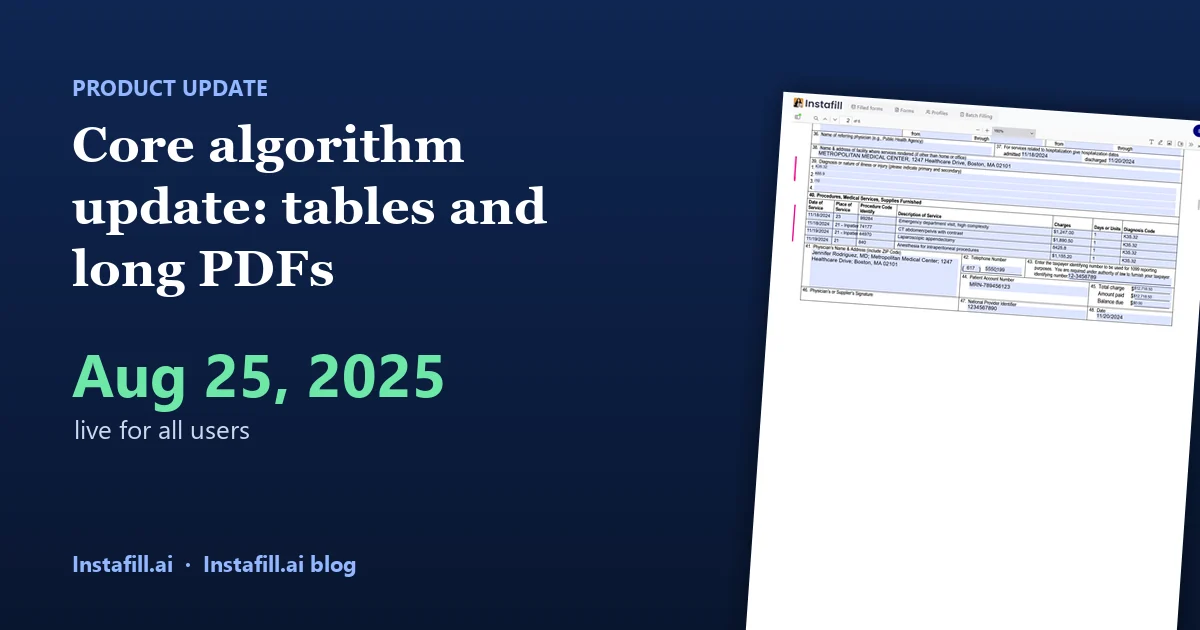
On March 6, 2026, Instafill.ai announced that it had replaced the AI model, rebuilt the processing pipeline and improved how it handles complex form layouts. The post listed nine improvements, in three groups: how the AI reads documents, how it understands a form's structure, and how precisely it fills.
Smarter reading
- GPT-5.2 across the platform. The previous-generation model was replaced with OpenAI's newer one for both text extraction and field filling. Several variants (GPT-5, 5.1, 5.2 and nano) were tested, and the best one was chosen for each type of operation.
- Page-by-page source reading. Every page of a source document is extracted on its own, so even a PDF of more than 70 pages is read in full.
- Relevance mapping. For large source files, the system finds the sections that matter for each form field instead of processing everything at once, which reduces errors and speeds up filling.
Better structure understanding
- Cross-page field dependencies. A checkbox on page 5 that says "Same as mailing address" depends on an address entered on page 1. A total on page 8 may sum figures on page 6. The AI now detects these relationships during fine-tuning and fills the fields consistently.
- Section-based processing. The system detects single-column and multi-column layouts and groups related fields into sections that can span page breaks. One form can use different processing strategies on different pages, chosen automatically.
- Row-by-row table filling. Tables are filled one row at a time, with each value mapped to its column by the header. This stops misplaced data in wide tables.
Precision and speed
- Text overflow handling. Every filled field is checked against its actual pixel boundaries. When the text does not fit, a separate AI step reformats or shortens it to fit without losing its meaning.
- Style replication. For narrative fields such as descriptions, clinical notes and progress reports, the AI matches the writing style of the examples you provide.
- A rebuilt processing pipeline. A new task queue runs up to 30 operations in parallel, so forms with several sources or complex layouts process faster and batch fills get more throughput.
What to do next
The improvements apply automatically to every new filled form, and all existing forms were migrated to support them, so nothing has to be re-uploaded. For a form fine-tuned more than a few weeks earlier, regenerating its fine-tuning is optional but recommended, especially when it has complex layouts or large source documents. Manual edits are always preserved.
The AI models have changed again since this post. The current description of how forms are filled is on the AI field filling page, and the fine-tuning steps are on the AI training page. The post's row-by-row approach is described on the table and list processing page.