Fill out Catholic diocese forms
with AI.
Catholic diocese forms are essential administrative documents used by the Church to manage sacramental records, legal permissions, and parish communications. These forms ensure that significant life events—such as baptisms, marriages, and confirmations—are recorded accurately according to both canon law and local diocesan requirements. Whether it's for tracking parishioner data or formalizing a request for a religious ceremony, these documents provide the formal framework necessary for the organized functioning of a diocese.
By continuing, you acknowledge Instafill's Privacy Policy and agree to get occasional product update and promotional emails.
About Catholic diocese forms
These forms are typically required by engaged couples, parents, and individuals seeking to participate in the life of the Church. For example, couples preparing for a wedding may need to submit an Application for Dispensations or provide detailed personal information for marriage records to their local parish. Parish administrators and clergy also rely on these documents to maintain clear communication between the central diocese and local congregations. Having the right paperwork ready is a crucial step in navigating the procedural side of religious milestones.
Completing these detailed documents can often be time-consuming, especially when they require precise religious and historical data. Tools like Instafill.ai use AI to fill these forms in under 30 seconds, handling sensitive information accurately and securely to streamline the administrative process. This allows families and parish staff to focus more on the spiritual significance of the occasion rather than the complexity of the paperwork.
Every form on this page can be completed without typing. Instafill is form filling software that reads a PDF and fills it for you — including flat and scanned documents that carry no fillable fields at all.
Forms in This Category
The forms in this category have a median Form Complexity Index of 62/100 (Moderate), measured across 1 forms by field count, input difficulty, length, conditional logic and structure. See how it is calculated.
| Form Name | Pages | FCI | |
|---|---|---|---|
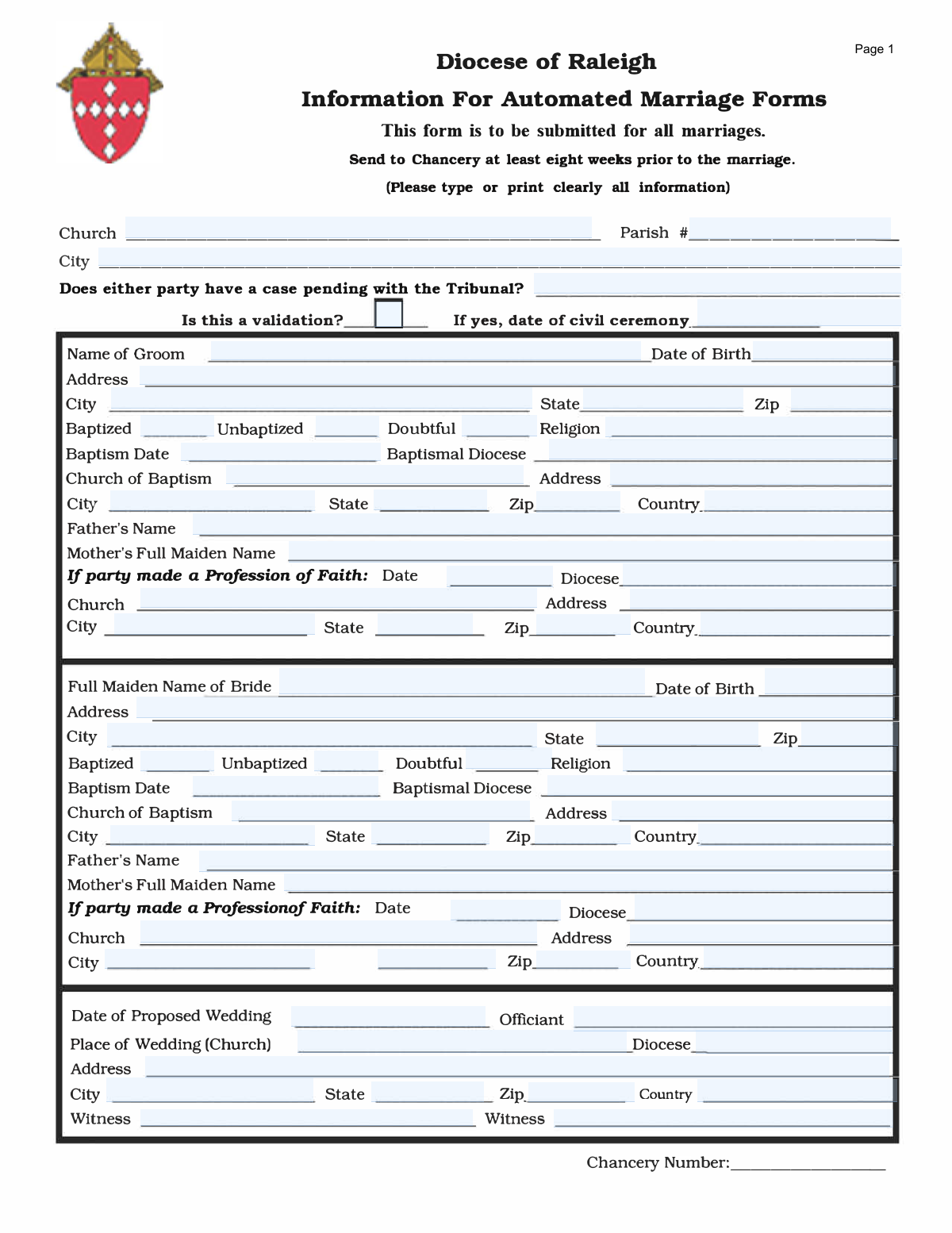
| 1. | Diocese of Raleigh Information For Automated Marriage Forms and Application for Dispensations/Permissions | 4 | Moderate 62 |
- Enterprise-grade security & data encryption
- 99%+ accuracy powered by AI
- 1,000+ forms from all industries
- Complete forms in under 60 seconds
How to Choose the Right Form
Navigating the administrative requirements for sacraments within the Catholic Church can often feel overwhelming. If you are preparing for a wedding within the Diocese of Raleigh, there is a specific primary document you will need to complete to ensure your ceremony is canonically recognized and all paperwork is filed correctly with the Chancery.
Preparing for Marriage
The primary document in this category is the Diocese of Raleigh Information For Automated Marriage Forms and Application for Dispensations/Permissions. This form is essential for couples who are beginning their marriage preparation process. It acts as a central repository for:
- Personal and Religious Data: Collecting names, contact information, and religious backgrounds for both the bride and groom.
- Sacramental History: Documenting baptismal details, which are a prerequisite for a Catholic wedding.
Handling Special Circumstances
This form is not just a basic information sheet; it also doubles as an Application for Dispensations/Permissions. You will specifically need this form if your marriage involves unique canonical circumstances, such as:
- Mixed-Religion Marriages: If one party is Catholic and the other is a baptized non-Catholic.
- Disparity of Cult: If one party is Catholic and the other is non-baptized.
- Permissions for Canonical Form: If you are seeking permission to marry in a location other than a parish church or under specific conditions required by the Bishop.
Streamlining the Process
Choosing this comprehensive form ensures that you are meeting all the requirements of the Raleigh Diocese in one go. Instead of filling out separate applications for information and dispensations, this version streamlines the data entry. Using Instafill.ai allows you to transform the standard PDF into a fillable format, making it easier to share with your parish priest or deacon for review. If you are a couple or a parish administrator in the Raleigh area, this is the definitive document required to move forward with the official marriage file.
Form Comparison
| Form | Purpose | Key Information Collected | Usage Scenario |
|---|---|---|---|
| Diocese of Raleigh Information For Automated Marriage Forms and Application for Dispensations/Permissions | Gathers data for marriage records and requests for canonical dispensations or permissions. | Personal details, religious affiliation, baptismal history, and specific marriage impediments. | Used by couples and clergy during the marriage preparation process in Raleigh. |
Tips for Catholic diocese forms
Most dioceses require baptismal certificates issued within the last six months rather than original copies from childhood. Collecting these documents before you start the form ensures you have accurate dates and parish locations ready for entry.
If you are planning a mixed-religion marriage or a ceremony outside of a parish church, specific canonical permissions are required. Reviewing these sections carefully helps avoid administrative delays in the marriage preparation process.
AI-powered tools like Instafill.ai can complete complex diocesan forms in under 30 seconds with high accuracy. Your sensitive personal and religious data stays secure during the process, making it a major time-saver for busy couples.
While these forms collect data, they must often be reviewed by a priest or deacon during your marriage preparation. Keep a draft copy to discuss during your meeting to ensure all canonical requirements are being met correctly.
Marriage applications frequently require full legal names and contact information for witnesses or sponsors. Having this information verified and on hand prevents interruptions while you are filling out the application.
Always save a digital version of your completed forms before submitting them to the chancery or parish office. This provides a quick reference if any questions arise during the final stages of your marriage file review.
Frequently Asked Questions
Any couple planning to be married within the Catholic Church must complete these forms to establish their canonical eligibility and provide necessary sacramental history. This process applies to both local parishioners and those seeking to marry in a parish other than their own.
These applications are necessary when specific canonical requirements are not met, such as when a Catholic wishes to marry a non-Catholic. The form allows the Bishop or his delegate to grant the required permission for the marriage to be validly and licitly celebrated according to Church law.
You will generally need recent copies of your baptismal certificates issued within the last six months, confirmation records, and government-issued identification. If either party was previously married, a decree of nullity or the death certificate of a former spouse will also be required for the file.
Yes, AI tools like Instafill.ai can process these forms in under 30 seconds by accurately extracting data from your source documents and placing it into the correct fields. This technology also helps convert static or non-interactive PDFs into fillable documents for a smoother experience.
Using automated AI tools, the data entry portion of the paperwork can be completed in less than a minute. However, you should still allow time to review the generated information for accuracy before submitting the final version to your parish priest or deacon.
Most diocese forms must be submitted directly to the parish where your marriage preparation is being conducted. The priest or deacon overseeing your case will review the documents and, if necessary, forward them to the Diocesan Tribunal or Chancery for official processing.
While the core information required by Canon Law is consistent across the Church, each diocese typically maintains its own specific forms and administrative procedures. It is important to use the specific forms provided by the diocese where your marriage will be recorded or where the dispensation is being requested.
This is a standard document used to record the 'freedom to marry' and the intentions of the couple. It includes essential questions regarding your understanding of Catholic marriage, including its permanence, fidelity, and openness to children.
In many dioceses, 'Affidavits of Freedom to Marry' are required, where parents or long-time friends testify to your current marital status. These forms serve as supplementary evidence to the main marriage application and help verify that there are no canonical impediments to the union.
Most dioceses recommend starting the paperwork and marriage preparation process at least six to nine months before the wedding date. This timeframe ensures there is enough time to gather sacramental records, complete required courses, and process any necessary permissions through the Bishop's office.
Glossary
- Form Complexity Index
- Instafill’s 0–100 measure of how much effort a form takes to complete, calculated deterministically from the form’s own structure rather than estimated. It combines the number of fillable fields (the largest factor), how difficult those fields are to complete based on their type, the number of pages that contain fields, the amount of conditional “fill-only-if” logic, and how many sections the form is divided into, then adds modifiers for tables and repeating lists, bundled instruction pages, and dense page layouts. A higher score means the form is harder to fill out by hand. The forms in this category have a median Form Complexity Index of 62/100 (Moderate). See exactly how it is calculated.
- Dispensation
- A formal exemption or release from a specific rule of Catholic Church law granted by a Bishop or authorized official.
- Canonical
- Relating to Canon Law, which is the internal legal system and set of regulations that govern the Catholic Church.
- Mixed Marriage
- A marriage between a Catholic and a person who is a baptized member of a different Christian denomination.
- Disparity of Cult
- A technical term for a marriage between a Catholic and a person who has not been baptized in any Christian faith.
- Impediment
- A specific legal or spiritual obstacle that, according to Church law, prevents a marriage from being validly performed without a dispensation.
- Tribunal
- The ecclesiastical court of a diocese that handles legal matters, including the processing of marriage applications and dispensations.
- Ordinary
- A high-ranking church official, usually the Bishop or his designated representative, who has the authority to grant permissions and sign official documents.
- Affidavit of Freedom to Marry
- A sworn statement provided by the couple or witnesses to prove that neither party is currently married and that there are no obstacles to the union.