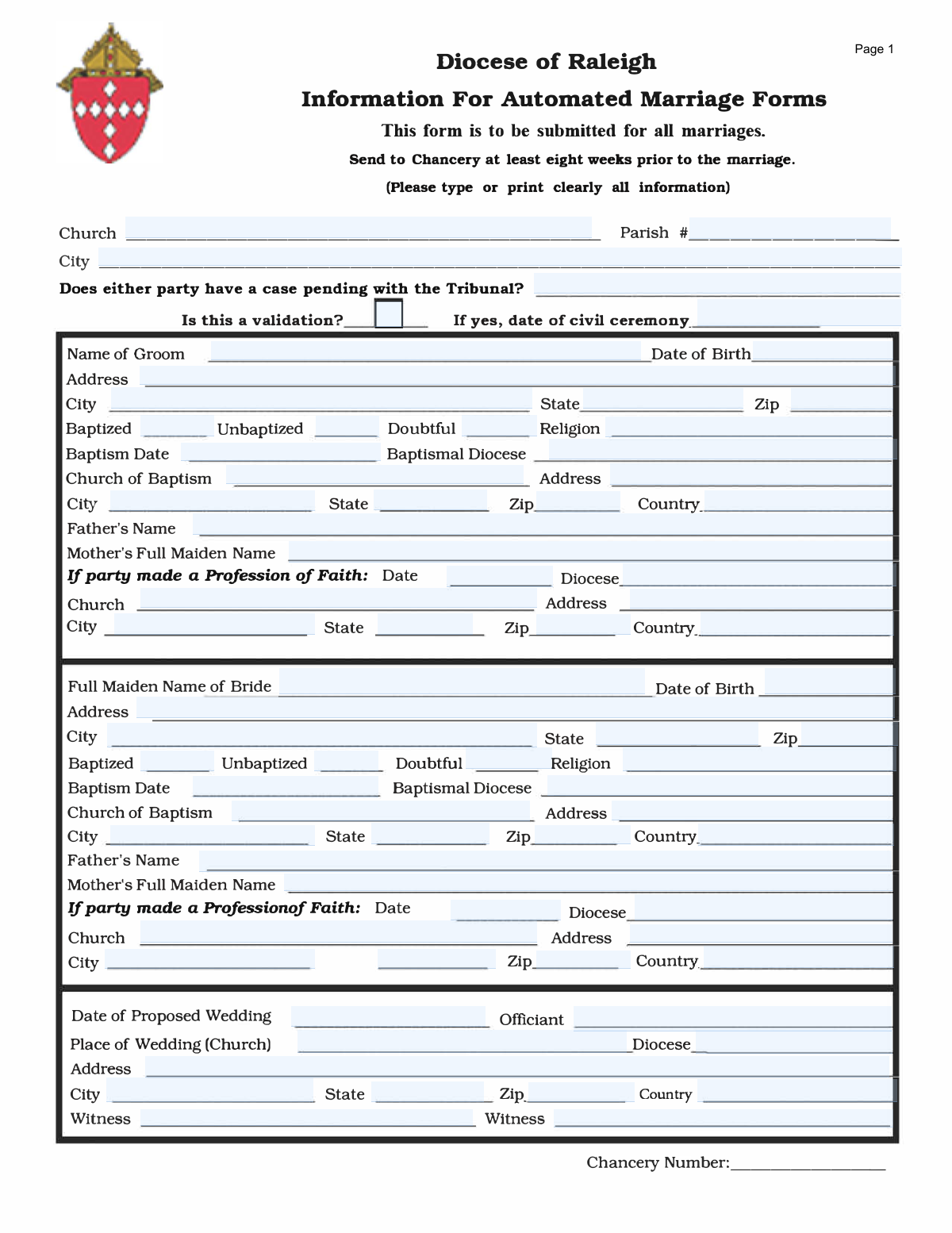
Yes! You can use AI to fill out Diocese of Raleigh Information For Automated Marriage Forms and Application for Dispensations/Permissions
The Diocese of Raleigh Information For Automated Marriage Forms is a comprehensive document used to gather essential personal, religious, and baptismal details for couples intending to marry within the Catholic Church. It also serves as an application for any necessary canonical dispensations or permissions, such as for a mixed-religion marriage. Today, this form can be filled out quickly and accurately using AI-powered services like Instafill.ai, which can also convert non-fillable PDF versions into interactive fillable forms.
Our AI automatically handles information lookup, data retrieval, formatting, and form filling.
It takes less than a minute to fill out Diocese of Raleigh Marriage Form using our AI form filling.
Securely upload your data. Information is encrypted in transit and deleted immediately after the form is filled out.
Form specifications
| Form name: | Diocese of Raleigh Information For Automated Marriage Forms and Application for Dispensations/Permissions |
| Number of pages: | 4 |
| Language: | English |
Instafill Demo: How to fill out PDF forms in seconds with AI
How to Fill Out Diocese of Raleigh Marriage Form Online for Free in 2026
Are you looking to fill out a DIOCESE OF RALEIGH MARRIAGE FORM form online quickly and accurately? Instafill.ai offers the #1 AI-powered PDF filling software of 2026, allowing you to complete your DIOCESE OF RALEIGH MARRIAGE FORM form in just 37 seconds or less.
Follow these steps to fill out your DIOCESE OF RALEIGH MARRIAGE FORM form online using Instafill.ai:
- 1 Navigate to Instafill.ai and upload or select the Diocese of Raleigh Marriage Form.
- 2 Use the AI assistant to accurately fill in the personal, contact, and baptismal information for both the groom and the bride.
- 3 Provide details about the parents of both the groom and the bride as requested.
- 4 Enter the information for the proposed wedding, including the date, location, officiant, and witnesses.
- 5 Carefully complete the 'Application for Dispensations/Permissions' section by checking the appropriate boxes if any special circumstances apply to the marriage.
- 6 Review all the information entered for accuracy, then proceed to the signature sections, such as the 'Mixed Marriage Promise', and sign electronically.
- 7 Download the completed and signed form to submit to the Chancery at least eight weeks prior to the marriage.
Our AI-powered system ensures each field is filled out correctly, reducing errors and saving you time.
Why Choose Instafill.ai for Your Fillable Diocese of Raleigh Marriage Form Form?
Speed
Complete your Diocese of Raleigh Marriage Form in as little as 37 seconds.
Up-to-Date
Always use the latest 2026 Diocese of Raleigh Marriage Form form version.
Cost-effective
No need to hire expensive lawyers.
Accuracy
Our AI performs 10 compliance checks to ensure your form is error-free.
Security
Your personal information is protected with bank-level encryption.
Frequently Asked Questions About Form Diocese of Raleigh Marriage Form
This form is used by the Diocese of Raleigh to collect essential information for couples preparing for marriage in the Catholic Church. It also serves as the application for any necessary permissions or dispensations required for the marriage to proceed.
The couple provides the personal details, but the form is typically completed and submitted by the priest, deacon, or pastoral minister handling their marriage preparation. It is required for all marriages within the Diocese of Raleigh.
The form must be completed and sent to the Chancery at least eight weeks prior to the proposed wedding date. This allows sufficient time for review and processing of any requested dispensations or permissions.
You must provide full names, current addresses, dates of birth, parents' full names, and religion for both individuals. Additionally, detailed baptismal information, including the date, church name, and diocese, is required for each baptized party.
A validation, also known as a convalidation, is the ceremony that makes a civil marriage valid in the eyes of the Catholic Church. If you are already married civilly, you would indicate 'yes' for validation and provide the date of your civil ceremony.
A 'Disparity of Cult' dispensation is required when a Catholic person intends to marry a person who has not been baptized. This form is used to formally petition the Bishop for this necessary dispensation.
You must request 'Permission for marriage' for a Catholic to marry a baptized non-Catholic. The Catholic party will also be required to make the 'Mixed Marriage Promise' to do all in their power to raise the children in the Catholic faith.
Yes, but this requires special permission from the Bishop. You must check the box for 'Ceremony in a place other than a Catholic church' and may need a 'Dispensation from Canonical Form' if a Catholic cleric is not officiating.
The 'Mixed Marriage Promise' is a formal declaration made by the Catholic party, affirming their faith and promising to do everything in their power to have their children baptized and raised as Catholics. The non-Catholic party must be made aware of this promise.
Your parish priest or deacon will send the completed form and all supporting documentation to the Chancery office at: Diocese of Raleigh, 7200 Stonehenge Drive, Raleigh, NC 27613.
Yes, services like Instafill.ai use AI to accurately auto-fill form fields, which can save time and reduce errors. This is particularly helpful for entering detailed information like names, dates, and addresses required on this form.
You can use a service like Instafill.ai to easily complete the form online. Simply upload the PDF document, and the platform will make all the fields interactive so you can type in your information, then save or print the completed form.
If you have a non-fillable or 'flat' PDF, tools like Instafill.ai can convert it into an interactive, fillable form. This allows you to type your answers directly into the fields on your computer, ensuring the information is clear and legible.
Compliance Diocese of Raleigh Marriage Form
Validation Checks by Instafill.ai
1
Ensures Proposed Wedding Date is in the Future
This check validates that the 'Date of Proposed Wedding' is a future date relative to the submission date. This is critical because the form is an application for a future event, not a record of a past one. If the date is in the past, the submission is invalid and must be corrected, as it likely represents a data entry error or a misunderstanding of the form's purpose.
2
Validates Conditional Requirement for Civil Ceremony Date
This check ensures that if the 'Is this a validation?' field is marked 'Yes', the 'Date of civil ceremony' field must be populated with a valid date. This is important for convalidations, where a prior civil union is being regularized in the Church. Failure to provide this date when required will result in an incomplete application and prevent proper processing of the validation.
3
Enforces Chronological Order for Validation Ceremony
This validation confirms that the 'Date of civil ceremony' occurs before the 'Date of Proposed Wedding'. This logical sequence is mandatory for a validation, as the Church ceremony must follow the civil one it intends to validate. An incorrect order indicates a significant data error that would make the canonical paperwork invalid.
4
Verifies Exclusive Selection of Baptismal Status
For both the groom and bride, this check ensures that only one of the three baptismal status options ('Baptized', 'Unbaptized', 'Doubtful') is selected. Providing multiple statuses for one person is contradictory and makes it impossible to determine the correct canonical permissions needed. The form must be rejected until a single, clear status is indicated for each party.
5
Checks for Required Baptismal Details
If a party is marked as 'Baptized', this validation ensures that the corresponding fields for 'Baptism Date', 'Church of Baptism', and 'Baptismal Diocese' are completed. This information is essential for verifying the sacrament and establishing the party's canonical status. An omission of these details will halt the process, as a recent, annotated baptismal certificate is a cornerstone of the prenuptial investigation.
6
Confirms Dispensation Request for Unbaptized Party
This check verifies that if one party is Catholic and the other is 'Unbaptized', the 'Disparity of Cult' dispensation box is checked. This dispensation is a canonical necessity for the validity of a marriage between a Catholic and an unbaptized person. If the dispensation is not requested, the marriage would be invalid, so the form must be returned for correction.
7
Confirms Permission Request for Mixed Marriage
If one party is Catholic and the other is a 'baptized non-Catholic', this validation ensures the 'Permission for marriage' (to marry a baptized non-Catholic) box is checked. This permission is required for the lawfulness of a mixed marriage. Failing to request it would render the marriage illicit and delay the wedding until the proper paperwork is filed.
8
Verifies Minimum Age for Marriage
This check calculates the age of the groom and bride based on their 'Date of Birth' to ensure they meet the minimum age for marriage as required by both canon law and civil law. This is a critical safeguard to prevent applications for underage marriages, which are invalid without specific and rare dispensations. Submissions for underage parties without such documentation will be immediately flagged for review.
9
Validates Chronological Integrity of Personal Dates
For each party, this rule ensures their 'Baptism Date' is after their 'Date of Birth' and before the 'Date of Proposed Wedding'. This check maintains the logical and chronological accuracy of the individual's sacramental history. Any date that falls outside this logical sequence indicates a data entry error that must be corrected for the record to be valid.
10
Ensures Completeness of Core Information
This validation confirms that essential fields such as 'Groom Name', 'Bride Full Maiden Name', 'Date of Proposed Wedding', and 'Place of Wedding (Church)' are not empty. These fields are the minimum data required to identify the couple and the planned ceremony. An incomplete submission would be unprocessable and would be rejected immediately.
11
Validates Mother's Name is a Maiden Name
This check scrutinizes the 'Mother's Full Maiden Name' field to ensure it does not contain a married surname, which is a common error. Accurate maiden names are required for proper canonical record-keeping and genealogical accuracy. The system may flag names that match the groom's surname or other known married names for manual review.
12
Checks for Nuptial Mass Restriction
This rule cross-references the parties' baptismal status with the request for a Nuptial Mass. Based on the form's note ('A Nuptial Mass is not to be celebrated when a Catholic marries an unbaptized person'), it flags or disallows checking the 'Nuptial Mass' box if the 'Disparity of Cult' dispensation is also checked. This prevents an improper liturgical request from being submitted.
13
Verifies Timely Submission
This check compares the form's submission date with the 'Date of Proposed Wedding' to ensure it adheres to the 'at least eight weeks prior' requirement stated on the form. This is crucial for allowing the Chancery adequate time to process the paperwork, grant dispensations, and avoid last-minute crises. Submissions inside this window would be flagged as late and may be rejected or require special handling.
14
Validates ZIP Code Format
This check ensures that all ZIP code fields (for the groom, bride, church, etc.) are in a valid format, such as 5 digits or ZIP+4 (e.g., 12345 or 12345-6789). Correctly formatted postal codes are essential for data integrity, location verification, and any physical mailings. An invalid format would trigger an error, requiring the user to correct the entry before submission.
Common Mistakes in Completing Diocese of Raleigh Marriage Form
Applicants often mistakenly enter the mother's current married last name instead of her full maiden name as required. This happens due to habit or misunderstanding the term 'maiden name'. Incorrect information can lead to delays as the chancery must request a correction, and it can cause inconsistencies in the permanent sacramental record. To avoid this, carefully read the field label and enter the mother's birth surname.
The form requires specific details about baptism, including the date, church, and diocese, which can be difficult to recall or locate. People may leave fields blank, guess, or provide partial information, which halts the application process until a recently-issued baptismal certificate is provided. Before filling out the form, obtain an official copy of the baptismal certificate (issued within the last six months) to ensure all details are entered correctly.
Page 2 distinguishes between 'Dispensations' (for impediments like marrying an unbaptized person) and 'Permissions' (for situations like marrying a baptized non-Catholic). Applicants frequently confuse these canonical terms and check boxes in the wrong section. This error can lead to the wrong canonical permissions being granted, requiring the entire form to be resubmitted. It is crucial to consult with the parish priest or deacon to determine which specific dispensations or permissions are necessary for your situation.
On page 2, several options for permission are marked with asterisks, indicating that 'particular circumstances motivating this request must be elaborated in an accompanying letter.' It is a very common mistake to check one of these boxes but fail to submit the required explanatory letter. This omission will cause the application to be considered incomplete and will delay its approval until the letter is received by the Chancery.
Page 4 is only for the specific and less common situation where a Catholic is marrying outside a Catholic church with a non-Catholic officiant. Many people mistakenly fill this out if their wedding is simply in a location other than a church, even with a priest or deacon officiating. This creates confusion and requires clarification, delaying the process. This section should only be completed after explicit direction from the parish priest.
The form requires an official Parish Seal in two separate locations (pages 3) to validate the priest/deacon's signature and the Mixed Marriage Promise. Since this is a physical stamp, it is often forgotten, especially if the priest or deacon signs the form away from the parish office. An absent seal invalidates the signature and promise, forcing the form to be returned for proper completion and causing significant delays.
Several sections on pages 2 and 4 provide an 'Other [specify]' checkbox, requiring the applicant to write in a reason. A frequent error is to check the 'Other' box but neglect to provide the written explanation in the corresponding blank space. This leaves the request vague and unsupported, preventing the Bishop's office from making an informed decision and resulting in the form being sent back for clarification.
The form asks for the baptismal status of each party with three options: 'Baptized,' 'Unbaptized,' and 'Doubtful.' People are often unsure what 'Doubtful' means and may select it incorrectly, or they may check 'Baptized' without having the necessary proof. A 'Doubtful' baptism has specific canonical implications and should only be checked after consulting with the priest. This error can lead to applying for the wrong dispensations.
Applicants sometimes use nicknames, shortened names, or omit middle names for themselves, their parents, or witnesses. The form requires full legal names as they would appear on official documents to ensure the sacramental record is accurate and legally sound. Using informal names can create discrepancies with other legal documents and may require a formal correction to the record later. AI-powered tools like Instafill.ai can help prevent this by cross-referencing with other data to ensure consistency.
The form explicitly requests to 'Please type or print clearly,' but submissions are often filled out with illegible handwriting. This leads to data entry errors at the Chancery, potentially misspelling names, dates, or addresses on the official record. Such errors can cause serious issues later and require a formal process to correct. Using a tool like Instafill.ai to convert the PDF into a fillable version and type the information ensures perfect clarity and avoids these problems.
Saved over 80 hours a year
“I was never sure if my IRS forms like W-9 were filled correctly. Now, I can complete the forms accurately without any external help.”
Kevin Martin Green
Your data stays secure with advanced protection from Instafill and our subprocessors

Robust compliance program
Transparent business model
You’re not the product. You always know where your data is and what it is processed for.
ISO 27001, HIPAA, and GDPR
Our subprocesses adhere to multiple compliance standards, including but not limited to ISO 27001, HIPAA, and GDPR.
Security & privacy by design
We consider security and privacy from the initial design phase of any new service or functionality. It’s not an afterthought, it’s built-in, including support for two-factor authentication (2FA) to further protect your account.
Fill out Diocese of Raleigh Marriage Form with Instafill.ai
Worried about filling PDFs wrong? Instafill securely fills diocese-of-raleigh-information-for-automated-marriage-forms-and-application-for-dispensationspermissions forms, ensuring each field is accurate.