Fill out child supplement forms
with AI.
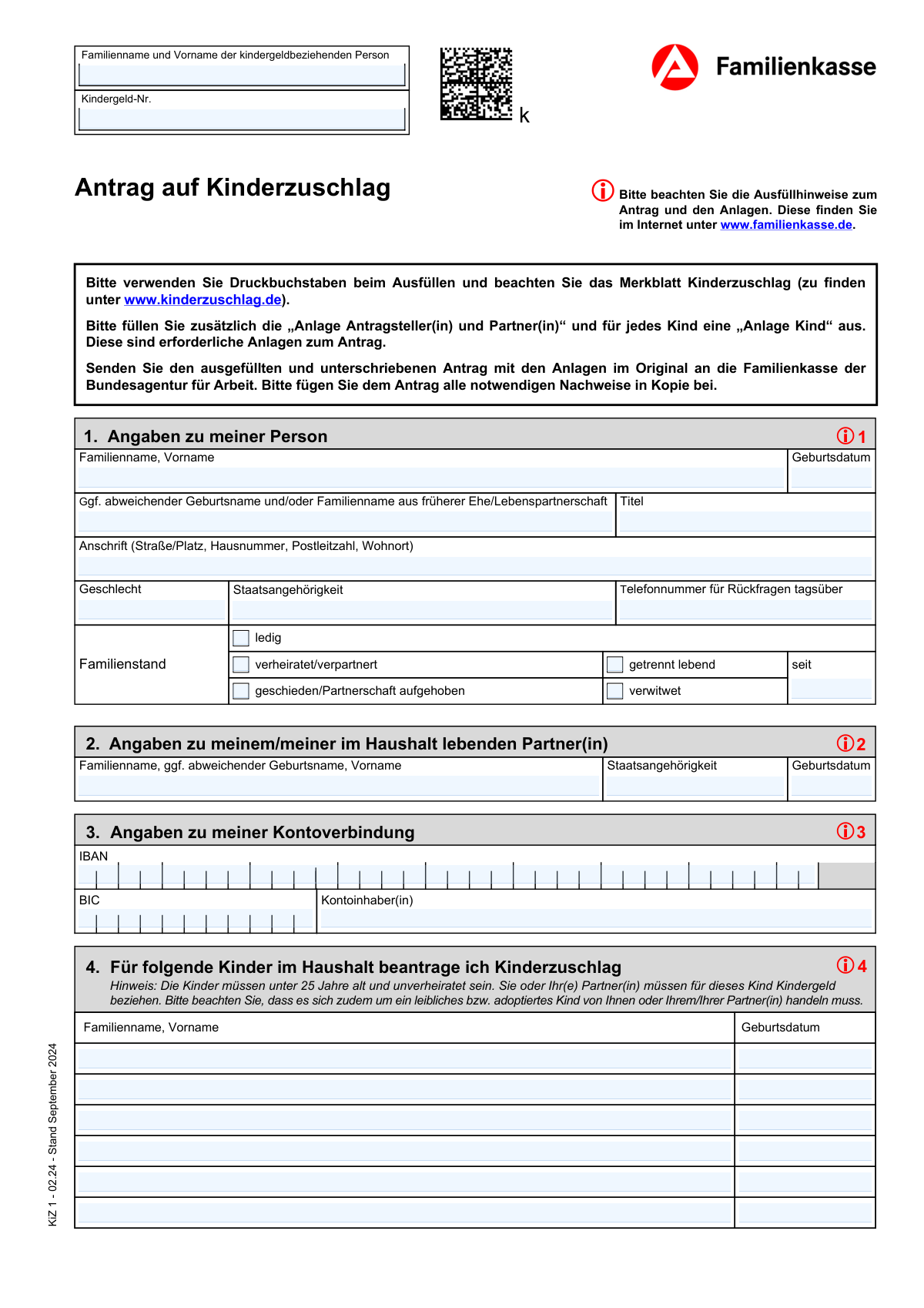
Child supplement forms are official documents used to apply for government financial support designed to help low-income families cover the costs of raising children. In Germany, this support is known as the Kinderzuschlag — a benefit provided by the Familienkasse (Federal Employment Agency's family benefits office) to parents who earn enough to support themselves but need additional assistance to meet their children's financial needs. These forms require detailed, accurate information and must be completed correctly to ensure a successful eligibility assessment.
By continuing, you acknowledge Instafill's Privacy Policy and agree to get occasional product update and promotional emails.
About child supplement forms
Families who typically need these forms include working parents with modest incomes who do not qualify for standard social assistance but still struggle to cover household and child-related expenses. The application process involves submitting supporting documentation alongside forms like the KiZ 1-AnA, which captures information about the applicant and their partner — including housing arrangements, assets, income, and expenditure over the preceding six months. Even small errors or omissions can delay or affect the outcome of an application, making careful completion essential.
Because these forms can be lengthy and complex, tools like Instafill.ai use AI to fill them out accurately in under 30 seconds, handling the data securely and reducing the risk of mistakes that could slow down your application.
Every form on this page can be completed without typing. Instafill is form filling software that reads a PDF and fills it for you — including flat and scanned documents that carry no fillable fields at all.
Forms in This Category
The forms in this category have a median Form Complexity Index of 51/100 (Moderate), measured across 3 forms by field count, input difficulty, length, conditional logic and structure. See how it is calculated.
- Enterprise-grade security & data encryption
- 99%+ accuracy powered by AI
- 1,000+ forms from all industries
- Complete forms in under 60 seconds
How to Choose the Right Form
With only one form in this category, choosing is straightforward — but understanding when and why you need it will help you complete it correctly.
Who Needs the KiZ 1-AnA Form?
The KiZ 1-AnA (Anlage Antragsteller(in) und Partner(in)) is required for anyone applying for the German Kinderzuschlag (child supplement benefit) through the Familienkasse. This is not a standalone application — it is a mandatory attachment to the main Kinderzuschlag application.
You need this form if you are:
- A parent or guardian applying for the child supplement benefit in Germany
- Applying as a single applicant or as a couple (the form covers both the applicant and their partner)
- Required to disclose your household's financial situation to determine eligibility
What Information You'll Need
Before starting the KiZ 1-AnA, gather the following:
- Personal status details — current education enrollment, inpatient care status
- Housing information — whether you rent or own, and related costs
- Asset declarations — savings, property, and other assets
- Six months of income and expenditure records — including wages, benefits, and regular expenses
- Additional needs (Mehrbedarf) — any special circumstances that increase household costs
Tips for Completing This Form
- Accuracy is critical — the Familienkasse uses this data to calculate your eligibility and benefit amount
- If you have a partner, their financial details must be included in the same form
- Use Instafill.ai to fill out the KiZ 1-AnA quickly using AI assistance, especially if you have a non-fillable PDF version that needs to be converted into an interactive format
If you are unsure whether you qualify for Kinderzuschlag, consult the Familienkasse directly before submitting.
Form Comparison
| Form | Purpose | Who Files It | When to Use |
|---|---|---|---|
| KiZ 1-AnA – Anlage Antragsteller(in) und Partner(in) zum Antrag auf Kinderzuschlag | Supplements main Kinderzuschlag application with applicant and partner details | Applicants and their partners applying for German child supplement benefit | Filed alongside main Kinderzuschlag application to Familienkasse |
Tips for child supplement forms
The KiZ 1-AnA requires a detailed account of your income and expenditure over the preceding six months. Before you start filling out the form, collect bank statements, pay slips, rental receipts, and any benefit letters from that period. Having everything on hand prevents incomplete submissions that can delay your Kinderzuschlag assessment.
This form covers the financial and personal situation of both the applicant and their partner, so both parties need to contribute accurate details. Leaving partner information blank or inconsistent with the main application is a common mistake that can trigger follow-up requests from the Familienkasse. Double-check that names, addresses, and income figures match across all submitted documents.
Many applicants focus on income and forget that assets — such as savings accounts, property, or investments — must also be declared. Failing to disclose assets, even unintentionally, can lead to delays or a negative eligibility decision. List all assets for both you and your partner, even if their value seems low or unlikely to affect the outcome.
The form asks about your current situation, including whether you or your partner are in education or inpatient care. Make sure you select the correct status at the time of application, not a past or anticipated future status. An incorrect status can misrepresent your household situation and affect the benefit calculation.
AI-powered tools like Instafill.ai can complete child supplement forms like the KiZ 1-AnA in under 30 seconds with high accuracy, which is a real time-saver when you're managing multiple documents for a Kinderzuschlag application. Your data stays secure throughout the process, and Instafill.ai can even convert non-fillable PDF versions into interactive forms. This is especially helpful if you're unfamiliar with German administrative forms.
The KiZ 1-AnA is a supplementary annex and cannot be submitted on its own — it must accompany the main Kinderzuschlag application form. Sending it separately or at a different time can cause processing delays. Organize all required forms together before submitting to the Familienkasse.
The form includes a section on additional needs (Mehrbedarf), which covers situations like pregnancy, disability, or specific dietary requirements that may entitle you to a higher benefit. Many applicants skip this section without realizing they qualify. Review the Mehrbedarf criteria carefully to ensure you're not leaving money on the table.
Always retain a complete copy of the filled-out KiZ 1-AnA and all supporting documents you send to the Familienkasse. If questions arise during the review process, having your own records makes it much easier to respond quickly and accurately. Digital copies stored securely are ideal for easy retrieval.
Frequently Asked Questions
The Kinderzuschlag is a German child supplement benefit administered by the Familienkasse (Family Benefits Office), designed to support lower-income families who earn enough to cover their own living costs but not enough to fully provide for their children. It is intended to help prevent families from having to rely on basic income support (Bürgergeld) solely because of the financial burden of raising children.
The KiZ 1-AnA (Anlage Antragsteller(in) und Partner(in)) is a supplementary form that must be submitted alongside the main Kinderzuschlag application. It collects detailed information about the applicant and their partner, including housing situation, assets, additional needs, and a six-month record of income and expenditure, all of which the Familienkasse uses to assess benefit eligibility.
Yes, the KiZ 1-AnA is specifically designed to capture information about both the applicant and their partner (if applicable). Both parties' financial circumstances, housing arrangements, and income details are required so the Familienkasse can make an accurate eligibility determination.
You will typically need to provide a comprehensive overview of your income and expenditure covering the preceding six months, details of any assets held, housing costs (whether renting or owner-occupied), and any additional needs (Mehrbedarf) that may apply to your household. Having bank statements, pay slips, and rental agreements on hand before you start will make the process smoother.
The completed KiZ 1-AnA, along with the main Kinderzuschlag application and any supporting documents, should be submitted to your local Familienkasse office. Submissions can generally be made by post, in person, or through the Familienkasse's online portal, depending on the options available in your region.
Incomplete or inaccurate information can delay the processing of your application or result in an incorrect eligibility assessment. The Familienkasse may request additional documentation or clarification, which can extend the time before any benefit is approved, so it is important to review all sections carefully before submitting.
Yes, AI-powered tools like Instafill.ai can fill out forms such as the KiZ 1-AnA in under 30 seconds by accurately extracting and placing data from your source documents. Instafill.ai can also convert non-fillable PDF versions of these forms into interactive, fillable formats, making the process faster and reducing the risk of manual errors.
Manually completing a detailed form like the KiZ 1-AnA can take 30 minutes or more, especially given the six-month income and expenditure records required. However, using an AI-powered service like Instafill.ai, the data extraction and form-filling process can be completed in under 30 seconds, significantly reducing the time and effort involved.
Before starting, you should collect recent pay slips, bank statements covering the last six months, your rental agreement or mortgage documents, proof of any additional costs or needs, and identification documents for both you and your partner. Having these ready in advance ensures you can complete the form accurately without interruptions.
No, the KiZ 1-AnA is a supplementary annex that accompanies the main Kinderzuschlag application form. Depending on your household situation, additional annexes — such as forms relating to your children or specific income types — may also be required. Check the Familienkasse's official guidance to confirm which forms apply to your circumstances.
Kinderzuschlag is generally not a one-time permanent benefit; eligibility is reassessed periodically, and you may need to reapply when your circumstances change or when a current approval period ends. The Familienkasse will typically notify you about renewal requirements, but it is advisable to monitor your approval period and any changes in your financial situation.
The KiZ 1-AnA and related Kinderzuschlag forms are official German government documents and are written in German. If you are not a native German speaker, you may wish to seek assistance from a translation service, a local social welfare advice centre (Sozialberatung), or use an AI-assisted form-filling tool that can help interpret and complete the form accurately.
Glossary
- Form Complexity Index
- Instafill’s 0–100 measure of how much effort a form takes to complete, calculated deterministically from the form’s own structure rather than estimated. It combines the number of fillable fields (the largest factor), how difficult those fields are to complete based on their type, the number of pages that contain fields, the amount of conditional “fill-only-if” logic, and how many sections the form is divided into, then adds modifiers for tables and repeating lists, bundled instruction pages, and dense page layouts. A higher score means the form is harder to fill out by hand. The forms in this category have a median Form Complexity Index of 51/100 (Moderate). See exactly how it is calculated.
- Kinderzuschlag (KiZ)
- A German child supplement benefit paid by the Familienkasse to low-income parents who can cover their own living costs but need additional financial support to avoid relying on basic income support (Bürgergeld) solely because of their children.
- Familienkasse
- The family benefits office within the German Federal Employment Agency (Bundesagentur für Arbeit) responsible for processing applications for child benefit (Kindergeld) and the child supplement (Kinderzuschlag).
- Anlage (Annex/Supplement Form)
- An official supplementary form that must be submitted together with a main application; in the KiZ context, the Anlage collects detailed personal and financial data that does not fit on the primary application form.
- Mehrbedarf
- Additional needs allowances recognized under German social law for specific circumstances—such as pregnancy, disability, or single parenthood—that increase a household's calculated financial requirement and may affect benefit eligibility.
- Bedarfsgemeinschaft
- The 'benefit unit' or household group whose combined income and assets are assessed together when calculating entitlement to means-tested German social benefits, typically including the applicant, their partner, and dependent children.
- Antragsteller(in)
- The formal German term for the applicant—the person who is officially submitting the Kinderzuschlag application and whose personal, financial, and housing details are recorded on the form.
- Vermögen (Asset Declaration)
- The section of the KiZ application requiring disclosure of the household's assets (savings, property, investments, etc.), which the Familienkasse uses to determine whether the family's own resources disqualify them from receiving the supplement.
- Einnahmen und Ausgaben (Income and Expenditure)
- A detailed record of all household income and expenses over the preceding six months that the Familienkasse requires to accurately calculate the net income used in the Kinderzuschlag eligibility assessment.
- Stationäre Unterbringung (Inpatient Care)
- A status indicator on the form noting whether the applicant or their partner is currently residing in a care facility or hospital, which can affect the household composition and benefit calculation.