Fill out developmental services forms
with AI.
Developmental services forms are essential for managing the relationship between service providers and state agencies, particularly within the California Department of Developmental Services framework. These documents ensure that individuals and organizations providing support for people with developmental disabilities meet strict regulatory and compliance standards. Accurate documentation is the cornerstone of the vendorization process, allowing regional centers to vet providers and ensure that public funds are used appropriately to support vulnerable populations.
By continuing, you acknowledge Instafill's Privacy Policy and agree to get occasional product update and promotional emails.
About developmental services forms
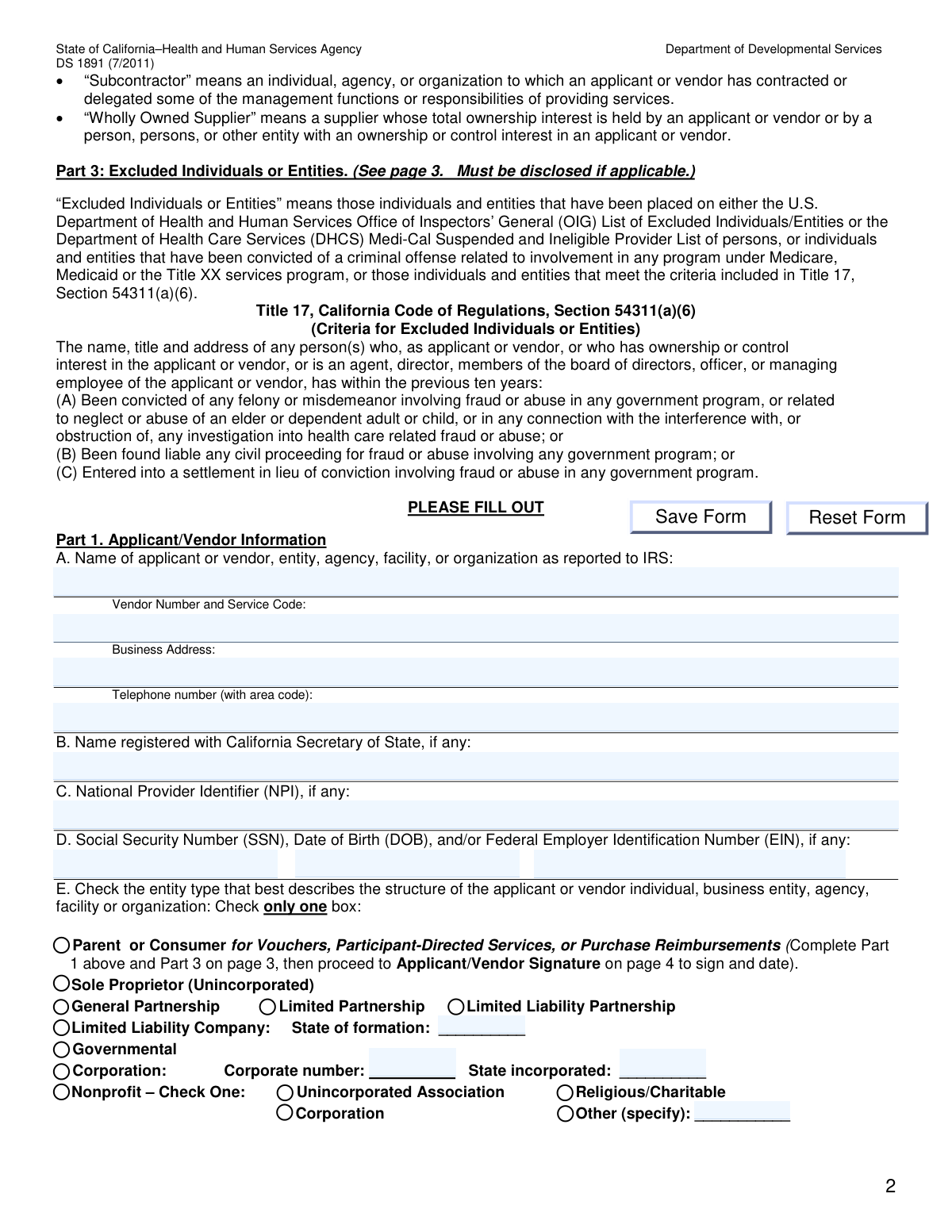
Typically, healthcare professionals, specialized vendors, and social service organizations use these forms when applying for or maintaining their status as approved service providers. For example, documents like the DS 1891 (Applicant/Vendor Disclosure Statement) are required to disclose ownership interests, identify managing employees, and prevent conflicts of interest. Whether you are a new applicant seeking to provide residential care or an established vendor reporting organizational changes, completing these forms correctly is mandatory for legal compliance and continued operation within the developmental services network.
Navigating the technical details of these disclosures can be time-consuming, but tools like Instafill.ai use AI to fill these forms in under 30 seconds while ensuring data is handled accurately and securely. By streamlining the paperwork, providers can reduce administrative overhead and focus more of their energy on the quality of care and support they provide to their communities.
Every form on this page can be completed without typing. Instafill is form filling software that reads a PDF and fills it for you — including flat and scanned documents that carry no fillable fields at all.
Forms in This Category
The forms in this category have a median Form Complexity Index of 58/100 (Moderate), measured across 1 forms by field count, input difficulty, length, conditional logic and structure. See how it is calculated.
| Form Name | Pages | FCI | |
|---|---|---|---|
| 1. | DS 1891, Applicant/Vendor Disclosure Statement (State of California Department of Developmental Services) | 4 | Moderate 58 |
- Enterprise-grade security & data encryption
- 99%+ accuracy powered by AI
- 1,000+ forms from all industries
- Complete forms in under 60 seconds
How to Choose the Right Form
Navigating the California Department of Developmental Services (DDS) requirements is a critical step for service providers. Currently, the primary document in this category is the DS 1891, Applicant/Vendor Disclosure Statement. This form is the standard tool used by the state to ensure transparency and compliance within the regional center system.
When to Use This Form
You should select the DS 1891 if you fall into one of the following categories:
- New Applicants: If you are currently applying for vendorization with a California regional center to provide developmental services, this form is a mandatory component of your initial application.
- Existing Vendors: If you are already a vendor, you must use this form when requested by your regional center during a periodic review or audit.
- Reporting Significant Changes: If there has been a change in your business ownership, managing employees, or subcontractors, you are required to submit an updated DS 1891 within 30 days of that change.
Key Information Required
To complete the DS 1891 (Applicant/Vendor Disclosure Statement) effectively, you will need to have the following information ready:
- Ownership Details: Information regarding any person or entity with an ownership or control interest of 5% or more.
- Managing Employees: Names and details of individuals who exercise operational or managerial control over the organization.
- Related-Party Relationships: Disclosures of any relationships between the vendor and regional center or DDS employees.
- Exclusion Status: Verification that no involved individuals or entities have been excluded from participating in federal or state healthcare programs.
Why Accuracy Matters
Because the DS 1891 is signed under penalty of perjury, it is vital to be thorough. Providing incomplete or inaccurate information can lead to the denial of your vendorization or the termination of your current contract with the regional center. Using our AI-guided filling process can help ensure that every section of the Applicant/Vendor Disclosure Statement is addressed clearly to maintain your compliance status.
Form Comparison
| Form | Primary Purpose | Key Disclosures | Required For |
|---|---|---|---|
| DS 1891, Applicant/Vendor Disclosure Statement (State of California Department of Developmental Services) | Discloses ownership and control interests for regional center vendorization compliance. | Ownership interests, related-party relationships, subcontractor details, and exclusion status. | Applicants seeking vendorization or current vendors upon regional center request. |
Tips for developmental services forms
Ensure you list every individual or entity with a 5% or more interest in the business as required by the DS 1891. Failing to disclose full ownership details is a common reason for application delays or rejections by the regional center.
Be transparent about any family or business relationships between owners and managing employees. Full disclosure helps avoid potential conflicts of interest and ensures compliance with Department of Developmental Services standards.
If there are changes to your business structure or managing employees after your initial submission, you must file an updated form promptly. Keeping your records current ensures your vendorization status remains active and compliant with state regulations.
AI-powered tools like Instafill.ai can complete these forms in under 30 seconds with high accuracy, which is a real time-saver for providers. Your data stays secure during the process, allowing you to focus on service delivery rather than tedious paperwork.
Before submitting, verify that no owners or managing employees are on state or federal exclusion lists. The form requires certification that all parties are eligible to participate in government-funded programs to avoid penalty of perjury.
A common mistake is omitting key staff members who have significant influence over the organization. Carefully review the form's specific definitions to ensure all directors, officers, and managers are properly documented in the disclosure statement.
Frequently Asked Questions
Developmental services forms are primarily used to facilitate the vendorization and oversight process for entities providing support to individuals with developmental disabilities. They help state agencies and regional centers ensure that service providers meet all regulatory, financial, and safety standards required by law.
These forms are required for service providers, business owners, and healthcare professionals who wish to become authorized vendors for regional centers. They are also used by existing vendors during periodic compliance reviews or when there are significant changes to their business structure.
A disclosure statement is designed to identify the owners, officers, and managing employees of a service provider to prevent conflicts of interest and ensure transparency. It also verifies that the applicant and its associates are not excluded from participating in state or federal programs due to legal or ethical violations.
Completed developmental services forms should generally be submitted to the specific Regional Center you are applying to or are currently vendored with. In some specific instances, the forms may need to be filed directly with the State Department of Developmental Services (DDS).
While many forms are part of the initial application, they must be updated whenever there is a change in ownership, control, or management. It is a common requirement to report these changes within 30 days to maintain an active and compliant vendor status.
Yes, you can fill out developmental services forms like the DS 1891 using AI tools. Platforms such as Instafill.ai can accurately extract data from your business documents and automatically place it into the correct fields in under 30 seconds.
When using automated AI tools, filling out complex developmental services forms takes significantly less time than manual entry. These systems can complete the mapping and data entry process in under 30 seconds, ensuring high accuracy by pulling directly from your source files.
You will typically need to provide details regarding business ownership, subcontractor relationships, and the names of all managing employees. Some forms also require information about significant business transactions and a history of any exclusions from government-funded programs.
Yes, these forms apply to both individual practitioners and larger corporate entities seeking to provide services. The specific sections required for completion may vary depending on whether you are an independent contractor or a multi-member organization.
Submitting incomplete or inaccurate forms can lead to the denial of a vendor application or the termination of an existing contract. Since many of these documents are signed under penalty of perjury, it is essential to ensure all disclosures are thorough and correct to avoid legal or administrative penalties.
Yes, vendors are generally required to notify the relevant regional center or state department of any changes in ownership or control interests. Maintaining an up-to-date disclosure on file is a condition of remaining an authorized service provider within the developmental services system.
Glossary
- Form Complexity Index
- Instafill’s 0–100 measure of how much effort a form takes to complete, calculated deterministically from the form’s own structure rather than estimated. It combines the number of fillable fields (the largest factor), how difficult those fields are to complete based on their type, the number of pages that contain fields, the amount of conditional “fill-only-if” logic, and how many sections the form is divided into, then adds modifiers for tables and repeating lists, bundled instruction pages, and dense page layouts. A higher score means the form is harder to fill out by hand. The forms in this category have a median Form Complexity Index of 58/100 (Moderate). See exactly how it is calculated.
- Vendorization
- The formal process through which a service provider is authorized by a regional center to provide specific services and receive payment for those services.
- Regional Center
- A private, non-profit organization that contracts with the State of California to coordinate and provide services for individuals with developmental disabilities.
- Managing Employee
- An individual, such as a general manager, director, or administrator, who exercises operational or managerial control over the day-to-day activities of a service provider.
- Ownership or Control Interest
- A legal designation for any person or entity that owns 5% or more of a business or has the power to make significant decisions for the organization.
- Significant Business Transaction
- Any business exchange or series of transactions between a provider and a subcontractor that exceeds $25,000 or 5% of the provider's total operating expenses in a year.
- Excluded Entity/Individual
- A person or business that is legally barred from participating in state or federal healthcare programs, such as Medi-Cal, due to previous fraud or regulatory violations.
- DDS (Department of Developmental Services)
- The California state agency responsible for overseeing the network of regional centers and the delivery of services to people with developmental disabilities.