Fill out electrical connection forms
with AI.
Electrical connection forms are essential documents for any project involving the integration of power systems into the public or private grid. These forms serve as the technical bridge between a power generation project—such as a solar panel array or a wind turbine—and the regulatory authorities responsible for grid stability and safety. Proper documentation ensures that all equipment meets local standards and that the installation is capable of handling the electrical load without compromising the existing infrastructure.
By continuing, you acknowledge Instafill's Privacy Policy and agree to get occasional product update and promotional emails.
About electrical connection forms
Typically, these forms are handled by electrical engineers, renewable energy installers, and project developers who need to secure grid access permits. Whether you are submitting a technical memorandum for a small-scale residential solar setup or a large industrial energy plant, precision is vital. Authorities like the General Directorate of Energy and Climate Change (DGECC) require detailed specifications regarding equipment, owner information, and technical layouts before granting permission to connect. Missing or incorrect data can lead to significant delays in project timelines and costly revisions.
Managing the complexities of technical paperwork like the Memòria Tècnica d’Instal·lació can be time-consuming, but tools like Instafill.ai use AI to fill these forms accurately and securely in under 30 seconds. This allows professionals to focus on the physical installation and engineering aspects while the AI handles the data entry and formatting requirements of the regulatory documents.
Every form on this page can be completed without typing. Instafill is form filling software that reads a PDF and fills it for you — including flat and scanned documents that carry no fillable fields at all.
Forms in This Category
The forms in this category have a median Form Complexity Index of 79/100 (Complex), measured across 1 forms by field count, input difficulty, length, conditional logic and structure. See how it is calculated.
- Enterprise-grade security & data encryption
- 99%+ accuracy powered by AI
- 1,000+ forms from all industries
- Complete forms in under 60 seconds
How to Choose the Right Form
Navigating electrical connection paperwork can be complex, especially when dealing with power generation and grid integration. In this category, the primary focus is on formalizing technical specifications for renewable energy projects to ensure they meet regulatory standards.
For Power Generation and Grid Access
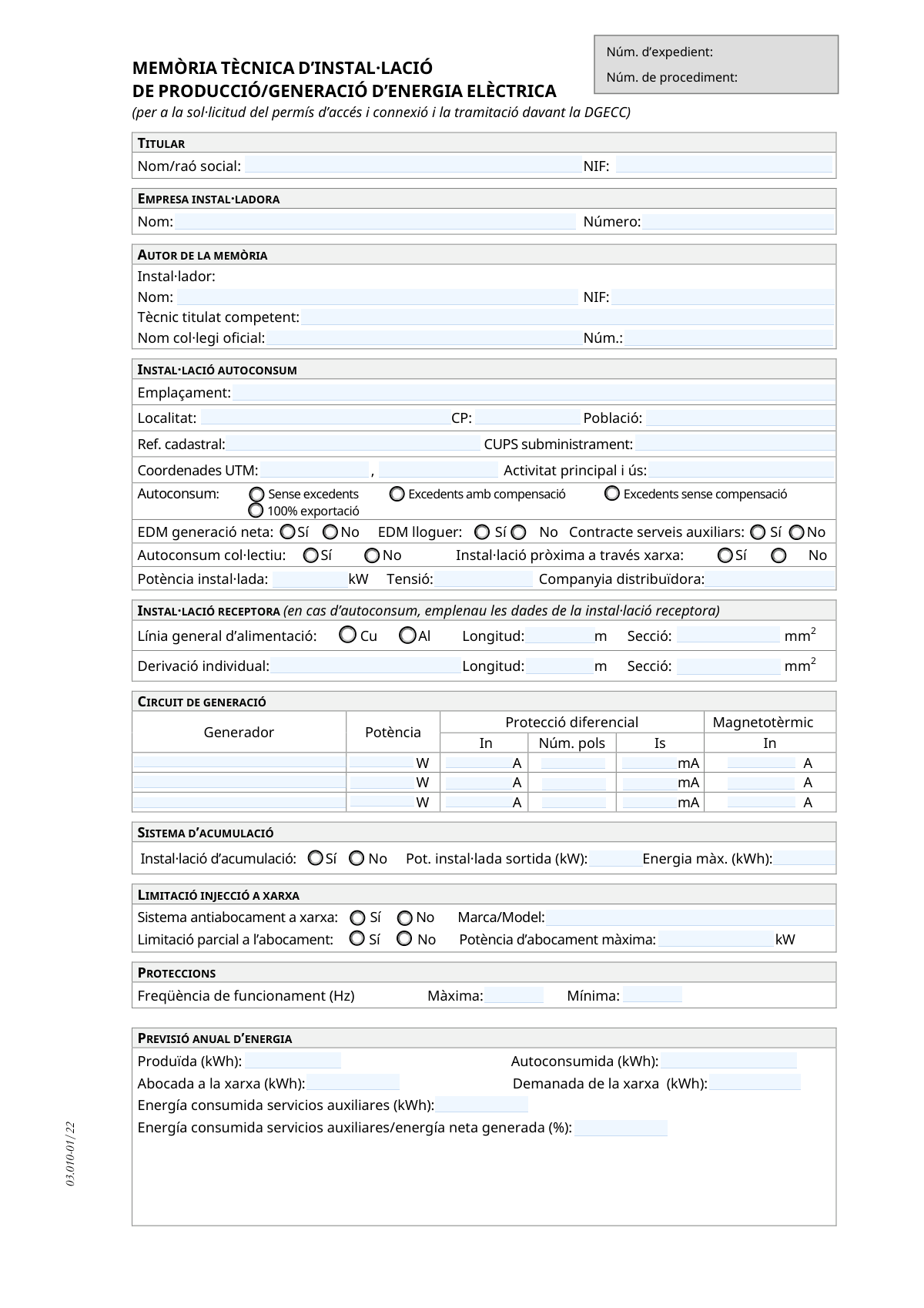
If you are installing a system to generate electricity—such as residential solar panels, small wind turbines, or other renewable energy sources—you will need the Memòria Tècnica d’Instal·lació de Producció/Generació d’Energia Elèctrica (per a la sol·licitud del permís d’accés i connexió i la tramitació davant la DGECC).
This document is the standard requirement for:
- Requesting Grid Connection: It is mandatory for obtaining the necessary permits to connect your private generation system to the public electrical grid.
- Regulatory Compliance: It facilitates the formal filing process with the General Directorate of Energy and Climate Change (DGECC).
- Technical Documentation: It captures essential data, including equipment specifications, owner details, and installation layouts.
When to Use This Specific Form
This technical memorandum is required before you can legally operate your generation facility. You should select this form if your project involves:
- Photovoltaic (Solar) Installations: For both small-scale residential and larger commercial arrays.
- Wind Energy: For small wind turbines requiring grid synchronization.
- Specific Regional Filing: This form is specifically designed for procedures handled by the DGECC, ensuring your application meets their specific data requirements.
Filling Out the Form Efficiently
Technical forms like the Memòria Tècnica d’Instal·lació de Producció/Generació d’Energia Elèctrica require high precision to avoid administrative delays. Whether you are a professional installer or a property owner, using Instafill.ai allows you to quickly populate technical fields and equipment specs, ensuring your submission is accurate and ready for the DGECC review process.
Form Comparison
| Form | Primary Purpose | Target User | Key Requirements | Typical Projects |
|---|---|---|---|---|
| Memòria Tècnica d’Instal·lació de Producció/Generació d’Energia Elèctrica (per a la sol·licitud del permís d’accés i connexió i la tramitació davant la DGECC) | Request grid access and connection permits for power generation systems. | Installers or owners of renewable energy production facilities. | Detailed technical specifications, equipment data, and site location information. | Solar photovoltaic installations, wind energy systems, and power generators. |
Tips for electrical connection forms
Ensure all power generation specs, such as nominal power and equipment models, match your technical project exactly. Inaccurate technical data is a leading cause of delays in the DGECC approval process and may lead to permit rejection.
Before filling out the form, gather your equipment datasheets, site maps, and ownership documents. Having these files ready allows you to cross-reference data points quickly and avoid leaving critical technical fields blank.
AI-powered tools like Instafill.ai can complete these complex technical forms in under 30 seconds with high accuracy. Your data stays secure throughout the process, making it a major time-saver for professionals managing multiple energy projects.
Clearly identify the specific grid connection point provided by the utility company before completing the form. Misidentifying the connection location on your memorandum can result in the immediate rejection of your access permit request.
Keep a digital archive of every technical memorandum submitted to the authorities. This helps you track revisions and ensures consistency if you need to resubmit or update your application during the project lifecycle.
Double-check that all listed components, particularly inverters and protection systems, are certified for use in your specific region. Listing non-compliant hardware on the form will require a full resubmission once the error is identified by the DGECC.
Frequently Asked Questions
These forms are used to formally request access to the electrical grid for new power generation installations, such as solar panels or wind turbines. They provide the necessary technical specifications to regulatory bodies like the DGECC to ensure the system is safe and compatible with the existing infrastructure.
Generally, a certified electrical engineer or a specialized installer is responsible for completing these forms. Because the documents require precise technical data regarding equipment and system architecture, professional expertise is usually necessary to ensure compliance with energy regulations.
Submission should occur during the project planning phase, well before the physical installation is finalized. Receiving approval for grid access and connection is a mandatory step before any renewable energy system can legally begin feeding power into the public utility network.
You will need to provide detailed information including the owner's contact details, the physical location of the project, and specific equipment ratings for inverters and generators. The form also requires data on the total power capacity and the technical configuration of the connection point.
In most cases, these forms are submitted to the regional General Directorate of Energy and Climate Change (DGECC) or the local utility provider responsible for the grid. Many authorities now prefer digital submissions through their official online portals to speed up the review process.
Yes, you can use AI tools like Instafill.ai to fill out these complex technical documents. The AI can accurately extract data from your technical specifications and source documents, placing the information into the correct fields in under 30 seconds.
Yes, even small residential systems usually require a technical memory or a simplified version of the form to notify the utility company. This ensures that the local grid can handle the additional power input and that the installation meets safety standards.
While manually filling out technical memories can take significant time due to the precision required, using an AI-powered service can complete the process in less than a minute. These tools automate data entry, ensuring that technical specifications are transcribed accurately from your reference files.
The authority will review the technical specifications to ensure they meet all safety and grid stability requirements. If the documentation is correct, they will issue a permit for access and connection, allowing you to proceed with the legal commissioning of the power plant.
Yes, the 'Memòria Tècnica' for power generation is designed to be versatile and covers various types of renewable energy installations. Whether your project involves photovoltaic panels or wind turbines, the form captures the relevant data needed for grid integration.
It is helpful to have your equipment data sheets, site maps, and the owner's identification information available in digital format. Having these documents ready allows AI filling tools to quickly scan and extract the necessary details to populate the form accurately.
Glossary
- Form Complexity Index
- Instafill’s 0–100 measure of how much effort a form takes to complete, calculated deterministically from the form’s own structure rather than estimated. It combines the number of fillable fields (the largest factor), how difficult those fields are to complete based on their type, the number of pages that contain fields, the amount of conditional “fill-only-if” logic, and how many sections the form is divided into, then adds modifiers for tables and repeating lists, bundled instruction pages, and dense page layouts. A higher score means the form is harder to fill out by hand. The forms in this category have a median Form Complexity Index of 79/100 (Complex). See exactly how it is calculated.
- DGECC
- The General Directorate of Energy and Climate Change, the governmental body responsible for overseeing energy regulations and approving power generation permits.
- Access and Connection Permit
- The legal authorization required from both the utility distributor and the administration to link a new energy production system to the existing electrical grid.
- Technical Memorandum (Memòria Tècnica)
- A comprehensive document detailing the engineering specifications, safety protocols, and equipment details of an electrical installation project.
- CUPS (Universal Supply Point Code)
- A unique 20 or 22-character alphanumeric code used in Spain to identify a specific location for electricity supply or generation.
- Nominal Power
- The maximum continuous power output for which an electrical system or component is designed and certified to operate safely.
- Self-consumption (Autoconsum)
- A setup where energy generated by a system, such as solar panels, is consumed directly by the producer instead of being entirely exported to the grid.
- Low Voltage (BT)
- A classification for electrical installations operating at 1,000 volts or less, common for residential and small-scale commercial generation systems.
- Inverter
- A device that converts the direct current (DC) generated by sources like solar panels into the alternating current (AC) used by the grid and home appliances.