Fill out marine propulsion forms
with AI.
Marine propulsion forms are essential technical documents used to manage the lifecycle of a vessel's power plant. They cover everything from initial installation and sea trials to routine maintenance and major overhauls. These documents are critical because they ensure that high-performance engines and propulsion systems are configured correctly, minimizing the risk of mechanical failure at sea and ensuring compliance with manufacturer safety standards. Proper documentation is not just a matter of record-keeping; it is a fundamental part of maritime safety and operational efficiency.
By continuing, you acknowledge Instafill's Privacy Policy and agree to get occasional product update and promotional emails.
About marine propulsion forms
These forms are typically utilized by marine service engineers, naval architects, and shipyard technicians during the commissioning or maintenance phases of a project. Whether you are performing a start-up checklist for a new engine or conducting a routine performance evaluation, accurate documentation is required to validate warranties and maintain detailed service histories for vessel owners. These records serve as a vital link between the technical work performed on the dock and the long-term reliability of the ship's propulsion system.
Managing complex technical documentation can be time-consuming, especially when working in demanding maritime environments. Tools like Instafill.ai use AI to fill these forms in under 30 seconds, handling technical data accurately and securely to streamline the reporting process. This allows engineers to focus on the mechanical integrity of the propulsion system rather than manual paperwork.
Every form on this page can be completed without typing. Instafill is form filling software that reads a PDF and fills it for you — including flat and scanned documents that carry no fillable fields at all.
Forms in This Category
The forms in this category have a median Form Complexity Index of 80/100 (Very Complex), measured across 1 forms by field count, input difficulty, length, conditional logic and structure. See how it is calculated.
| Form Name | Pages | FCI | |
|---|---|---|---|
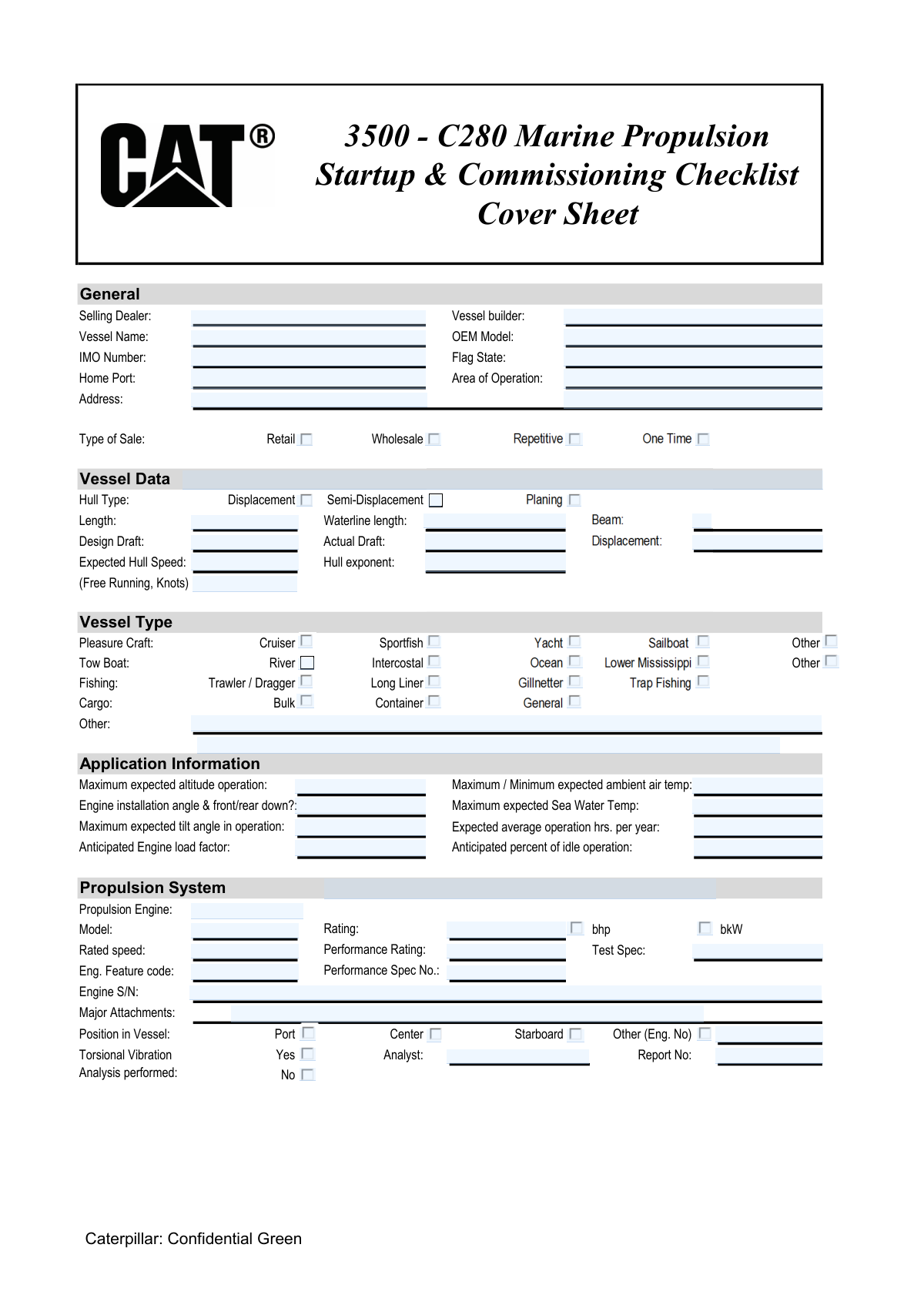
| 1. | Caterpillar 3500 - C280 Marine Propulsion Start-up & Commissioning Checklist | 18 | Very Complex 80 |
- Enterprise-grade security & data encryption
- 99%+ accuracy powered by AI
- 1,000+ forms from all industries
- Complete forms in under 60 seconds
How to Choose the Right Form
Choosing the right marine propulsion documentation is critical for ensuring vessel safety, regulatory compliance, and the preservation of manufacturer warranties. In this category, the focus is on high-performance engine systems that require rigorous verification before they are put into service.
Commissioning and Initial Setup
If you are overseeing the installation of a new engine or completing a major overhaul on a large-scale vessel, the primary document you will need is the Caterpillar 3500 - C280 Marine Propulsion Start-up & Commissioning Checklist. This form is specifically designed for the 3500 and C280 series engines, which are commonly found in tugs, ferries, and offshore supply vessels.
You should choose this form if your workflow involves:
- Warranty Validation: Ensuring that the installation meets Caterpillar’s strict specifications to protect the engine’s warranty.
- System Integration: Verifying that fuel systems, cooling circuits, and engine controls are correctly interfaced with the vessel's hull.
- Safety Compliance: Performing a systematic check of all safety shut-offs and alarms before the first sea trial.
Technical Precision and Compliance
Because marine propulsion systems are complex, using a generic checklist is often insufficient. The Caterpillar 3500 - C280 Marine Propulsion Start-up & Commissioning Checklist provides the granular detail required by marine service engineers. It moves beyond basic maintenance into the technical specifics of commissioning, including fuel system priming, lubrication verification, and mounting alignment.
Streamlining Documentation with AI
Filling out extensive technical checklists manually in a cramped or loud engine room can lead to data entry errors. By using Instafill.ai, you can process the Caterpillar 3500 - C280 Marine Propulsion Start-up & Commissioning Checklist digitally. This allows engineers to capture data accurately on-site, ensuring that every pressure reading and temperature check is recorded correctly for the final commissioning report, which can then be instantly shared with stakeholders or the manufacturer.
Form Comparison
| Form | Primary Purpose | Who Files It | Key Verification Areas |
|---|---|---|---|
| Caterpillar 3500 - C280 Marine Propulsion Start-up & Commissioning Checklist | Validates installation, safety, and performance standards for new marine propulsion systems. | Certified marine service engineers or technical commissioning specialists. | Fuel systems, engine controls, cooling, and manufacturer warranty compliance. |
Tips for marine propulsion forms
Before starting the checklist, ensure you have all engine, cooling system, and control module serial numbers readily available. Having these technical details on hand prevents delays and ensures that the warranty registration data is accurate from the start.
Marine commissioning forms are structured to follow a logical safety flow, moving from pre-start inspections to live engine testing. Completing these sections out of order can lead to safety risks or the omission of critical checks required for manufacturer validation.
A common mistake is simply checking a box for fluid levels without verifying the specific grades of oil and coolant used. Ensure all fluids meet the exact Caterpillar C280 specifications to prevent mechanical issues during the initial startup phase.
Managing complex technical checklists can be time-consuming, but AI-powered tools like Instafill.ai can complete these forms in under 30 seconds with high accuracy. This process ensures your data stays secure while significantly reducing the administrative burden for marine engineers.
Be careful to record static measurements, such as mounting bolt torque, separately from dynamic data like fuel pressure under load. Clearly distinguishing these two phases of the commissioning process is vital for a successful sea trial and final sign-off.
Keep a digital copy of every completed commissioning form as a baseline for future engine performance audits. These documents serve as the 'birth certificate' for the propulsion system and are essential for troubleshooting performance deviations later in the engine's lifecycle.
Frequently Asked Questions
These forms are technical documents used to document the installation, testing, and operational status of marine engines and propulsion systems. They ensure that complex machinery is set up according to manufacturer specifications before being put into full service.
This checklist is generally completed by certified marine service engineers or authorized technicians during the final stages of engine installation. Their expertise ensures that all mechanical and electronic systems are functioning safely and efficiently.
Completing a formal checklist is essential for validating the engine's warranty and ensuring it meets safety standards. It provides a historical record of the engine's initial performance parameters, which can be critical for future maintenance and troubleshooting.
The start-up process occurs after the engine has been physically installed in the vessel but before the ship is cleared for regular maritime operations. It often includes both dockside testing and sea trials to verify performance under load.
These forms typically require data on fuel system pressure, cooling system flow, exhaust temperatures, and electronic control settings. They also involve verifying that peripheral components like gearboxes and shafts are correctly aligned and synchronized.
Filling out these extensive technical forms manually can take significant time, but using AI-powered tools can streamline the process. Services like Instafill.ai can fill these forms in under 30 seconds by accurately extracting data from your technical logs and placing it directly into the PDF.
Yes, AI can be used to automate the completion of complex marine propulsion forms. AI tools like Instafill.ai can process data from source documents and populate the required fields, reducing the risk of manual entry errors in critical safety documents.
Once finalized, these forms are typically submitted to the engine manufacturer to register the installation and activate the warranty. Copies are also kept by the vessel owner and the service provider for their maintenance records.
While the general principles of propulsion commissioning apply across the industry, specific forms like the Caterpillar 3500 - C280 checklist are tailored to particular engine series. It is important to use the form that matches the specific engine model and application.
Failing to complete a required commissioning checklist can result in the voiding of the manufacturer's warranty. More importantly, it increases the risk of mechanical failure or safety incidents if an installation error goes undetected during the initial start-up.
Yes, most marine propulsion forms require the signature of a certified technician or an authorized representative from the service dealership. This signature verifies that the engine has been inspected and meets all manufacturer requirements for safe operation.
Many manufacturer-provided propulsion forms are non-interactive PDFs, which makes digital entry difficult. AI services like Instafill.ai can convert these static documents into interactive fillable forms, making it easier for technicians to complete them on tablets or laptops in the field.
Glossary
- Form Complexity Index
- Instafill’s 0–100 measure of how much effort a form takes to complete, calculated deterministically from the form’s own structure rather than estimated. It combines the number of fillable fields (the largest factor), how difficult those fields are to complete based on their type, the number of pages that contain fields, the amount of conditional “fill-only-if” logic, and how many sections the form is divided into, then adds modifiers for tables and repeating lists, bundled instruction pages, and dense page layouts. A higher score means the form is harder to fill out by hand. The forms in this category have a median Form Complexity Index of 80/100 (Very Complex). See exactly how it is calculated.
- Commissioning
- The formal procedure of verifying that a marine engine and its auxiliary systems are installed and functioning according to manufacturer specifications before being placed into service.
- ECM (Electronic Control Module)
- The onboard computer system that monitors engine sensors and controls fuel injection, timing, and other critical performance parameters.
- Sea Trials
- A series of rigorous tests conducted while the vessel is underway to evaluate the propulsion system's performance, speed, and reliability under actual load conditions.
- Jacket Water
- The coolant fluid that circulates through the engine block and cylinder heads to regulate temperature and protect components from overheating.
- Aftercooler
- A heat exchanger used to cool the intake air after it has been compressed by the turbocharger, which increases air density and improves combustion efficiency.
- Governor
- A mechanical or electronic device that automatically regulates the engine speed by adjusting the fuel supply in response to changes in the load.
- Torsional Vibration
- The rotational vibration of the crankshaft caused by combustion pulses, which must be measured during startup to ensure it does not reach levels that could cause mechanical failure.
- EPA/IMO Tier Rating
- Regulatory standards that specify the maximum allowable levels of exhaust emissions for marine diesel engines based on their date of manufacture and power output.