Fill out Maryland correctional forms
with AI.
Maryland correctional forms encompass a vital range of documentation used by the Department of Public Safety and Correctional Services to manage the legal and administrative status of individuals within the state's justice system. These forms are essential for those seeking to resolve past legal issues, update their records, or apply for specific types of relief. Because these documents often involve sensitive legal matters, accuracy and completeness are paramount to ensuring that the requests are processed correctly by state officials.
By continuing, you acknowledge Instafill's Privacy Policy and agree to get occasional product update and promotional emails.
About Maryland correctional forms
Individuals who typically require these forms include legal professionals, family advocates, and formerly incarcerated persons seeking to reintegrate into society or clear their records. A primary example is the Application for Pardon, which is a detailed request submitted to the Governor to forgive a past criminal offense. Completing such documentation involves disclosing extensive personal history and financial data, a process that can be both emotionally and administratively taxing for the applicant.
Given the complexity and length of these documents, manual entry can lead to errors that delay the review process. Tools like Instafill.ai use AI to fill these forms in under 30 seconds, handling the data accurately and securely to ensure every field is addressed correctly. This technology simplifies the administrative burden, allowing users to focus on their legal goals rather than the technicalities of paperwork.
Every form on this page can be completed without typing. Instafill is form filling software that reads a PDF and fills it for you — including flat and scanned documents that carry no fillable fields at all.
Forms in This Category
The forms in this category have a median Form Complexity Index of 70/100 (Complex), measured across 1 forms by field count, input difficulty, length, conditional logic and structure. See how it is calculated.
| Form Name | Pages | FCI | |
|---|---|---|---|
| 1. | Maryland Department of Public Safety and Correctional Services Application for Pardon | 27 | Complex 70 |
- Enterprise-grade security & data encryption
- 99%+ accuracy powered by AI
- 1,000+ forms from all industries
- Complete forms in under 60 seconds
How to Choose the Right Form
Navigating Maryland Pardon Applications
While our collection currently focuses on the Maryland Department of Public Safety and Correctional Services Application for Pardon, it is a comprehensive document designed for individuals seeking executive clemency from the Governor. Choosing to file this form is a significant legal step for those looking to move past a criminal history and demonstrate rehabilitation.
Is this the right form for you?
To determine if you should proceed with the Application for Pardon, consider your specific goals and legal standing:
- Restoring Rights: This form is for individuals seeking to restore rights lost due to a conviction, such as the right to hold certain professional licenses or public offices.
- Seeking Official Forgiveness: A pardon is an act of executive clemency. Unlike an expungement, which may hide or destroy a record, a pardon is a formal recognition of your rehabilitation and good character since the offense.
- Employment and Reputation: Use this form if you need a formal statement from the State of Maryland to improve your standing with potential employers, educational institutions, or the general public.
Understanding the Requirements
The Application for Pardon is one of the most detailed correctional forms in Maryland. When filling it out, be prepared to provide:
- Comprehensive Personal Background: A complete history of your residency and employment history.
- Financial Status: Detailed information regarding your current financial situation.
- Detailed Criminal History: A full list of past offenses and a compelling narrative explaining why you believe you deserve clemency.
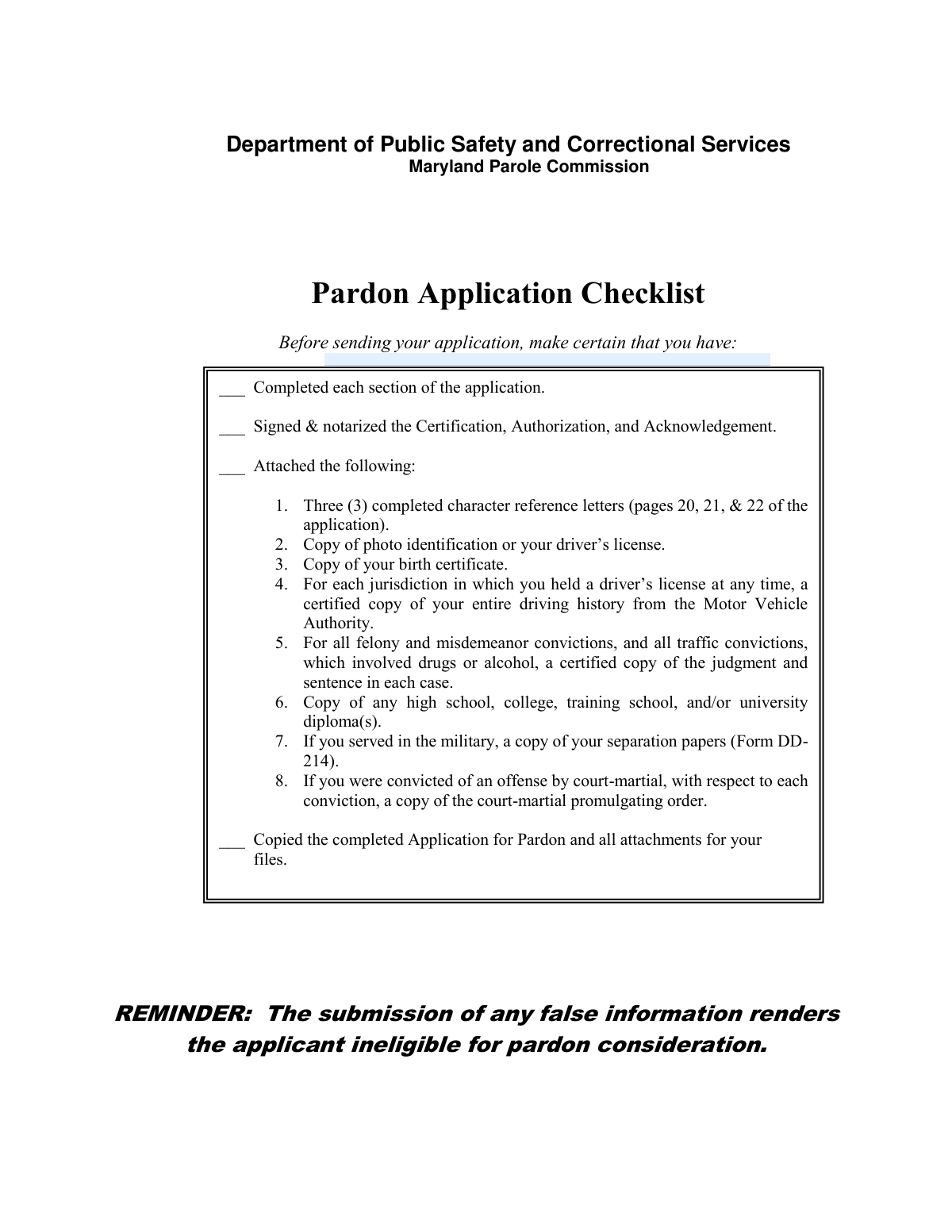
- Supporting Documentation: You will need to gather character references and evidence of your contributions to the community.
Streamlining the Process with Instafill
Because the Application for Pardon is so extensive, manual entry can be prone to errors that might delay your request. Using Instafill.ai allows you to convert the standard PDF into an interactive, fillable format. Our AI tools help ensure that every section—from financial data to personal statements—is captured accurately, helping you present a professional and organized application to the Maryland Parole Commission.
Form Comparison
| Form | Purpose | Eligibility | Key Requirements |
|---|---|---|---|
| Maryland Department of Public Safety and Correctional Services Application for Pardon | Request official forgiveness from the Governor for past criminal convictions. | Individuals who have completed their sentence and satisfied mandatory waiting periods. | Detailed criminal history, financial status, personal background, and reasons for request. |
Tips for Maryland correctional forms
One of the most common reasons for delays or denials is omitting past offenses or providing incorrect dates. Obtain an official copy of your Maryland criminal record before starting to ensure every entry on the form matches state records exactly.
Pardon applications require significant documentation, including proof of employment, tax returns, and letters of recommendation. Collecting these documents before you begin the application process prevents the need to pause and restart, ensuring a smoother submission.
Be specific about how a pardon will improve your life, such as expanding career opportunities or restoring civil rights. Focus on your personal growth and contributions to the community since the offense occurred to provide a persuasive narrative.
Maryland correctional forms can be lengthy and intimidating, but AI-powered tools like Instafill.ai can complete these forms in under 30 seconds with high accuracy. Your sensitive data stays secure during the process, making it a reliable way to handle multiple forms quickly.
Ensure that dates, addresses, and financial information are consistent throughout the entire document and match your supporting attachments. Discrepancies can raise red flags during the review process by the Parole Commission or the Governor's office.
Always keep a full digital or physical copy of the completed application and all attachments for your own records. This is essential if you need to reference specific details during a follow-up interview or if the Commission requests clarification.
Pardon applications often ask for detailed financial disclosures to assess stability and responsibility. Provide honest, up-to-date information regarding income and debts to avoid any appearance of withholding information from the state.
Frequently Asked Questions
Maryland correctional forms primarily include documents for individuals seeking post-conviction relief, such as applications for pardons or sentence modifications. These forms allow individuals to formalize requests to the Governor or the Maryland Department of Public Safety and Correctional Services (DPSCS) to address past criminal records.
This form is used by individuals who have been convicted of a crime in Maryland and wish to have their legal guilt officially forgiven by the Governor. It is often sought by those looking to restore certain civil rights, such as firearm rights or voting eligibility, or to improve their employment prospects after completing their sentence.
Most correctional forms, including the Application for Pardon, are submitted to the Maryland Parole Commission. The Commission acts as the administrative body that reviews the documentation and conducts investigations before making a recommendation to the Governor’s office for a final decision.
Applicants must usually provide a comprehensive criminal history, personal background information, and a detailed explanation of their conduct since the offense occurred. Financial status, employment history, and character references are also common requirements for these types of legal requests.
Yes, AI tools like Instafill.ai can process Maryland correctional forms by accurately extracting data from your source documents and placing it directly into the required fields. This technology ensures that complex legal forms are completed with high precision while reducing the risk of manual entry errors.
Using traditional manual methods, these forms can take several hours to complete due to the extensive level of detail required for personal and criminal histories. However, with AI-powered services, you can fill out these forms in under 30 seconds, significantly streamlining the preparation process.
Generally, applicants must wait a specific number of years after completing their entire sentence, including any period of probation or parole, before they are eligible to apply for a pardon. The specific timeframe required often depends on the nature and severity of the original offense committed.
A pardon is an act of executive clemency that forgives a crime but does not automatically remove it from your record. Expungement is a separate legal process that removes or shields a criminal record from public view, though obtaining a pardon can often serve as a strong justification for a subsequent expungement request.
While you are not legally required to have an attorney to fill out these forms, many people seek legal advice to ensure their application is persuasive and legally sound. AI tools can assist with the technical completion of the documents, but the overall legal strategy remains the responsibility of the applicant.
Once submitted, the Maryland Parole Commission will conduct a thorough investigation, which may include interviews and a review of institutional records. After the investigation concludes, the Commission provides a written recommendation to the Governor, who holds the ultimate authority to grant or deny the request.
It depends on the specific relief you are seeking; however, most pardon applications are handled as standalone requests. If you have multiple convictions, you generally list them all within the same comprehensive application rather than filing separate forms for each individual offense.
Glossary
- Form Complexity Index
- Instafill’s 0–100 measure of how much effort a form takes to complete, calculated deterministically from the form’s own structure rather than estimated. It combines the number of fillable fields (the largest factor), how difficult those fields are to complete based on their type, the number of pages that contain fields, the amount of conditional “fill-only-if” logic, and how many sections the form is divided into, then adds modifiers for tables and repeating lists, bundled instruction pages, and dense page layouts. A higher score means the form is harder to fill out by hand. The forms in this category have a median Form Complexity Index of 70/100 (Complex). See exactly how it is calculated.
- Pardon
- A formal act of legal forgiveness granted by the Governor of Maryland that restores certain civil rights lost due to a criminal conviction.
- DPSCS
- The Maryland Department of Public Safety and Correctional Services, the state agency that manages correctional facilities and oversees the pardon application process.
- Maryland Parole Commission
- The agency responsible for evaluating pardon applications and providing formal recommendations to the Governor on whether to grant clemency.
- Clemency
- The broad power of the Governor to provide relief from criminal penalties, which encompasses pardons, commutations, and reprieves.
- Expungement
- The legal process of shielding or deleting a criminal record from public view, which is distinct from a pardon and often requires a separate court filing.
- Commutation of Sentence
- A specific type of clemency that reduces the severity of a punishment, such as shortening a prison term, without fully forgiving the underlying crime.
- Petitioner
- The individual who is completing and submitting the application for a pardon or other form of correctional relief.
- Verified Statement
- A formal declaration within the application where the applicant confirms that all provided information is true and correct to the best of their knowledge.