Fill out mental health assessment forms
with AI.
Mental health assessment forms are foundational tools used by clinicians to gather detailed insights into a patient's psychological, social, and physical well-being. These documents are more than just paperwork; they serve as a roadmap for diagnosis and personalized care. By systematically documenting a client's history, current symptoms, and environmental factors, providers can identify patterns that might otherwise be overlooked, ensuring that treatment plans are grounded in comprehensive data rather than just immediate observations.
By continuing, you acknowledge Instafill's Privacy Policy and agree to get occasional product update and promotional emails.
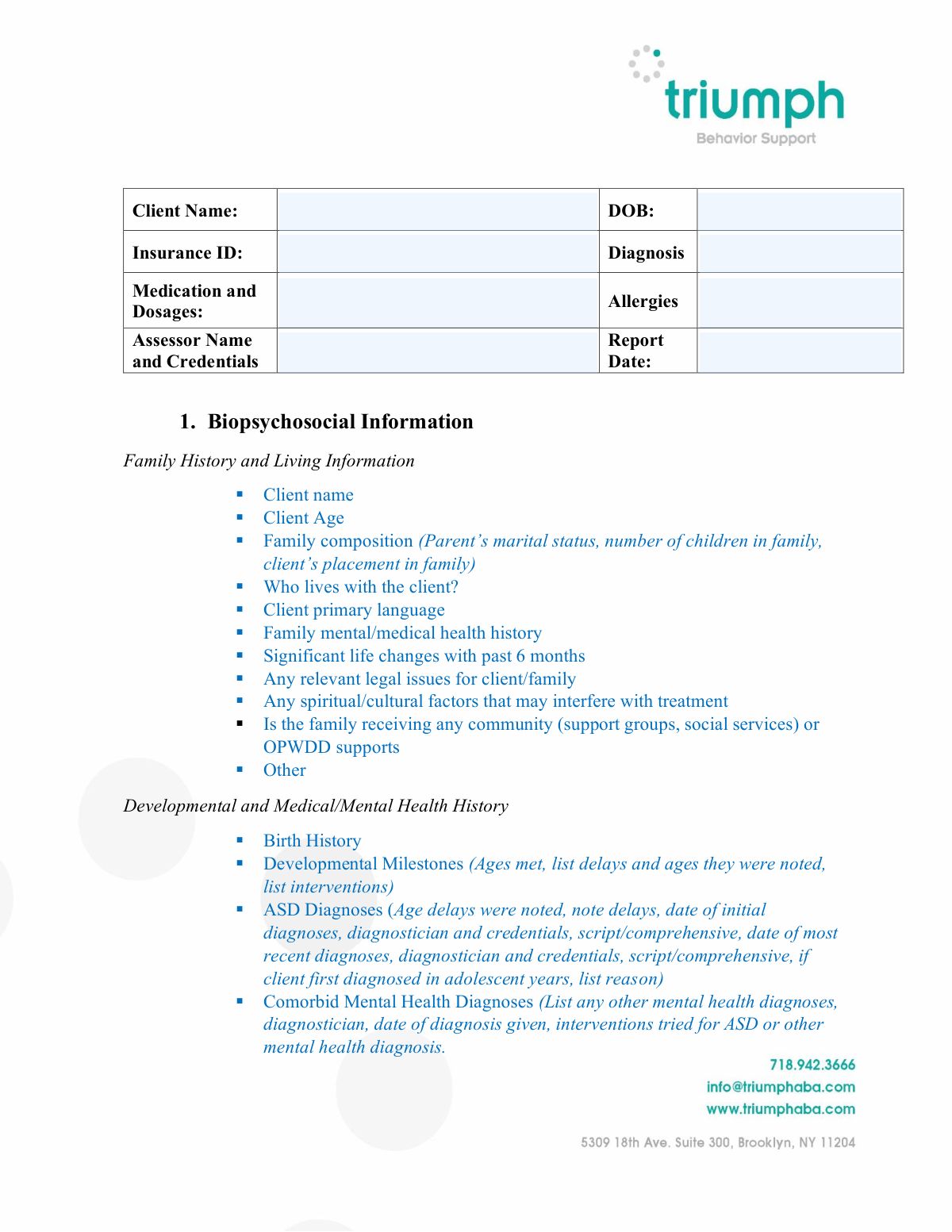
About mental health assessment forms
These forms are primarily utilized by mental health professionals, including psychologists, social workers, and Board Certified Behavior Analysts (BCBAs), during the intake process or periodic re-evaluations. For instance, comprehensive assessments like the Biopsychosocial Assessment are often required to justify treatment hours to insurance providers and to establish a baseline for tracking progress. Whether you are conducting an initial consultation or updating an Applied Behavior Analysis (ABA) treatment plan, having accurate and thorough documentation is essential for maintaining clinical standards and ensuring continuity of care.
Managing the administrative burden of these detailed assessments can be time-consuming for busy practitioners. Tools like Instafill.ai use AI to fill these forms in under 30 seconds, handling sensitive data accurately and securely to streamline your clinical workflow. This allows providers to spend less time on manual data entry and more time focusing on patient outcomes and direct care.
Every form on this page can be completed without typing. Instafill is form filling software that reads a PDF and fills it for you — including flat and scanned documents that carry no fillable fields at all.
Forms in This Category
The forms in this category have a median Form Complexity Index of 83/100 (Very Complex), measured across 1 forms by field count, input difficulty, length, conditional logic and structure. See how it is calculated.
| Form Name | Pages | FCI | |
|---|---|---|---|
| 1. | Biopsychosocial Assessment and ABA Treatment Plan | 15 | Very Complex 83 |
- Enterprise-grade security & data encryption
- 99%+ accuracy powered by AI
- 1,000+ forms from all industries
- Complete forms in under 60 seconds
How to Choose the Right Form
Determining Your Clinical Documentation Needs
When navigating mental health assessment forms, it’s essential to select the document that aligns with your specific therapeutic approach and the requirements of insurance providers. Currently, this category features a comprehensive tool designed for behavioral health professionals specializing in developmental and behavioral support.
For ABA Professionals and BCBAs
If you are a Board Certified Behavior Analyst (BCBA) or working within a clinical behavioral setting, the Biopsychosocial Assessment and ABA Treatment Plan is your primary resource. This form is designed to bridge the gap between initial intake and long-term goal setting. You should choose this form if your objective is to:
- Gather Holistic Client Data: Collect detailed medical, family, and developmental histories to inform your clinical approach and understand the client's environmental context.
- Secure Insurance Authorization: This document is specifically structured to justify recommended service hours to insurance companies by providing evidence-based rationales and clear clinical necessity.
- Establish Baseline Progress: Set clear, measurable goals that allow for systematic tracking of a client’s development over time, which is crucial for both clinical success and regulatory compliance.
When to Use This Specific Form
The Biopsychosocial Assessment and ABA Treatment Plan is the right choice during several key stages of the therapeutic process:
- Initial Intake: Use it to create the foundational document for a new client entering Applied Behavior Analysis (ABA) therapy.
- Re-authorization Periods: Select this when you need to update treatment plans to ensure continued coverage and demonstrate meaningful progress to payers.
- Clinical Reviews: It serves as a structured summary of a client's status for multi-disciplinary teams or internal audits.
By using Instafill.ai to complete these assessments, you can ensure that complex behavioral data is organized clearly and professionally, allowing you to focus more on patient care and less on manual data entry.
Form Comparison
| Form | Purpose | Primary User | Key Components | Common Use Case |
|---|---|---|---|---|
| Biopsychosocial Assessment and ABA Treatment Plan | Comprehensive evaluation for individual treatment planning and insurance justification. | Board Certified Behavior Analysts (BCBAs) and clinical professionals. | Medical history, developmental background, and measurable progress tracking goals. | Initiating or renewing Applied Behavior Analysis (ABA) therapy services. |
Tips for mental health assessment forms
AI-powered tools like Instafill.ai can complete complex mental health assessments in under 30 seconds with high accuracy. Your sensitive data stays secure throughout the process, providing a reliable way for clinicians to manage high volumes of paperwork without sacrificing quality.
When documenting symptoms or behaviors, avoid subjective terms like 'frustrated' or 'angry' which can be interpreted differently. Instead, describe specific, observable actions such as 'threw objects' or 'vocalized for 5 minutes' to ensure clinical accuracy and insurance compliance.
Insurance providers require a clear connection between the assessment results and the requested treatment hours. Ensure your treatment plan explicitly explains how each proposed goal addresses a specific deficit or need identified during the initial biopsychosocial evaluation.
Biopsychosocial forms require extensive family, medical, and developmental history which can be time-consuming to find. Gathering these records into a single reference sheet beforehand prevents gaps in the assessment and ensures the treatment plan is based on a complete clinical picture.
To accurately measure a client's growth over months or years, use consistent metrics and terminology across every assessment form. This continuity makes it easier to justify adjustments to the treatment plan during periodic reviews and simplifies the data for audits.
Double-check that the goals listed in the treatment plan section directly correspond to the needs identified in the assessment portion. Inconsistencies between the evaluation and the proposed plan are a common cause for delays in service authorization or insurance denials.
Frequently Asked Questions
These forms are standardized tools used by healthcare professionals to evaluate a patient's emotional, behavioral, and social well-being. They help in diagnosing conditions, establishing a baseline for treatment, and monitoring progress over time to ensure the best possible care outcomes.
Mental health assessment forms are usually filled out by licensed professionals such as psychologists, Board Certified Behavior Analysts (BCBAs), or clinical social workers. While clinicians provide the professional evaluation, patients or their guardians often contribute the initial background and history information.
A biopsychosocial assessment is essential because it looks at the biological, psychological, and social factors that influence a person's behavior. This holistic view allows BCBAs to create more effective, individualized Applied Behavior Analysis (ABA) treatment plans that address the root causes of specific behaviors.
These assessments are typically updated whenever there is a significant change in the patient's condition or at regular intervals required by insurance providers, often every six months. Regular updates ensure the treatment plan remains relevant to the patient's current needs and progress.
Yes, most insurance companies require a completed assessment and a detailed treatment plan to authorize coverage for mental health services. These documents provide the clinical justification needed to prove that the requested services are medically necessary for the patient.
Selecting the right form depends on the specific clinical goals and the age of the patient. For behavioral issues, an ABA-focused assessment is standard, while general mental health concerns might require a broader biopsychosocial or diagnostic intake form.
Yes, you can fill out mental health assessment forms using AI. Tools like Instafill.ai can accurately extract data from source documents and populate complex clinical forms in under 30 seconds, reducing the manual administrative burden for clinicians.
Completing these forms manually can take hours, but using AI-powered online tools significantly speeds up the process. AI can process and place data into the correct fields almost instantly, allowing professionals to focus more on patient care rather than paperwork.
Once completed, these forms are usually submitted to the healthcare facility's internal records system and to the patient's insurance provider for service authorization. They may also be shared with other members of the patient's multidisciplinary care team to coordinate treatment.
Most assessments require a mix of medical history, developmental milestones, social background, and current behavioral observations. They also include specific goals for treatment and the clinical methods that will be used to achieve them.
Yes, assessments are frequently shared between providers to ensure continuity of care, provided the patient or guardian has signed the necessary consent forms. This helps all specialists involved—such as pediatricians and therapists—stay aligned on the patient's treatment trajectory.
Digital forms offer convenience and can be handled through platforms that prioritize data security. Using professional digital tools ensures that sensitive patient information is managed according to standard privacy regulations during the filling and submission process.
Glossary
- Form Complexity Index
- Instafill’s 0–100 measure of how much effort a form takes to complete, calculated deterministically from the form’s own structure rather than estimated. It combines the number of fillable fields (the largest factor), how difficult those fields are to complete based on their type, the number of pages that contain fields, the amount of conditional “fill-only-if” logic, and how many sections the form is divided into, then adds modifiers for tables and repeating lists, bundled instruction pages, and dense page layouts. A higher score means the form is harder to fill out by hand. The forms in this category have a median Form Complexity Index of 83/100 (Very Complex). See exactly how it is calculated.
- Biopsychosocial Assessment
- A comprehensive evaluation that examines the biological, psychological, and social factors that contribute to a person's mental health and functional status.
- Applied Behavior Analysis (ABA)
- A type of therapy focused on improving specific behaviors, such as social skills, communication, and learning, through positive reinforcement and systematic observation.
- BCBA (Board Certified Behavior Analyst)
- A professional with graduate-level certification in behavior analysis who is qualified to design and oversee behavioral treatment plans.
- Clinical Justification
- The evidence-based reasoning provided in a form to prove to insurance companies that a specific treatment or number of service hours is medically necessary.
- Developmental History
- A detailed record of a client's growth milestones, such as physical, cognitive, and social development, used to identify potential delays or patterns.
- Adaptive Behavior
- The collection of conceptual, social, and practical skills that people use to function in their daily lives and meet the demands of their environment.
- Comorbidity
- The presence of two or more mental health conditions or disorders occurring in the same person at the same time.
- Functional Assessment
- A process used to identify the specific triggers and consequences that maintain a particular behavior, helping to determine the purpose the behavior serves for the individual.