Fill out military mental health forms
with AI.
The military mental health forms category encompasses the essential documentation required by the Department of Veterans Affairs (VA) and the Department of Defense (DoD) to substantiate psychological health claims. These documents are vital for veterans and active-duty service members seeking disability compensation, specialized medical treatment, or support services for service-connected conditions. By providing a formal channel to document traumatic events and their ongoing impact, these forms serve as the evidentiary foundation for a service member's medical and benefits record.
By continuing, you acknowledge Instafill's Privacy Policy and agree to get occasional product update and promotional emails.
About military mental health forms
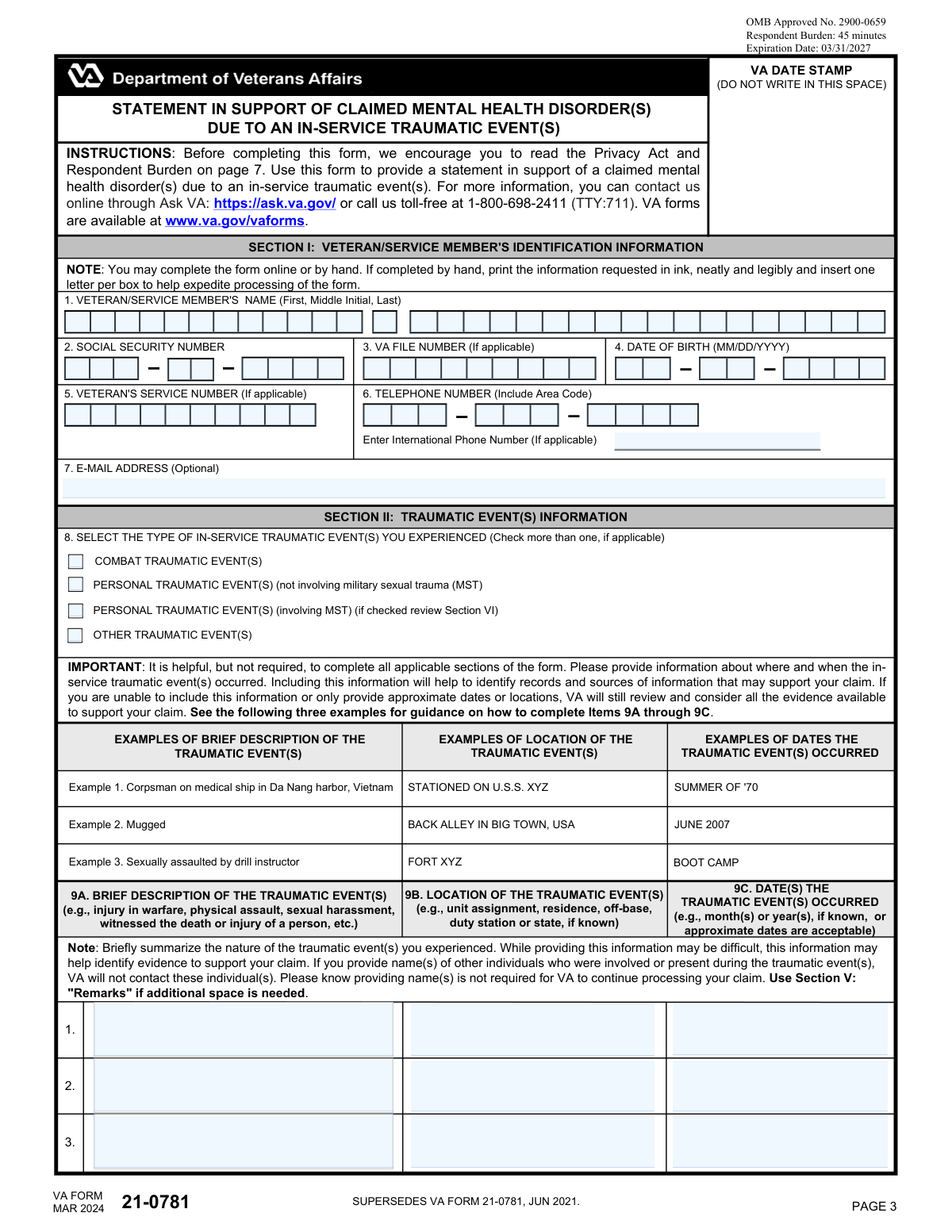
Typically, these forms are utilized by individuals who have experienced significant stressors during their service, such as combat exposure or other traumatic incidents, and are now filing for benefits or an increase in their disability rating. For example, documents like VA Form 21-0781 allow veterans to provide the specific details and context regarding in-service events that led to conditions such as PTSD or depression. Navigating this paperwork often occurs during the transition to civilian life or when a veteran’s mental health needs change, requiring a clear and detailed account of their history to ensure they receive the appropriate level of care.
Recalling and documenting traumatic events can be an emotionally demanding process, making accuracy and efficiency paramount. Tools like Instafill.ai use AI to fill these forms in under 30 seconds, handling sensitive data accurately and securely to streamline the administrative burden. This allows veterans and their families to focus on the recovery process rather than the complexities of manual form completion.
Every form on this page can be completed without typing. Instafill is form filling software that reads a PDF and fills it for you — including flat and scanned documents that carry no fillable fields at all.
Forms in This Category
The forms in this category have a median Form Complexity Index of 65/100 (Complex), measured across 1 forms by field count, input difficulty, length, conditional logic and structure. See how it is calculated.
| Form Name | Pages | FCI | |
|---|---|---|---|
| 1. | VA Form 21-0781, Statement in Support of Claimed Mental Health Disorder(s) Due to an In-Service Traumatic Event(s) | 5 | Complex 65 |
- Enterprise-grade security & data encryption
- 99%+ accuracy powered by AI
- 1,000+ forms from all industries
- Complete forms in under 60 seconds
How to Choose the Right Form
When to Use VA Form 21-0781
If you are a veteran filing a claim for disability compensation related to a mental health condition—most commonly Post-Traumatic Stress Disorder (PTSD)—VA Form 21-0781 (Statement in Support of Claimed Mental Health Disorder(s) Due to an In-Service Traumatic Event(s)) is the essential document for providing your personal statement.
This form is specifically designed for:
- Documenting In-Service Stressors: Use this form to describe the specific traumatic events (stressors) that occurred during your military service which you believe caused your current mental health condition.
- Supporting a Disability Claim: It serves as the primary evidence bridge between your service records and your current diagnosis, helping the VA understand the "nexus" or connection.
- Combat and Non-Combat Incidents: Whether the event occurred during active combat or was a non-combat-related traumatic accident, this form is the standard requirement for reporting those stressors.
What to Include in Your Statement
To ensure your application is processed efficiently, VA Form 21-0781 requires specific details regarding the incidents you are reporting. When filling out this form using Instafill.ai, be prepared to provide:
- Dates and Locations: You must provide the approximate dates (at least the month and year) and the specific location where the incident occurred.
- Unit Assignment: Identify the unit you were assigned to at the time of the event.
- Detailed Description: A clear account of the event. While this can be difficult to write, being as specific as possible about the circumstances helps the VA verify the occurrence through official records.
Is This the Right Form for You?
Currently, this category focuses on VA Form 21-0781, which covers general traumatic events. It is important to note that if your claim is specifically related to personal assault or military sexual trauma (MST), the VA typically requests VA Form 21-0781a instead. However, for all other service-connected traumatic stressors, VA Form 21-0781 is the correct choice to help substantiate your mental health disability claim.
Form Comparison
| Form | Purpose | Who Files It | Key Information Needed | Filing Context |
|---|---|---|---|---|
| VA Form 21-0781, Statement in Support of Claimed Mental Health Disorder(s) Due to an In-Service Traumatic Event(s) | Documents specific traumatic in-service events to support mental health disability claims. | Veterans applying for disability benefits related to service-connected mental health conditions. | Specific dates, locations, and descriptions of traumatic stressors experienced during service. | Submitted as evidence when filing a claim for service-connected PTSD or disorders. |
Tips for military mental health forms
Avoid vague descriptions when recounting traumatic events. Include specific dates, locations, and the units involved to help the VA verify the occurrence through official service records more efficiently.
Beyond the event itself, explain how the resulting mental health condition affects your current ability to work and maintain social relationships. This context is vital for the VA to understand the severity of your condition.
AI-powered tools like Instafill.ai can complete these complex forms in under 30 seconds with high accuracy. Your data stays secure during the process, making it a practical time-saver for veterans managing multiple pieces of paperwork.
Collect 'buddy statements,' medical records, or police reports that support your claim before you begin filling out the form. Having these documents ready ensures your statement remains consistent with other evidence in your file.
You do not need to use clinical or medical terminology to be effective. Describing your experiences and feelings in your own words often provides a more authentic and compelling account of the trauma and its aftermath.
Double-check that dates and event details match what you have provided in other parts of your VA claim. Discrepancies between different forms can lead to processing delays and requests for additional clarification.
Always save a digital or physical copy of your completed form for your personal records. This provides a vital reference point for future C&P exams or if you need to file an appeal later.
Frequently Asked Questions
These forms allow veterans to provide detailed accounts of traumatic incidents that occurred during their service to support disability claims. They serve as essential evidence for establishing a service connection for mental health conditions like PTSD, depression, or anxiety.
Veterans who are seeking disability compensation for a mental health condition caused or aggravated by their military service should complete these documents. They are particularly vital when the official service record does not explicitly document the specific traumatic events or stressors.
While these forms are most commonly used for Post-Traumatic Stress Disorder (PTSD), they can support claims for various mental health conditions resulting from in-service stressors. They help the VA verify the specific events that led to the current diagnosis, regardless of the specific label.
You generally need to provide specific details about the event, including the approximate date, location, and a factual description of what occurred. You may also be asked to include names of individuals who witnessed the event or secondary sources like news reports or unit logs.
Completed forms are typically submitted to the Department of Veterans Affairs (VA) as part of a formal disability compensation package. Submissions can be handled through the VA's online portal, by mail to a centralized claims processing center, or in person at a VA regional office.
Yes, if you experienced multiple traumatic events during your service, you should document all of them to provide a complete picture of your history. If the form lacks sufficient space, you can use additional copies of the form or attach a supplemental statement.
The VA treats all medical and mental health documentation with a high level of confidentiality under federal privacy laws. The information you provide is used strictly for evaluating your claim and determining your eligibility for healthcare and financial benefits.
Yes, AI tools like Instafill.ai can fill out military mental health forms accurately by extracting and placing data from your source documents. This technology ensures that your descriptions and personal details are transferred correctly into the required fields.
Using AI-powered services like Instafill.ai, you can complete these forms in under 30 seconds. The system automates the data entry process, allowing you to finalize complex paperwork much faster than manual typing or handwriting.
These forms should ideally be submitted at the same time you file your initial claim for disability benefits to avoid processing delays. Providing a detailed statement early helps the VA's evidence-gathering team verify your stressors more efficiently.
If you do not have exact dates, you should provide the most accurate timeframe possible, such as a specific month or a 60-day window. The VA uses this information to search military archives and unit records to find corroborating evidence of the incident.
Glossary
- Form Complexity Index
- Instafill’s 0–100 measure of how much effort a form takes to complete, calculated deterministically from the form’s own structure rather than estimated. It combines the number of fillable fields (the largest factor), how difficult those fields are to complete based on their type, the number of pages that contain fields, the amount of conditional “fill-only-if” logic, and how many sections the form is divided into, then adds modifiers for tables and repeating lists, bundled instruction pages, and dense page layouts. A higher score means the form is harder to fill out by hand. The forms in this category have a median Form Complexity Index of 65/100 (Complex). See exactly how it is calculated.
- In-Service Traumatic Event
- A specific incident occurring during military service that caused significant psychological distress or physical harm, forming the basis of a mental health claim.
- Stressor
- A specific event or series of events that triggered a mental health condition; veterans must provide details of these occurrences on VA Form 21-0781.
- Nexus
- A formal link or connection between a veteran's current mental health diagnosis and a specific event that happened during their military service.
- MST (Military Sexual Trauma)
- A term used by the VA to describe sexual assault or repeated sexual harassment experienced during a service member's time in the military.
- C&P Exam (Compensation and Pension Exam)
- A medical evaluation conducted by a VA or third-party physician to assess the severity of a veteran's condition and its relationship to service.
- Lay Evidence
- Statements from non-medical sources, such as family, friends, or fellow service members, used to corroborate the veteran's account of a traumatic event.
- Service Connection
- The official recognition by the Department of Veterans Affairs that a mental health condition is directly related to a veteran's military service.
- VSO (Veteran Service Officer)
- A trained professional who assists veterans in navigating the VA claims process and filling out necessary documentation at no cost.