Fill out Minnesota DHS forms
with AI.
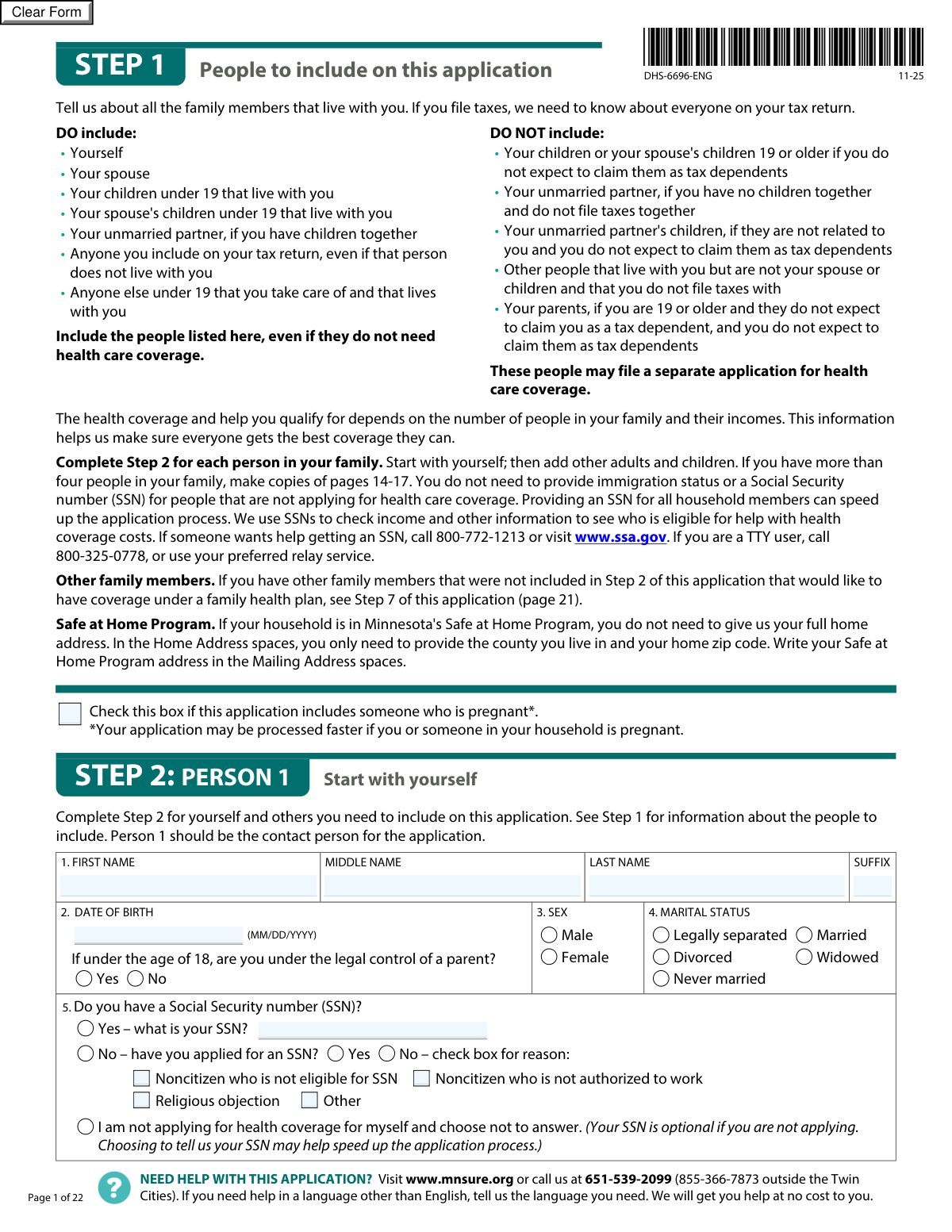
Minnesota Department of Human Services (DHS) forms are official government documents used to apply for, manage, and renew state-administered health and social service programs. This category centers on health coverage applications processed through MNsure and DHS — the pathways Minnesotans use to access programs like Medical Assistance (MA) and MinnesotaCare. These forms collect detailed household information, including income, residency, citizenship or immigration status, and tax filing details, all of which are used to determine eligibility for public health coverage and financial assistance.
By continuing, you acknowledge Instafill's Privacy Policy and agree to get occasional product update and promotional emails.
About Minnesota DHS forms
People who typically need these forms include low-income individuals and families, seniors, people with disabilities, and others who may qualify for state or federally subsidized health coverage. You might need to complete one of these applications if you've recently lost employer-sponsored insurance, experienced a change in income or household size, or are applying for coverage for the first time. The forms also include important consent and acknowledgment sections related to privacy rights and benefit renewal obligations, so it's important to complete them carefully and accurately.
Because these applications can be lengthy and involve sensitive personal information, tools like Instafill.ai use AI to help fill them out in under 30 seconds — handling the data accurately and securely, so you can focus on getting the coverage you need rather than navigating complex paperwork.
Every form on this page can be completed without typing. Instafill is form filling software that reads a PDF and fills it for you — including flat and scanned documents that carry no fillable fields at all.
Forms in This Category
The forms in this category have a median Form Complexity Index of 95/100 (Very Complex), measured across 1 forms by field count, input difficulty, length, conditional logic and structure. See how it is calculated.
| Form Name | Pages | FCI | |
|---|---|---|---|
| 1. | DHS-6696-ENG, Minnesota Health Care Programs Application (MNsure/DHS) | 13 | Very Complex 95 |
- Enterprise-grade security & data encryption
- 99%+ accuracy powered by AI
- 1,000+ forms from all industries
- Complete forms in under 60 seconds
How to Choose the Right Form
Navigating Minnesota Department of Human Services (DHS) forms can be complex, but for most residents seeking health coverage, the process centers around one primary application. Understanding when and how to use this form is the first step toward securing state-funded medical benefits.
Applying for State Health Coverage
If you are looking for affordable health insurance through the state, the DHS-6696-ENG (Minnesota Health Care Programs Application) is the essential document. This comprehensive form serves as a multi-purpose gateway used by both MNsure and the DHS to determine your eligibility for:
- Medical Assistance (MA): Minnesota's Medicaid program designed for low-income individuals, families, children, and pregnant women.
- MinnesotaCare: A program for residents who do not have access to affordable health insurance through an employer and earn too much to qualify for Medical Assistance.
Is this the right form for you?
You should choose the DHS-6696-ENG if you are currently seeking health coverage and need to provide the state with a complete picture of your household. It is the correct choice for:
- New Applicants: Individuals or families who are not currently enrolled in a state program.
- Financial Assistance Seekers: Those looking for subsidies or tax credits to help lower the cost of health insurance.
- Mixed-Status Households: Families where different members may qualify for different types of assistance based on income or immigration status.
Key Information Required
Because the DHS-6696-ENG is used to verify identity and coordinate benefits, you will need to have specific details ready before you begin filling it out online. This includes your household tax filing status, residency and citizenship documentation, and detailed income information for all members of your household. Providing accurate data on this form is critical, as it directly impacts your eligibility determination and future benefit renewals.
Form Comparison
| Form | Purpose | Who Files It | Key Information Required | Programs Covered |
|---|---|---|---|---|
| DHS-6696-ENG, Minnesota Health Care Programs Application (MNsure/DHS) | Apply for public health coverage and financial assistance in Minnesota. | Individuals or families seeking state-funded health insurance programs. | Household size, tax status, income, residency, and citizenship details. | Medical Assistance (MA), MinnesotaCare, and related financial health subsidies. |
Tips for Minnesota DHS forms
Before starting your Minnesota Health Care Programs application, collect Social Security numbers, tax filing details, and recent income documentation for everyone in your household. Having these details ready prevents errors and ensures the information you provide matches official records used for verification.
AI-powered tools like Instafill.ai can complete complex Minnesota DHS forms in under 30 seconds with high accuracy. Your data stays secure during the process, making it a massive time-saver for navigating lengthy health care applications that require repetitive data entry.
A common mistake is misreporting who counts as a household member for health coverage purposes. Ensure you list everyone you claim as a dependent on your taxes, as this figure directly affects your eligibility for Medical Assistance or MinnesotaCare.
Since eligibility for financial assistance often depends on your projected annual income, provide the most accurate estimate possible. If your income changes significantly after filing, remember that you are typically required to report those changes to the DHS to maintain correct coverage.
Carefully read the required consents regarding tax information use and privacy policies at the end of the form. These acknowledgments allow the state to verify your data electronically, which is a critical step for speeding up the approval of your health coverage.
Failing to list existing health insurance can lead to processing delays or coordination of benefits issues. Be sure to include details for any employer-sponsored plans or private insurance currently held by any member of your household.
Always download and save a digital copy of your finished DHS-6696-ENG form for your personal records. This is essential for future renewals or if you need to clarify specific details with a county worker or MNsure representative later on.
Frequently Asked Questions
Minnesota Department of Human Services (DHS) forms are primarily used to apply for and manage public health care coverage. These documents collect essential information regarding your household, income, and residency to determine if you qualify for programs like Medical Assistance (MA) or MinnesotaCare.
These forms are intended for Minnesota residents who need health coverage and do not have access to affordable insurance through an employer. Eligibility is generally based on factors such as household size, monthly or annual income, and citizenship or immigration status.
Completed forms can typically be submitted online through the MNsure portal, or by mail to your specific county or tribal human services office. Some forms also allow for in-person drop-off at local government service centers depending on your residency.
Yes, AI tools like Instafill.ai can be used to fill out complex Minnesota DHS forms quickly. These tools can accurately extract data from your personal documents and place it into the corresponding fields on the PDF in under 30 seconds.
Manually completing a multi-page health care application can take an hour or more due to the detailed financial information required. Using AI automation allows you to complete the same forms in less than a minute by automatically syncing data from your source files.
You should gather Social Security numbers for all household members, recent tax filing information, and proof of current income, such as pay stubs or employer statements. Having these documents ready ensures that the data you provide matches the records the state uses for verification.
Most Minnesota health care forms, such as the DHS-6696, act as a single application for multiple programs. The DHS will review your submitted information and automatically determine whether you qualify for Medical Assistance, MinnesotaCare, or other financial assistance.
Minnesota requires applicants and enrollees to report changes in income or household composition within a specific timeframe, usually 10 to 30 days. You may need to submit a supplemental change report form to the DHS to ensure your coverage remains accurate.
Yes, while there are general applications for individuals and families, the DHS provides specific forms tailored to seniors (65+) and individuals with disabilities. These forms may ask additional questions regarding assets and long-term care needs.
Minnesota offers assistance through certified MNsure navigators and county caseworkers who can guide you through the application process. Additionally, many forms include detailed instruction sections that explain the legal definitions of terms like 'household' or 'tax dependent'.
Glossary
- Form Complexity Index
- Instafill’s 0–100 measure of how much effort a form takes to complete, calculated deterministically from the form’s own structure rather than estimated. It combines the number of fillable fields (the largest factor), how difficult those fields are to complete based on their type, the number of pages that contain fields, the amount of conditional “fill-only-if” logic, and how many sections the form is divided into, then adds modifiers for tables and repeating lists, bundled instruction pages, and dense page layouts. A higher score means the form is harder to fill out by hand. The forms in this category have a median Form Complexity Index of 95/100 (Very Complex). See exactly how it is calculated.
- Medical Assistance (MA)
- Minnesota's version of Medicaid, which provides health care coverage for residents with low income, including families with children, pregnant women, and people with disabilities.
- MNsure
- The state's health insurance marketplace where individuals and families can compare private health plans and apply for financial assistance or public health programs.
- MinnesotaCare
- A state-funded health insurance program for Minnesotans who earn too much to qualify for Medical Assistance but do not have access to affordable employer insurance.
- Minnesota Department of Human Services (DHS)
- The state agency responsible for overseeing public health programs and social services, including the processing of health care applications.
- Modified Adjusted Gross Income (MAGI)
- A specific way of calculating household income used to determine eligibility for Medical Assistance, MinnesotaCare, and federal tax credits.
- Advanced Premium Tax Credit (APTC)
- A federal subsidy that reduces your monthly health insurance premiums when you purchase a plan through the MNsure marketplace.
- Qualified Health Plan (QHP)
- A private insurance plan that is certified by MNsure and provides all essential health benefits required by the Affordable Care Act.
- Cost-Sharing Reductions (CSR)
- Discounts that lower the amount you pay for deductibles, copayments, and coinsurance, available to eligible individuals who enroll in a Silver-level plan.