Fill out municipal forms
with AI.
Municipal forms are the essential link between residents, developers, and local government services. These documents cover a wide range of administrative requirements, from property renovations to large-scale urban development projects. By submitting these forms, individuals and businesses ensure that their projects align with local zoning laws, safety regulations, and environmental standards. This structured process is vital for maintaining the integrity of community infrastructure and ensuring that all construction or land-use changes are officially documented and inspected.
By continuing, you acknowledge Instafill's Privacy Policy and agree to get occasional product update and promotional emails.
About municipal forms
Typically, homeowners, general contractors, and professional developers are the primary users of these forms. Whether you are planning a minor home addition, a complete interior renovation, or a new commercial build, filing documents like building permit applications or plan reviews is a mandatory step before work can begin. Navigating these requirements can often be the most time-consuming part of a project, as they require precise details regarding project scope, estimated costs, and technical specifications. Tools like Instafill.ai use AI to fill these municipal forms in under 30 seconds, handling the data accurately and securely to help you move from paperwork to construction faster. This automated approach reduces the risk of manual errors and ensures that your submissions are professional and complete.
Every form on this page can be completed without typing. Instafill is form filling software that reads a PDF and fills it for you — including flat and scanned documents that carry no fillable fields at all.
Forms in This Category
The forms in this category have a median Form Complexity Index of 70/100 (Complex), measured across 2 forms by field count, input difficulty, length, conditional logic and structure. See how it is calculated.
| Form Name | Pages | FCI | |
|---|---|---|---|
| 1. | City of Manchester Application for Plan Review and Building Permit | 2 | Complex 70 |
| 2. | Nevada Justice / Municipal Civil Court Cover Sheet | 1 | Moderate 55 |
- Enterprise-grade security & data encryption
- 99%+ accuracy powered by AI
- 1,000+ forms from all industries
- Complete forms in under 60 seconds
How to Choose the Right Form
Navigating municipal requirements is a critical step for any construction or renovation project. Choosing the correct document ensures that your project remains compliant with local zoning laws and building codes, preventing costly delays or fines.
For Construction and Renovations in Manchester
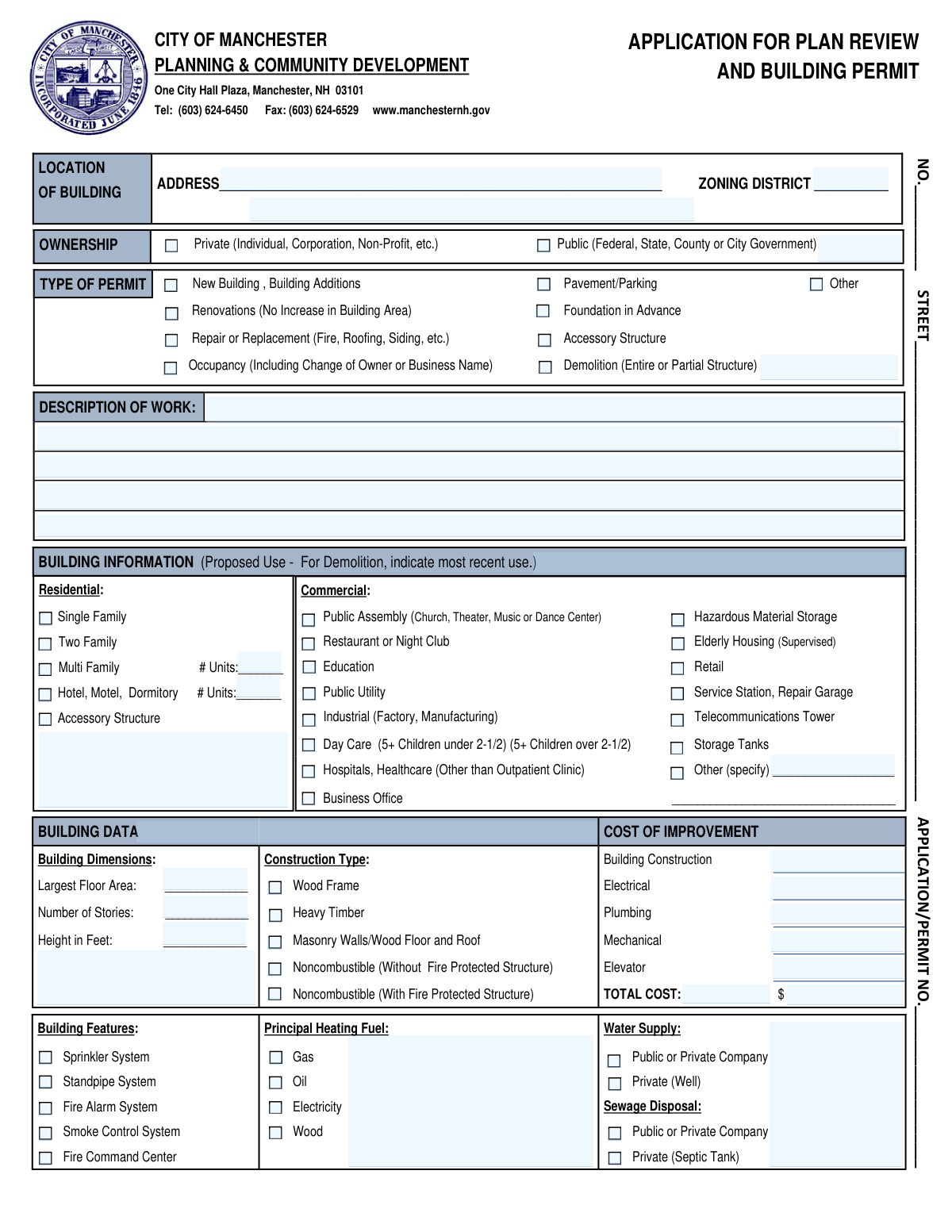
If your project is located within the City of Manchester, the primary document you will need is the City of Manchester Application for Plan Review and Building Permit. This comprehensive form is the standard requirement for the Planning & Community Development department and covers a variety of project types, including:
- New Construction: For building entirely new residential or commercial structures.
- Additions and Alterations: When you are expanding an existing building’s footprint or making significant internal structural changes.
- Demolition: For the safe and legal removal of existing structures from a property.
- Renovations: Ensuring that updates to structural, electrical, or mechanical systems meet current safety standards.
Key Information Required
Before you begin filling out the City of Manchester Application for Plan Review and Building Permit, ensure you have the following details on hand to make the process smoother:
- Project Scope: A detailed description of the work being performed.
- Valuation: The estimated cost of the project, which is often used to determine permit fees.
- Professional Contacts: Information for any licensed contractors, architects, or engineers involved in the work.
Simplifying Municipal Paperwork
Municipal forms are notoriously detailed and often provided in static PDF formats that are difficult to edit. By using Instafill.ai, you can turn the City of Manchester Application for Plan Review and Building Permit into an interactive experience. Our AI-powered tools help you accurately map your project data into the required fields, ensuring that your submission is professional, legible, and ready for official review.
Form Comparison
| Form | Primary Purpose | Applicable Projects | Key Information Required |
|---|---|---|---|
| City of Manchester Application for Plan Review and Building Permit | To obtain official municipal approval for building plans and construction permits. | New construction, additions, renovations, and demolition within the City of Manchester. | Project location, scope of work, estimated construction costs, and contractor details. |
Tips for municipal forms
Before filling out permit applications, ensure your project aligns with Manchester's specific zoning ordinances. Incorrectly categorizing your project type can lead to immediate rejection or costly delays during the plan review process.
Municipal forms often require valid license numbers and contact details for all contractors involved in the project. Gathering this information in advance prevents you from having to pause mid-application to track down credentials.
AI-powered tools like Instafill.ai can complete these forms in under 30 seconds with high accuracy, and your data stays secure during the process. This is a major time-saver for property owners and contractors managing multiple municipal filings simultaneously.
Avoid vague descriptions of your construction project; instead, provide specific details about additions, structural changes, or demolitions. Precise language helps the Planning & Community Development department assess your application without requesting additional clarifications.
Ensure the estimated cost of work listed on the form is as accurate as possible, as permit fees are often calculated based on this figure. Underestimating costs can lead to discrepancies during audits or final inspections.
Missing signatures or blank fields are the most common reasons for municipal form processing delays. Carefully review every section of your PDF to ensure all mandatory fields are addressed before submitting it to the city office.
Frequently Asked Questions
Municipal forms are official documents used by local governments to manage and regulate activities within their jurisdiction, such as construction, zoning, and business licensing. These forms ensure that all proposed projects or activities comply with local safety codes, environmental regulations, and community planning standards.
A building permit form is generally required for any project involving new construction, structural alterations, additions, or major renovations to an existing structure. You may also need one for specific tasks like demolition, significant electrical work, or changing the use of a building from residential to commercial.
While the property owner is ultimately responsible for ensuring compliance, these forms are often filled out by the general contractor or architect managing the project. It is important to determine who will handle the paperwork during the planning phase to avoid delays in starting construction.
Completed forms are typically submitted to the local city or town's Planning and Community Development department or a specific Building Department. Many municipalities now offer online submission portals, though some may still require physical copies to be delivered to city hall.
In addition to the primary application form, you will often need to provide detailed site plans, architectural drawings, and proof of professional licensing or insurance. Some projects may also require environmental impact reports or historical preservation reviews depending on the location.
The correct form depends on the scope and type of your project, such as whether it is a small residential renovation or a large-scale commercial development. Reviewing the category descriptions or contacting your local building official can help you identify if you need a general building permit or a more specialized application.
Yes, AI-powered tools like Instafill.ai can be used to fill out municipal forms efficiently. These tools can accurately extract data from your source documents and place it directly into the required fields, ensuring that your application is complete and legible.
Using AI services like Instafill.ai, you can fill out complex municipal forms in under 30 seconds. This process automates the manual data entry that usually takes much longer, significantly speeding up the preparation phase of your project.
After submission, the relevant department will review the application to ensure it meets all local ordinances and safety standards. This process may involve back-and-forth communication for clarifications or adjustments to the plans before the final permit is issued.
Many municipalities distinguish between residential and commercial projects and may require different forms for each. Commercial applications often require more detailed information regarding fire safety, accessibility, and environmental impact compared to standard residential permits.
Glossary
- Form Complexity Index
- Instafill’s 0–100 measure of how much effort a form takes to complete, calculated deterministically from the form’s own structure rather than estimated. It combines the number of fillable fields (the largest factor), how difficult those fields are to complete based on their type, the number of pages that contain fields, the amount of conditional “fill-only-if” logic, and how many sections the form is divided into, then adds modifiers for tables and repeating lists, bundled instruction pages, and dense page layouts. A higher score means the form is harder to fill out by hand. The forms in this category have a median Form Complexity Index of 70/100 (Complex). See exactly how it is calculated.
- Zoning Ordinance
- Local laws that regulate how land can be used and what types of structures can be built in specific areas of the municipality.
- Setback
- The minimum distance required by law between a building and the property line, street, or other structures.
- Certificate of Occupancy (CO)
- A formal document issued by the city certifying that a building is safe for use and complies with all local building codes.
- Variance
- Legal permission granted by the municipality to deviate from specific zoning requirements due to unique property constraints.
- Easement
- A legal right for a third party, such as a utility company or the city, to use a specific portion of your land for a designated purpose.
- Site Plan
- A detailed scale drawing showing the layout of a property, including existing structures, proposed construction, and landscaping features.
- Right-of-Way (ROW)
- Land that is reserved for public use, such as streets, sidewalks, or utilities, often extending beyond the edge of the pavement.
- Building Code
- A set of safety standards and regulations that dictate how structures must be designed, constructed, and maintained.