Fill out off-road vehicle forms
with AI.
Off-road vehicle forms are essential for managing specialized machinery used in construction, forestry, and public infrastructure projects. These documents ensure that heavy equipment—ranging from diesel-powered excavators to specialized hauling units—meets specific state and local environmental standards. Compliance is often a prerequisite for securing public works contracts, particularly in regions with strict air quality mandates. By documenting fleet specifications and emissions compliance, these forms help maintain transparency and environmental accountability across various industrial sectors.
By continuing, you acknowledge Instafill's Privacy Policy and agree to get occasional product update and promotional emails.
About off-road vehicle forms
Typically, these forms are required by contractors, fleet managers, and subcontractors who are bidding on government infrastructure projects or operating heavy equipment in regulated zones. For example, when submitting a bid for a Department of Transportation project, companies must often provide detailed inventories of their diesel-fueled vehicles, including official reporting ID numbers from systems like DOORS. Navigating these requirements can be time-consuming, especially when managing large fleets or tight project deadlines where precise documentation is critical for contract eligibility.
To streamline this administrative process, tools like Instafill.ai use AI to fill these forms in under 30 seconds while ensuring data accuracy and security. This allows project managers to focus on field operations rather than manual paperwork, transforming static PDF requirements into efficient digital workflows.
Every form on this page can be completed without typing. Instafill is form filling software that reads a PDF and fills it for you — including flat and scanned documents that carry no fillable fields at all.
Forms in This Category
The forms in this category have a median Form Complexity Index of 78/100 (Complex), measured across 1 forms by field count, input difficulty, length, conditional logic and structure. See how it is calculated.
| Form Name | Pages | FCI | |
|---|---|---|---|
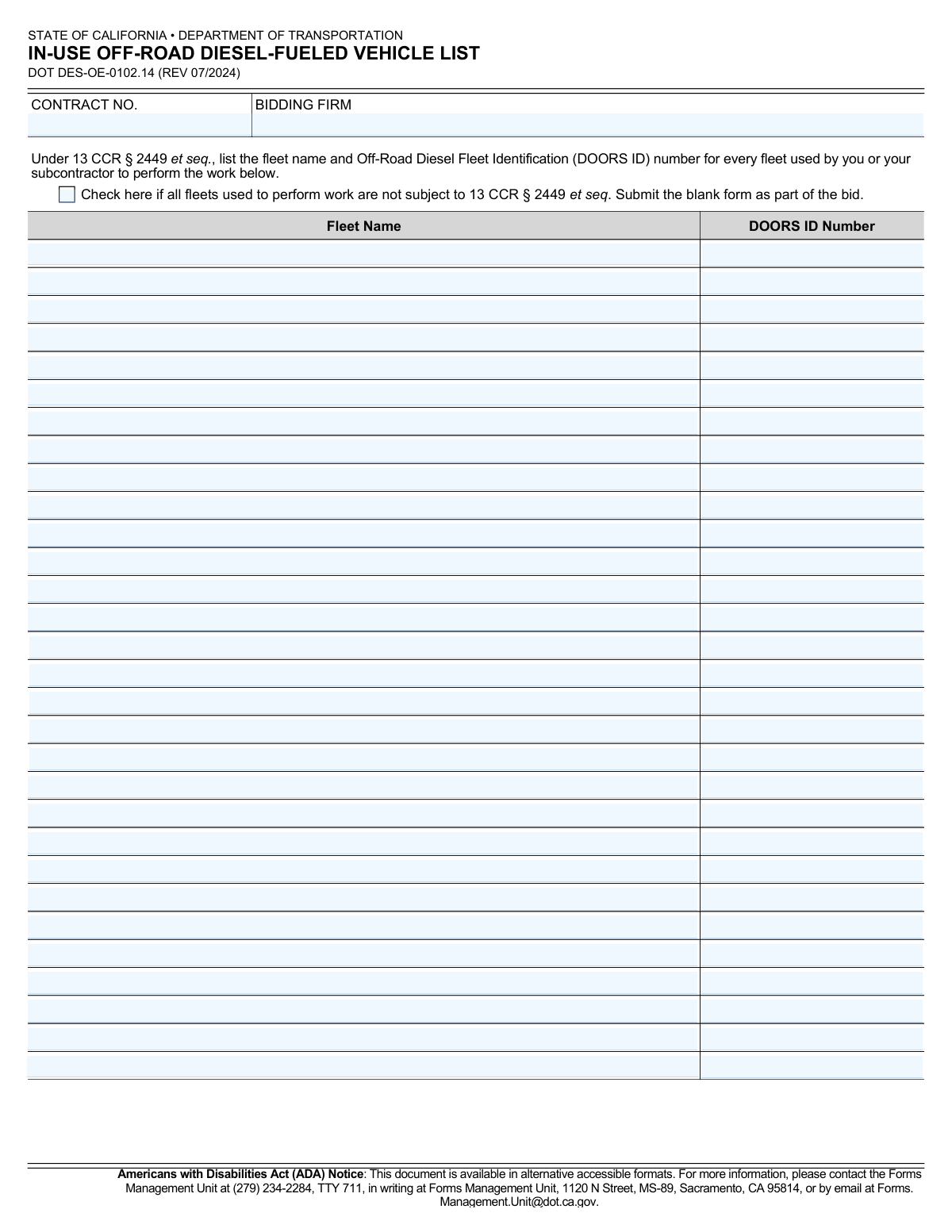
| 1. | Form DOT DES-OE-0102.14, IN-USE OFF-ROAD DIESEL-FUELED VEHICLE LIST | 1 | Complex 78 |
- Enterprise-grade security & data encryption
- 99%+ accuracy powered by AI
- 1,000+ forms from all industries
- Complete forms in under 60 seconds
How to Choose the Right Form
When navigating off-road vehicle documentation, it is important to distinguish between standard registration and specific regulatory compliance required for public works. Currently, the primary focus of this category is on environmental reporting for heavy machinery used in state-funded projects.
For Caltrans Bidders and Contractors
If you are a firm bidding on a California Department of Transportation (Caltrans) contract, you must ensure your fleet meets state air quality standards.
- Form DOT DES-OE-0102.14 (In-Use Off-Road Diesel-Fueled Vehicle List): This is a mandatory document for the bidding process. You must use this form to list all off-road diesel vehicles in your fleet, as well as those belonging to your subcontractors. It serves as a formal verification that your equipment is compliant with California’s strict emissions standards.
Key Compliance Requirements
To complete Form DOT DES-OE-0102.14 accurately, you will need to have specific data points ready for your fleet and any subcontractors involved in the bid:
- DOORS ID Numbers: You must provide the official Diesel Off-Road Online Reporting System (DOORS) identification for every fleet listed. This is issued by the California Air Resources Board (CARB).
- Regulatory Alignment: This form is designed to prove compliance with 13 CCR § 2449, which regulates in-use off-road diesel-fueled fleets to reduce nitrogen oxide and particulate matter emissions.
- Subcontractor Transparency: Unlike internal fleet logs, this form requires you to aggregate data from all subcontractors to ensure the entire project footprint meets state mandates.
Is this the right form for you?
You should select Form DOT DES-OE-0102.14 if:
1. You are currently in the bidding phase for a Caltrans public works project.
2. Your project involves diesel-powered off-road equipment (such as excavators, bulldozers, or cranes).
3. You need to certify that your equipment and your subcontractors' equipment are registered and compliant with CARB requirements.
Using Instafill.ai allows you to transform this technical document into a fillable format, making it easier to input complex DOORS ID numbers and fleet details accurately before your bid deadline.
Form Comparison
| Form | Purpose | Who Files It | Key Information |
|---|---|---|---|
| Form DOT DES-OE-0102.14, IN-USE OFF-ROAD DIESEL-FUELED VEHICLE LIST | Verifies air quality compliance for off-road diesel fleets during contract bidding. | Firms and subcontractors bidding on California Department of Transportation (Caltrans) contracts. | Requires listing of all diesel fleets and their official DOORS ID numbers. |
Tips for off-road vehicle forms
Ensure every Diesel Off-Road Online Reporting System (DOORS) ID number is entered correctly for your fleet and your subcontractors. A single digit error can lead to compliance issues or significant delays in contract approval, so always cross-reference your entries with the official CARB database.
When submitting off-road vehicle lists for Department of Transportation contracts, you must include data for all subcontractors involved in the project. Failure to list every participating fleet can disqualify a bid, so gather this information from your partners well before the submission deadline.
AI-powered tools like Instafill.ai can complete these complex vehicle lists in under 30 seconds with high accuracy, saving you hours of manual data entry. Your data stays secure during the process, providing a practical and fast solution for contractors dealing with multiple forms.
Regulations often vary based on whether a fleet is categorized as small, medium, or large. Categorizing your vehicle data internally before filling out the form helps ensure you are applying the correct compliance standards and reporting requirements for each piece of equipment.
Match the vehicle identification numbers (VINs) on your forms with your internal maintenance or purchase records. This prevents the accidental inclusion of retired or sold equipment, which can cause discrepancies during a regulatory audit or bid review.
Save a digital copy of every completed off-road vehicle list to use as a reference for future project bids. Since much of your fleet data remains static, having an organized archive allows you to quickly update only the necessary fields for new submissions rather than starting from scratch.
Before submitting your forms, verify that all listed vehicles meet the specific engine tier requirements mandated by current air quality regulations. Listing non-compliant vehicles on your official forms can result in project rejection or administrative penalties.
Frequently Asked Questions
These forms are used to verify that a contractor's heavy equipment meets specific environmental and safety standards required for government projects. They ensure that all diesel-fueled off-road vehicles are registered and compliant with state air quality regulations before work begins.
Any firm bidding on a California Department of Transportation (Caltrans) contract must complete this form. It is a mandatory requirement for the prime contractor as well as any subcontractors who will be using diesel-powered equipment on the job site.
You will generally need to provide the names of the firms operating the equipment and their unique Diesel Off-Road Online Reporting System (DOORS) ID numbers. This information links your fleet to the California Air Resources Board’s tracking system to confirm emission compliance.
These documents are typically submitted as part of the formal bid package or during the pre-award phase of a contract. Providing this information on time is critical, as missing documentation can lead to a bid being disqualified for non-responsiveness.
Yes, you can use AI-powered tools to streamline the documentation process. AI platforms like Instafill.ai can extract data from your fleet records and populate the required PDF forms in under 30 seconds, ensuring high accuracy and reducing manual data entry.
While manual entry can take significant time to cross-reference fleet IDs, using an AI tool allows you to complete these forms almost instantly. These tools can accurately extract and place data from your source documents into the official form fields in less than 30 seconds.
The requirement generally focuses on in-use off-road diesel-fueled vehicles that fall under specific state regulations, such as 13 CCR § 2449. This typically includes heavy construction equipment like bulldozers, loaders, and cranes rather than standard road-legal vehicles.
A DOORS ID is a unique identifier assigned by the California Air Resources Board (CARB) to a specific fleet. It is required on off-road vehicle forms to prove that the fleet is registered and that the owner is reporting their emissions as required by law.
Yes, the prime contractor is responsible for documenting that all subcontractors involved in the project are also compliant. The form acts as a comprehensive list of all off-road diesel fleets that will be present on the project site.
Submitting inaccurate information can lead to delays in contract approval or the rejection of your bid. State agencies use this data to verify compliance, so it is essential that the ID numbers and fleet names match official regulatory records exactly.
Generally, yes. Because each project may involve different subcontractors or a different subset of your fleet, a project-specific form is usually required to ensure the equipment assigned to that specific job is compliant.
Official forms are usually provided by the Department of Transportation or the specific state agency overseeing the contract. You can also find fillable versions on specialized document platforms that help format the data for submission.
Glossary
- Form Complexity Index
- Instafill’s 0–100 measure of how much effort a form takes to complete, calculated deterministically from the form’s own structure rather than estimated. It combines the number of fillable fields (the largest factor), how difficult those fields are to complete based on their type, the number of pages that contain fields, the amount of conditional “fill-only-if” logic, and how many sections the form is divided into, then adds modifiers for tables and repeating lists, bundled instruction pages, and dense page layouts. A higher score means the form is harder to fill out by hand. The forms in this category have a median Form Complexity Index of 78/100 (Complex). See exactly how it is calculated.
- DOORS ID
- The Diesel Off-Road Online Reporting System ID is a unique identification number assigned by the California Air Resources Board to a fleet once it has been registered.
- CARB
- The California Air Resources Board, the state agency responsible for protecting public health and the environment by regulating air pollutants from vehicles.
- 13 CCR § 2449
- The specific section of the California Code of Regulations that mandates the reduction of emissions from in-use off-road diesel-fueled vehicles.
- Off-Road Diesel Fleet
- A group of one or more diesel-powered vehicles with 25 horsepower or greater that are not intended for use on public highways, such as construction or mining equipment.
- Tier Rating
- A classification system used to categorize engines based on their emission levels, ranging from Tier 0 for the oldest engines to Tier 4 for the newest and cleanest engines.
- EIN
- The Equipment Identification Number is a unique number issued by CARB that must be permanently affixed to each piece of equipment in a registered fleet.
- Retrofit
- The addition of an emission control device, such as a diesel particulate filter, to an existing engine to reduce its pollutant output.
- VDECS
- Verified Diesel Emission Control Strategy refers to specific technologies or devices tested and approved by CARB to reduce engine emissions.