Fill out Oregon DMV forms
with AI.
Oregon Driver and Motor Vehicle Services (DMV) forms are essential legal documents used to track vehicle ownership, registration, and driver licensing within the state. Whether you are buying a used car from a private party or updating your residency information, these forms ensure that the state has an accurate record of motor vehicle transactions. Proper documentation is vital for protecting both buyers and sellers, as it establishes a clear paper trail for liability, taxes, and legal title transfers.
By continuing, you acknowledge Instafill's Privacy Policy and agree to get occasional product update and promotional emails.
About Oregon DMV forms
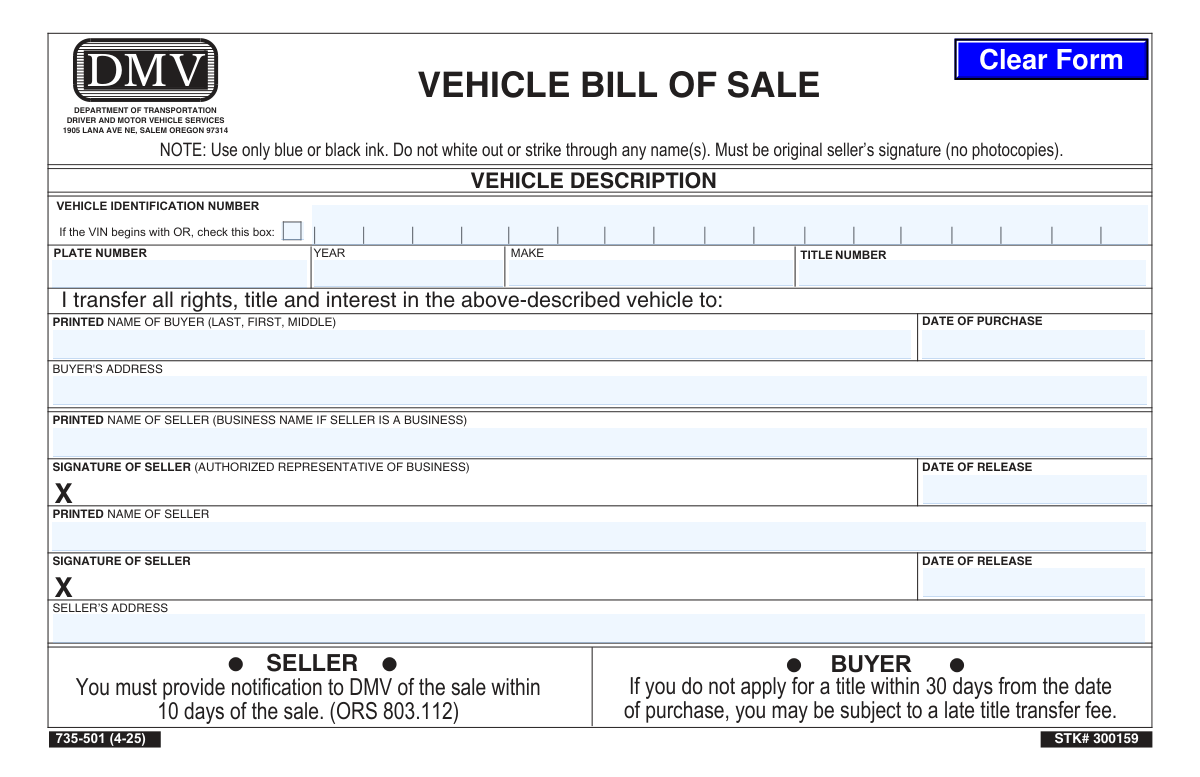
Most individuals encounter these forms during major life transitions, such as purchasing a new vehicle, selling an old one, or moving to Oregon from another state. For example, a Vehicle Bill of Sale (Form 735-501) is a common requirement for documenting the transfer of ownership and is necessary for the buyer to secure a new title. Private sellers, car enthusiasts, and new residents often need to navigate these requirements to remain compliant with Oregon state laws and avoid potential fines or registration delays.
Managing paperwork can be a tedious part of vehicle ownership, but modern technology has simplified the process. Tools like Instafill.ai use AI to fill these Oregon DMV forms in under 30 seconds, ensuring that your data is handled accurately and securely while saving you the hassle of manual entry. This allows you to focus on getting your vehicle on the road rather than spending hours on administrative tasks.
Every form on this page can be completed without typing. Instafill is form filling software that reads a PDF and fills it for you — including flat and scanned documents that carry no fillable fields at all.
Forms in This Category
The forms in this category have a median Form Complexity Index of 27/100 (Simple), measured across 1 forms by field count, input difficulty, length, conditional logic and structure. See how it is calculated.
| Form Name | Pages | FCI | |
|---|---|---|---|
| 1. | Form 735-501, Vehicle Bill of Sale | 1 | Simple 27 |
- Enterprise-grade security & data encryption
- 99%+ accuracy powered by AI
- 1,000+ forms from all industries
- Complete forms in under 60 seconds
How to Choose the Right Form
Documenting Your Vehicle Sale or Transfer
Navigating Oregon DMV requirements is essential for ensuring that a vehicle transfer is legally recognized and that both parties are protected. When a vehicle changes hands through a private sale or gift in Oregon, the primary document required to record the transaction is the Form 735-501, Vehicle Bill of Sale.
When to Use Form 735-501
You should reach for this specific form if you are involved in any of the following scenarios:
- Selling a Vehicle: As a seller, this form is your primary protection. It provides a legal record of the sale, which is necessary when you notify the DMV that you are no longer the owner. This prevents you from being held liable for future parking tickets, towing fees, or accidents involving the vehicle.
- Buying a Vehicle: If you are the purchaser, you must obtain a signed Form 735-501 from the seller. You will need to present this document to the DMV when you apply for a new title and registration in your name.
- Transferring Ownership as a Gift: Even if the sale price is $0, using this official form helps the state track the chain of ownership accurately and assists in the smooth issuance of a new title.
Key Details for Completion
To ensure your Form 735-501 is accepted by the Oregon Driver and Motor Vehicle Services, make sure you have the following information ready:
- Vehicle Identification: The Year, Make, and Vehicle Identification Number (VIN).
- Party Details: Full legal names and current addresses for both the buyer and the seller.
- Transaction Specifics: The date of the sale and the total purchase price.
Why Use Instafill.ai?
Filling out government paperwork manually often leads to illegible handwriting or missed fields, which can result in delays at the DMV office. By using the AI-powered tools at Instafill.ai, you can quickly convert the Form 735-501 into a clean, fillable document. This ensures all information is professional, accurate, and ready for submission, making your vehicle transfer as seamless as possible.
Form Comparison
| Form | Primary Purpose | Required Information | Key Requirement |
|---|---|---|---|
| Form 735-501, Vehicle Bill of Sale | Documents the legal transfer of a motor vehicle between a buyer and seller. | Buyer/seller details, vehicle description, VIN, purchase price, and signatures of both parties. | Necessary for the buyer to apply for a new title and registration in Oregon. |
Tips for Oregon DMV forms
Ensure the Vehicle Identification Number (VIN) and odometer reading are recorded exactly as they appear on the vehicle's dashboard or frame. Any discrepancies between the Bill of Sale and the physical vehicle can lead to significant delays in title processing with the Oregon DMV.
In Oregon, sellers are responsible for notifying the DMV of a sale within 10 days to release liability. Having a completed Bill of Sale on hand makes it easy to provide the required buyer information and exact sale date during this notification process.
AI-powered tools like Instafill.ai can complete Oregon DMV forms in under 30 seconds with high accuracy. Your data stays secure during the process, providing a fast and reliable way to handle vehicle transfer paperwork without manual data entry.
A common mistake is submitting a Bill of Sale with only one seller's signature when multiple owners are listed on the title. Verify the current title first and ensure every listed owner signs the form to prevent the DMV from rejecting your transfer application.
Handwritten forms are often difficult for DMV staff to read, which can result in errors on the newly issued title. Filling out your Oregon DMV forms digitally ensures all information is clear, professional, and easy for administrative systems to process.
Both the buyer and the seller should keep a copy of the signed Bill of Sale for their own records. This document serves as essential proof of the transaction date and transfer of ownership in the event of future legal or insurance inquiries.
Before finalizing the Bill of Sale, sellers should confirm the buyer's full legal name and address using a government-issued ID. Accurate buyer details are necessary for the Oregon DMV to correctly register the vehicle to the new owner.
Frequently Asked Questions
When selling a vehicle in Oregon, the most important documents include the vehicle title and the Form 735-501 (Vehicle Bill of Sale). These documents ensure the legal transfer of ownership and protect both the buyer and the seller during the transaction.
Yes, while the title is the primary document for transferring ownership, the Oregon DMV recommends using Form 735-501 as a legal record of the sale. It provides essential proof of the purchase price and the date the transaction occurred, which is necessary for tax and registration purposes.
Sellers must notify the Oregon DMV within 10 days of the sale. This can be done online through the DMV website or by submitting a Notice of Sale form to ensure you are no longer held liable for the vehicle's future tickets or incidents.
Generally, standard Oregon DMV forms like the Vehicle Bill of Sale do not require notarization. However, both the buyer and seller must provide clear, legible signatures to ensure the document is accepted by the DMV for title processing.
Yes, you can use AI tools like Instafill.ai to complete Oregon DMV forms quickly and accurately. These tools can extract data from your source documents and place it into the required fields in under 30 seconds, reducing the risk of manual entry errors.
Form 735-501 requires the vehicle's year, make, and Vehicle Identification Number (VIN), along with the full names and addresses of both the buyer and seller. You must also include the total purchase price and the exact date of the sale.
While manual entry can take several minutes, using an AI-powered service like Instafill.ai allows you to complete these forms in under 30 seconds. The system accurately maps data from your ID or existing records directly into the official PDF.
The buyer typically retains the original Bill of Sale to submit with their application for a new title and registration. The seller should keep a signed copy for their personal records as proof of the transaction and to assist with the mandatory notification of sale.
When gifting a vehicle, you still use the standard transfer forms, but you should list the purchase price as 'gift' or '$0.' It is important to consult the Oregon DMV regarding any additional tax affidavits that may be required for non-monetary transfers.
If a vehicle is owned by more than one person, all owners listed on the title must typically sign the transfer documents unless the title specifies 'or' between the names. Ensuring all necessary signatures are present on the Bill of Sale prevents delays in the processing of the new title.
Glossary
- Form Complexity Index
- Instafill’s 0–100 measure of how much effort a form takes to complete, calculated deterministically from the form’s own structure rather than estimated. It combines the number of fillable fields (the largest factor), how difficult those fields are to complete based on their type, the number of pages that contain fields, the amount of conditional “fill-only-if” logic, and how many sections the form is divided into, then adds modifiers for tables and repeating lists, bundled instruction pages, and dense page layouts. A higher score means the form is harder to fill out by hand. The forms in this category have a median Form Complexity Index of 27/100 (Simple). See exactly how it is calculated.
- VIN (Vehicle Identification Number)
- A unique 17-character code used to identify a specific motor vehicle, which must be accurately recorded on all Oregon DMV transfer forms.
- Title
- The official legal document issued by the Oregon DMV that serves as proof of ownership for a vehicle and is required for any permanent transfer.
- Lienholder
- An individual or financial institution that holds a legal claim on a vehicle until the owner has fully paid off the associated loan.
- Odometer Disclosure
- A mandatory statement on the bill of sale or title where the seller certifies the current mileage of the vehicle at the time of the transaction.
- Notice of Sale
- A required notification that a seller must submit to the Oregon DMV within 10 days of a sale to release themselves from liability for the vehicle.
- Release of Interest
- A formal signature or legal document provided by an owner or lienholder to officially give up their claim to a vehicle's title.
- ODOT
- The Oregon Department of Transportation, the state-level parent agency that oversees the Driver and Motor Vehicle (DMV) Services division.
- Power of Attorney (Vehicle)
- A legal document that grants a specific person the authority to sign title or registration paperwork on behalf of the vehicle owner.