Fill out pardon application forms
with AI.
Pardon application forms, often referred to as clemency or criminal record forms, are the official legal documents required to request formal forgiveness for past offenses from a government authority. These forms are a vital step for individuals seeking to restore their civil rights, such as the right to vote or hold public office, and to remove the long-term barriers to employment and housing that often accompany a criminal record. Completing these applications is a significant milestone in the rehabilitation process, signaling a transition toward full reintegration into society.
By continuing, you acknowledge Instafill's Privacy Policy and agree to get occasional product update and promotional emails.
About pardon application forms
Typically, these forms are utilized by individuals who have completed their court-ordered sentences and have maintained a clean record for a specified period. In jurisdictions like Maryland, the process involves submitting detailed disclosures regarding one’s personal background, financial status, and the specific circumstances of the past offenses to the Governor or a Parole Commission. Because these applications are subject to rigorous review by government officials, ensuring that every field is filled out precisely and professionally is crucial for a successful outcome.
Navigating the complexity of these multi-page documents can be overwhelming, but modern technology has simplified the process. Tools like Instafill.ai use AI to fill these forms in under 30 seconds, ensuring that data is handled accurately and securely. By automating the data entry portion of the Maryland Application for Pardon and similar forms, applicants can save time and reduce the risk of errors, allowing them to focus on the broader requirements of their clemency petition.
Every form on this page can be completed without typing. Instafill is form filling software that reads a PDF and fills it for you — including flat and scanned documents that carry no fillable fields at all.
Forms in This Category
The forms in this category have a median Form Complexity Index of 70/100 (Complex), measured across 1 forms by field count, input difficulty, length, conditional logic and structure. See how it is calculated.
| Form Name | Pages | FCI | |
|---|---|---|---|
| 1. | Maryland Department of Public Safety and Correctional Services Application for Pardon | 27 | Complex 70 |
- Enterprise-grade security & data encryption
- 99%+ accuracy powered by AI
- 1,000+ forms from all industries
- Complete forms in under 60 seconds
How to Choose the Right Form
Navigating the path toward restoring your record in Maryland starts with selecting the correct legal document. While there is currently one primary form in this category, understanding its specific purpose and the requirements involved is crucial for a successful application.
The Primary Maryland Clemency Form
The Maryland Department of Public Safety and Correctional Services Application for Pardon is the definitive document for individuals seeking executive clemency. Unlike an expungement, which can remove or shield a record from public view, a pardon is a formal act of forgiveness granted by the Governor.
You should choose this form if:
- You have already completed your full sentence, including any parole or probation requirements.
- You are seeking to restore specific civil rights or improve your eligibility for certain professional licenses.
- You have maintained a clean record and demonstrated a significant period of good citizenship since your conviction.
Pardon vs. Other Criminal Record Forms
It is important to ensure this is the specific Maryland government form you need. If you are looking to have a record physically destroyed or shielded from public background checks, you may be looking for expungement forms. However, for many offenses where expungement is not an option, the Maryland Department of Public Safety and Correctional Services Application for Pardon is the only available path for official recognition of rehabilitation.
Key Requirements for Your Application
This application is extensive and requires high attention to detail. To fill it out efficiently using Instafill.ai, ensure you have the following information ready:
- Criminal History: Detailed records of the offense, including case numbers and specific sentencing dates.
- Financial Status: A comprehensive disclosure of your current financial situation.
- Personal Background: Information regarding your employment history, residency, and community involvement since the conviction.
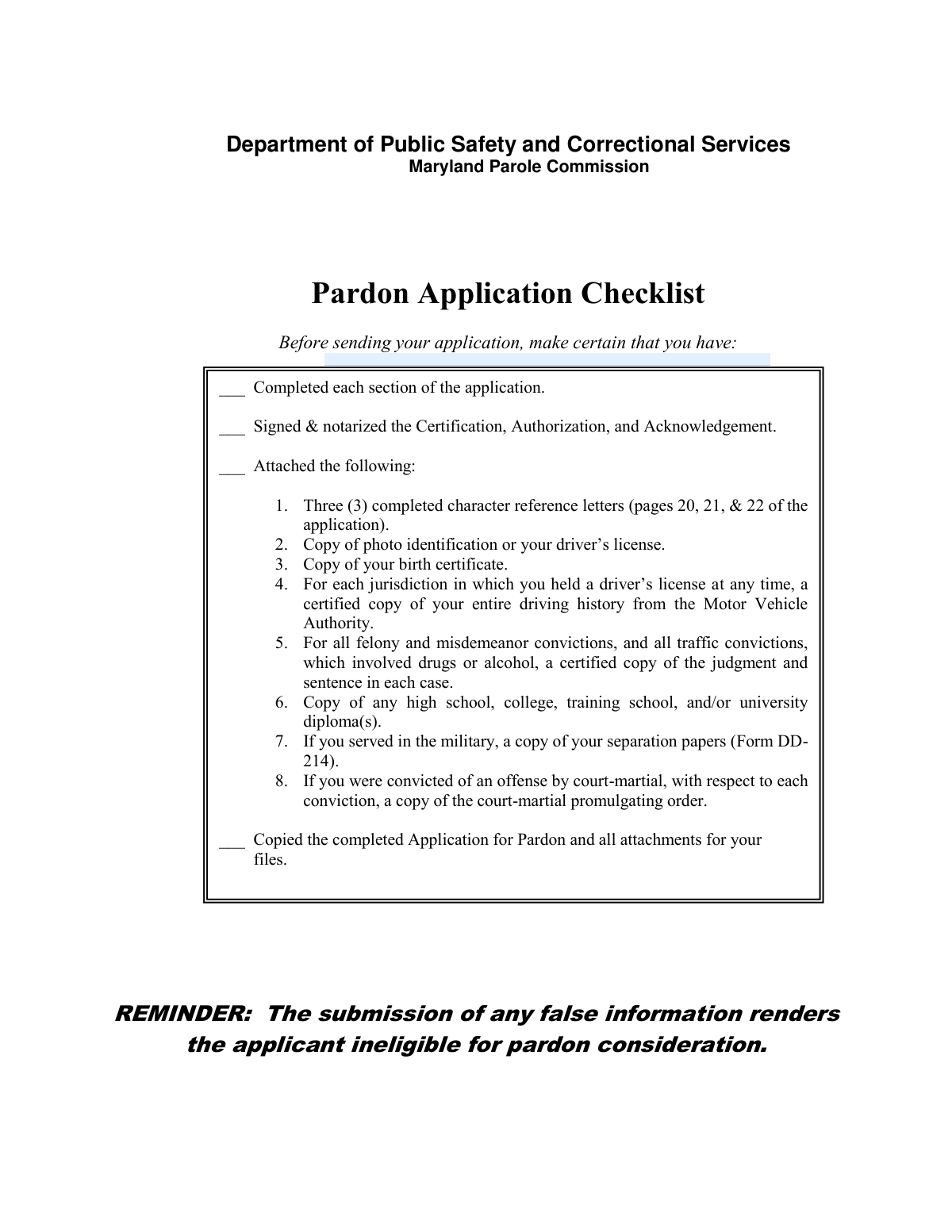
- Supporting Documentation: Be prepared to attach character references and proof of rehabilitation.
Using Instafill.ai helps you manage this complex process by converting the standard PDF into a user-friendly, fillable format, ensuring you can complete the application accurately before submission to the Parole Commission.
Form Comparison
| Form | Purpose | Who Files It | Key Requirements |
|---|---|---|---|
| Maryland Department of Public Safety and Correctional Services Application for Pardon | Formal request to the Governor of Maryland to forgive a past criminal offense. | Individuals seeking legal forgiveness for past Maryland state criminal convictions. | Detailed criminal history, financial status, personal background, and extensive supporting documentation. |
Tips for pardon application forms
Pardon and clemency applications often require extensive attachments, such as certified court records, character references, and proof of employment. Collect these documents before you begin filling out the form to ensure you have all the specific case numbers and dates needed for accurate completion.
One of the most common reasons for denial is the failure to list all past offenses, even minor ones. Be thorough and transparent about your history, as the reviewing commission will conduct their own background check and any discrepancies can be viewed as an attempt to mislead officials.
Completing detailed clemency forms manually can be overwhelming and prone to errors. AI-powered tools like Instafill.ai can complete these forms in under 30 seconds with high accuracy, and your data stays secure during the process, making it a major time-saver for complex applications.
Most pardon forms include a section asking why you are seeking clemency. Focus on your rehabilitation, how you have contributed to your community since the offense, and specific ways a pardon will help your future, such as obtaining professional licenses or restoring civil rights.
Before submitting your application, confirm that you have met the required waiting period since completing your sentence, including any parole or probation. Submitting too early often leads to an automatic rejection, which can delay your ability to reapply in the future.
If the form requires character references or witness statements, ensure their contact information is current and accurate. Investigators often reach out to these individuals to verify your rehabilitation, and unreachable references can stall your application for months.
Pardon processes can take a significant amount of time to review. Always keep a complete copy of the signed application and all attached exhibits for your own records so you can reference exactly what was submitted if you are contacted for an interview or follow-up questions.
Frequently Asked Questions
A pardon application is a formal request for executive clemency from the Governor to forgive a past criminal conviction. While it does not erase the record, it serves as an official recognition of rehabilitation and can restore certain civil rights lost due to the conviction.
This form is intended for individuals convicted of crimes in Maryland who have completed their full sentences, including any associated parole or probation. It is used by those seeking to demonstrate their rehabilitation and positive contribution to society since their conviction.
A pardon is an act of forgiveness by the Governor, whereas an expungement is a court process that removes a record from public view. In Maryland, obtaining a pardon is often a necessary first step before an individual can apply for the expungement of certain types of criminal records.
Applicants typically need to provide a comprehensive personal history, employment records, and financial disclosures. You may also be required to submit character references and official transcripts of your criminal record to ensure the application is complete and accurate.
Once the application is filled and all supporting documents are attached, it is generally submitted to the Maryland Parole Commission. The Commission reviews the materials and conducts an investigation before making a recommendation to the Governor.
Yes, AI-powered tools like Instafill.ai can help you complete complex pardon applications by accurately extracting data from your source documents and placing it into the form. This technology ensures that detailed sections, such as personal history and financial status, are handled with high precision.
Using AI services like Instafill.ai, even extensive pardon forms can be completed in under 30 seconds. The AI automates the data entry process by mapping information from your uploaded documents directly into the required fields, saving significant manual effort.
Yes, there are typically specific waiting periods that must pass after the completion of a sentence before one is eligible to apply. These timeframes vary based on the nature of the offense and the guidelines set by the Department of Public Safety and Correctional Services.
The application often asks for a detailed disclosure of your current income, assets, and liabilities. This information is used to assess your financial stability and your ability to maintain a law-abiding lifestyle since your conviction.
The Maryland Parole Commission may require an interview or a formal hearing as part of their investigation into your request. This allows the commission to evaluate your rehabilitation efforts and the merits of your case before providing a recommendation to the Governor.
No, these forms are specifically for convictions handled by the Maryland state court system. For federal crimes, you must apply for a presidential pardon, and for convictions in other states, you must follow the specific clemency process of that state's government.
Generally, the Maryland Parole Commission does not charge a fee to process a pardon application. However, you may incur personal costs for obtaining required supporting documents, such as official court records or notarized statements.
Glossary
- Form Complexity Index
- Instafill’s 0–100 measure of how much effort a form takes to complete, calculated deterministically from the form’s own structure rather than estimated. It combines the number of fillable fields (the largest factor), how difficult those fields are to complete based on their type, the number of pages that contain fields, the amount of conditional “fill-only-if” logic, and how many sections the form is divided into, then adds modifiers for tables and repeating lists, bundled instruction pages, and dense page layouts. A higher score means the form is harder to fill out by hand. The forms in this category have a median Form Complexity Index of 70/100 (Complex). See exactly how it is calculated.
- Pardon
- An executive act of forgiveness by the Governor that restores certain civil rights and removes the legal consequences of a criminal conviction.
- Clemency
- An umbrella term for the government's power to grant leniency, which includes pardons, commutations of sentences, and reprieves.
- Maryland Parole Commission
- The state agency that processes pardon applications, conducts investigations, and provides a formal recommendation to the Governor.
- Expungement
- The legal process of removing or shielding a criminal record from public view; notably, a pardon in Maryland does not automatically result in an expungement.
- Commutation
- A form of clemency that reduces a criminal sentence to a lesser timeframe but does not remove the conviction from the individual's record.
- Petitioner
- The formal name for the person applying for the pardon and submitting the documentation to the state authorities.
- Restitution
- Court-ordered payments made by an offender to a victim to cover losses; applicants must typically prove all restitution is paid before a pardon is considered.
- Disposition
- The final status or outcome of a criminal charge, such as 'guilty,' 'not guilty,' or 'nolle prosequi,' which must be documented in the pardon request.